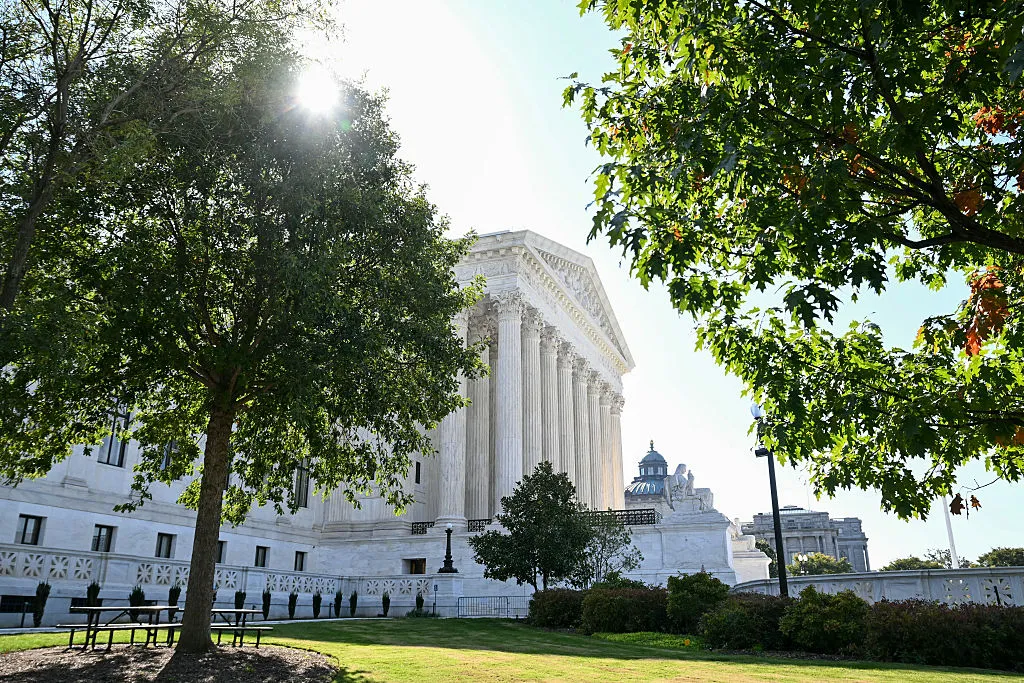
10月14日拍摄的位于华盛顿特区的最高法院外景。索尔·勒布(Saul Loeb)/法新社通过盖蒂图片社 周二,最高法院将就一起案件听取辩论,该案使天主教会与科罗拉多州面向所有4岁儿童的纳税人资助学校项目对立起来。争议的焦点在于,宗教学校是否可以拒绝接纳同性恋和跨性别父母的子女,而这违反了禁止歧视的州法律。
A view of the Supreme Court in Washington, D.C., on Oct. 14. Saul Loeb/AFP via Getty Images On Tuesday, the Supreme Court hears arguments in a case that pits the Catholic Church against taxpayer funded school programs for all 4-year-olds in Colorado. At issue is whether religious schools may refuse to admit the children of gay and trans parents in violation of a state law that bars discrimination.
《权利法案》的第一行写道:“国会不得制定关于确立宗教或禁止宗教自由 esercise 的法律。”早在该国建国之初,托马斯·杰斐逊就将该条款描述为创建了“一道政教分离的高墙”。最高法院在20世纪40年代正式采纳了这一观点,使其成为全国的法律——直到大约10年前。正是在那时,该法院新的保守派多数派做出了一次日益剧烈的教义大转弯,其焦点不再是政教分离,而是第一修正案中的第二个条款:保护宗教自由。
The first line of the Bill of Rights says: "Congress shall make no law respecting an establishment of religion, or prohibiting the free exercise thereof." As early as the founding of this country, Thomas Jefferson described the clause as creating a "wall of separation between church and state." The Supreme Court formally embraced that idea in the 1940s, making it the law of the land — until roughly 10 years ago. That's when the court's new conservative majority made an increasingly dramatic doctrinal U-turn, focusing not on the separation of church and state, but on that second clause in the First Amendment: protecting the free exercise of religion.
密歇根州立大学法学教授弗兰克·拉维奇说:“这简直与不久前的法律完全相反。这完全是一个转变。”他曾大量撰文探讨宪法中的宗教条款。
"It's literally the opposite of what the law was not that long ago. It is just a complete shift," says Michigan State University law professor Frank Ravitch, who has written extensively about the Constitution's religion clauses.
仅举一个例子,最高法院在1983年以8比1的投票结果裁定,鲍勃·琼斯大学应失去其免税地位,因为它以宗教为由禁止不同种族间约会和不同种族间结婚,这构成了政府资金不得支持的种族歧视。话虽如此,目前尚不清楚法院现在是否会得出类似的结论。
To cite just one example, the Supreme Court, by an 8-to-1 vote, ruled in 1983 that that Bob Jones University should lose its tax exempt status because it prohibited interracial dating and interracial marriage on religious grounds, and that constitutes racial discrimination that the government money may not support. That said, it's unclear if the court will reach a similar conclusion now.
这是为什么呢?得克萨斯大学奥斯汀分校和弗吉尼亚大学法学名誉教授道格拉斯·莱科克(Douglas Laycock)认为,因为种族在美国历史上占有“独特”的地位。他说:“没有任何其他群体经历过250年的奴隶制、内战、75万人的死亡以及三条宪法修正案。没有任何其他群体经历过类似的事情。”
Why is that? Because race has a "unique" place in U.S. history, contends professor Douglas Laycock, emeritus professor of law at the University of Texas at Austin and the University of Virginia. "There's nothing like 250 years of slavery, civil war, 750,000 dead, three constitutional amendments. Nothing like that for any other group," he says.
至于科罗拉多州的案件,莱科克承认丹佛总教区存在歧视,但他补充道:“问题在于这种歧视是否属于受保护的宗教行使。”当前的法院没有关注政教分离,而是将焦点放在了宗教集团的权利上,即当这些权利与禁止基于种族、性别、宗教或其他类别进行歧视的州法律和联邦法律相抵触时的情况。
As for the Colorado case, Laycock acknowledges that the Denver archdiocese is discriminating, but he adds, "The question is whether that discrimination is a protected exercise of religion." Rather than focusing on separation of church and state, the current court instead has focused on the rights of religious groups when pitted against state and federal laws that ban discrimination based on race, sex, religion or other categories.
正是“性别”这一部分,给科罗拉多州旨在确保该州几乎所有4岁儿童都能接受学前教育的宏大计划制造了严重障碍。
It's the sex part that has thrown a monkey wrench into Colorado's broad program aimed at ensuring that virtually all 4-year-olds in the state get a pre-K education.
曾任科罗拉多州参议院议长的史蒂夫·芬伯格(Steve Fenberg)说:“这项法律其实是为了实施一项计划,即我们希望无论你住在哪里,每个孩子都能获得接受普遍学前教育的机会。”该学前教育计划颁布时,附带了为该计划中注册的每名儿童每年提供6300美元津贴的规定,这笔资金来自烟草税。
"The law really was about implementing a program that said we want every kid, no matter where you live, to be able to have access to universal preschool," says Steve Fenberg, who served as president of the Colorado state Senate when the pre-k program was enacted, complete with a $6,300 benefit for each child enrolled in the program every year, money that comes from a tobacco tax.
为了实现这一目标,该州采取了大多数其他州没有做过的事情。它制定了一项涵盖宗教学校在内的广泛计划,前提是这些学校遵守一项禁止基于种族、宗教、性取向或性别认同进行歧视的州法律。
To accomplish that, the state did something most other states have not. It created a broad plan, including religious schools, as long as the schools abide by a state law that bars discrimination based on race, religion, sexual orientation or gender identity.
普遍学前教育法案的主要提案人、科罗拉多州众议员埃米莉·西罗塔(Emily Sirota)强调,该州希望父母在4岁孩子去哪里上学的问题上拥有“充分的选择权”。
Colorado state Rep. Emily Sirota, a prime sponsor of the universal pre-K bill, emphasizes that the state wanted parents to have "a robust choice" about where their 4-year-olds would go to school.
事实上,她指出,天主教会最初支持该项目,天主教慈善会(Catholic Charities)目前仍在参与,其他宗教团体也加入了进来,其中包括至少35所基督教学校、1所穆斯林学校和3所犹太学校。
Indeed, she notes that the Catholic Church initially endorsed the program, and Catholic Charities continues to participate, along with other religious groups, including at least 35 Christian schools, one Muslim and three Jewish schools.
前州参议员芬伯格(Fenberg)表示:“前提条件是,你不能歧视,你需要允许所有学生参加。”
"The caveat is that you can't discriminate, and you need to allow all students to participate," says former state Sen. Fenberg.
正是这个前提条件出了问题。丹佛总教区(Denver Archdiocese)和两个教区在法庭上对该法律提出了挑战,他们由宗教自由贝克特基金会(Becket Fund for Religious Liberty)及其首席执行官马克·里恩齐(Mark Rienzi)代表。他坚称,科罗拉多州的法律明确歧视天主教学校。
That caveat is where things went awry. The Denver Archdiocese and two parishes challenged the law in court, represented by the Becket Fund for Religious Liberty and its CEO, Mark Rienzi. He maintains that the Colorado law flatly discriminates against Catholic schools. "They're only excluding religious schools that are organized around beliefs that Colorado doesn't like.
里恩齐说:“他们只是在排挤那些围绕科罗拉多州不喜欢的信仰组织起来的宗教学校。这就是宪法问题。并不是每个人到场都必须是天主教徒,但他们确实必须同意支持天主教教义,并且不公开反驳天主教教义。这些学校就是这样建立的。”因此,教会希望获得豁免,不受该州反歧视法的约束,该法律规定,如果4岁儿童的父母或其他潜在家庭成员是同性恋或跨性别者,拒绝这些儿童入学属于违法行为。当然,并非所有的天主教项目都步调一致。
And that's the constitutional problem," says Rienzi. "Not everybody has to be Catholic to show up, but they do have to agree to support Catholic teachings and not publicly contradict Catholic teachings. That's the way these schools are set up." Therefore, the church wants an exemption from the state's anti-discrimination law, which makes it illegal to refuse entrance to school for 4-year-olds whose parents or potentially other family members are gay or trans. Of course, not all Catholic programs march to the same drummer.
曾在七个州的天主教学校系统担任过多项领导职务的蒂姆·乌尔(Tim Uhl)表示:“我不同意天要塌下来的说法。”他目前是加利福尼亚州圣何塞圣母高中(Notre Dame High School)的临时使命与事工主任,也是提交了一份支持科罗拉多州简报的天主教学校主任群体之一。
"I don't agree with the sky is falling," says Tim Uhl, who has held multiple leadership positions for Catholic school systems in seven states. He is currently the interim director of mission and ministry at Notre Dame High School in San Jose, Calif., and is among a group of Catholic school directors who has filed a brief siding with Colorado.
“我们也确实录取非天主教学生和非天主教家庭,”乌尔(Uhl)指出。他补充说,非天主教家庭“明白,即便他们不同意某些教义,但这并不意味着他们会去扰乱秩序……要知道,观点多元和思想多元是教育经历的一部分。”
"We do admit students that are not Catholic and families that are not Catholic," Uhl notes, adding that non-Catholic families "understand that even if they don't agree with certain doctrine, that doesn't mean they're going to be disruptive … You know, diversity of opinion and diversity of thought is part of an educational experience."
但丹佛总教区有着不同的观点。在大主教詹姆斯·R·戈尔卡(James R. Golka)发表在《丹佛邮报》(Denver Post)上的一篇文章中,他写道,由于科罗拉多州的学前教育项目,整个总教区的天主教学校入学率下降了百分之二十,两所学前班已经关闭,其中包括一所服务于“少数族裔和低收入家庭”的学前班。
But the archdiocese of Denver has a different viewpoint. In an article published in the Denver Post Archbishop James R. Golka wrote that as a result of the Colorado pre-K program, enrollment in Catholic schools is down 20% across the archdiocese and two preschools have closed, including one which serves "minority and low income families."
但这位大主教说,更大的“悲剧”在于,“科罗拉多州对天主教教育的攻击威胁到了更广泛的文化。在我们这个过度世俗化、道德相对主义和技术还原论的时代,我们迫切需要这样的学校:它们教导学生认识自己真正的身份:不朽的灵魂,为上帝所钟爱。”他接着补充说,相反,“可以预见的结果是一种脱离真理、在困惑中漂泊的文化。”
But the larger "tragedy," said the archbishop, is that "Colorado's attack on Catholic education threatens the broader culture. In our age of hyper- secularization, moral relativism, and technical reductionism, we urgently need schools that teach students who they truly are: immortal souls, beloved by God." Instead, he added, "The predictable result is a culture unmoored from truth, adrift in confusion."
该总教区天主教学校总监斯科特·埃尔默(Scott Elmer)表示,LGBTQ家长试图为其子女办理入学的情况“非常罕见”。他补充说:“这不是我们经常需要应对的事情话。”
Scott Elmer, superintendent of Catholic schools for the Archdiocese, says "it's very rare" for LGBTQ parents to try to enroll their children. "This is not something we deal with regularly," he adds.
话虽如此,最高法院由保守派占绝对优势的多数派——包括特朗普总统任命的三名法官在内——已经发出强烈信号,表明他们正朝着以以往未被广泛接受的方式彻底变革宗教权利的方向前进。
That said, however, the Supreme Court's conservative supermajority, including President Trump's three appointees, have sent strong signals that they are headed toward revolutionizing religious rights in ways not widely embraced before.
去年,对于纳税人资助的特许学校是否可以包括宗教学校和教义,大法官们的意见势均力敌。但由于大法官艾米·科尼·巴雷特(Amy Coney Barrett)因潜在的利益冲突而回避,大法官们放弃了该案。
Last year, the court was evenly divided as to whether taxpayer-funded charter schools could include religious schools and teachings. But because Justice Amy Coney Barrett recused herself over a potential conflict of interest, the justices dropped the case.
现在,科罗拉多州的案件已经摆在最高法院面前,这一次巴雷特认为没有必要回避。因此,将有一个完整的法院准备对该案作出裁决。
Now, the Colorado case is before the Supreme Court, and this time Barrett has not felt a necessity to recuse. So there will be a full court ready to decide the case.
加州大学伯克利分校法学院院长欧文·切梅林斯基(Erwin Chemerinsky)问道:“问题在于,最高法院在要求政府为宗教学校出资方面会走多远?”
"The question is, how far will the Supreme Court go in requiring the government to pay for religious schools?" asks Berkeley Law School dean Erwin Chemerinsky.
此外,他还指出:“还有一个问题是,政府是否必须资助宗教特许学校?……我们不知道最高法院愿意走多远。”毕竟,特许学校被设计为公立学校,在与州或地方政府机构签订的基于绩效的合同下独立运营,这些机构提供纳税人的资金进行资助。
Then too, he observes, "there's the issue of will the government have to fund religious charter schools? … We don't know how far the court's willing to go." After all, charter schools were designed to be public schools that operate independently under a performance-based contract with state or local government agencies that provide taxpayer money for funding.
全国大约有8000所特许学校,科罗拉多州大约有276所,直到现在,它们一直没有由宗教团体运营。
There are some 8,000 charter schools nationally, and roughly 276 in Colorado, and they have not, until now, been run by religious groups.
然而就在几周前,俄克拉何马州的一名联邦地区法官允许一所由纳税人资助、并“立足于持久的犹太价值观”的犹太特许学校开办,使用了260万美元的州政府资金,预计到2030年,这一州政府资金将增加到830万美元。这所学校的命运仍然处于悬而未决的状态。这种情况是否会持续并扩大,当然取决于最高法院对科罗拉多州一案的裁决。
Just a few weeks ago, however, a federal district judge in Oklahoma allowed a taxpayer-funded Jewish charter school "grounded in enduring Jewish values" to open, using $2.6 million in state funding that is projected to grow to $8.3 million in state funds by 2030. The fate of the school remains in limbo Whether that continues and expands depends, of course, on the Supreme Court's decision in the Colorado case.