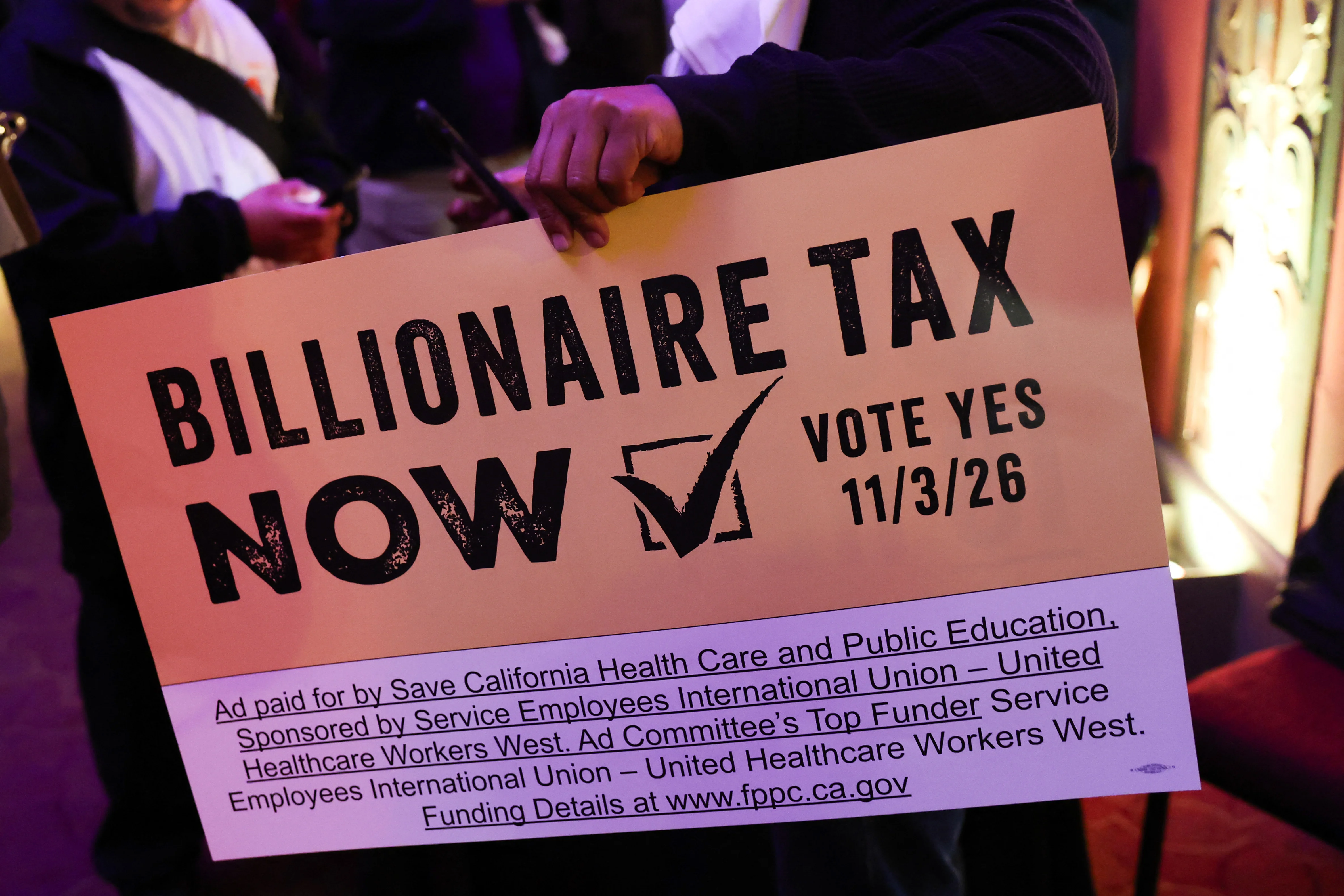
一名与会者在集会开始前举着标语牌,该集会由佛蒙特州独立参议员伯尼·桑德斯主导,是加州亿万富翁税法案竞选启动活动的一部分,2026年2月18日,洛杉矶威尔特恩剧院。桑德斯正寻求加州选民支持一项11月投票倡议,即对亿万富翁征收紧急税以帮助该州医疗体系。
An attendee holds a sign before the start of a rally led by US Senator Bernie Sanders, Independent of Vermont, during the campaign kickoff for the California Billionaire Tax Act at The Wiltern in Los Angeles, February 18, 2026. Sanders is seeking the support of California voters for a November's ballot initiative of an emergency tax on billionaires to help the state's healthcare system.
PATRICK T. FALLON/AFP via Getty Images/AFP 1978年,加州选民通过了13号提案,这是一场历史性的纳税人起义,成为里根革命及其全国性减税运动的开篇之战。如今,加利福尼亚人正在就40号提案进行投票,其革命性影响可能不亚于13号提案——但方向截然相反:它将创立美国首个针对亿万富翁的财富税。
PATRICK T. FALLON/AFP via Getty Images/AFP In 1978, California voters approved Proposition 13, a historic tax revolt that became an opening salvo in the Reagan revolution and its national movement to slash taxes. Now, Californians are voting on Proposition 40, which could prove to be just as revolutionary — but in the opposite direction: it would create America's first-ever wealth tax targeted at billionaires.
随着选举日临近,经济学家们正就这项拟议的财富税展开激烈辩论。这场辩论可为即将到来的关于对超级富豪征税的全国性斗争提供某种学术性预演。这项财富税将有助于遏制失控的不平等并充实州财政——还是说会说服亿万富翁启动私人飞机、在州外豪宅安家?自该税收提案出台以来,一些超级亿万富翁已离开加州。
As Election Day approaches, economists have been duking it out over this proposed wealth tax. It could provide a sort of nerdy preview of a coming national fight over taxing the superrich. Will this wealth tax help rein in runaway inequality and fill the state's coffers — or will it convince billionaires to fire up their private jets and set up residence in mansions outside the state? Some megabillionaires have already fled California since the tax was proposed.
站在辩论一方的是经济学家加布里埃尔·祖克曼,他是向超级富豪征税的主要倡导者,在加州大学伯克利分校和巴黎经济学院两地工作。祖克曼曾协助设计参议员伊丽莎白·沃伦和伯尼·桑德斯在竞选总统时的全国性财富税提案(我当时曾在《星球金钱》通讯播客中对此进行过报道)。他合著了一本标题直白的新书:《我们需要向亿万富翁征税》 自然,他支持加州的财富税,并合著了一份有影响力的分析报告,估算该税每年可带来约1000亿美元收入。
e side of this debate is economist Gabriel Zucman, a leading advocate for taxing the superrich who splits his time between UC Berkeley and the Paris School of Economics. Zucman helped design the national wealth tax proposals of Senators Elizabeth Warren and Bernie Sanders when they were running for president (which I covered back then in the Planet Money newsletter podcast ). He is the author of a new book with a blunt title: We Need To Tax Billionaires Naturally, he supports California's wealth tax, and he co-authored an influential analysis estimating it could raise about $100 billion in revenue.
“如果加州说:‘我们可以向亿万富翁征税。我们可以向世界上最富有、最有权势的人征税’,这不仅将开启一场更广泛的全美运动,最终为联邦财富税铺平道路——我认为这也将开启一场国际运动,”祖克曼告诉《论坛报》。
"If California says, 'We can tax billionaires. We can tax the wealthiest, most powerful people in the world,' it will be the beginning of not only a broader U.S.-wide movement, ultimately paving the way for a federal wealth tax — but I think it will be the beginning of an international movement," Zucman tells On the other side of the debate is Stanford economist and Hoover Institution senior fellow Joshua Rauh.
辩论的另一方是斯坦福大学经济学家、胡佛研究所高级研究员约书亚·劳。他与本杰明·贾罗斯合著的分析得出了截然不同的结论:该税收可能导致亿万富翁大举离开加州,损害该州经济,并在加州已从亿万富翁那里征收的所得税收入中撕开一个缺口。
His analysis, co-authored with Benjamin Jaros, comes to a wildly different conclusion: the tax could lead to an exodus of billionaires out of California, damaging the state's economy and blowing a hole in the income tax revenue the state already collects from billionaires.
“它不会为州政府筹集1000亿美元,”劳辩称。相反,他估计,这项税收实际上可能最终耗尽加州州库。“我们计算出,第40号提案将使加州损失390亿美元。”这是一场经典的伯克利-斯坦福对决,但赌注远高于一场橄榄球赛。加州选民正在决定是否推行一项历史性的财富税实验,这可能影响全美乃至全球的税收政策。确实,超级富豪担心这项财富税可能引发广泛运动,据《纽约时报》最近的一份报告,他们已向一个试图击败该提案的团体倾注了惊人的3.33亿美元。金州的黄金机遇?
" It would not raise $100 billion for the state," Rauh argues. Instead, he estimates, this tax could actually end up draining California's state coffers. " We calculate that Proposition 40 would cost the state of California $39 billion." It's a classic Berkeley-Stanford rivalry, but the stakes are much higher than a football game. California voters are deciding whether to pursue a historic wealth tax experiment, which could influence tax policy around the nation, even the world. Indeed, the superrich, fearing that this wealth tax could spark a widespread movement, have poured a staggering $333 million into a group trying to defeat this proposition, according to a recent report The New York Times A golden opportunity in the Golden State?
第40号提案提出的财富税相当直接:对亿万富翁的净资产一次性征收5%的税,部分资产豁免。它将追溯适用于2026年1月1日是加州居民的任何亿万富翁。这笔资金主要指定用于低收入加州居民的医疗保健,以帮助抵消联邦对医疗补助计划的削减。
The wealth tax Prop 40 proposes is pretty straightforward: a one-time, 5% tax on the net worth of billionaires, with some assets exempted. It would apply retroactively to any billionaire who was a resident of California on January 1, 2026. The money would be earmarked mostly for the health care of low-income Californians, to help offset federal cuts to Medicaid.
财富税有点像财产税,只不过它的范围超越了房地产,对一整套资产征税:股票、超级游艇、巴斯基亚画作、恐龙骨架、奔驰G级越野车、武士刀,基本上是富人拥有的一切东西。当然,弄清亿万富翁所有东西的价值——尤其是那些很少易手的资产——可能会变得很复杂。你是按最初支付的价格、今天可能的售价,还是按投保金额来给一幅毕加索画作或一艘游艇估值?诸如此类。话虽如此,加州亿万富翁持有的大部分财富都是上市交易的股票,其价值很容易确定。
A wealth tax is sort of like a property tax, except it extends beyond real estate and taxes a whole range of assets: stocks, superyachts, Basquiat paintings, dinosaur skeletons, Mercedes G Wagons, samurai swords, basically everything a rich person owns. Of course, figuring out what all a billionaire's stuff is worth — especially assets that rarely change hands — can get complicated. Do you value a Picasso or a yacht by the price originally paid, what it might sell for today, by how much they've insured it for? And so on. That said, most of the wealth held by California billionaires is in publicly traded stocks, whose value is easy to determine.
祖克曼与贾斯珀·博尔和埃马纽埃尔·萨伊兹共同发布了一份关于加州亿万富翁阶层及这项拟议财富税的分析。
Zucman, together with Jasper Boll and Emmanuel Saez, released an analysis of the California billionaire class and this proposed wealth tax.
他们写道:“到2026年年中,加州亿万富翁的财富已达2.3万亿美元,相当于所有加州人在所得税申报表上申报的年收入总和。”他们发现,得益于人工智能繁荣,2023年至2025年间,加州亿万富翁财富激增了144%。“从长期来看,加州亿万富翁阶层——即最富有的0.001%家庭——的实际财富从1982年到2026年增长了25倍,而加州平均实际家庭收入仅翻了一番。”
"California billionaires' wealth has reached $2.3 trillion by mid-2026, as large as all the annual income reported on income tax returns of all Californians," they wrote. They found that California billionaire wealth had exploded by 144% between 2023 and 2025, thanks largely to the AI boom. "Over the longer run, the real wealth of California's billionaire class — the top 0.001% richest households — has been multiplied by 25 from 1982 to 2026, while average real family income in California has only doubled."
祖克曼表示,加州、美国乃至更广泛地区现行税制的一个关键问题是,超级富豪的财富像滚雪球一样越滚越大,缴纳的所得税却相对很少。亿万富翁可以安排财务,使其产生极少或没有应税收入,这让所得税率变得“完全无关紧要”,他认为。祖克曼相信,财富税将有助于解决这一问题,从而帮助对抗日益加剧的不平等,制衡“寡头”的政治权力,并为其他人筹集急需的资金。
Zucman says a crucial problem with the existing tax system in California, America, and beyond is that the superrich have been seeing their wealth snowball bigger and bigger while paying relatively little in income taxes. Billionaires can structure their finances to generate little or no taxable income, making the income tax rate "totally irrelevant," he argues. Zucman believes a wealth tax will help address this, thereby helping to fight rising inequality, counteract the political power of "the oligarchs," and raise much-needed funds for everyone else.
Zucman、Boll 和 Saez 估计,40 号提案提出的州财富税每年可筹集“约 1000 亿美元,对所得税收入的影响相对较小”。他们得出这一数字的方法是:取其对亿万富翁财富 2.3 万亿美元估值的 5%,再将预计收入减少 10%,以应对避税、逃税,以及部分亿万富翁可能在 2026 年 1 月 1 日前终止加州居民身份的可能性。
Zucman, Boll, and Saez estimated that the state wealth tax proposed by Prop 40 could raise "about $100 billion, with comparatively minor impacts on income tax revenue." They arrive at that figure by taking 5% of their $2.3 trillion estimate of billionaire wealth, then reducing the projected revenue by 10% to account for avoidance, evasion, and the possibility that some billionaires ended their California residency before January 1, 2026.
Rauh 认为,为应对亿万富翁避税而将预计收入减少 10% 过于乐观。
Rauh argues that this 10% reduction to account for billionaires avoiding the tax is too optimistic.
为何过去的财富税是“彻底的失败”我们此前曾报道,财富税在全球各地曾被尝试过,但战绩惨淡。即使是财富税的拥护者 Zucman,在其新书中也写道,过去的财富税“总体而言,是彻底的失败”。Zucman 及其圈子里的其他(通常是法国)经济学家花费大量时间研究过去财富税失败的原因,并致力于设计能够解决这些问题的新型财富税。
Why past wealth taxes have been "abject failures" we've previously reported wealth taxes have been tried before around the world and they have had a dismal track record. Even Zucman, a wealth tax champion, writes in his new book that past wealth taxes "by and large, have been abject failures." Zucman and his coterie of other (typically French) economists have spent a lot of time studying why past wealth taxes failed and have sought to design new ones that address those failures.
一个关键问题是,财富税往往存在漏洞,让富人得以庇护资产,导致这些税收如同漏桶。例如,法国在 2018 年废除财富税前,曾豁免合格的企业资产,包括所有者经营的公司股份。Zucman 表示,这是一个巨大的漏洞,大幅减少了其征收的税收金额。
One crucial problem was that wealth taxes tended to have loopholes that allowed the rich to shelter their assets, making these taxes a leaky bucket. For example, before France scrapped its wealth tax back in 2018 it exempted qualifying business assets, including shares in companies their owners ran. That, Zucman says, was a big loophole that drastically reduced the amount of revenue it raised.
另一个关键问题——也是围绕这项加州财富税提案辩论的核心——是部分钱人为避税而移居他地。法国成了一个警示故事,批评者常引用估算称,在财富税实施期间,数万名百万富翁离开了法国。然而,这场外流中有多少是由财富税导致的,仍有争议。
Another crucial problem — which is at the center of the debate on this California wealth tax proposal — is that some superrich people move to avoid the tax. France became a cautionary tale, with critics often pointing to estimates that tens of thousands of millionaires left while its wealth tax was in place. However, how much of that exodus was caused by the wealth tax remains disputed.
祖克曼承认,富人外流一直是以往财富税面临的问题,但他同时认为,这一问题被夸大了。例如,他引用了一份关于挪威的最新工作论文。挪威自1892年起就征收财富税。该论文发现,近期对现有财富税的增税,加上对富人的其他增税措施,最多只导致100名富人离境。但论文也发现,这些离境并未对由此带来的财富税收入增长造成太大影响。话虽如此,挪威是一个国家,而非一个州,移居他国比搬离加利福尼亚州去内华达州要复杂得多。
Zucman acknowledges that the flight of rich people has been an issue with past wealth taxes, but he also argues that this problem has been overblown. He, for example, pointed to a recent working paper about Norway, which has had a wealth tax since 1892 It found that recent increases to this existing wealth tax, alongside other tax increases on the rich, drove at most 100 rich people to leave. But, it found, those departures didn't do much to dent the resulting gains in wealth-tax revenue. That said, Norway is a nation, not a state, and moving to another country is a bigger deal than, say, moving from California to Nevada.
为避免以往财富税的失败,第40号提案的设计者试图堵住潜在漏洞。与法国旧有的财富税不同,该提案将对商业持股征税,包括亿万富翁经营的公司股份。通过将其设为一次性、追溯性征税,并以亿万富翁在2026年1月1日的居住地为准,他们希望防止亿万富翁仅靠搬家就逃避纳税。然而,这些条款是否真能奏效,正是争论的核心。第40号提案的支持者只是在做“加州梦”吗?
To avoid the failures of past wealth taxes, Prop 40's designers have tried to plug potential leaks. Unlike France's old wealth tax, it would tax business holdings, including shares in companies that billionaires run. And by making it a one-time, retroactive tax tied to where billionaires lived on January 1, 2026, they hope to prevent billionaires from escaping the bill by simply moving away. However, whether these provisions will actually work is at the heart of the debate. Are Prop 40 supporters just California Dreamin'?
劳最近发布了一份竞争性分析,得出了一个颇具挑衅意味的结论:与祖克曼及该提案支持者声称的筹集1000亿美元不同,这项财富税最终可能让州政府损失数十亿美元。
Rauh recently released a competing analysis with a provocative conclusion: instead of raising $100 billion, as Zucman and the measure's supporters claim, this wealth tax could ultimately cost the state billions.
首先,劳辩称,至少有七位知名亿万富翁已在2026年1月1日的居住截止日期前离开加利福尼亚,使其财富置于该税种触及范围之外。这七位亿万富翁分别是拉里·佩奇、谢尔盖·布林、彼得·蒂尔、唐·汉基、史蒂文·斯皮尔伯格、特拉维斯·卡拉尼克和大卫·萨克斯。
First, Rauh argues, at least seven famous billionaires had already left California before the January 1, 2026, residency cutoff, putting their fortunes beyond the tax's reach. Those billionaires are Larry Page, Sergey Brin, Peter Thiel, Don Hankey, Steven Spielberg, Travis Kalanick, and David Sacks.
劳说,仅这些离开的人就使这项财富税的潜在税收减少了“大约300亿美元”。然而,祖克曼质疑这些财富是否已超出加州的管辖范围。他说,他信任的法律专家认为,这些亿万富翁中不太可能有人在截止日期前成功终止其加州纳税居民身份。他主张,终止居民身份不仅仅是临时跨州搬家那么简单。40号提案正是考虑到这一点而设计的。该提案于2025年10月下旬公布,让亿万富翁只有大约两个月的时间在2026年1月1日之前在其他地方建立居民身份。说是元旦后的宿醉,也不为过。
Those departures alone, Rauh says, reduced the potential revenue from this wealth tax by "around $30 billion." Zucman, however, disputes that those fortunes are beyond California's reach. He says the legal experts he trusts believe it's unlikely that any of these billionaires successfully ended their California tax residency before the cutoff. Ending your residency, he argues, takes more than a last-minute move across state lines. Prop 40 was designed with this in mind. It was announced in late October 2025 giving billionaires only about two months to establish residency elsewhere before January 1, 2026. Talk about a New Year's Day hangover.
以谷歌联合创始人谢尔盖·布林为例。当然,他已经搬到了距离加州边界不远的内华达州塔霍湖一侧——与此同时,他还花费超过一亿美元试图击败40号提案。但祖克曼说,他仍然经常往返硅谷上班。他主张,快速更改地址不一定就意味着在税务上已经离开加州。劳反驳说,布林由我们只能认为是最好的会计师和律师支持,很可能已经成功建立了内华达州的居民身份。他坚持认为,布林和其他人已超出这项税收的管辖范围。
Take Google co-founder Sergey Brin. Sure, he's moved just across the border to the Nevada side of Lake Tahoe — and meanwhile spent more than a hundred million dollars trying to defeat Prop 40. But, Zucman says, he still frequently commutes to work in Silicon Valley. A quick change of address, he argues, doesn't necessarily mean you've left California behind for tax purposes. Rauh counters that Brin, backed by what we can only assume are the best accountants and lawyers, has likely succeeded in establishing Nevada residency. He stands by his assumption that Brin and the others are beyond the tax's reach.
关于这项税收最终能筹集多少资金的大部分争论,这场争议与法律问题有关,与经济问题一样多。
Like much of the debate over how much this tax will ultimately raise, this dispute has as much to do with the law as it does economics.
这就引出了劳认为这项拟议中的财富税筹集的资金将远低于支持者期望的第二个原因:法院。亿万富翁们将动用金钱能买到的最好的律师,对这项税收发起一系列宪法挑战。考虑到这项财富税的新颖性——以及最高法院保守派占多数——40号提案至少部分内容被推翻的风险是真实存在的。
Which leads us to the second reason Rauh believes this proposed wealth tax will raise much less money than its supporters hope: the courts. Billionaires, armed with the best lawyers money can buy, will mount a slew of constitutional challenges to this tax. And given this wealth tax's novelty — and the Supreme Court's conservative majority — there's a real risk that at least part of Prop 40 could be struck down.
例如,提案40中有争议的追溯性条款。该条款将对部分亿万富翁根据其过去居住地征税。劳认为,这可能违反宪法的正当程序保护,尽管最高法院过去曾支持过其他追溯性税收。该税收还超出加利福尼亚州的边界,瞄准全球范围内持有的财富,这可能引发法律问题。劳还对该税如何评估私人持有公司的价值提出法律担忧。他说,风险投资交易可能会给公司定价,高估其实际价值。他主张,对业主持有的被高估价值份额征税,可能会引发宪法问题。
For example, Prop 40's controversial retroactive provision. It would tax some billionaires based on where they used to live. Rauh argues that could violate the Constitution's due process protections, although the Supreme Court has upheld other retroactive taxes in the past. The tax also reaches beyond California's borders, targeting wealth held around the world, which could create legal issues. Rauh also raises legal concerns about how the tax would value privately held companies. He says that venture capital deals can put a price on a company that overstates what it's actually worth. Taxing an owner's share of that inflated value, he argues, could create constitutional problems.
提案40的设计者在制定法律时就考虑到了法律挑战,并设置了各种备用条款,旨在即使法院推翻其中任何部分,也能让税收继续运作。但经过这些法律斗争后,还能剩下多少税收?这是劳和祖克曼之间的另一大分歧。
The architects of Prop 40 designed the law with legal challenges in mind, and it has all sorts of fallback provisions meant to keep the tax working if the courts strike down any part of it. But how much revenue would survive those legal battles? This is another big disagreement between Rauh and Zucman.
劳和贾罗斯估计了可能结果的一个很大范围。但他们的核心估计——这一估计引发了大量头条新闻——将剩余预计税收减半,以考虑法律不确定性。这是一个强烈的假设——并非关于法院将如何裁决的肯定——祖克曼对此表示质疑。
Rauh and Jaros estimate a big range of possible outcomes. But their central estimate, which has generated plenty of headlines, cuts the remaining projected revenue in half to account for legal uncertainty. That is a strong assumption — not a certainty about how the courts will rule — and Zucman disputes it.
在考虑亿万富翁离开州以及预期的法律挑战后,劳和贾罗斯估计,这项财富税将只带来“大约300亿美元”的收入。但这还不是他们悲观估计的终点。因为劳和贾罗斯预计,如果提案40通过,将有更多亿万富翁逃离该州,并带走他们现有的所得税缴纳。
After accounting for billionaire departures and the anticipated legal challenges, Rauh and Jaros estimate the wealth tax would bring in only "around $30 billion." But that's not the end of their gloomy estimate. Because Rauh and Jaros expect even more billionaires to flee the state if Prop 40 passes, taking their existing income tax payments with them.
祖克曼质疑这一预测:如果搬迁不一定能让亿万富翁免于支付这项追溯性的一次性税收,他们为什么要离开?他们已经要为此买单,而且这不是一项年度税收。
Zucman questions that prediction: if moving won't necessarily get billionaires out of paying this retroactive, one-time tax, why would they leave? They're already on the hook, and this isn't an annual tax.
劳的回答是:因为他们会理性地担心,这不会是加利福尼亚州通过的最后一项财富税。他认为,加利福尼亚州正在成为超级富豪不友好的环境这一感觉,即使另一项财富税从未出台,也可能促使他们离开。毕竟,祖克曼和许多其他支持提案40的人认为,这项一次性税收只是个开始。祖克曼在他的书中主张征收年度财富税,他告诉我们,是的,他并不真的希望这只是一次性税收。
Rauh's answer: because they will rationally fear that this won't be the last wealth tax that California passes. The sense that California is becoming a hostile environment for the superrich could drive departures even if another wealth tax never materializes, he argues. After all, Zucman and many other supporters of Prop 40 see this one-time tax as only the beginning. Zucman advocates for an annual wealth tax in his book, and he told us, yeah, he doesn't really want this to be a one-time tax.
劳认为,提案40用未来的所得税收入流,换取今天更直接的财富税收入。他的计算假设这些所得税损失将无限期持续。正因如此,他和贾罗斯得出了一个惊人的结论:“从净效果来看,该州因这项税收将损失390亿美元,”劳辩称。
The way Rauh sees it, Prop 40 trades a stream of income-tax revenue in the future for a more immediate payout of wealth-tax revenue today. His calculation assumes those income tax losses continue indefinitely. All of which is how he and Jaros arrive at their shocking conclusion: "On net, the state loses $39 billion in expectation because of this tax," Rauh argues.
祖克曼反对,称他们的计算考虑了亿万富翁因担心财富税而逃离所带来的未来所得税损失,却没有计入这些假设的财富税本应带来的收入。
Zucman objects that their calculation factors in future income tax losses from billionaires fleeing feared wealth taxes — but none of the revenue those hypothetical wealth taxes would bring in.
“这极其片面,”祖克曼说。“你不能只计算损失,不计算收益。”祖克曼还认为,逃离的亿万富翁带来的所得税损失会比劳预测的要小。利用公开的财务披露,他的团队估计,一些最富有的亿万富翁——包括拉里·佩奇和谢尔盖·布林——缴纳的所得税相对较少。
"That's absurdly one-sided," Zucman says. "You can't just count the loss and not the gain." Zucman also argues that the income tax losses from departing billionaires would be smaller than Rauh predicts. Using public financial disclosures, his team estimates that some of the richest billionaires — including Larry Page and Sergey Brin — pay relatively little in income taxes.
劳为他们的计算辩护,称其遵循了评估税收提案的标准程序。“对尚未提出的税收计入收入是荒谬的,”他说。他还认为,祖克曼及其团队关注的公开财务披露,无法完整反映亿万富翁缴纳的所得税数额。
Rauh defends their calculation, arguing it follows standard procedures for scoring tax proposals. "It would be absurd to count revenue from not yet proposed taxes," he says. He also argues that the public financial disclosures Zucman and his team focus on give an incomplete picture of how much billionaires pay in income taxes.
硅谷的吸引力 加利福尼亚州可能损失多少所得税收入,不仅取决于亿万富翁目前缴纳多少,还取决于如果40号提案通过,会有多少人离开。而该州拥有一种强大的吸引力,能让他们留下:其蓬勃发展的科技生态系统。
The pull Of Silicon Valley How much income tax revenue California could lose depends not just on what billionaires currently pay, but also on how many leave if Prop 40 passes. And the state has a powerful magnet that could keep them there: its thriving tech ecosystem.
多年来,保守派一直将加利福尼亚州描绘成进步主义的烂摊子,预测民主党的管理不善将使其经济陷入困境,并迫使富人逃离。然而,该州已成为人工智能热潮的中心。据湾区委员会经济研究所称,2025年,湾区公司吸引了美国所有AI资金的四分之三——以及全球总额的一半以上。
For years, conservatives have been painting California as a progressive basket case, predicting that Democratic mismanagement would plunge its economy down the tubes and send rich people fleeing. Yet the state has become the epicenter of the AI boom. In 2025, Bay Area companies attracted three-quarters of all U.S. AI funding— and more than half the worldwide total — according to the Bay Area Council Economic Institute.
经济学家将这种产业集聚称为“集聚效应”。同一行业的公司、员工和投资者因彼此相近而受益。它就像经济活动的巨大磁铁。祖克曼认为,这些集聚效应如此强大,即使征收财富税,亿万富翁仍会希望在加利福尼亚州生活和工作。
Economists refer to this industrial clustering as "agglomeration." Companies, workers, and investors in the same industry benefit from being near one another. It's like a gigantic magnet for economic activity. Zucman suggests these agglomeration effects are so strong that billionaires will still want to live and work in California even if there is a wealth tax.
祖克曼以马克·扎克伯格为例。据报道,扎克伯格并未简单地离开加利福尼亚州,而是与Meta董事会达成协议,使他能够缴纳税款而不放弃对公司的控制权。基本上,该协议将允许他出售无投票权股份以支付潜在的财富税账单,同时保留足够的有投票权股份以维持对公司的控制权。作为回报,他同意在加利福尼亚州停留八年,并受若干条件约束,包括Meta继续将总部设在那里。
Zucman points to Mark Zuckerberg as an example. Rather than simply leaving California, Zuckerberg reportedly struck a deal with Meta's board that would let him pay the tax without sacrificing control of his company. Essentially, the deal would let him sell nonvoting shares to cover his potential wealth tax bill while holding on to enough voting shares to keep control of the company. In return, he agreed to stay in California for eight years, subject to conditions, including Meta remaining headquartered there.
英伟达首席执行官黄仁勋在1月表示,他“完全可以接受”支付提案40所设想的财富税。按照该提案,他将需要支付大约80亿美元。“我得告诉你,我一次都没考虑过这件事,”黄仁勋说。“我们选择住在硅谷,他们想征收什么税,那就随它去。我完全可以接受。”然而,劳认为,如果该税收提案通过,加州的科技生态系统可能不足以让亿万富翁留在当地。
Jensen Huang, the CEO of Nvidia, told in January that he was "perfectly fine" with paying the wealth tax envisioned by Prop 40. Under it, he would be on the hook for something like $8 billion. "I've got to tell you, I have not even thought about it once," Huang said. "We chose to live in Silicon Valley, and whatever taxes they would like to apply, so be it. I'm perfectly fine with it." Rauh, however, doubts that California's tech ecosystem has enough gravity to keep billionaires there if the tax passes.
“集聚效应是脆弱的,”他主张。财富税可能会让初创公司创始人面临巨额税单,其依据是公司估值,即使他们尚未变现。提案40包含一些条款,允许拥有非流动性财富的合格纳税人延期缴纳,但劳认为这些保护措施不足。
"Agglomeration effects are fragile," he argues. A wealth tax could saddle startup founders with big tax bills based on their companies' valuations, even before they've cashed out. Prop 40 includes provisions that would allow qualifying taxpayers with illiquid wealth to defer payments, but Rauh argues those protections are inadequate.
“你必须明白,加州整个初创企业生态系统都受到此类税收的威胁,”劳主张。他预测,“如果财富税通过,投资者将撤出加州。”祖克曼在所有这些关于征收财富税的警告中,听到了早先一场争论的回声:20世纪初关于征收所得税的争论。他说,当时批评者认为,所得税会驱走人们并损害经济。
" You have to understand that the entire startup ecosystem of California is threatened by taxes like this," Rauh argues. He predicts that "investors will pull out of California if the wealth tax is passed." Zucman hears echoes of an earlier fight in all these warnings about taxing wealth: the fight over taxing income back in the early 20th century. Back then, he says, critics argued that an income tax would drive people away and hurt the economy.
他指出,威斯康星州于1911年采用累进所得税是一个关键转折点。两年后,美国采用了如今所知的联邦所得税。祖克曼希望加州能为征收财富税发挥类似作用。
He points to Wisconsin's adoption of a progressive income tax in 1911 as a crucial turning point. Two years later, America adopted the federal income tax we know today. Zucman hopes California can play a similar role for taxing wealth.
“我毫不怀疑,这对加州来说会运行得非常好,”他说。“然后你很快就会看到其他州也效仿。”最终,祖克曼希望这场运动能导致联邦财富税的出台。他承认,亿万富翁为了逃避国家财富税而迁移的可能性,小于逃避州财富税。
"I have little doubt that it will work very well for the state of California," he says. "And then very quickly you'll see other states doing the same." Ultimately, Zucman hopes this movement will lead to a federal wealth tax. He acknowledges that billionaires are less likely to move to avoid a national wealth tax than a state one.
劳也预计,在全国性财富税下,资本外逃会减少。但他认为,这种税收仍会抑制投资,并威胁美国经济。
Rauh also expects less flight under a national wealth tax. But he argues that such a tax would still discourage investment and threaten the U.S. economy.
加州选民目前正被广告和精美邮件淹没,这场投票之争已被证明是该州历史上最昂贵的之一。如果财富税支持者如愿以偿,美国其他地区在不久的将来可能面临类似的选择。目前,由加州人来决定,这项财富税是黄金机遇还是代价高昂的错误。
California voters are now being deluged with ads and glossy mailers in what has proven to be one of the most expensive ballot fights in the state's history. If wealth tax supporters have their way, the rest of America could face a similar choice in the near future. For now, it's up to Californians to decide whether this wealth tax is a golden opportunity or a costly mistake.