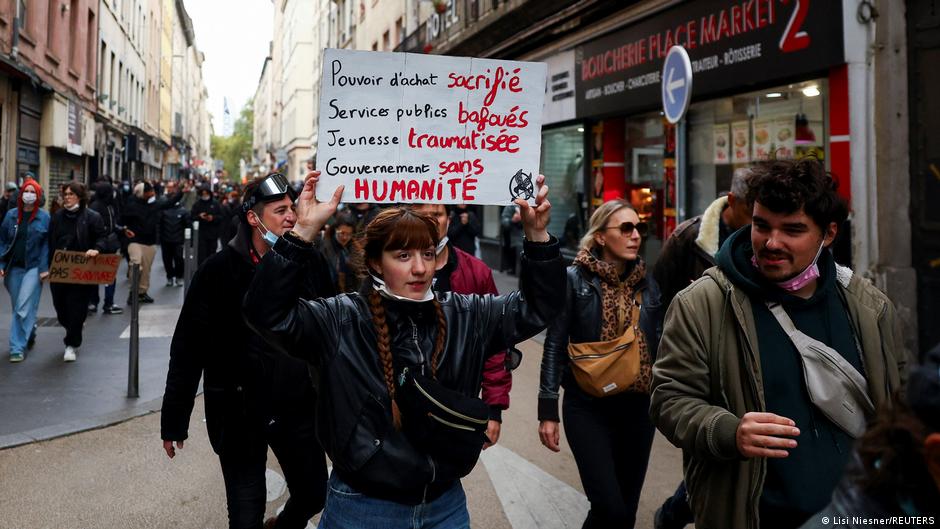
法国计划在教育上额外投入40亿欧元,正值全国爆发抗议之际。但随着公共债务攀升、利息成本上涨,政府究竟还有多少财政空间?
France plans to spend an extra €4 billion on education amid nationwide protests. But with public debt mounting and interest costs climbing, how much fiscal room does the government have?
法国政府不仅面临因生活成本上涨引发的抗议,还在应对不断攀升的债务成本。深陷债务泥潭、在极端派别对峙中陷入政治困境、且由一个没有议会多数席位的政府领导:这些是法国当前困境的显著特征。
Prefer DW on Google The French government is facing not only protests over the rising cost of living but is also grappling with mounting debt costs Deeply indebted, politically trapped in a standoff between extremes and led by a government without a parliamentary majority: These are the defining features of France's current predicament.
如果政府为回应全国抗议,计划到2030年提供40亿欧元(约合44.8亿美元)低息贷款用于翻新学校,并到2029年向高校再拨付10亿欧元,那么它承诺的是国家根本没有的钱。
If, in response to nationwide protests the government plans to provide €4 billion ($4.48 billion) in low-interest loans to renovate schools by 2030 and allocate a further €1 billion to universities by 2029, it is promising money the state simply does not have.
法国公共债务约占国内生产总值(GDP)的120%。相比之下,德国的债务占GDP比率约为65%,尽管德国推出了6000亿欧元的基础设施和国防投资计划。
France's public debt stands at around 120% of gross domestic product (GDP). By comparison, Germany's debt-to-GDP ratio is roughly 65%, despite its €600 billion investment package for infrastructure and defense.
德国仍享有最高的AAA信用评级,而法国的评级则为AA、A+或Aa3,视具体评级机构而定。德国的评级展望一致被评为稳定,而多家机构给法国的展望评为负面。
Germany still enjoys the highest possible AAA credit rating France, by contrast, is rated AA, A+ or Aa3, depending on the credit agency. While Germany's outlook is consistently rated as stable, several agencies have assigned France a negative outlook.
因此,法国政府借款利率高于柏林。法国国债相对于德国国债的风险溢价(即息差)现处于金融危机以来的最高水平。在10年期债券上,法国支付的利息比德国高出近1.6个百分点。
As a result, the French government must pay higher interest rates on its borrowing than Berlin. The risk premium over German government bonds, known as the spread, is now at its highest level since the financial crisis. France pays nearly 1.6 percentage points more in interest than Germany on 10-year bonds.
法国公共财政的晴雨表 息差就像债券市场的一种“发烧计”,曼海姆莱布尼茨欧洲经济研究中心(ZEW)经济学家弗里德里希·海内曼解释说。
A barometer of France's public finances The spread acts as a kind of fever gauge for bond markets, explains Friedrich Heinemann, an economist at the Leibniz Center for European Economic Research (ZEW) in Mannheim.
“这种发烧指标随后会迫使政策转向。如果利差过快上升,法国的融资条件就会承压,法国所有需要贷款的人都必须支付更高的利率。银行随之陷入困境,危机进一步升级,”海内曼对德国之声表示。
"This fever gauge then forces a change of course. If the spread rises too sharply, France's financing conditions come under pressure, and anyone in France who needs a loan has to pay higher interest rates. Banks then get into trouble, and the crisis escalates further," Heinemann told DW.
“随后这可能演变为一场金融危机,最终向所有人发出明确信号:除非你准备冒真正的经济崩溃的风险,否则事情不能继续这样下去,”他解释道。
"This could then slide towards a financial crisis, which would finally send a clear signal to everyone: Things cannot continue like this unless you are prepared to risk a genuine economic collapse," he explained.
然而,波恩大学高等安全、战略与融合研究中心的研究员兰德里·夏里耶并不指望法国这种债务驱动的挥霍会很快结束。
Landry Charrier, a researcher at the University of Bonn's Center for Advanced Security, Strategic and Integration Studies, however, does not expect France's debt-fuelled spending spree to end anytime soon. "French people are aware of the country's high public debt.
“法国人意识到国家公共债务高企。但如果其后果在日常生活中几乎感觉不到,债务仍是一个抽象的概念。据法国国家统计与经济研究所(INSEE)数据,56%的人口获得的政府福利和服务多于他们缴纳的税收和社会分摊。因此,大多数人都有切身利益维持现状,”夏里耶对德国之声表示。
But debt remains an abstract concept if its consequences are barely felt in everyday life. According to INSEE (the French national statistics agency — the ed.), 56% of the population receive more in government benefits and services than they pay in taxes and social contributions. The majority therefore have a tangible interest in maintaining the status quo," Charrier told DW.
半个多世纪以来,法国经常花的钱比收到的税收收入多。上一次实现国家预算平衡还是1974年。
For more than half a century, France has regularly spent more than it collects in tax revenue. The last time it balanced its national budget was in 1974.
欧元区危机的回响 法国上一次支付类似的高风险溢价是在2011年底,当时正值欧元区债务危机。特别引人注目的是其上升速度之快:自2026年6月以来,相对于德国国债的利差已翻了一倍多。
Echoes of the eurozone crisis France last paid a similarly high-risk premium at the end of 2011, during the eurozone debt crisis. What is particularly striking is how quickly it has risen: Since June 2026, the spread over German government bonds has more than doubled.
主要推动因素与其说是利率总体水平,不如说是投资者因高债务水平、政治不稳定、大额财政赤字和近期骚乱而要求的不断上升的风险溢价。利率越高,国家预算中仅用于偿债的份额就越大。法国预计2026年将为其全部公共债务支付超过790亿欧元的利息。该数字预计2027年将超过910亿欧元,到2030年可能达到1250亿至1320亿欧元之间。
The main driver is not so much the general level of interest rates. Rather, it's the growing risk premium investors demand in response to high debt levels, political instability, large budget deficits and the recent unrest The higher the interest rates, the larger the share of the national budget that must be devoted to debt servicing alone. France is expected to pay more than €79 billion in interest on its total public debt in 2026. That figure is projected to exceed €91 billion in 2027 and could reach between €125 billion and €132 billion by 2030.
这些数字包括社会保障基金和地方当局产生的费用。仅中央政府的利息支出,目前由法国财政部机构法国财政总署(Agence France Trésor)估计为626亿欧元。
These figures include the costs incurred by social security funds and local authorities. The central government's interest bill alone is currently estimated at €62.6 billion by the Agence France Trésor, a French Treasury agency.
未来几年,法国将不得不重新融资大量在利率处于历史低位时发行的未偿债券。与此同时,该国巨额的财政赤字意味着它必须承担额外债务。
In the coming years, France will have to refinance large amounts of outstanding bonds that were issued when interest rates were at historic lows. At the same time, the country's substantial budget deficit means it must take on additional debt.
对德国的警告 利息成本上升的趋势也正在影响德国。ZEW的海内曼(Heinemann)计算,德国利息支付可能在2030年代初期急剧增加。
A warning shot for Germany The trend of rising interest costs is also affecting Germany. The ZEW's Heinemann has calculated that German interest payments are likely to increase sharply by the early 2030s.
“仅联邦政府迄今已支付约300亿欧元,随着债务和利率双双上升,该数字将在几年内翻三倍。而且不会止步于此——将超过900亿欧元。在联邦预算中达到每年1000亿欧元的利息支付,那时已不再遥远,”这位位于曼海姆的经济学家警告说。
"For the federal government alone, which has so far paid around €30 billion, the figure will triple within a few years as both debt and interest rates rise. And it won't stop there — it will exceed €90 billion. Reaching €100 billion in annual interest payments in the federal budget is then no longer far off," warns the Mannheim-based economist.
然而在法国,经济现实似乎对政治辩论影响甚微。极右翼国民联盟(RN)和极左翼法国反抗党(LFI)都在推行代价高昂的承诺。
In France, however, economic realities seem to have little impact on political debate. Both the far-right National Rally (RN) and the far-left La France insoumise (LFI) are campaigning on costly promises.
国民阵线领袖马琳·勒庞,例如,希望恢复62岁的退休年龄,同时承诺节省1400亿欧元。法兰西不屈运动领袖让-吕克·梅朗雄甚至建议,法国央行持有的政府债券应当“扔进火里”。“没人会注意到它们已经消失,”他声称。“左右两派的童话故事”对海内曼来说,这是“左右两派的激进政党只是在讲经济童话故事的一个很好例子。”他说,他们的共同信息是,“摆脱这一困境的办法不需要财政紧缩,也不需要痛苦的削减。”沙里耶相信,许多法国人尚未意识到局势的严重性。
RN leader Marine Le Pen for example, wants to reinstate the retirement age of 62 while promising €140 billion in savings. Jean-Luc Mélenchon, LFI's leader, has even suggested that government bonds held by the French central bank should be "thrown into the fire." "Nobody will ever notice they've disappeared," he claims. 'Fairy tales from the left and the right' For Heinemann, this is "a good example of radical parties on both the right and the left simply telling economic fairy tales." Their common message, he says, is that "there is a way out of this mess that requires neither fiscal consolidation nor painful cuts." Charrier is convinced that many French people have yet to grasp the seriousness of the situation.
“欧元使法国更容易获得廉价融资,并长期缓和了调整的压力,”这位专家指出。
"The euro has made it easier for France to access cheap financing and has long softened the pressure to adjust," the expert points out.
“过去,法郎(编者注:法兰西法郎)的货币贬值会通过购买力下降和物价上涨,立即让经济失衡显现出来。如今,这种警示信号已经缺失。这造成了一种错觉,即必要的调整可以无限期推迟,”沙里耶说。本文最初以德语发表。法国的债务危机会成为欧洲的问题吗?
"In the past, currency devaluations (of the French franc — the ed.) made economic imbalances immediately felt through declining purchasing power and rising prices. Today, that warning signal is missing. This has created the illusion that necessary adjustments can be postponed indefinitely," Charrier said. This piece was originally published in German. Could France's debt crisis become a problem for Europe?