
经济预测者们再次在周五发布的最新美国劳动力市场状况报告上大错特错,这增加了一连串错误预测的记录,并引出了一个显而易见的问题:为什么那些以预测整个经济中最重要的数据点之一为生的人,会如此频繁地预测得如此之错?
Yet again, the economic soothsayers couldn’t have been more wrong about the latest report on the state of the US labor market released Friday, adding to a mounting string of errant forecasts and raising an obvious question: Why do the people who make a living forecasting one of the most important data points in the whole economy get it so wrong so often?
劳工统计局称,10月非农就业岗位增加了16.5万个,是彭博社对70多位经济学家调查得出的7万个中位数预估值的两倍多。没有任何一份预测接近实际数值,最高预估也仅为13.1万个。我们是否应该对经济学家预期与实际结果之间持续存在的巨大偏离感到担忧,无论是高估还是低估?是的,原因很简单,因为这增加了金融市场不必要的波动。但这并非源于政府操纵数据的阴谋,也非预测者无能所致。
The Bureau of Labor Statistics said nonfarm payrolls expanded by 165,000 in October, more than twice the median estimate of 70,000 in a Bloomberg survey of more than 70 economists. None of the forecasts came close, with the highest estimate being 131,000. Should we be concerned about the consistently wide divergence between what economists anticipate and the actual results, both on the upside and the downside? Yes, for the simple reason that it adds to unnecessary volatility in financial markets. But it’s not the result of some government conspiracy to manipulate the data or forecaster incompetence.
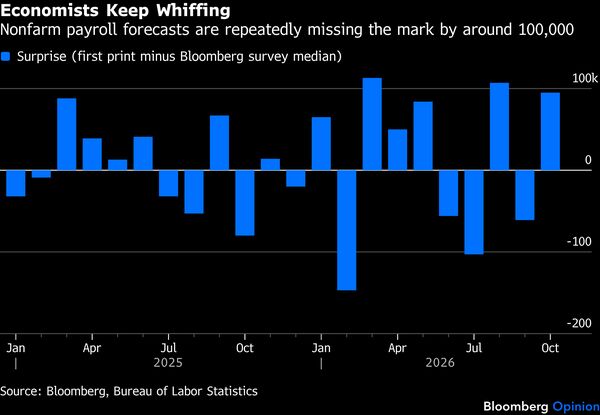
先看看最近的偏差。经济学家对10月的预期与实际数值之间相差9.5万,甚至不是今年最大的偏差。2月、3月、7月和8月的预估值每个月都偏离了10万以上!2026年平均偏差幅度(不论偏高偏低)约为8.8万,高于我作为“常态”代理指标的2010-2019年约5万的水平。这在很大程度上是美国决定削减对统计机构投资的可预见后果,这些机构长期被视为世界黄金标准,但近来被迫在资源萎缩的情况下竭力做到最好。
Let’s start with the recent misses. The 95,000 gap between what economists were expecting for October and the actual numbers wasn’t even the biggest of the year. Estimates for February, March, July and August were off by more than 100,000 each of those months! The average size of the miss (ignoring whether it missed low or high) has been around 88,000 in 2026, up from about 50,000 in 2010-2019, the period that I’m using as a proxy for “normal.”This is, to a significant degree, the predictable result of the decision to forego investment in America’s statistics agencies, long considered the world’s gold standard but lately forced to do the best that they can with shrinking resources.
按通胀调整后计算,劳工统计局的经费自2010年以来已下降逾20%,如果议员们没有反对,第二届特朗普政府本会实施更深度的削减。因此,样本量萎缩、劳工统计局难以解决调查回复率不足的问题,也就不足为奇了。
In inflation-adjusted terms, BLS funding has fallen well over 20% since 2010, and the second Trump administration would have instituted deeper cuts still if lawmakers hadn’t pushed back. It’s no surprise then that sample sizes are shrinking and the BLS is struggling to counter the problem of getting enough people to respond to its surveys.
“回复率下降到处都在发生,”前劳工统计局局长埃里卡·麦肯塔弗7月告诉《金融时报》:“这主要是因为人们和企业比过去更难联系上。但另一个因素是,实地资源是那些预算削减中受冲击最大的部分。因为人们更难联系上了,所以联系他们的成本实际上更高,但我们没有钱用于这些资源——所以这也在影响回复率。”所有这些导致公布数字周围的误差区间变大。
“Declining response rates are happening everywhere,” former BLS commissioner Erika McEntarfer told the Financial Times in July. “That’s largely because people and businesses are harder to reach than they used to be. But another factor is that field resources are taking the biggest hit from those budget cuts. Because people have gotten harder to reach, it actually costs more to reach them, but we don’t have the money for those resources — so that’s also impacting response.”All of that leads to larger error bands around the published numbers.
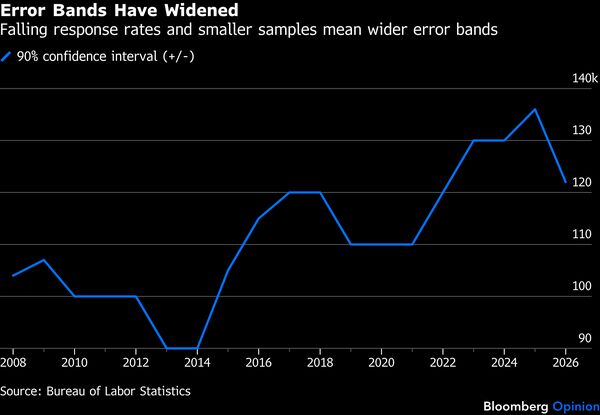
从这个角度看,没有人应该对数字看起来比十年前更加波动感到震惊。目前90%置信区间在12.2万左右,小于这个幅度的变化在统计上无法与零区分——事实上,2026年大约有一半的就业报告都属于这种情况。
Looked at in those terms, no one should be shocked that the numbers look more choppy than they did a decade ago. With the 90% confidence interval currently around 122,000, changes smaller than that are statistically indistinguishable from zero — and indeed that’s been the case for around half of jobs reports in 2026.
这让我想到第二点——这是我借用彭博观点专栏作家凯瑟琳·安妮·爱德华兹的见解——当劳动力市场增长在统计上如此接近零时,很难进行预测。特朗普政府对合法移民的限制及其针对无证人口的恐吓行动切断了流入美国经济的劳动力来源,这是其中一个副作用。我们面对的就业增长按历史标准来看非常小,以至于经济学家和统计学家往往难以将其与正常的月度波动区分开来。
That brings me to a second point — which I’m adapting from the wisdom of my Bloomberg Opinion colleague Kathryn Anne Edwards — that it’s hard to predict labor market growth that’s this statistically close to zero. The Trump administration’s restrictions on legal immigration and its fear campaign against the undocumented population have stanched the flow of labor into the US economy, and this is one side effect. We’re dealing in job gains that by historical standards are so small that they’re often hard for economists and statisticians to differentiate from normal month-to-month noise.
最后还有一个细微之处:劳工统计局通过调查具有代表性的企业样本来估算非农就业人数,但一个挑战是,新雇主不断被创建或倒闭。政府用所谓的“生灭模型”来填补这一空白,该模型随时间发生了变化。旧模型基本上是以相当平滑的方式将陈旧数据外推到当前时期。如果你是试图预测下一份报告的经济学家,这很不错;但如果你是试图了解经济真实情况的人,这就不太好了。
One final bit of nuance: The BLS estimates payrolls by surveying a representative sample of establishments, but one challenge is that new employers are always being created or going out of business. The government fills the gap with what it is known as the birth-death model that has changed over time. The old model basically extrapolated stale data into the current period on a fairly smooth basis. That’s great if you’re an economist trying to guess the next report but not-so-great if you’re trying to understand what is really happening in the economy.
截至2026年1月,劳工统计局启用了一个新模型,将外推法与更多同期信息相结合,使其本质上更具波动性。它是否效果更好?在这个早期阶段仍有待观察,但它肯定更难预测。
As of January 2026, the BLS instituted a new model that combines the extrapolation with more contemporaneous information, making it inherently more volatile. Does it work better? That remains to be seen at this early juncture, but it’s definitely harder to forecast.
要记住的是,这些数据将继续保持波动和不可预测,关注劳动力市场的人最好专注于长期趋势,而不要对个别报告过度反应。周五的强劲数字固然令人欣慰,但很难判断其中包含多少有效信号。与此同时,决策者必须最终致力于扩大对劳工统计局的资助,并回到制定明智移民政策的任务上来,为经济提供所需的工人。也许那时我们才能开始创造出一些在统计学上可与零区分开来的就业增长。
The thing to hold onto is that this data is going to remain volatile and unpredictable, and labor market-watchers would be well served by focusing on longer-term trends instead of getting too worked up about individual reports. Friday’s strong number was certainly nice, but it’s hard to tell if there’s much signal in it. Meanwhile, policymakers must finally work to expand funding to the BLS and return to the task of creating sensible immigration policy that gives the economy the workers we need. Maybe then we can start producing some payroll gains that are statistically distinguishable from zero.