这场对人工智能的盲目冲刺伴随着一种普遍共识,即人工智能聊天机器人消耗着巨大的电量,其中大部分电力是通过燃烧化石燃料产生的。更难以得知的是,每当ChatGPT、Claude或DeepSeek投入运转时,究竟排放了多少会使地球变暖的二氧化碳。
The headlong rush into artificial intelligence comes with a general awareness that AI chatbots consume vast amounts of power, much of it generated by burning fossil fuels. What’s harder to know is precisely how much planet-warming carbon dioxide is released each time ChatGPT, Claude or DeepSeek leap into action.
美国最大的几家人工智能公司尚未公布其能源或排放表现的详细账目。这将需要分享他们宁愿秘而不宣的技术细节。人工智能的排放不仅取决于你使用的是哪项服务,还取决于你的提示词是在哪里得到处理的。处理这项任务的数据中心可能由煤炭供电,也可能由风力涡轮机供电。此外,人工智能服务器农场使用各种半导体和冷却技术,这为这个方程式增添了更多变量。
The biggest US AI companies haven’t published detailed accounts of their energy or emissions performance. That would require sharing technical details they would rather keep under wraps. AI’s emissions depend not just on which service you are using, but where your prompt gets processed. The data center handling the task may be powered by coal, or by wind turbines. And AI server farms use a variety of semiconductor and cooling technologies, adding more variables to the equation.
然而,研究人员一直在寻找方法,以便做出比有根据的猜测更好的估算,从而使企业、政府和用户能够更好地了解人工智能对环境的影响。
Yet researchers have been finding ways to make something better than an educated guess so that companies, governments and users can better understand AI’s environmental impact.
“人们对此感到非常畏惧,”帮助人工智能公司衡量和报告其环境影响的Watershed科学负责人约翰·比斯特莱因(John Bistline)表示。但他们也认识到,“公司、监管机构和审计人员都在索取这些切实经得起推敲的人工智能排放估算数据。”
“People are super intimidated by this,” said John Bistline, head of science at Watershed, which helps AI companies to measure and report their environmental impact. But they also recognize “that companies and regulators and auditors are all asking for these AI emissions estimates that actually hold up.”
查询被发送到数据中心,并在半导体(通常是针对人工智能工作负载进行过改造的图形处理器)上进行处理。当人工智能将书面提示词分解为其神经网络能够处理的更小的块(即“输入词元”)时,这些芯片会大量消耗电力。随后,它会多次执行数十亿次计算,以提供理想的响应。这种高强度的海量数据处理会产生大量热量,这些热量必须被散发掉,以免芯片发生故障。
The query is sent to a data center to be processed on semiconductors, typically graphics processing units adapted for AI workloads. The chips burn through electricity as the AI breaks the written prompt into smaller chunks, or “input tokens,” that its neural network can process. It then performs billions of calculations multiple times to deliver the ideal response. This intense data crunching creates a lot of heat that needs to be removed so the chips don’t malfunction.
根据研究与咨询公司可持续人工智能集团联合创始人兼首席科学官、人工智能初创公司Hugging Face的萨莎·卢乔尼(Sasha Luccioni)的一份报告,数据中心所使用的高达40%的能量被用于冷却。
As much as 40% of the energy used by a data center is used for cooling, according to a report by Sasha Luccioni, co-founder and chief scientific officer of the research and advisory firm Sustainable AI Group, and AI startup Hugging Face.
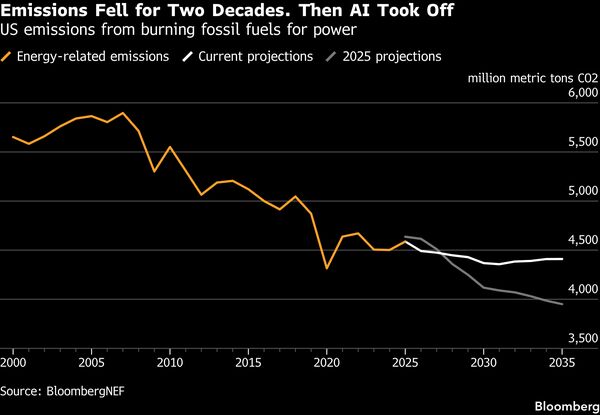
人工智能数据中心的激增正导致能源需求飙升,这威胁到放慢甚至阻断由可再生能源增长以及工业、供暖和交通电气化所带来的碳排放下降趋势。
The proliferation of AI data centers is leading to a surge in energy demand that threatens to slow or even arrest the decline in carbon emissions brought about by the growth in renewables and the electrification of industry, heating and transportation.
美国电力研究所(Electric Power Research Institute)在2024年的一份白皮书预估,对于早期模型而言,单次ChatGPT查询平均消耗的电力是传统谷歌网络搜索的10倍。
In a 2024 whitepaper, the Electric Power Research Institute estimated that for earlier models, a single ChatGPT query consumed 10 times more power on average than a traditional Google web search.
基于文本的任务在耗电量上会有所不同。诸如“洛杉矶的平均气温是多少”这样需要简短简单回答的问题,其消耗的能量可能比关于量子物理学的查询要少。处理请求的AI模型类型也很重要。
Text-based tasks will vary in their power consumption. A question that requires a short and simple response such as “what is the average temperature in Los Angeles” is likely to be less energy intensive than a query about quantum physics. The type of AI model that’s processing the request matters as well.
随着越来越多的人使用这项技术,且开发人员推出了能够处理日益复杂工作负载的更大、能力更强的AI平台,AI对能源的需求正在呈爆炸式增长。要求ChatGPT制作图像或视频所需的能量,将远超提出一个问题的能量。能够执行复杂的多步骤任务的自主“智能体”的采用,进一步增加了AI的耗电量。基准测试公司Vals AI的一项分析发现,使用AI构建一个软件应用程序所产生的环境影响,可能是简单查询的1万倍。
AI’s appetite for energy is exploding as more people tap into the technology and developers roll out larger, more capable AI platforms that can handle increasingly complex workloads. Asking ChatGPT to make an image or a video will require far more energy than posing a question. The adoption of autonomous “agents” that can perform complex, multi-step tasks is adding to AI’s power consumption. An analysis from benchmarking company Vals AI found that using AI to build a software application can have an environmental impact 10,000 times greater than that of a simple query.
计算一个AI模型的排放量,还意味着要将聊天机器人为回答问题而需要发生的一切因素都考虑在内。因此,研究人员已经开始研究AI服务在其整个生命周期中消耗了多少能量——从制造芯片和数据中心冷却厂的原材料开采,到AI服务本身的运行,再到最终淘汰冗余芯片。环保非营利组织落基山研究所(RMI)的数据显示,仅在2030年之前用于建造美国AI设施的水泥,就可能产生相当于41.5万辆汽车一年的温室气体排放量。
Calculating an AI model’s emissions also means factoring in everything that needed to happen for the chatbot to answer it. So researchers have begun to study how much energy is consumed during an AI service’s entire life cycle — from extracting raw materials to make chips and data center cooling plants to the operation of the AI service itself and the eventual scrapping of redundant chips. The cement alone used to construct US AI facilities through 2030 could generate as much greenhouse gases as 415,000 cars emit in a year, according to environmental nonprofit RMI.
可持续人工智能(Sustainable AI)的研究员尼达尔·热加姆(Nidhal Jegham)建立了一个开源仪表板,用于比较各种人工智能模型的估计能耗与碳排放。其基准是一个使用专用天然气发电厂的美国数据中心。该国的许多数据中心开发商正在转向天然气来为这些设施提供动力。
Nidhal Jegham, a researcher at Sustainable AI, built an open-source dashboard that compares the estimated energy consumption and carbon emissions of various AI models. Its baseline is a US data center using a dedicated, gas-fired power plant. Many data center developers in the country are turning to natural gas to power the facilities.
热加姆及其团队发现,单个模型的温室气体排放量取决于几个变量,包括批处理大小(同时处理多少个提示)、用于处理查询的芯片数量、特定的芯片类型以及每个词元(人工智能模型读取和生成的文本或其他数据的基本单位)的能源使用量。
Jegham and his team found the greenhouse-gas emissions of individual models depend on several variables, including batch size (how many prompts are being handled together), the number of chips used to process a query, the specific type of chip and energy use per token (the basic unit of text or other data that an AI model reads and generates).
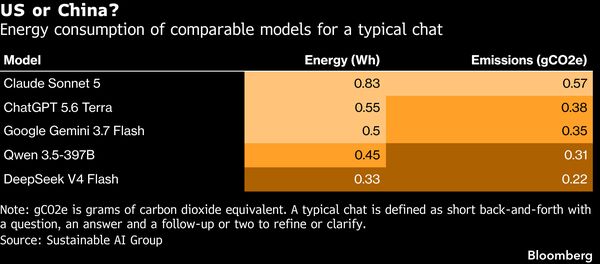
诸如ChatGPT 5.6 Terra等美国前沿模型的耗电量似乎高于阿里巴巴集团的通义千问(Qwen)等中国同类模型。这是因为后者普遍采用了一种“推理”架构,将复杂的数学、逻辑和编码任务分解为更小的连续步骤,而不是为每一个词元激活整个神经网络。
US frontier models such as ChatGPT 5.6 Terra appear to consume more energy than Chinese counterparts such as Alibaba Group’s Qwen. This is because the latter generally use a “reasoning” architecture that breaks complex math, logic, and coding tasks into smaller, sequential steps instead of activating the entire neural network for every single token.
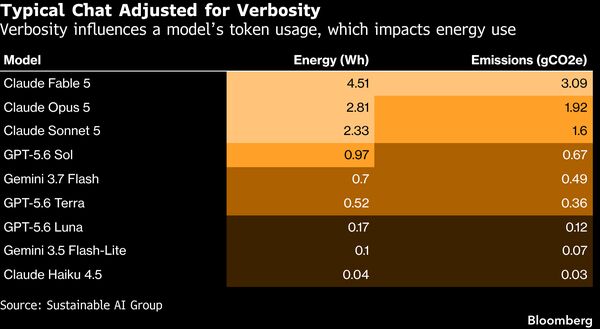
作为一般规律,最复杂的前沿模型往往会消耗最多的能源。这是因为对查询生成更复杂的响应需要进行更多的计算。因此,与该公司更尖端的平台Claude Fable 5相比,Anthropic“最轻量级”的人工智能模型Claude Haiku在生成响应时消耗的能源要少得多。
As a general rule, the most complex, frontier models tend to burn through the most energy. That’s because generating a more sophisticated response to a query involves running more calculations. So Anthropic’s “lightest” AI model, Claude Haiku, consumes far less energy to generate its responses compared with the company’s more cutting-edge platform, Claude Fable 5.
在实践中,较小的模型为了弥补较低的智能水平,通常比较大的模型消耗更多的词元来生成响应。这将缩小能耗方面的差距。
In practice, smaller models often burn through more tokens to generate a response than their larger counterparts to compensate for a lower level of intelligence. This will narrow the gap in energy consumption.
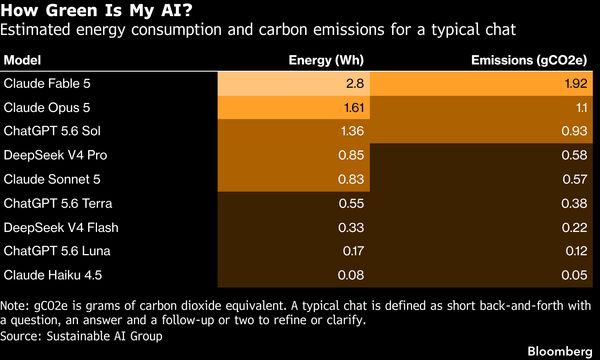
“如果你看看Claude Sonnet,它比Opus便宜得多,体量也小得多,”杰加姆(Jegham)说。“然而,为了弥补体量较小或智能程度较低的不足,它生成的Token(词元)数量多了近60%。”“该模型每个Token产生的碳排放较少,但需要更多的Token才能得出相同的答案。”不过,即使把冗长性考虑在内,对于同等任务,大多数轻量级模型似乎仍然比前沿模型需要更少的电力。
“If you look at Claude Sonnet, it’s way cheaper than Opus and it’s way smaller. However, it generates almost 60% more tokens to compensate for being smaller or for being less intelligent,” Jegham said. “The model emits less carbon per token, but needs way more tokens to get to the same answer.”Even factoring in verbosity, however, most lighter models still appear to require less power for a comparable task than frontier models. Prompting a chatbot to perform an “agentic” task that involves multiple steps consumes many times more energy than inputting a simple text query.
提示聊天机器人执行涉及多个步骤的“智能体”(agentic)任务,所消耗的能量比输入简单的文本查询要多出许多倍。在这里,平台的选择同样会对能源消耗以及——取决于工作在哪里处理——碳排放产生巨大影响。
Here again, the choice of platform will make a big difference to the energy consumption and — depending where the work is handled — the carbon emissions. The estimated 76.2 watt-hours sucked up by Claude Fable for an agentic task would produce about the same emissions as four smartphone charges.
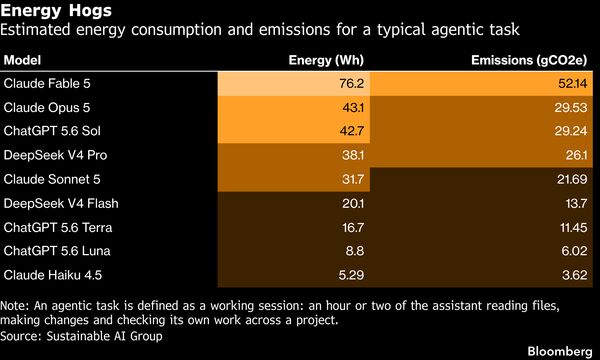
据估计,Claude Fable在执行一项智能体任务时会消耗76.2瓦时的电量,这产生的碳排放大致相当于给智能手机充电四次。孤立来看,这似乎并不算多。但AI平台每天被提示数以十亿计的次数,其能源使用量和碳排放量很快就会积少成多。
That may not seem like a lot in isolation. But AI platforms are being prompted billions of times per day, and the energy usage and carbon emissions quickly add up. US AI companies say they are working hard to limit their emissions.
美国AI公司表示,它们正在努力限制自身的碳排放。在其2026年环境报告中,谷歌(Google)估计,Gemini Apps文本提示的中位数耗电量为0.24瓦时——相当于看电视不到九秒钟。该公司表示,由于“研究创新以及软件和硬件效率的提升”,在2024年至2025年期间,其文本提示的能源使用量和碳足迹分别减少了33倍和44倍。
In its 2026 environmental report, Google estimated that the median Gemini Apps text prompt used 0.24 watt-hour of energy — the same as watching TV for less than nine seconds. It said that between 2024 and 2025 it was able to reduce its text prompt energy use and carbon footprint by 33 times and 44 times, respectively, due to “research innovations and software and hardware efficiency improvements.”Generally, however, estimates published by the industry tend to be vague and hard to verify.
然而,总体而言,业界公布的估计数据往往较为模糊且难以核实。杰加姆表示,谷歌开发了被称为TPU(即张量处理器)的自有芯片,该公司称这种芯片能效更高、速度更快,从而使最终的碳足迹比使用GPU时更小。谷歌不允许外部研究人员购买和研究其TPU芯片,并且只公布了关于这些芯片的有限数据。
Google develops its own chips called TPUs, or tensor processing units, which the company says are more energy efficient and faster, making the final carbon footprint smaller than when using GPUs. Google doesn't let outside researchers purchase and study its TPU chips and has published limited data about them, according to Jegham. Anthropic, OpenAI, Google, DeepSeek and Alibaba didn’t reply to Bloomberg emails seeking comment on Sustainable AI’s findings.
Anthropic、OpenAI、谷歌、DeepSeek和阿里巴巴没有回复彭博社就Sustainable AI的调查结果寻求置评的电子邮件。
Prompting ChatGPT in, say, Copenhagen could emit a lot less carbon than prompting it in Charleston.
例如,在哥本哈根向ChatGPT输入提示词,其排放的碳量可能会比在查尔斯顿少得多。这是因为在欧洲,化石燃料在发电量中所占的比例比美国小。斯堪的纳维亚半岛的人工智能数据中心消耗了大量风能、太阳能和水能等可再生能源。美国的数据中心平均依靠因地区而异的化石燃料和可再生能源组合运行。2025年,美国公用事业规模发电量的约24%由可再生能源产生。
That’s because in Europe, fossil fuels account for a smaller share of power generation than in the US. AI data centers in Scandinavia consume a lot of renewable energy sources like wind, solar and hydropower. The average data center in the US runs on a mix of fossil fuels and renewables that varies from region to region. About 24% of US utility-scale electricity generation was produced from renewable sources in 2025. Google announced in September that it was investing $15.1 billion in AI infrastructure in Finland, in part because of the Nordic country’s cold climate and carbon-free power.
谷歌于9月宣布将向芬兰的人工智能基础设施投资151亿美元,部分原因在于这个北欧国家寒冷的气候和无碳电力。在建设人工智能计算能力最多的欧洲国家中,法国位居其中,其大部分电力来自低碳核能和可再生能源。
Among the European countries building the most AI computing capacity is France, which gets most of its power from low-carbon nuclear and renewables. New data centers in the US are projected to emit more carbon than the entire country of Mexico by 2030 if all are built on time with current air-quality permits, according to an analysis by the Sierra Club, an environmental nonprofit.
环保非营利组织山峦协会的一项分析显示,如果美国的所有新数据中心都能按现有空气质量许可准时建成,到2030年,它们的碳排放量预计将超过整个墨西哥。研究公司全球能源监测的数据显示,2026年上半年提议与美国数据中心相连的燃气电厂数量是2025年全年的两倍,达到了189吉瓦。美国在建的燃气发电量是中国两倍。
The number of gas plants linked to US data centers that were proposed in the first half of 2026 was double that of full-year 2025, reaching 189 gigawatts, according to Global Energy Monitor, a research firm. The US has twice as much gas power under construction as China does. It’s difficult to compare the carbon footprints of US AI platforms to their Chinese equivalents.
比较美国人工智能平台与中国同类平台的碳足迹是困难的。中国一直在建设可再生能源基础设施,增加风能和太阳能发电,部分原因是为了在人工智能方面给自己带来对美国的竞争优势。但中国的电网总体上仍然比美国的电网更具污染性,部分原因是中国的发电厂燃烧大量的煤炭。另一方面,许多美国的人工智能系统比中国的人工智能系统需要更多的能源。
China has been building out its renewable energy infrastructure, adding more wind and solar power, in part to give itself a competitive edge against the US when it comes to AI. But China’s grids are still dirtier overall than those of the US, partly because Chinese power stations burn large amounts of coal. On the other hand, many US AI systems require more energy than Chinese ones. In the US, “the traffic is more, the models are bigger, the models need larger compute to handle them, so I would say US companies are emitting more, but it also depends on the grid itself because that's very important,” said Jegham.
在美国,“流量更多,模型更大,模型需要更大的计算能力来处理它们,所以我可以说美国公司的碳排放量更多,但这同时也取决于电网本身,因为这非常重要,”杰加姆(Jegham)说。
Even if a data center is run by a tech company claiming net-zero emissions, it doesn’t mean there won’t be any greenhouse gases released.
即使数据中心由一家声称实现净零排放的科技公司运营,也不意味着不会释放任何温室气体。许多公司使用可再生能源证书来抵消其排放。这些证书支付给在其他地方生产的清洁能源,但公司的运营仍然依赖于很大程度上由化石燃料供电的本地电网。
Many use renewable energy certificates to offset their emissions. Those certificates pay for clean energy produced elsewhere, but the company’s operations still rely on local grids that are powered in large part by fossil fuels. Consumers, investors, activists, corporations and regulators want more granular data to guide their choice of model, help measure community impact, do cost analysis, make investment decisions and develop regulations around AI.
消费者、投资者、活动人士、企业和监管机构希望获得更细颗粒度的数据,以指导他们选择模型、帮助衡量对社区的影响、进行成本分析、做出投资决策以及围绕人工智能制定法规。
Natural gas plants could pose local air-pollution hazards, and states, cities and counties have pushed back against data-center expansion due to concerns over energy costs.
天然气发电厂可能会带来本地空气污染隐患,出于对能源成本的担忧,各州、城市和县级行政区一直在抵制数据中心的扩张。有可持续发展目标的机构需要了解,他们正在迅速整合到流程中的人工智能如何影响自身的排放以及实现净零目标的能力。一些国家出台了政策,要求对这些信息进行核算和报告。优先考虑可持续发展的投资者可能不愿意购买其运营会危害环境的人工智能公司的股份。
Companies with sustainability goals need to understand how the AI they are rapidly integrating into processes impacts their own emissions and their ability to meet net-zero targets. Some countries have policies in place that require this information to be accounted for and reported. Investors who prioritize sustainability might not want to purchase stakes in AI companies whose operations harm the environment. Investment research firm Morningstar said in a report that the lack of disclosure from AI companies “limits investors’ ability to assess environmental performance or resource efficiency.”
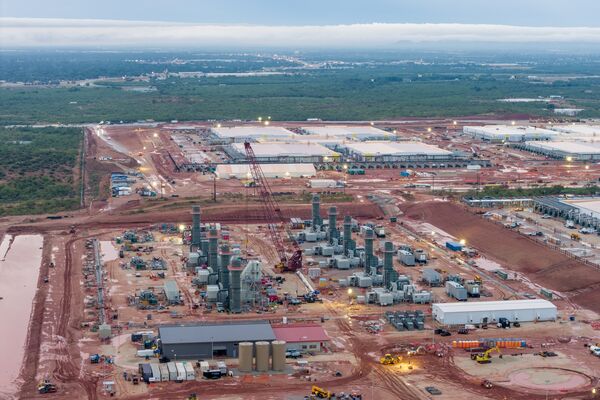
投资研究公司晨星在一份报告中表示,人工智能公司缺乏信息披露“限制了投资者评估环境表现或资源效率的能力”。相对较小的改变就能在降低人工智能的能耗和成本方面发挥巨大作用。总部位于台湾的全球绿色硬件制造商德尔塔电子表示,如果平均电源供应效率提高0.5%,每年可减少数据中心用电量约5太瓦时,从而每年减少200万吨二氧化碳排放。
Relatively small changes can go a long way to reducing AI’s energy consumption and costs. If the average power-supply efficiency improved by 0.5%, it could reduce data center electricity consumption by roughly 5 terawatt-hours per year, which would cut out 2 million metric tons of carbon dioxide emissions annually, according to Delta Electronics, a Taiwan-based global green-hardware manufacturer. Companies don’t need perfect data to reduce their climate impact by choosing models known to require less energy, and from regions with cleaner power sources, said Bistline at Watershed.
Watershed的Bistline表示,公司无需完美的数据,即可通过选择已知耗能较少的模型,以及来自电力来源更清洁的地区的模型,来降低其气候影响。
“Model selection can be one thing that drives up to a 30 times difference in energy use for the same AI task,” he said.
他说:“模型选择可能导致同一项人工智能任务的能耗相差高达30倍。这可能是目前大多数公司拥有的影响最大的单一杠杆。”
“And that's probably the single highest-impact lever that most companies have today.”
美国证券交易委员会已放弃拜登时代要求大公司披露排放数据的计划。但民主党在中期选举中大获全胜,意味着更严格的人工智能监管可能即将到来,透明度压力将随之增加。与此同时,加利福尼亚州开始推出针对所谓范围一和范围二排放的自有披露要求,范围三将于明年生效。这些要求将适用于年收入超过10亿美元且在该州开展业务的公司——包括大型人工智能初创企业。
The US Securities and Exchange Commission has backed away from Biden-era plans to require large companies to disclose their emissions. But Democrats' sweeping victory in the midterm elections means stricter AI regulation may be on the way, with more pressure for transparency. In the meantime, the state of California is beginning to roll out its own disclosure requirements for so-called scope 1 and scope 2 emissions, with scope 3 going into effect next year. These will apply to companies that generate more than $1 billion in annual revenue and do business in the state — including big AI startups.
欧盟的排放披露框架CSRD已对欧洲公司产生影响,并将在未来几年扩展至跨国公司。全球其他框架也在推出中,包括ISSB。不断演变的监管将迫使人工智能公司在环境影响方面更加透明。
The European Union’s emissions disclosure framework, CSRD, is already impacting European-based companies and will expand to multinational corporations in the next few years. There are other frameworks rolling out across the globe, including ISSB. The evolving regulation will force AI companies to be more transparent about their impact on the environment.
人工智能耗电量令人费解的增长,意味着像比斯特莱恩(Bistline)和露西奥尼(Luccioni)这样的研究人员一直在忙于开发可靠的方法来衡量其影响。
The bewildering growth of AI energy use means researchers such as Bistline and Luccioni are kept busy developing robust ways of measuring its impact.
露西奥尼说:“有一段时间,各公司只是认为测量排放是不可能的,而现在他们正来自员工、股东的压力……我认为现在很难再对人工智能的使用敷衍了事了。”
“For a while, companies just didn't think it was possible” to measure the emissions, said Luccioni, “and now they're getting pressure from their employees, from shareholders... I think it's really hard nowadays to just sweep AI use under the rug.”