在美国于2025年限制英伟达专为中国设计的芯片后,黄仁勋在公开场合对中国的言论变得更加赞赏,对出口管制的立场也更加批评——而与此同时,他与一名疑似中国间谍的女子有婚外情。
Jensen Huang’s public rhetoric on China became more admiring, and his stance on export controls more critical, after the US restricted Nvidia’s made-for-China chip in 2025 — and as he had an affair with a suspected Chinese spy.
Semafor对自2022年初以来黄仁勋的42次播客采访进行了分析,结果显示,在一系列长篇、无脚本且往往气氛友好的访谈中,黄仁勋围绕全球芯片政策的论述如何逐步演变:他盛赞中国的优势,将北京描绘成一个强大的竞争对手,同时更有力地主张在保护美国利益与让美国技术成为全球AI发展 backbone 之间取得谨慎平衡。
A Semafor analysis of 42 podcast interviews with Huang since early 2022 shows how Huang’s argument around global chip policy evolved in a series of long-form, unscripted, and often friendly settings: Huang talked up China’s strengths and cast Beijing as a formidable competitor as he argued more forcefully for a careful balance between protecting US interests and making US technology the backbone of global AI development.
英伟达CEO的这一立场是否受到他与一家总部位于新加坡、据称与北京有关联的数据中心公司高管婚外情的影响,如今已成为公司董事会和国会的事项——董事会聘请了华尔街律师事务所Wachtell Lipton展开调查,国会则计划就此举行听证会。但他对中国和芯片管制的立场正重新受到关注。
Whether the Nvidia CEO’s position was shaped by his affair with an executive at a Singapore-based data center firm with alleged ties to Beijing is now a matter for the company’s board, which hired Wall Street law firm Wachtell Lipton to investigate, and for Congress, who plan hearings on the matter. But his stance on China and chip controls is freshly in the spotlight.
Semafor在访谈中找出了数十处涉及中国的交流,并使用Anthropic和OpenAI的两款AI模型,就黄仁勋对出口限制的立场以及他如何看待中国,对每一处进行评分。
Semafor identified dozens of exchanges about China across the interviews and used a pair of AI models from Anthropic and OpenAI to score each one on Huang’s stance on export restrictions and how he regarded China.
根据我们的梳理,在中国DeepSeek登上全球舞台、华盛顿于2025年初对英伟达对华销售实施新限制之前,黄仁勋在播客中谈论出口限制时语气基本中立,将其视为合规问题。
Before China’s DeepSeek burst onto the global stage and Washington put new limits on Nvidia’s sales to the country in early 2025, Huang spoke on podcasts about export restrictions in a largely neutral tenor, framing them as a matter of compliance, according to our review.
2025年的这些限制出台后,黄仁勋访谈中提及中国的次数增加了约六倍,这位芯片CEO主张,这些限制对美国的伤害大于对中国的伤害。“如果我们完全退出一个市场,毫无疑问会有别人填补进来,”他在2025年5月对迈克尔·米尔肯说。
Mentions of China in Huang’s interviews rose roughly sixfold after those 2025 curbs, as the chip CEO argued that the restrictions hurt the US more than China. “If we leave a market altogether, there’s no question somebody else would step in,” he told Michael Milken in May 2025.
自2025年限制措施实施以来,他在14次采访中大力赞扬中国的人工智能研究人员、开源模型和制造业,常常以此作为美国不能切断与该国联系的理由,或拒绝将该国视为敌人的观点。
In 14 interviews since the 2025 curbs, he talked up China’s AI researchers, open-source models, and manufacturing, often as reasons the US can’t afford to cut the country off, or rejected the idea of treating it as an enemy.
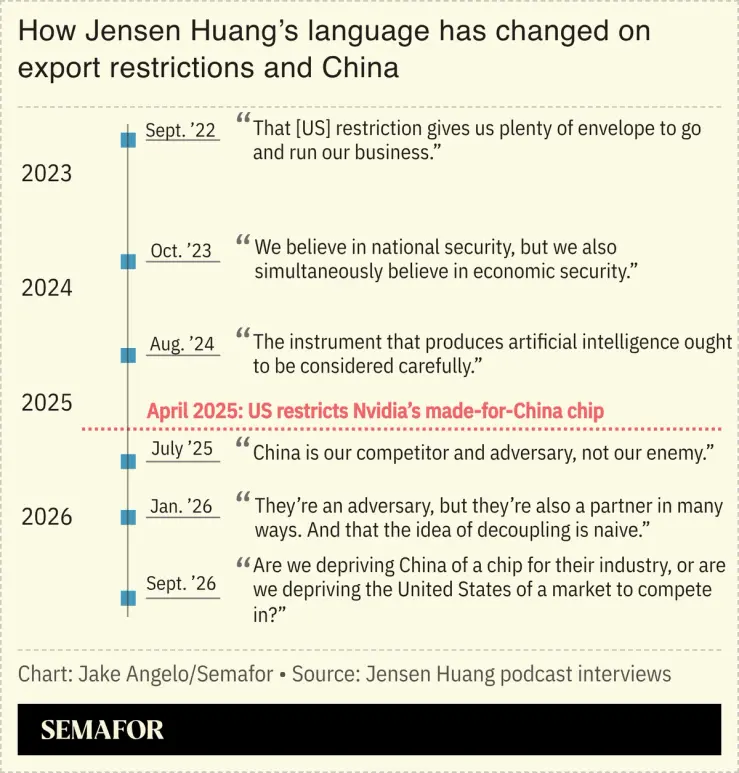
自2025年7月以来,他在八次采访中34次提及“美国技术栈”,主张全球开发者应当构建于美国技术之上。在八次采访中,他表示全球50%的人工智能研究人员是中国人或位于中国,暗示该国的科技人才不可忽视。—— J.D. Capelouto
He invoked the “American tech stack” 34 times across eight interviews since July 2025, arguing that the world’s developers should build on US technology. In eight interviews he said that 50% of the world’s AI researchers are Chinese or in China, suggesting the country’s tech talent can’t be ignored. — J.D. Capelouto