意大利总理梅洛尼宣布明年草案预算法案将包含针对富裕移民资本利得的“离境税”仅仅几天之后,便开始退让。11月5日,副经济部长毛里齐奥·利奥表示,政府“对修改持开放态度”。从税务律师到政界人士,批评声音此起彼伏。其中包括前总理伦齐,他在任时曾提议对富裕移民的境外收入征收10万欧元(约合11.1万美元)的统一税。该税种于2017年推出,被认为让意大利对外国专业人士更具吸引力。他说,这一民粹主义举措将浪费十年的努力。
Only a few days after Giorgia Meloni, Italy’s prime minister, said her draft budget bill for next year would contain an “exit tax” on wealthy emigrants’ capital gains, she was back-pedalling. On November 5th her deputy economy minister, Maurizio Leo, said the government was “open to changes”. From tax lawyers to politicians, critics have been vocal. They include Matteo Renzi, who as prime minister proposed a flat tax of €100,000 ($111,000) on rich immigrants’ income from abroad. Introduced in 2017, it has been credited with making Italy attractive to foreign professionals. A populist measure, he says, will waste a decade of work.
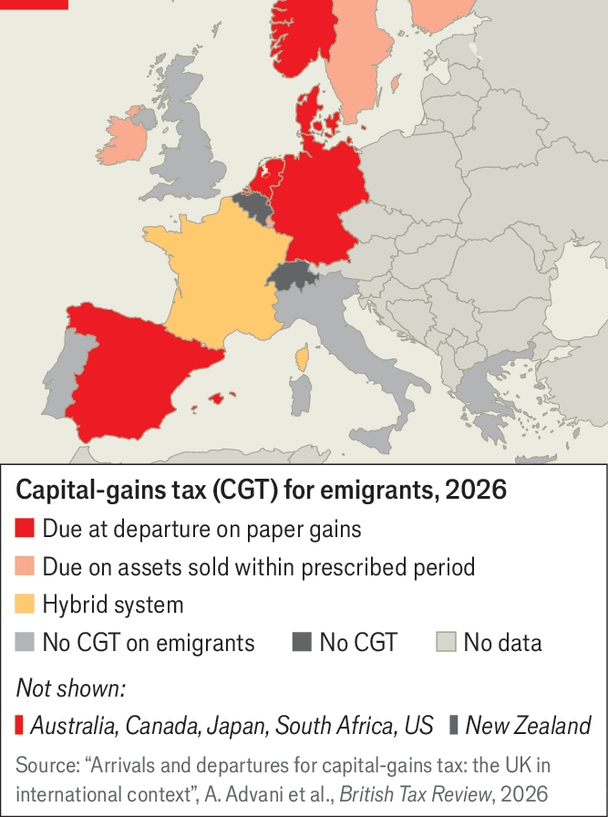
从原则上讲,离境税有其合理性。它消除了为躲避股票或债券等资产增值带来的资本利得税而移居国外的动机。多个国家已采纳此类税收(见地图)。根据意大利草案法律,该法案将于下月提交表决,拥有超过80万欧元全球金融资产的居民若离境,将缴纳26%的资本利得税,无论其是否出售资产。征税范围涵盖金融资产总额(即扣除负债或债务前的金额),包括衍生品和加密资产以及股票和债券——比其他国家的征税基础更宽。在离境前十个纳税年度中居住满六个纳税年度的任何人均需纳税。
In principle an exit tax has something to be said for it. It removes the incentive to move abroad to dodge capital-gains tax on, say, shares or bonds that have risen in value. Several countries have adopted such taxes (see map). Under Italy’s draft law, which is subject to a vote next month, residents with more than €800,000 of financial holdings worldwide who leave the country will pay a 26% capital-gains tax, regardless of whether they sell their stash. It covers gross financial assets (ie, before liabilities or debts), including derivatives and crypto assets as well as equities and bonds—a broader base than in other countries. Anyone resident for six out of the ten tax years before leaving Italy will be liable.
但该税种存在缺陷。收益将按资产购买价格计算,即使资产是在当事人抵达意大利前购买的。移民可能还会对为未实现收益买单心生不满,不过如果他们迁往另一欧盟国家并继续持有积蓄,五年后将获得退税。追踪纳税人并计算应缴税款也可能颇为繁琐。且意大利政府收益微薄:预计明年仅得340万欧元,随后四年每年670万欧元,此后每年340万欧元。
But the tax has its flaws. Gains are to be calculated from the purchase price of assets, even if they were bought before someone arrived in Italy. Emigrants might also grumble about getting a bill for unrealised gains, although if they move to another European Union country and hold on to their nest-eggs they will be reimbursed after five years. Tracking those liable and calculating what is due may also be fiddly. And the Italian government will reap little: it expects merely €3.4m next year, €6.7m in each of the following four and €3.4m a year from then on.
政府内部人士表示,除了在明年议会选举前争取选民外,梅洛尼还认为英国会推出退出税,从而使意大利成为七国集团中唯一没有此类税的国家。这种担忧似乎并不成立。去年,时任英国财政大臣蕾切尔·里夫斯曾考虑对移民商业资产的未实现资本利得征收20%的税。但在收到警告称这将促使富人迁往没有此类税的地方——比如意大利——之后,她放弃了这个想法。
Government insiders say that besides courting voters before next year’s parliamentary election, Ms Meloni has acted in the belief that Britain would introduce an exit tax, leaving Italy as the only G7 country without one. That fear seems misplaced. Last year Rachel Reeves, then Britain’s chancellor, pondered a 20% charge on unrealised capital gains on emigrants’ business assets. But she ditched the idea after warnings that it would prompt rich folk to move to places with no such levy—such as Italy.
2022年,德国改用了一种制度,与梅洛尼的提案类似,对移民资产的账面价值征税。此前,只有在十年内出售资产时才需要缴税。家族企业游说团体“家族企业基金会”负责人乌尔里希·斯托尔认为,新制度抑制了企业家的流动性。斯托尔还拥有拥有101年历史的工程公司费斯托六分之一的股份。他表示,在新制度下,在美国工作六年将付出高昂得令人望而却步的成本,而这段经历对他的职业生涯很有帮助。
In 2022 Germany switched to a system that, like Ms Meloni’s proposal, taxes gains on the paper value of emigrants’ assets. Hitherto tax had been due only if assets were sold within ten years. Ulrich Stoll, who heads the Stiftung Familienunternehmen, a lobby group for family companies, argues that the new set-up inhibits entrepreneurs’ mobility. Mr Stoll, who also owns one-sixth of Festo, a 101-year-old engineering firm, says that under the new regime it would have been prohibitively costly to work in America for six years, a spell that proved useful for his career.
设计良好的税收或许能缓解这些担忧。咨询公司贝克·蒂利的律师克里斯蒂安·肯普格斯表示,他想不出有哪个国家把退出税处理得当。他建议,只有在资产出售时才应征税,但不设时间限制——并且经合组织应制定一项适用于所有成员国的规则。梅洛尼可能被迫修改她的计划。但她担心的是失去选票,而不是失去富人。
A well-designed tax might allay such concerns. Christian Kempges, a lawyer at Baker Tilly, a consulting firm, says he can think of no country that has got exit taxes right. He suggests they should kick in only if an asset is sold, but with no time limit—and that the OECD should devise a rule to apply to all its members. Ms Meloni may be pushed into changing her plan. But her worry is losing votes, not losing the rich.