OpenAI 押注消费者、应用与广告。Anthropic 专注企业工具。
OpenAI bets on consumers, apps and ads. Anthropic focuses on tools for businesses.
从远处看,OpenAI 与 Anthropic 仿佛是同一家公司。两家均由同一脉络的研究人员创立,都在训练前沿大语言模型,且都在迈向公开市场。Anthropic 于 10 月 26 日向美国证券交易委员会提交了 S-1 注册声明;OpenAI 于 6 月秘密提交,但表示今年不会上市。
From a distance, OpenAI and Anthropic look like the same company. Both were founded by researchers from the same lineage, both train frontier large language models, and both are heading for the public markets. Anthropic filed its S-1 with the SEC on 26 October; OpenAI filed confidentially in June but has said it will not list this year.
然而,若仔细观察,两家正在构建截然不同的业务。OpenAI 正将 ChatGPT 打造为大众消费平台,越来越多地依靠广告营收,并将其封装在自家应用、浏览器以及即将推出的硬件中。Anthropic 则在建设一种更接近企业公用事业的模式:按 Token 向公司和开发者出售智能,主要通过大型云平台分发,且明确不投放广告。这些相互竞争的策略,可能会在两家公司登陆公开市场时,塑造它们各自的估值。
However, if one looks closer, the two are building fundamentally different businesses. OpenAI is turning ChatGPT into a mass-market consumer platform, increasingly funded by advertising and wrapped in its own apps, browser and soon, hardware. Anthropic is building something closer to an enterprise utility: intelligence sold by the token to companies and developers, largely distributed through the big cloud platforms, and explicitly free of ads. These competing strategies could shape how both companies are valued when they reach the public markets.
同技术,异客户 看清差异最简单的方式,是问谁在买单。在其大部分历史中,OpenAI 都是一家消费者公司。直到 2024 年底,其营收约四分之三仍来自 ChatGPT 订阅。这一图景已发生变化。8 月,首席财务官 Sarah Friar 告诉投资者,企业营收已超越消费者营收,比计划提前数月,且企业营收跑率仅在第三季度就增长了 107%。但公司的重心依然是 ChatGPT,其每周用户数今夏已达 10 亿。
Same Technology, Opposite Customers The simplest way to see the difference is to ask who pays. For most of its life, OpenAI has been a consumer company. As recently as late 2024, roughly three-quarters of its revenue came from ChatGPT subscriptions. This picture has changed. In August, CFO Sarah Friar told investors that enterprise revenue had overtaken consumer, months ahead of plan, and the enterprise run rate grew 107% in the third quarter alone. But the gravitational centre of the company remains ChatGPT, which reached one billion weekly users this summer.
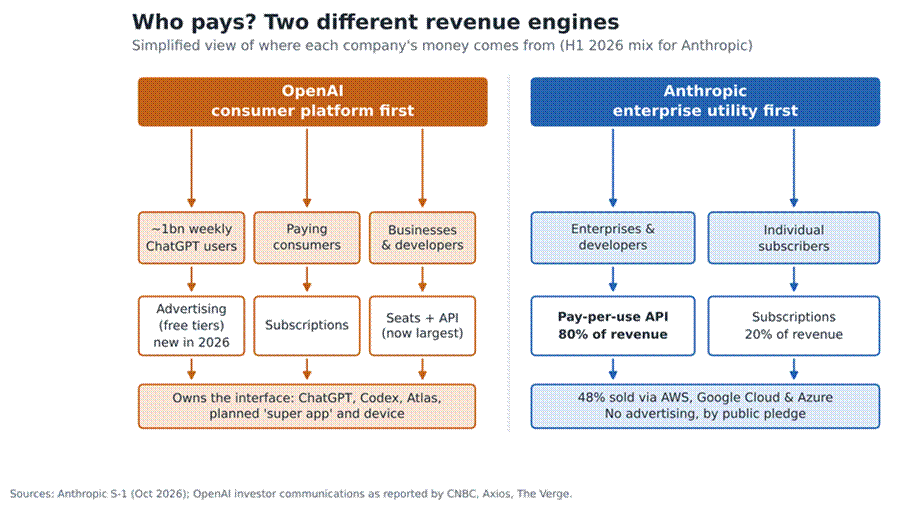
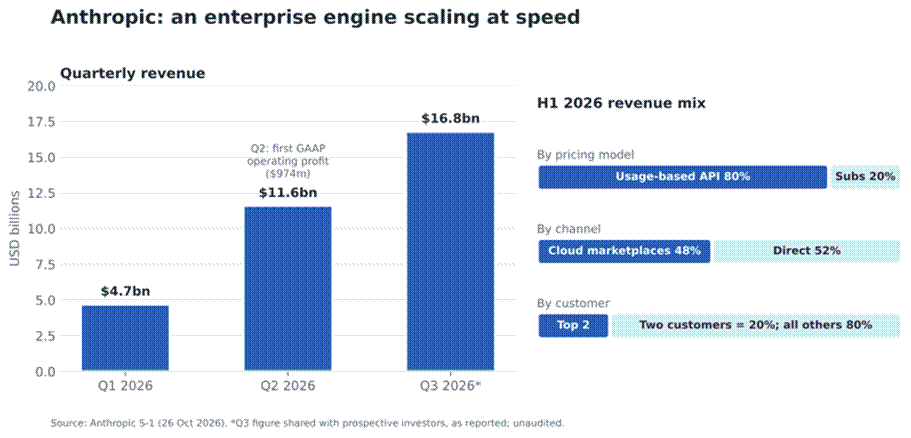
Anthropic 处于另一端。其 S-1 文件显示,2026 年上半年收入中 80% 来自基于消费的模式,即客户为使用 Claude 模型付费,主要通过 API;订阅制占剩余 20%。近半数收入(48%)通过亚马逊云科技、谷歌云和微软 Azure 的云市场获得。在截至 9 月的十二个月里,有超过 11,900 位客户各自贡献了超过 10 万美元的收入,而一年前这一数字约为 950 位。编程已成为主要增长引擎,Claude Code 助力推动了企业客户的采用。
Anthropic sits at the other end of the spectrum. Its S-1 shows that 80% of first-half 2026 revenue was consumption-based, meaning customers paying for usage of Claude models, mostly through the API. Subscriptions made up the remaining 20%. Almost half of revenue (48%) came through the cloud marketplaces of Amazon Web Services, Google Cloud and Microsoft Azure. More than 11,900 customers each generated over $100,000 of revenue in the twelve months to September, up from about 950 a year earlier.
OpenAI 的消费端押注:广告、应用与设备 2026 年最引人注目的战略举措是 OpenAI 拥抱广告。2024 年 10 月,Sam Altman 曾将广告形容为公司的“最后手段”。十五个月后,即 2026 年 1 月,OpenAI 宣布将在美国针对免费版和低价 Go 方案的成年用户测试广告。广告于 2 月 9 日上线,据报 CPM(每千次展示成本)为 60 美元。广告以标注过的赞助卡片形式出现在具有商业意图的回答下方;付费版保持无广告。
Coding has become a major growth engine, with Claude Code helping drive adoption across enterprise customers. OpenAI’s Consumer Bet: Ads, Apps and a Device The most striking strategic move of 2026 has been OpenAI’s embrace of advertising. In October 2024, Sam Altman described ads as a “last resort” for the company. Fifteen months later, in January 2026, OpenAI announced it would test ads for adult users on its Free tier and its low-cost Go plan in the United States. Ads went live on 9 February at a reported $60 CPM.
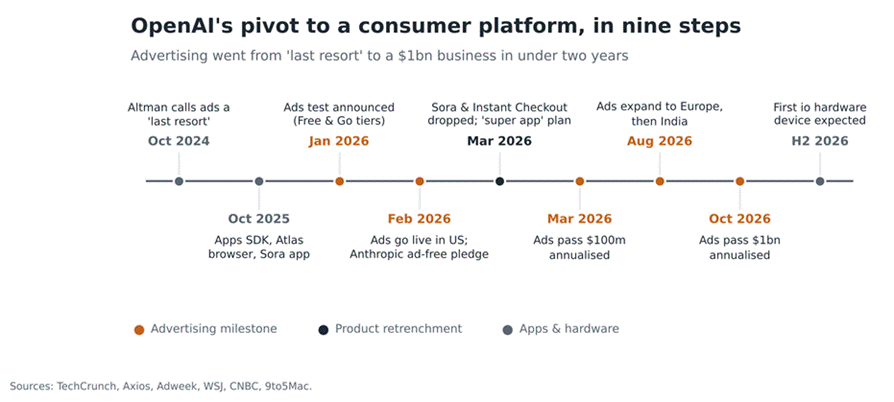
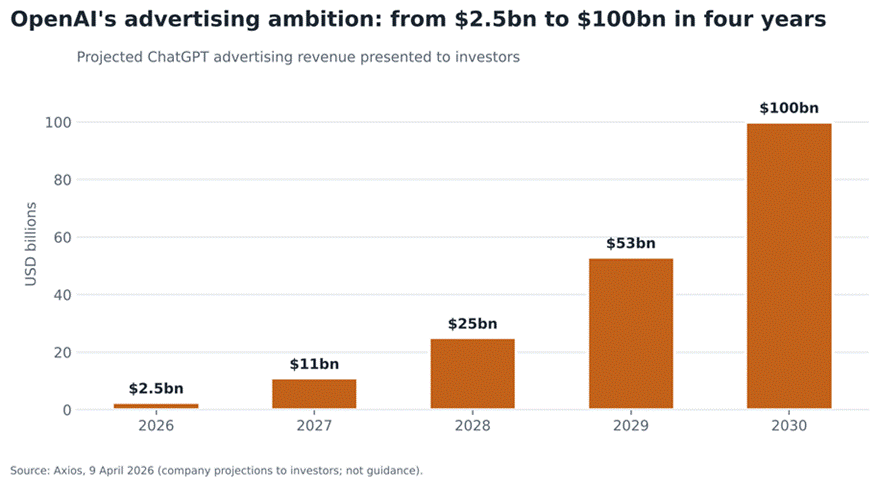
推进速度很快。试点在约六周内实现了 1 亿美元的年化收入,随后于 8 月扩展至欧洲,不久后又进入印度。10 月初,ChatGPT 广告业务的年化收入跑率突破 10 亿美元。野心更大:据 Axios 报道,OpenAI 已告知投资者,预计今年广告收入约 25 亿美元,2027 年达 110 亿美元,2028 年达 250 亿美元,到 2030 年达到 1000 亿美元。
They appear as labelled sponsored cards beneath answers with commercial intent; paid tiers stay ad-free. The ramp has been fast. The pilot passed $100mn of annualized revenue within about six weeks, and the programme expanded to Europe in August and India shortly after. In early October, ChatGPT’s ad business passed a $1bn annualized run rate.
广告只是消费者战略的一半;另一半是分发。2025年10月,OpenAI推出了Apps SDK,让Zillow、Instacart和Target等公司能够在ChatGPT内部运行,将聊天机器人变成了某种类似操作系统的东西。它推出了Atlas浏览器和独立的Codex编码应用。2026年3月,OpenAI宣布计划将ChatGPT、Codex和Atlas整合为一个单一的桌面“超级应用”。在以65亿美元收购了由前苹果设计主管Jony Ive共同创立的AI硬件初创公司io之后,该公司也在准备其首款专用设备,高管们表示将于2026年下半年发布。
The ambition is even larger: according to Axios, OpenAI has told investors it expects about $2.5bn of ad revenue this year, $11bn in 2027, $25bn in 2028 and $100bn by 2030. Advertising is only half of the consumer strategy; the other is distribution. In October 2025, OpenAI launched an Apps SDK that lets companies such as Zillow, Instacart and Target run inside ChatGPT, turning the chatbot into something resembling an operating system. It launched the Atlas browser and a standalone Codex coding app. In March 2026, OpenAI announced plans to combine ChatGPT, Codex and Atlas into a single desktop “super app”.
其逻辑是经典的消费互联网行事手册:拥有界面,拥有用户关系,并将注意力和意图变现。如果ChatGPT成为十亿人、规划购物和办理杂事的地方,它将占据Google搜索二十年来所处的同一战略位置。
Following its $6.5bn acquisition of io, an AI hardware startup co-founded by former Apple design chief Jony Ive, the company is also preparing its first dedicated device, which executives have said will be unveiled in the second half of 2026. The logic is the classic consumer-internet playbook: own the interface, own the user relationship, and monetize attention and intent.
执行情况参差不齐。OpenAI于3月关闭了其Sora视频应用,距离发布不足六个月,在此过程中失去了一项计划中的10亿美元迪士尼投资。同一个月,由于采用率疲软,它停止了应用内购物功能Instant Checkout,将商业业务转向零售商自营的应用。
If ChatGPT becomes the place where a billion people start their searches, plan their purchases and run their errands, it occupies the same strategic position that Google Search has held for two decades. Execution has been uneven. OpenAI shut down its Sora video app in March, less than six months after launch, losing a planned $1bn Disney investment in the process.
为何要做广告?十亿免费用户的经济账 向广告转型关乎单位经济。ChatGPT的很大一部分用户不付费;OpenAI在2月报告称拥有超过5000万消费端订阅用户,而当时每周用户约为9亿。媒体披露的泄露财务文件显示,OpenAI 2025年的运营亏损约为210亿美元,且公司背负着数千亿美元的多年算力承诺。
The same month, it discontinued Instant Checkout, its in-chat shopping feature, after weak uptake, redirecting commerce to retailer-run apps instead. Why Ads? The Economics of a Billion Free Users The shift to advertising is about unit economics. A major share of ChatGPT’s users pay nothing; OpenAI reported more than 50 million consumer subscribers in February, compared with roughly 900 million weekly users at the time.
仅靠订阅无法弥补这一缺口,因为只有极少数用户愿意每月支付 20 美元。广告是大规模变现免费长尾用户的成熟途径。对于一家建立在触达基础上的公司而言,这种转型可以说是不可避免的。这也是为何投资者以约 1.4 万亿美元的私有估值支持 OpenAI,实际上是在为谷歌广告业务的潜在继任者提供资金支持。
Leaked financial documents reported by the press put OpenAI’s 2025 operating loss at about $21bn, and the company carries hundreds of billions of dollars of multi-year compute commitments. Subscriptions alone cannot close that gap, because only a small minority of users will ever pay $20 a month. Advertising is the proven way to monetize the long tail of free users at internet scale. For a company built on reach, the pivot is arguably inevitable.
风险在于广告会改变产品。一旦企业由广告主付费,就会产生永久性的动力去最大化用户参与度和使用时长,并面临让商业利益影响回答的诱惑。OpenAI 坚称广告不会影响回复。然而,信任是人们在健康、金钱和个人事务上咨询对话式助手的核心资产,而这种信任如今正面临监管和法律审视,近期得克萨斯州一起涉及儿童安全的诉讼便是例证。
It is also why investors backing OpenAI at a private valuation of around $1.4tn are underwriting a potential successor to Google’s advertising franchise. The risk is that advertising changes the product. Once a business is paid by advertisers, there is a permanent incentive to maximize engagement and time spent, and a temptation to let commercial interests shade the answers. OpenAI insists that ads do not influence responses.
Alphabet 面临的考验 如果 OpenAI 的计划奏效,受冲击最大的现有巨头是 Alphabet(纳斯达克代码:GOOGL)。ChatGPT 中的赞助回答是迄今为止最接近谷歌搜索广告的替代品:它在用户产生意图的那一刻触达用户,而聊天机器人用户会用自己的语言准确描述想要什么。D.A. Davidson 董事总经理 Gil Luria 认为,ChatGPT 的广告预算将主要来自搜索业务,且消费者注意力是零和博弈,这也让 YouTube 面临风险。
Still, trust is the core asset of a conversational assistant that people consult on health, money and personal matters, and that trust is now subject to regulatory and legal scrutiny, as a recent Texas lawsuit over child safety illustrates. The Alphabet Question If OpenAI’s plan works, the most exposed incumbent is Alphabet (NASDAQ:GOOGL). A sponsored answer in ChatGPT is the closest substitute yet for a Google search ad: it reaches the user at the moment of intent, and chatbot users describe exactly what they want in their own words. Gil Luria, Managing Director at D.A.
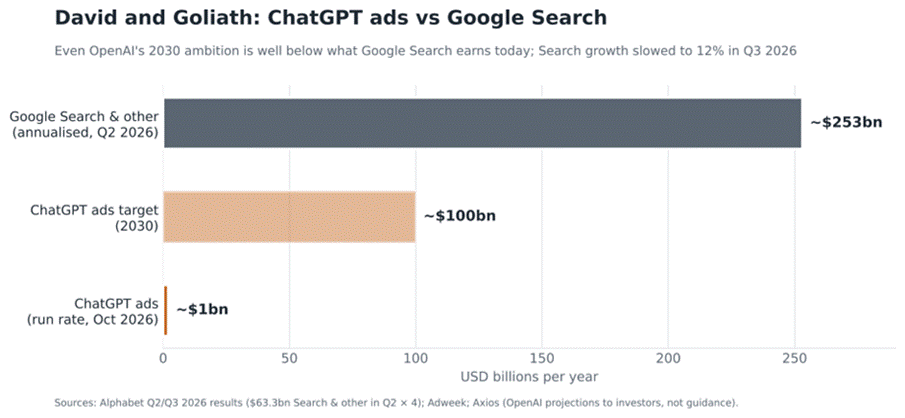
规模使威胁保持在相对比例内。谷歌搜索年收入超过 2500 亿美元,ChatGPT 广告收入约为 10 亿美元。即便 OpenAI 设定的 2030 年 1000 亿美元目标,也远低于搜索业务当前的收入。然而,市场越来越关注增长方向。第三季度搜索业务增速放缓至 12%,前两个季度分别为 17% 和 19%,尽管谷歌云收入大幅增长,Alphabet 股价在 10 月 28 日财报发布后仍下跌约 8%。
Davidson’s, argues that ChatGPT’s ad budgets will come mainly out of Search, and that consumer attention is zero-sum, which also exposes YouTube. Scale keeps the threat in proportion. Google Search runs at more than $250bn a year, ChatGPT ads at roughly $1bn. Even OpenAI’s $100bn target for 2030 sits well below what Search earns today. Yet markets are increasingly focused on the direction of growth.
Alphabet 远非毫无防备。其 Gemini 应用和搜索中的 AI 模式各自拥有约 10 亿月活用户,正在全球范围内在 AI 回答中投放广告,并能利用企业历史上最赚钱的业务之一为转型提供资金。对搜索业务而言,更现实的风险是定价权逐渐被侵蚀,因为追求意图的广告主二十年来首次有了一个可信的第二渠道。
Search growth slowed to 12% in the third quarter, from 17% and 19% in the previous two, and Alphabet’s shares fell about 8% after results on 28 October, even as Google Cloud revenue roughly doubled. Alphabet is far from defenceless. Its Gemini app and AI Mode in Search each reach around a billion monthly users, it is rolling out ads inside AI answers globally, and it can fund the transition from one of the most profitable franchises in corporate history.
Anthropic 的企业级押注:AI 公用事业。Anthropic 选择了截然不同的路径并公开传达了这一选择。2 月,它发布承诺称 Claude 将在所有层级保持无广告,并以“广告即将进入 AI。但不会进入 Claude” 为口号投放了首个超级碗广告。Sam Altman 公开称该广告活动不诚实,反而帮其推了一把。
The more realistic risk for Search is a gradual erosion of pricing power, as advertisers chasing intent now have a credible second channel for the first time in two decades. Anthropic’s Enterprise Bet: The AI Utility Anthropic has chosen the opposite approach and communicated it. In February, it published a pledge that Claude would remain ad-free across all tiers and ran its first Super Bowl campaign under the tagline “Ads are coming to AI. But not to Claude.”Sam Altman publicly called the campaign dishonest, which helped promote it.
这一承诺反映了 Anthropic 更广泛的商业战略及其背后的经济逻辑。Anthropic 不需要广告,因为其客户是为可衡量的生产力提升买单的企业。客户按消耗的 token 付费,因此支出随创造的价值而扩展。这使收入更具可预测性,对消费者偏好的敏感度更低,且在边际上即可盈利。
The commitment reflects Anthropic’s broader business strategy and the economics behind it. Anthropic does not need advertising because its customers are companies paying for measurable productivity gains. They pay per token consumed, so spending scales with value created. That makes revenue more predictable, less sensitive to consumer fashion, and, profitable at the margin.
S-1 文件中的数字令人瞩目。收入从 2023 年的 4100 万美元增至 2025 年的 46 亿美元,随后在 2026 年上半年达到 163 亿美元,约为上年同期的 14 倍。仅第二季度就实现了 116 亿美元收入和 9.74 亿美元 GAAP 经营利润。第三季度收入进一步增长 47% 至近 170 亿美元,公司报告调整后经营利润为 25 亿美元,尽管按 GAAP 标准录得 5.67 亿美元经营亏损。
The numbers in the S-1 are remarkable. Revenue rose from $41mn in 2023 to $4.6bn in 2025, then reached $16.3bn in the first half of 2026, roughly 14 times the prior-year period. The second quarter alone produced $11.6bn of revenue and $974mn of GAAP operating income. Third-quarter revenue rose a further 47% to nearly $17bn, with the company reporting $2.5bn in adjusted operating income, despite a $567mn operating loss under GAAP.
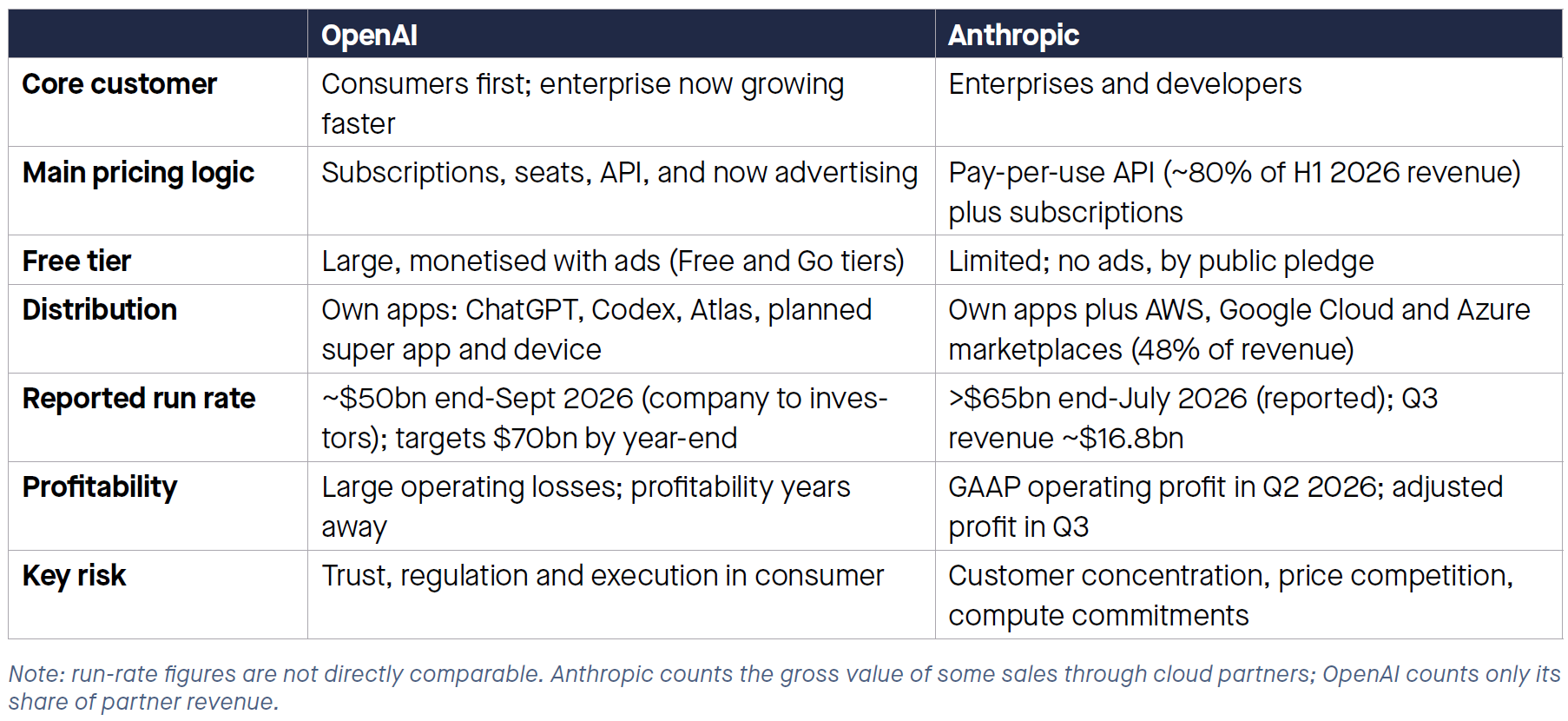
该模型也存在弱点。上半年约20%的收入来自仅两位客户,且近半数收入通过云合作伙伴流转,而这些合作伙伴也是拥有自有模型的竞争对手。Anthropic已承诺在未来十年向云和算力投入至少5180亿美元,如果需求降温,这将是一项巨大的固定义务。价格竞争正在加剧。据报道,OpenAI凭借激进的折扣赢得了一些Anthropic的客户,且由于缺乏大规模消费者受众,Anthropic对最终用户如何发现AI的直接控制力较弱。评分卡 下表总结了这两种模式的现状。
This model has weaknesses too. About 20% of first-half revenue came from just two customers, and almost half flows through cloud partners who are also competitors with their own models. Anthropic has committed at least $518bn to cloud and compute over the next decade, a massive fixed obligation if demand cools. Price competition is intensifying. OpenAI has reportedly won some Anthropic customers with aggressive discounts, and without a mass consumer audience, Anthropic has less direct control over how end users discover AI. The Scorecard The table below summarises the two models as they stand today.
早期10月关于OpenAI年化收入达700亿美元的报道被证实为投资者估算;OpenAI自身引用的数字接近500亿美元。投资者应等待经审计、可比的数据,再决定哪家公司规模实际上更大。
Early-October reports of a $70bn OpenAI run rate turned out to be an investor estimate; OpenAI itself cited nearer $50bn. Investors should wait for audited, comparable figures before deciding which company is actually larger.
结论 最好的类比或许是历史性的。OpenAI试图成为AI领域的Google:一个通过广告变现的消费者入口,企业业务作为不断增长的第二支柱。Anthropic更像是Microsoft与基础设施提供商的结合体:一个企业对企业平台,其收入取决于客户通过它推送多少工作量。它们值得不同的估值框架。
Conclusion The best analogy may be historical. OpenAI is trying to become the Google of AI: a consumer gateway monetized by advertising, with enterprise as a growing second leg. Anthropic looks more like a combination of Microsoft and an infrastructure provider: a business-to-business platform whose revenue tracks how much work its customers push through it. They deserve different valuation frameworks.
对OpenAI而言,主要变量在于用户粘性、单用户广告收益,以及广告能否在不损害信任或引发监管的情况下规模化。对Anthropic而言,重点在于企业客户留存、推理毛利、客户集中度以及算力支出的纪律性。其盈利路径更清晰,但其上行空间取决于AI能否成为企业基础设施不可或缺的一部分,并在日益激烈的竞争市场中保持持久的定价权。
For OpenAI, the main variables are user engagement, advertising yield per user, and whether ads can scale without eroding trust or triggering regulation. For Anthropic, the focus is on enterprise retention, gross margins on inference, customer concentration and discipline in compute spending. Its path to profitability is clearer, but its upside depends on AI becoming an integral part of enterprise infrastructure, with lasting pricing power in an increasingly competitive market.
这两种策略都没有把握,且未来界限将变得模糊。OpenAI 正大力进军企业市场,而 Anthropic 的消费级应用正实现快速增长。但起点决定了激励机制。由广告商付费的公司会针对关注度进行优化,由企业付费的公司则会针对结果进行优化。随着首批 AI 巨头进入市场,这种激励机制的差异可能比任何单一的基准测试分数更为重要。
Neither strategy is guaranteed, and the boundaries will blur in the future. OpenAI is making a strong push into the enterprise market, while Anthropic is seeing rapid growth in its consumer apps. But the starting point is what shapes the incentives. A company paid by advertisers will optimize for attention and a company paid by enterprises will optimize for results. As the first AI giants come to market, that difference in incentives may prove more important than any single benchmark score.