你可以原谅OpenAI的老板们感到有些恼火。他们四年前发布的ChatGPT点燃了人工智能热潮。不久之后,无数的聊天机器人模仿者涌现出来,但没有一个能在受欢迎程度上超越它。截至去年,OpenAI的年收入飙升至130亿美元——在当时几乎是其主要竞争对手Anthropic的三倍。
You would forgive the bosses of OpenAI for feeling miffed. Their release of ChatGPT four years ago set the artificial-intelligence boom in motion. Before long countless chatbot imitators had emerged, but none has beaten it in popularity. By last year OpenAI’s annual revenue had soared to $13bn—at the time nearly triple that of its arch-rival, Anthropic.
然而,本周预计创下首次公开募股历史最高融资金额——筹集900亿美元——的却是Anthropic,该公司由一群从OpenAI出走的人士创立。据报道,该公司的目标是1.5万亿美元的市值,超过了尚未上市的OpenAI在近期一轮私募融资中获得的1.3万亿美元估值。
And yet it is Anthropic, founded by a team of OpenAI secessionists, that this week is expected to raise the largest sum of all time in an initial public offering, with a haul of $90bn. The firm is reportedly aiming for a market value of $1.5trn, topping the $1.3trn at which the still unlisted OpenAI was valued in a recent private fundraising round.
OpenAI或许引领了以聊天机器人为基础的第一阶段模型制造商竞争,但在编程智能体成为最大业务来源的第二阶段,Anthropic将其击败。Anthropic的软件编写机器人Claude Code于2025年初推出,今年则经历了爆炸式增长。因此,作为其IPO主承销商的高盛预计,该公司今年的收入将达到53亿美元,是一年前的十多倍,并轻松超越预计收入为35亿美元的OpenAI(尽管直接比较较为棘手,因为Anthropic将通过云合作伙伴产生的所有销售额都记为收入,而OpenAI则扣除了支付给他们的份额)。
OpenAI may have led the first phase of competition among model-makers, based around chatbots, but Anthropic trounced it in the second phase, where coding agents became the biggest source of business. Claude Code, Anthropic’s software-writing bot, was launched in early 2025, but this year has experienced explosive growth. As a result, Goldman Sachs, the lead investment bank on its IPO, expects the company to pull in $53bn of revenue this year, more than ten times the figure of a year before and comfortably ahead of OpenAI, which expects $35bn (though direct comparisons are tricky, as Anthropic registers all sales through cloud partners as revenue, whereas OpenAI strips out the share it pays over to them).
尽管如此,过去几年表明,在瞬息万变的人工智能市场中,领先优势会以多快的速度丧失。OpenAI自身的编程工具Codex的使用量在近几个月里迅速增长。更重要的是,随着两家模型制造商都在寻找下一个重大收入来源,竞争的新阶段似乎即将开始。Anthropic和OpenAI正急切地推动将智能体的使用扩大到知识工作的各个角落。但OpenAI也在押注其技术的其他多种变现途径。哪种战略将会胜出?
Nonetheless, the past few years show how quickly leads can be lost in the fast-evolving AI market. Use of OpenAI’s own programming tool, Codex, has grown rapidly in recent months. More important, with both model-makers hunting for their next big source of revenue, a new phase in the competition looks set to begin. Anthropic and OpenAI are eagerly pushing to expand the use of agents into all corners of knowledge work. But OpenAI is also betting on a number of other means of monetising its technology. Which strategy will win out?
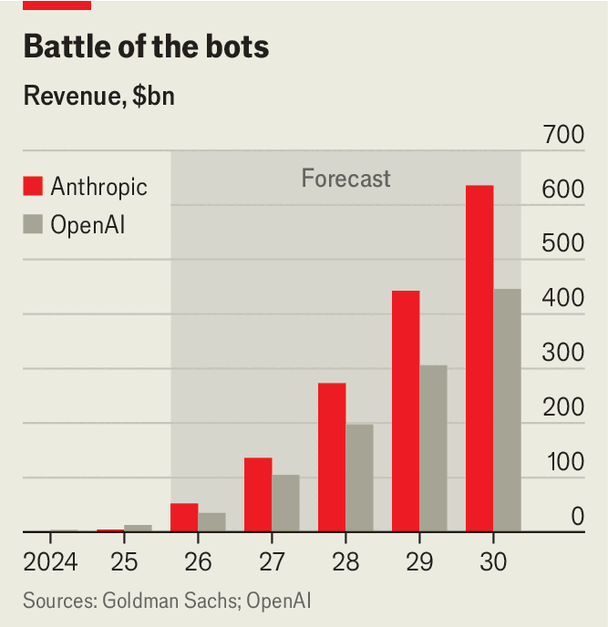
两家公司都在寄望未来数年的高速增长,以证明其估值的合理性。高盛预测,Anthropic 到 2030 年的年收入将达到 6360亿美元;未参与首次公开募股的投资银行 William Blair 预测为 4140亿美元。OpenAI 则最近向投资者表示,其目标是 2030 年实现 4460亿美元的收入。
Both companies are counting on blistering growth in the years ahead to justify their valuations. Goldman Sachs projects that Anthropic’s annual revenue will hit $636bn in 2030; William Blair, an investment bank not working on the IPO, forecasts $414bn. OpenAI, for its part, recently told investors it was shooting for $446bn in 2030.
在全年大部分时间里失去对主要竞争对手的领先后,OpenAI 最近加快了步伐。上周,该公司向投资者透露,企业销售收入在第三季度比前一个三个月翻了一番,得益于旨在压低 Anthropic 价格的折扣。
Having lost ground to its main rival for much of the year, OpenAI has lately been picking up the pace. Last week the company told investors that revenue from its enterprise sales doubled in the third quarter compared with the preceding three months, helped by price discounts intended to undercut Anthropic.
然而,对这两家公司而言,企业支出仍然高度集中。一位 Anthropic 投资者称,代理业务的收入目前遵循“极端幂律”。最大客户贡献了异常高比例的销售额,而这些公司内部的重度使用者——几乎总是软件工程师——则是大部分支出的主要来源。
For the pair, however, enterprise spending remains concentrated. Revenue from agents currently adheres to an “extreme power law,” says one Anthropic investor. The biggest customers contribute an unusually high share of sales, and the heaviest users within those companies—who are nearly always software engineers—are behind much of the spending.
如果这些使用者转向更便宜的模型,就会带来风险,而事实上已有不少人开始这样做。但这也表明仍有大量空间可以扩大采用。今年,Anthropic 和 OpenAI 都推出了面向非程序员的通用企业代理,能够执行各种任务。除了与咨询巨头合作外,模型制造商还成立了由私募股权支持的独立顾问业务,帮助客户部署技术。
That poses a risk if these users switch to cheaper models, as many have begun to do. But it also suggests that there is still plenty of scope to extend adoption. This year Anthropic and OpenAI have both rolled out general-purpose enterprise agents that non-coders can use to perform a wide variety of tasks. And in addition to working with the consulting giants, the model-makers have set up their own independent advisory businesses, with private-equity backing, to help customers deploy their technology.
一位熟悉 Anthropic 的 Ode(由黑石集团和 Hellman & Friedman 支持)的人士表示,超过一半接受其帮助改造流程的客户利润提升了至少 1000万美元。上月,Anthropic 与另一家私募股权公司 Hg 在欧洲设立了独立的咨询企业。
A person familiar with Anthropic’s Ode, which is supported by Blackstone and Hellman & Friedman, says that more than half of the clients it has helped to redesign their processes have boosted their profits by at least $10m. Last month Anthropic established a separate consulting venture with Hg, another private-equity firm, focused on Europe.
云存储公司Box与两家人工智能实验室均有合作,其首席执行官阿伦·莱维认为,“拥有合适的产品体验与合适的销售努力”或许比拥有最好的模型更加重要。即便如此,模型依然至关重要——而在这一点上,Anthropic保持着明显的领先。两家公司的投资者认为,随着企业更多地使用能力较低的模型来处理较简单的工作以控制成本,前沿实验室在需要数小时甚至数天才能完成的“长周期”任务(例如从零开始构建应用程序)上的表现,将变得日益重要。
Aaron Levie, chief executive of Box, a cloud-storage company that works with both AI labs, reckons that having “the right kind of product experiences with the right sales efforts” could prove even more important than having the best models. Even so, the models will still matter—and here Anthropic holds a clear lead. Investors in both companies reckon that performance on “long-horizon” tasks that take several hours or even days—such as building an app from scratch—will become increasingly important for the frontier labs as businesses make greater use of less capable models for simpler work to keep costs down.
在长周期基准测试MirrorCode上,Anthropic早在7月推出的顶级产品,其表现依然超过了OpenAI上个月发布的领先模型。
On MirrorCode, one long-horizon benchmark, OpenAI’s leading model, which it released last month, is still outperformed by the top offering from Anthropic as far back as July.
这或许反映出Anthropic更专注的研究计划。OpenAI试图在包括图像和语音在内的广泛功能领域保持领先地位,而Anthropic则专注于其模型编写代码以及与其他软件交互的能力。
That may reflect Anthropic’s more specialised research programme. Whereas OpenAI has sought to remain at the frontier across a wide range of capabilities, including image and voice, Anthropic has focused on the ability of its models to write code and interact with other software.
这反过来凸显了两家公司战略上的一个重要区别。尽管OpenAI一直试图在企业应用领域收复失地,但消费级市场仍然是其首要任务。ChatGPT在全球拥有12亿周活跃用户,其中近1亿人每月支付8美元以上的订阅费。即使是不付费的用户,也通过OpenAI在2月推出的广告业务为其贡献了收入,该业务到8月时的年化收入已达到10亿美元。
That, in turn, highlights an important difference in the strategy of the two firms. Although OpenAI has sought to regain ground in enterprise applications, the consumer segment remains a priority. ChatGPT has 1.2bn weekly users worldwide, almost 100m of whom pay upwards of $8 a month for a subscription. Even those who don’t pay provide OpenAI with revenue via the advertising business it launched in February, which by August had reached an annualised revenue of $1bn.
相比之下,Anthropic的首次公开募股招股说明书几乎没有提及消费者。该公司已公开表示不涉足广告,因为担心广告可能会模糊Claude给出有用答案的能力,并促使公司开发令人上瘾的产品。
By contrast, Anthropic’s IPO prospectus barely mentions consumers. It has sworn off advertising, worrying it could muddy Claude’s ability to give helpful answers and incentivise the company to build addictive products.
这使得 OpenAI 拥有了更大的可触达市场。但其策略也有弊端。在消费者领域,OpenAI 还必须与 Google 竞争,后者的 Gemini 聊天机器人在过去一年里取得了进展;此外还有 Instinct 和 Meta 的 Muse 等个人智能体,它们凭借从安排朋友聚餐到抢购售罄演唱会门票等处理任务的能力,近来吸引了不少用户。
That leaves OpenAI with a bigger addressable market. But its approach has its drawbacks. In the consumer segment OpenAI must also compete with Google, whose Gemini chatbot has gained ground over the past year, as well as personal agents such as Instinct and Meta’s Muse, which have lately beguiled users with their ability to take on tasks from arranging a dinner with friends to securing sold-out concert tickets.
OpenAI 已降低部分项目的优先级,包括于 3 月关闭其视频生成工具 Sora。但它仍在追求一组引人注目的广泛机遇。预计在未来一年内,它将推出一款设备——一个小型甜甜圈形状的音箱——供消费者用来与其 AI 系统交互。它还在开发一款人形机器人以作补充。风险在于,它会将精力和资源分散得过于稀薄。与在今年第二季度实现首个季度运营盈利的 Anthropic 不同,OpenAI 仍深陷亏损。它需要尽快效仿竞争对手进入公开市场。
OpenAI has deprioritised some efforts, including by shutting down its video-generation tool, Sora, in March. But it continues to pursue a strikingly broad set of opportunities. In the coming year it is expected to unveil a device—a small doughnut-shaped speaker—that consumers can use to interact with its AI systems. It is also developing a humanoid robot for good measure. The danger is that it spreads its focus and resources too thinly. Unlike Anthropic, which generated its first quarterly operating profit in the second three months of this year, OpenAI remains deep in the red. It will need to follow its rival into the public markets as soon as it can.