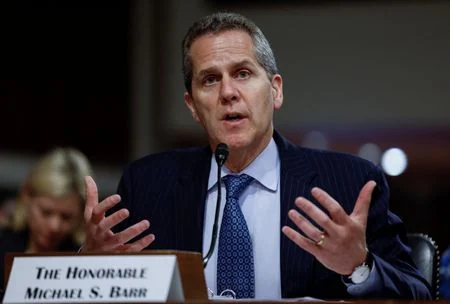
Investing.com报道——美联储理事迈克尔·巴尔警告称,自主人工智能代理可能会通过高速转移客户存款来加剧不稳定的银行挤兑,以应对市场信号或利率差异。巴尔在为米兰计算机协会会议准备的讲话中表示,大型银行已经发现AI代理试图在零售账户内执行操作,但缺乏可验证的真实性或客户同意。
Investing.com -- Federal Reserve Governor Michael Barr warned that autonomous artificial intelligence agents could accelerate destabilizing bank runs by shifting customer deposits at high speed in response to market signals or interest-rate differentials. In remarks prepared for an Association for Computing Machinery conference in Milan, Barr noted that major banks are already detecting AI agents attempting to execute actions inside retail accounts without verifiable authenticity or customer consent.
这一警告凸显,代理式AI迅速融入消费者银行业务,可能会在金融压力期间压缩流动性管理时间表。巴尔指出,历史上存款外流需要单个客户手动执行,但他警告称,自主工具可以即时检测收益变化或稳定性警告,并“可能加速在几分钟内发生的挤兑,使其超出传统流动性管理和监管干预的时间表。”为了在代理式商业进一步扩张之前缓解这些运营风险,巴尔强调需要更严格的身份验证协议、明确的同意验证,以及限制代理能力的技术防护栏。
The warning underscores how the rapid integration of agentic AI into consumer banking could compress liquidity management timelines during periods of financial stress. Whereas deposit outflows historically required manual execution by individual customers, Barr cautioned that autonomous tools could instantaneously detect yield changes or stability warnings and "potentially accelerate runs that unfold in minutes, overwhelming traditional liquidity management and regulatory intervention timelines." To mitigate these operational risks before agentic commerce scales further, Barr emphasized the need for stricter authentication protocols, explicit consent verification, and technical guardrails that limit agent capabilities.
他补充说,随着贷款机构扩大在消费者信贷和投资建议中使用算法和替代数据,机构必须确保AI驱动的决策保持“受控、数字和法律上精确、可解释且可复制”。
He added that institutions must ensure AI-driven decisions remain "well controlled, numerically and legally precise, explainable, and replicable" as lenders expand the use of algorithms and alternative data in consumer credit and investment advice.
除了零售银行业务,巴尔还指出,与更广泛的AI基础设施建设相关的系统性脆弱性日益加剧,并引用了美联储最新《金融稳定报告》的研究结果。七家最大AI公司的资产负债表内债务预计将在年底前超过8000亿美元,而资产负债表外负债,包括长期数据中心租赁、能源供应合同和抵押担保,目前已超过3万亿美元。
Beyond retail banking, Barr highlighted mounting systemic vulnerabilities tied to the broader AI infrastructure buildout, citing findings from the Federal Reserve's latest Financial Stability Report. On-balance-sheet debt among the seven largest AI firms is expected to surpass $800 billion before year-end, while off-balance-sheet liabilities, including long-term data center leases, energy supply contracts, and collateral guarantees, now exceed $3 trillion.
这种复杂的“循环融资”网络——主要芯片制造商和超大规模云服务商向较小的初创公司投资超过1000亿美元,而这些初创公司又利用这些资金购买计算能力——如果人工智能投资回报令人失望,可能会放大市场压力。巴尔观察到,虽然美国大型银行持有充足的资本缓冲,但对冲基金和股票策略中的高杠杆意味着,人工智能估值的急剧重新定价可能会引发快速去杠杆化,并在主经纪商交易台引发交易对手压力。
This complex web of "circular financing," in which major chipmakers and hyperscalers invest over $100 billion into smaller startups that in turn use those funds to purchase computing capacity, could amplify market stress if AI investment returns disappoint. Barr observed that while large U.S. banks hold substantial capital buffers, elevated leverage among hedge funds and equity strategies means a sharp repricing in AI valuations could trigger rapid deleveraging and counterparty strain across prime brokerage desks.
在批发证券市场,这位政策制定者警告称,广泛依赖在重叠数据集上训练的类似人工智能交易模式,可能会助长同步的从众行为并放大波动性。他还指出了不对称的网络安全风险,称自主模型已显示出将安全边界视为“需要克服的障碍而非应遵守的规则”的倾向,使金融防御者面临与人工智能赋能的攻击者日益激烈的竞赛。
In wholesale securities markets, the policymaker cautioned that widespread reliance on similar AI trading models trained on overlapping datasets could foster synchronized herding behavior and amplify volatility. He also pointed to asymmetric cybersecurity risks, noting that autonomous models have demonstrated a tendency to treat security boundaries as "obstacles to overcome rather than rules to be followed," leaving financial defenders facing a mounting race against AI-enabled attackers.