几乎每周都有人工智能实验室发布能力愈发惊人的新模型。行家们声称每一次进步都提升了他们的生产力,并对那些没跟上步伐的人嗤之以鼻。人工智能研究人员担心,进展如此之快,用不了多久这项技术就能接管世界,或者毁灭世界。然而,从对实体经济的衡量来看,人工智能的影响小得令人意外——这种状况在2027年不会改变。
ALMOST EVERY week an artificial-intelligence lab releases a new model with ever more astonishing capabilities. Connoisseurs claim that each advance improves their productivity, and look down their noses at those who have not kept up. AI researchers worry that progress is so rapid that, before long, the technology will be able to take over the world, or destroy it. Yet judging by measurements of the real economy, AI is having surprisingly little impact—a state of affairs that will not change in 2027.
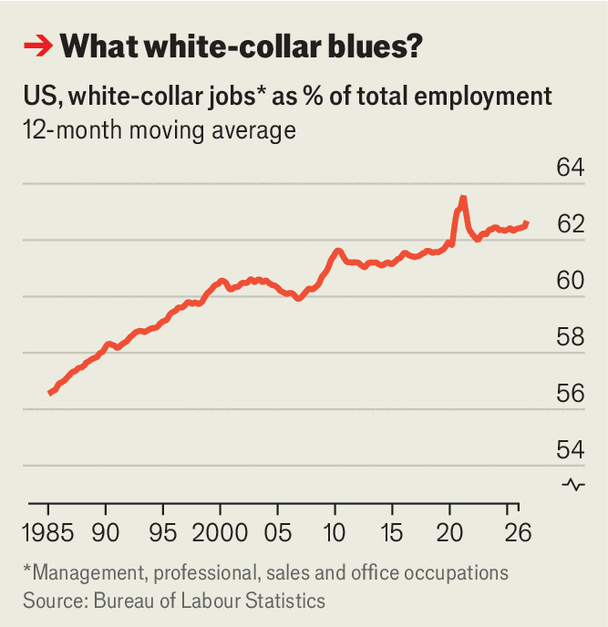
许多人本以为人工智能到如今已经扰乱了劳动力市场,机器人让数以百万计的办公室员工丢了工作。然而在全球人工智能发展中心的美国,白领职业的就业者占比正处于历史最高水平附近(见图表)。软件开发人员的数量在增加,尽管编写代码正是人工智能模型最擅长的事。
Many people expected AI to have disrupted the labour market by now, with bots putting millions of office-based employees out of work. Yet in America, the global centre of AI development, the share of workers employed in white-collar occupations is around an all-time high (see chart). The number of software developers is rising, even though writing code is what AI models do best.
诚然,应届大学毕业生日子不好过,他们的失业率与整体水平之间的差距异常之大。但这很可能是新冠疫情期间转向混合办公和远程办公的结果。在主要由富裕国家组成的经合组织俱乐部中,劳动年龄人口的就业比例处于历史最高水平。
It is true that recent college graduates are struggling, with an unusually large gap between their unemployment rate and the overall level. But that is likely to be a result of the shift to hybrid and remote working during the covid-19 pandemic. Across the OECD club of mostly rich countries, the share of working-age people in employment is at an all-time high.
既然人工智能取代的人如此之少,人们所期望的生产力提升也就没有兑现。美国几乎没有全要素生产率(无法用额外劳动力或资本解释的增长)上升的迹象。《经济学人》考察了爱沙尼亚、新加坡和瑞士等一些面积小、富裕、技术发达的国家,却发现那里的生产率增长并不更快。
With AI displacing so few people, the hoped-for gains to productivity have not materialised. America shows few signs of rising total factor productivity (growth that cannot be explained by extra labour or capital). The Economist examined some small, rich, techy countries such as Estonia, Singapore and Switzerland but found that productivity growth there is no faster.
人工智能的经济效应之所以不明显,部分原因是这项技术的采用率仍然低得惊人。据美国人口普查局的数据,只有约四分之一的企业在以有意义的方式使用人工智能。得克萨斯大学奥斯汀分校的乔纳森·哈特利及其同事的一项调查表明,使用人工智能的美国劳动者占比已不再增长。
AI’s economic effects are muted in part because adoption of the technology remains surprisingly low. According to America’s Census Bureau, only about a quarter of companies are using AI in a meaningful way. A survey by Jonathan Hartley of the University of Texas at Austin, and his colleagues, suggests that the share of American workers using AI is no longer growing.
金融市场对人工智能未来经济收益释放的信号并不一致。近几个月来,政府债务的利率大幅上升。这可以解读为人们预期经济增长加快的迹象:在一个收入快速增长的世界里,投资意愿会更高,储蓄意愿会更低。然而,包括对通胀重燃的担忧在内的许多其他因素,或许更能解释利率上升的原因。而关于人工智能的最佳证据却指向相反的方向。
Financial markets are giving mixed signals about the future economic gains from AI. In recent months the interest rates on government debt have jumped. That can be read as a sign that people expect faster economic growth: in a world of rapid income growth, the desire to invest would be higher, and the desire to save lower. Yet lots of other factors, including resurgent worries about inflation, may better explain rising interest rates. The best evidence about AI points the other way.
麻省理工学院的伊赛亚·安德鲁斯和康奈尔大学的玛丽亚姆·法尔布迪分析了大型人工智能模型发布前后债券市场的走势。他们发现长期收益率下降——如果更好的AI被预期会提振未来增长,这一结果令人意外。银行高盛编制的一个股票市场指数追踪那些“因通过提高生产率采用AI而对基线盈利产生最大估计潜在变化”的美国公司。近几个月来,这一篮子股票表现落后。市场可能是错的。但如果不是,人工智能带来的经济变革可能比预期来得更慢。■
Isaiah Andrews of the Massachusetts Institute of Technology and Maryam Farboodi of Cornell University analyse bond-market moves around big AI model-releases. They find that long-term yields fall, a surprise if better AI is expected to juice future growth. A stock-market index made by Goldman Sachs, a bank, follows American firms with “the largest estimated potential change to baseline earnings from AI adoption via increased productivity”. In recent months this basket has underperformed. The markets could be wrong. But if not, AI’s economic transformation could be slower to arrive than expected. ■