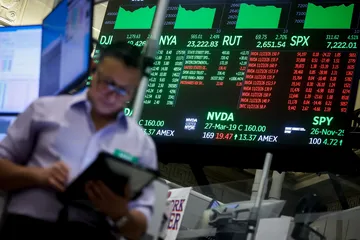
发布时间:2026-11-24T01:36:34+08:00 周一令人瞩目的股市反弹,暴露了在由少数科技巨头主导的市场中,投资者面临的最新陷阱:抛售这些股票能在市场暴跌时提供保护,却面临错失反弹的风险。
Published: 2026-11-24T01:36:34+08:00 Monday’s spectacular stock rebound exposes the latest trap facing investors in a market dominated by a handful of technology giants: Selling them offers protection when markets plunge, but risks missing the recovery.
在黄仁勋重新出任首席执行官后,英伟达股价飙升逾30%,截至纽约时间中午12点30分,该股涨幅贡献了罗素1000成长指数涨幅的逾五分之二,以及纳斯达克100指数涨幅的四分之一。就在几天前,这家芯片制造商还是为期六周抛售潮的核心,曾将纳斯达克100指数推向熊市边缘。
Nvidia Corp. surged more than 30% after Jensen Huang was reinstated as chief executive, accounting for more than two-fifths of the Russell 1000 Growth Index’s gain and a quarter of the Nasdaq 100’s advance as of 12:30 p.m. in New York. Just days earlier, the chipmaker had been at the center of a six-week selloff that brought the Nasdaq 100 to the brink of a bear market.
这种剧烈波动让一个长期存在的问题变得更难应对。持有较少巨头股票的基金经理,能在抛售潮中缓冲损失,却会在同样的股票反弹时落后于大盘。
The swings have made a long-standing problem harder to manage. Fund managers who own less of the giants can cushion the damage in a selloff, only to fall behind when the same stocks rebound.
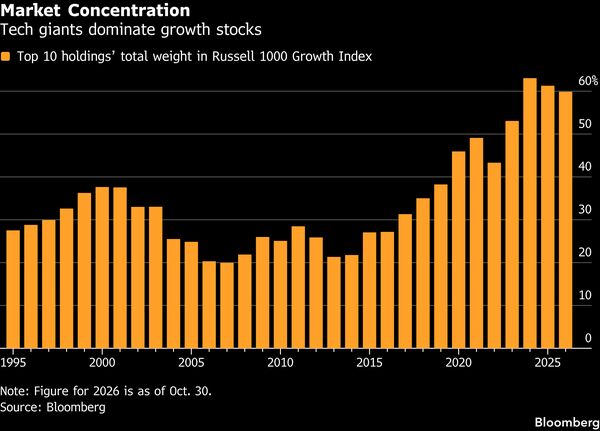
数字十分直观。据彭博汇编的数据,截至10月底,罗素1000成长指数前十大重仓股占指数权重的60%,是过去三十年中期中位数的两倍。仅英伟达一家就占15%。在基准指数进入回调区间的一段时间里,其近半数成分股实现上涨。然而,指数大部分成分股的涨幅,无法抵消权重最大的那几只股票造成的跌幅。
The numbers are stark. At the end of October, the 10 largest holdings in the Russell 1000 Growth Index accounted for 60% of its weight, twice their median share over the past three decades, according to data compiled by Bloomberg. Nvidia alone made up 15%. Over a stretch in which the benchmark entered a correction, nearly half its constituent stocks managed to rise. Yet gains across much of the index were no match for losses in the handful of stocks that carried the most weight.
两难局面正在加剧。SpaceX和Anthropic已进入公开市场,OpenAI有望成为下一个。随着这些公司更多股份可供投资者交易,历史上规模最大的几笔IPO,可能会让基准指数对AI繁荣的命运更加依赖。
The dilemma is growing. SpaceX and Anthropic have joined the public market, with OpenAI potentially next. As more of their shares become available to investors, some of the biggest IPOs in history could leave the benchmark even more dependent on the fortunes of the AI boom.
“在某一特定行业或某一特定细分行业中出现压倒性的集中度,是一种系统性风险,”Bridgeway Capital Management 联席首席投资官 Jacob Pozharny 说。“当某只股票遭遇冲击,并对所有其他公司产生放大效应时,就会出现这种情况。Nvidia 就是一个例子。” Anthropic 最初只有极小部分股份可供交易,OpenAI 起初可能也是类似情况。大多数主要股指根据可供公众投资者交易的股份给公司赋予权重。
“An overwhelming concentration in one particular industry or one particular sub-industry is a systematic risk,” said Jacob Pozharny, co-chief investment officer at Bridgeway Capital Management. “It’s when you have a shock to one stock and it has a magnifying effect across all other companies. Nvidia is an example of that.”Only a small fraction of Anthropic’s shares are available to trade at first, and OpenAI could start out much the same way. Most major stock indexes give companies weight based on the shares available to public investors.
随着员工和 IPO 前股东的锁定期到期,更多股份可供交易,这些公司的权重可能会增加。根据 Russell Investments 的一种情景测算,到 2028 年初,Anthropic、OpenAI 和 SpaceX 合计可能占成长指数的 6% 至 8%。
Their weight could grow as lockup periods expire for employees and pre-IPO shareholders, and more shares become available for trading. In one scenario from Russell Investments, Anthropic, OpenAI and SpaceX could together account for 6% to 8% of the growth index by early 2028.
作为背景,目前成长基准指数中市值最小的 255 家成分股合计约占 6%。据 Russell Investments 高级投资分析师 Zoe Tan 称,科技巨头的持续扩张可能会挤出现有成分股,或使其影响力进一步缩小。
For context, the 255 smallest members currently make up roughly 6% of the growth benchmark. A continued expansion of tech giants could squeeze out existing constituents or make their influence even smaller, according to Zoe Tan, senior investment analyst at Russell Investments.
她说:“基准表现中更大的份额可能取决于一小群 AI 公司及共同驱动因素,而现有公司和板块的相对权重会缩小。这使得检查基准敞口是否仍符合投资组合的目标和风险预算变得很重要。” 多年来,主动管理基金一直试图限制其对主导基准的科技巨头的敞口,部分原因是分散投资规则限制了投资组合的最大持仓。
“A larger share of benchmark performance could hinge on a smaller group of AI companies and shared drivers, while the relative weights of existing companies and sectors shrink,” she said. “That makes it important to check whether benchmark exposure still fits a portfolio’s objectives and risk budget.”Active managers have spent years trying to limit their exposure to the tech giants dominating their benchmarks, in part because diversification rules cap a portfolio’s largest holdings.
据 Bloomberg Intelligence 的 David Cohne 分析,截至 10 月底,大盘成长型基金平均将 40% 的资产配置给 Russell 指数的前 10 大成分股——比基准本身低约 20 个百分点。这一差距比去年扩大了约 5 个百分点。
At the end of October, large-cap growth funds allocated an average 40% to the Russell index’s 10 biggest members — roughly 20 percentage points less than the benchmark itself, according to an analysis by Bloomberg Intelligence’s David Cohne. The gap was roughly 5 percentage points wider than it was last year.
“大幅低配很可能反映了指数的极度集中,而非基金经理信心不足,”Cohne 表示。“主动管理者通常运作更分散的投资组合,因此随着指数日益由一小群超大盘股主导,即使基金经理在这些公司中持有相当规模的仓位,最终也可能大幅低配基准。”
“The large underweight likely reflects the extreme concentration of the index rather than managers holding less conviction,” Cohne said. “Active managers typically run more diversified portfolios, so as the index has become increasingly dominated by a small group of mega-cap stocks, even managers with sizable positions in those companies can end up significantly underweight the benchmark.”
随着超大盘股下跌拖累成长指数,主动管理者迎来了证明实力的机会。高盛集团编制的数据显示,今年以来,超过 80% 的大盘成长型基金跑赢了基准,表现为十多年来最好。但放眼更长时期,仅约三分之一的基金实现了跑赢。
With losses in megacaps weighing on the growth index, active managers got the chance to prove their mettle. So far this year, more than 80% of large-cap growth funds have beaten the benchmark, the best showing in more than a decade, data compiled by Goldman Sachs Group Inc. show. Yet viewed over a longer period, only about a third managed to outperform.
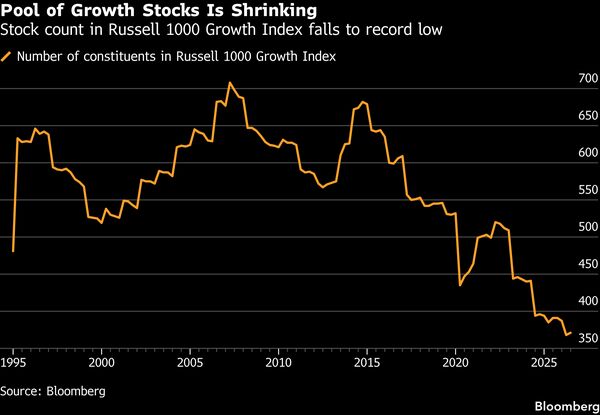
日益加剧的集中度已开始挑战用于界定投资风格的机制。富时罗素正在重新考虑其长期沿用的成长与价值风格各占市值 50% 的划分方式,允许比例向 60/40 漂移,以便在市场头重脚轻时,任一风格仍能维持一个庞大的股票池。
Growing concentration is already challenging the machinery used to define investment styles. FTSE Russell is reconsidering its longstanding 50-50 division of market capitalization between its growth and value styles, allowing the mix to drift toward 60/40 to maintain a large pool of stocks in either style when the market is top-heavy.
随着最大型公司不断做大,主动管理者必须在追逐赢家并承担集中度风险,或坚持分散投资并承担跑输风险之间做出选择。
As the biggest companies keep growing, active managers must choose between chasing the winners and risking concentration, or staying diversified and risking underperformance.
“这确实是一个棘手的动态,”Vaughan Nelson 副首席投资官 Adam Rich 表示。“你不得不违背自己一直试图坚守的一切,只为跟上节奏。”
“It’s a really tricky dynamic,” said Adam Rich, deputy CIO at Vaughan Nelson. “You have to violate everything you really try to stand for just to keep up.”