基辅——随着每天仅有四小时供电,季季亚娜·利马罗娃(Tetiana Limarova)原本井井有条的生活本月彻底崩塌。
KYIV—The last threads of Tetiana Limarova’s frictionless world withered away this month as she found herself living on four hours of power a day.
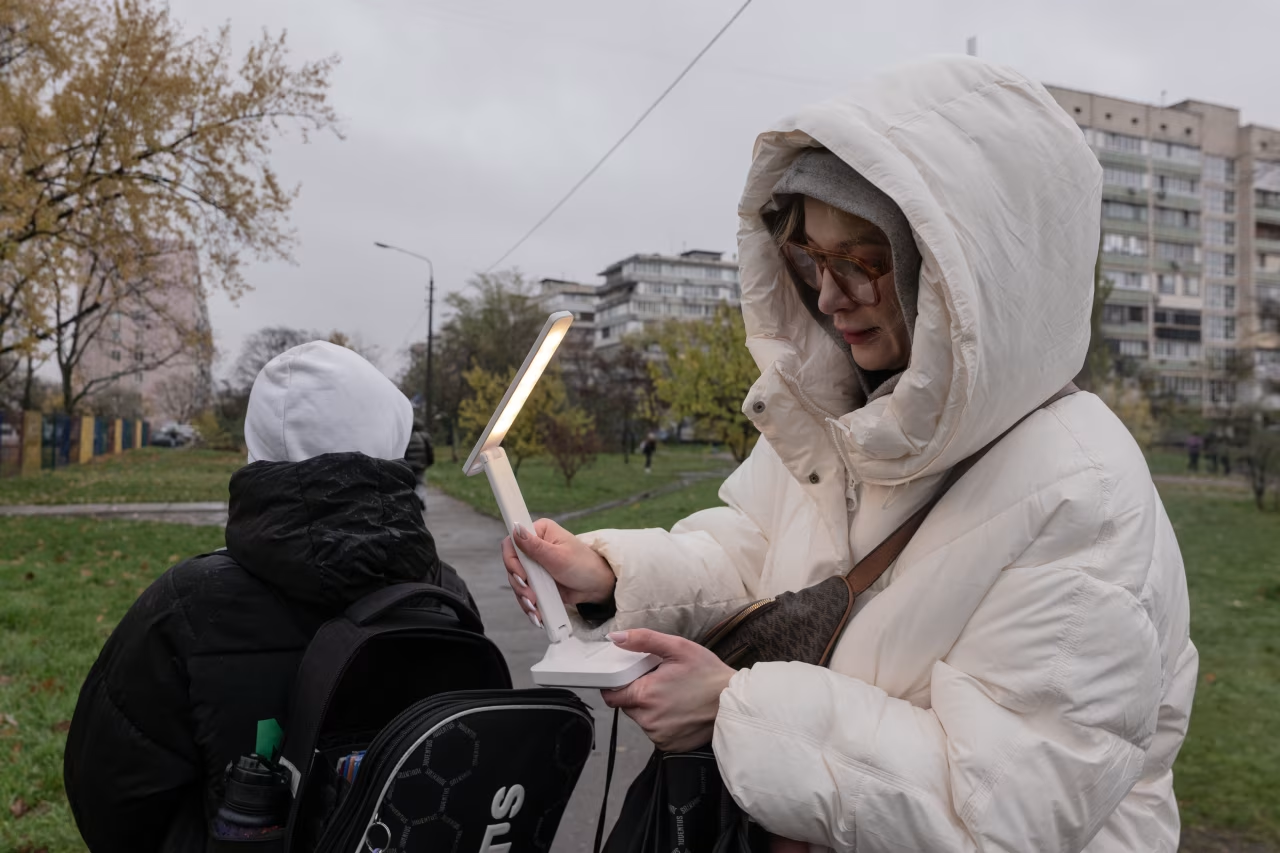
吹干头发成了奢望。漫长停电期间 Wi-Fi 中断,充电宝没电后,她不得不跋涉到最近的商场给设备充电。她 10 岁儿子的书包里现在多了一盏阅读灯,以便小学停电时使用。
Blow-drying her hair has become a luxury. Her Wi-Fi cuts out during the long blackouts, and when her power banks die she has to trek to the nearest mall to recharge her devices. Her 10-year-old son’s schoolbag now includes a reading lamp for when the blackouts hit his elementary school.
她工作的美容院 11 月中旬室温徘徊在 50 华氏度(约 10 摄氏度)左右,顾客裹着毯子洗头以御寒。
At the beauty salon where she works, the temperatures hovered around 50 degrees Fahrenheit in mid-November, so the customers bundled up in blankets to stay warm as they got their hair washed.
“我们在硬撑,不想离开,”40 岁的利马罗娃说。“但如果孩子上不了学,生活在根本无法生存的环境里,那种情况会逼我走。”
“We’re hanging in there and don’t want to leave,” said Limarova, 40. “But if my child can’t go to school and is living in conditions that make survival impossible, that’s the situation that would force me to go.”
随着俄罗斯总统普京(Vladimir Putin)今冬全力打击乌克兰发电厂等关键基础设施,基辅及其他城市的数百万乌克兰人正在重新审视自己的底线——一旦触及,就会被迫转移到安全地带。
As Russia’s President Vladimir Putin goes all in on targeting Ukraine’s power plants and other critical infrastructure this winter, millions of Ukrainians in Kyiv and other cities are reassessing the red lines that, once breached, would compel them to move to safety.
乌克兰总统泽连斯基(Volodymyr Zelensky)表示,俄罗斯持续发动导弹和无人机袭击,旨在瘫痪乌克兰经济、在物理上分裂国家。“我们详细讨论了俄罗斯针对我们桥梁和电网的行动带来的挑战——俄罗斯试图沿第聂伯河分裂乌克兰,让民众的生活尽可能艰难——让我们的城市和村庄寸步难行,”他在本月初与政府高层官员会晤后说道。
Ukrainian President Volodymyr Zelensky says Russia’s goal with its relentless missile and drone strikes is to paralyze Ukraine’s economy and physically separate the country. “We discussed in detail the challenges posed by Russia’s operation against our bridges and power grid—Russia is trying to divide Ukraine along the Dnipro River and make life as difficult as possible for people—for our cities and villages,” he said after a meeting with top government officials earlier this month.
这让普通乌克兰人面临抉择:要么在基辅加倍做好过冬准备,要么向更西边或乌克兰境外寻求安全。
That leaves ordinary Ukrainians with a choice: double down on their winter prep in Kyiv, or seek safety farther west or beyond Ukraine’s borders.
到目前为止,许多人似乎仍愿意坚守。利马罗娃打算留在基辅,以便离在乌克兰军队服役的丈夫和住在附近的母亲更近一些。但这个选择变得越来越艰难,越来越多的人发现自己处于边缘。“无论是在寒冷中还是在饥饿中,我都能活下来,但我有个孩子,我是为了他才做这个选择的,”利马罗娃说。
So far, many appear willing to bunker down. Limarova aims to stay in Kyiv to be closer to her husband in the Ukrainian military and her mother, who lives nearby. But the choice is becoming more difficult and more people are finding themselves on the edge. “I’d survive, whether in the cold or hunger, but I have a child, and I’m making this choice for him,” Limarova said.
随着冬季临近,俄罗斯的袭击早已升级,但后果今年显现得更早。在全天停水期间,她不得不提着加仑桶装水爬八层楼,以便刷牙、洗碗和冲厕所。
The Russian attacks have long intensified as winter approaches, but the consequences kicked in sooner this year. During daylong water cuts, she had to carry gallons of water up eight floors to brush teeth, wash dishes and flush toilets.
由于基辅的空袭警报导致学校间歇性上课,利马罗娃和嫂子在美容院减少了工作天数,以便她们其中一人随时能在身边,万一儿子在家上网课时遭遇袭击。工作上的情况也好不了多少;随着人们离城,她的客源在萎缩。
Since school functions intermittently, depending on air alerts in Kyiv, Limarova and her sister-in-law work fewer days in the beauty salon so that one of them can always be around in case her son gets caught in an attack while studying at home. The situation at work isn’t much better; her client base is shrinking as people leave town.
“10月中旬,我的许多客户为过冬离开了,尤其是那些远程办公的人,要么去投亲戚在乡下,要么去国外,”她说。“他们说:‘我们会回来,但就是没法忍受这些。’”乌克兰检察官称,俄罗斯的袭击多年来系统性地以发电厂为目标,且轰炸正在加剧。11月的一个星期里,乌克兰最大的私营电力公司DTEK正努力为超过100万用户恢复供电。供水公司难以维持水泵运转。城镇部分地区失去水压数小时。市中心时髦的酒吧用过滤水给顾客洗手,提供灰水桶冲无法冲水的马桶;有些干脆关闭了卫生间。
“In mid-October, many of my clients left for the winter, especially those who work remotely, either to stay with relatives in villages or abroad,” she said. “They say, ‘We’ll come back, but there’s just no way to put up with this.’”The Russian attacks have systematically targeted power plants for years, and the barrage is intensifying, Ukrainian prosecutors say. During one week in November, Ukraine’s largest private power company DTEK was working to restore power to over a million consumers. Water companies struggled to power their pumps. Parts of town lost water pressure for hours. Trendy downtown bars poured filtered water over the clients’ hands to wash them and offered jugs of gray water for toilets that wouldn’t flush; some closed their bathrooms altogether.
基辅餐厅联合所有者斯坦尼斯拉夫·扎韦尔泰洛安装了备用供水系统以维持营业,但他所需发电机的成本不断上升,与需求的萎缩发生冲突。他的生意上个月处于亏损状态。
Kyiv restaurant co-owner Stanislav Zavertailo installed a backup water system to stay open, but the growing cost of the generators he needs to work is colliding with waning demand. His business operated at a loss last month.
“这是我们第一次面临如此严峻的挑战——人们在离开,一切都在变得更贵,”扎韦尔泰洛说,并补充称,俄罗斯对其他企业的打击导致了交付中断。他目前正考虑关闭一些门店。“我不会说这是最艰难的部分,因为最艰难的部分还在后头。”
“This is the first time we’re facing such critical challenges—people are leaving and everything is getting more expensive,” Zavertailo said, adding that Russian strikes on other businesses caused delivery disruptions. He is now considering closing some locations. “I’m not going to say this is the hardest part because the hardest part is still ahead.”
当俄军加大喷气式无人机和弹道导弹的使用力度时,33岁的达里娜·特鲁诺娃觉得是该离开的时候了。她对7岁儿子日益增长的恐惧让她在基辅的生活变得难以维持,她于10月搬到了西部城市利沃夫。
When Russian forces stepped up their use of jet-powered drones and ballistic missiles, Daryna Trunova, 33, felt it was time to go. Her growing fear for her 7-year-old son made life too hard to stay in Kyiv and she moved west to Lviv in October.
“情况发展到这样一个地步:即使在我们的休息日,无论我们去哪里,都会拉响防空警报,无人机会被击落,”她回忆道。“你必须待在防空洞里,或者你必须接受这是上帝的旨意——要么它杀死你,要么不杀死你。当你有了孩子,就不可能接受这一点。”
“It got to the point where even on our day off, no matter where we went, there would be an air-raid alert, and drones would be shot down,” she recalled. “You had to stay in a shelter, or you had to accept that it’s all God’s will—either it would kill you or it wouldn’t. When you have a child, it’s impossible to come to terms with that.”
她的一位朋友,25岁的米罗斯拉娃·特罗菲姆丘克,计划留在基辅。她目前正全力备战冬天,囤积不易腐烂的食物,以防俄罗斯对配送枢纽的袭击持续,还储备了露营炉用的燃气罐,以应对停电。清单上的下一项是露营淋浴和厕所。
One of her friends, Myroslava Trofymchuk, 25, plans to stay in Kyiv. She is now in the throes of winter prep, stockpiling nonperishable foods in case the Russian attacks on distribution hubs continue and a supply of gas for the camping stove she uses during power cuts. Next on the list are a camping shower and toilet.
“如果供水管道泄漏或冻结,会让房子完全无法居住。你洗不了碗,做不了饭,因为很难弄到水,”特罗菲姆丘克谈到她对即将到来的冬天最大的担忧时说。即便如此,她也没考虑去立陶宛和那里生活的家人团聚。
“If the water supply leaks or freezes, it makes the house completely uninhabitable. You can’t wash dishes, you can’t cook a meal, because it’s hard to get water,” said Trofymchuk about her biggest concern for the winter ahead. Even so, she isn’t considering joining her family in Lithuania, where they now live.
她从2014年的记忆中汲取力量,那时她13岁,在俄军支持的武装力量袭击乌克兰东部顿涅茨克地区的家乡时,不得不在没有水、煤气和电力供应的情况下生存下来。
She gathers strength from her memories of 2014, when at 13 she had to survive without water, gas and power supplies when Russian-backed forces attacked her hometown in the Donetsk region in eastern Ukraine.
“从夏天到11月我们都没有电。我们睡在地下室里。他们用高爆炮弹轰炸我们,那要可怕得多,”她回忆道。因这些事件导致的创伤后应激障碍在春天复发,她开始服用抗抑郁药。
“We had no electricity from the summer through November. We slept in basements. They bombarded us with high-explosive shells and that was much scarier,” she remembered. Her post-traumatic stress disorder from these events flared up in the spring and she started taking antidepressants.
“如今基辅发生的事——弹道导弹和无人机袭击——也非常、非常艰难。但到目前为止,我们还没有陷入那种绝望的境地,以至于应该直接放弃。”
“What’s happening in Kyiv now—ballistic and drone attacks—is also really, really tough. But so far, we’re not yet in such a hopeless situation that we should just give up.”