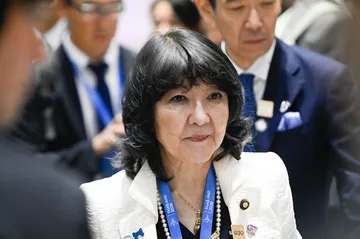
发布时间:2026-11-27T09:36:11+08:00 随着日本围绕防卫费拨款展开博弈,财务大臣片山沙月(Satsuki Katayama)周五表示,支出应由实际需求决定,而非预设数字。
Published: 2026-11-27T09:36:11+08:00 As a struggle over funding for defense spending plays out in Japan, Finance Minister Satsuki Katayama said on Friday that outlays should be determined by actual needs rather than a preset figure.
“我们不应从预定金额着手,”片山周五对记者说。“例如,如果我们着眼于新的作战方式,就需要从实际角度审视究竟需要什么,并围绕所需的具体能力展开讨论。”此前,《朝日新闻》周四报道称,政府正朝着敲定从下一财年起为期五年的防卫费计划迈进,规模为56.3万亿日元,高于现行五年框架下的43万亿日元。报道称,首相高市早苗(Sanae Takaichi)预计将很快做出决定。
“We shouldn’t start with a predetermined amount,” Katayama told reporters on Friday. “If we are looking at new ways of warfare, for example, we need to examine what is actually needed in practical terms and build up our discussions around the specific capabilities required.”Katayama spoke after the Asahi Newspaper reported on Thursday that the government was moving toward finalizing a five-year defense spending plan starting from the next fiscal year at ¥56.3 trillion, up from ¥43 trillion under the current five-year framework. Prime Minister Sanae Takaichi is expected to make a decision soon, the paper said.
日本预计将于年底前修订其关键国家安全文件,这一过程有望揭示其军事扩充的规模和步伐。
Japan is revising its key national security documents by year-end, a process expected to shed light on the scale and pace of its military buildup.
预算磋商暴露了高市旨在增强日本军事能力的目标与其他财政优先事项之间的张力。早前媒体报道显示,防卫当局曾寻求约70万亿至80万亿日元,而财务省和首相官邸倾向于50万亿至60万亿日元,以便为经济增长举措和计划中的消费税减税留出空间。
The budget talks have exposed tensions between Takaichi’s goal to bolster Japan’s military capabilities and competing fiscal priorities. Earlier media reports suggested that defense officials had sought around ¥70 trillion to ¥80 trillion, while the Finance Ministry and the prime minister’s office favored ¥50 trillion to ¥60 trillion to leave room to fund economic growth initiatives and a planned sales tax cut.
执政党内的防卫鹰派也呼吁拨款80万亿日元,警告称60万亿日元左右的水平实际上将等同于削减,因为通胀和日元贬值推高了军事采购成本。
Defense hawks within the ruling party have also called for spending of ¥80 trillion, warning that a level around ¥60 trillion would effectively amount to a cut as inflation and a weaker yen drive up military procurement costs.
最终的支出数字也可能对日本与美国的关系产生影响。唐纳德·特朗普总统的政府一直在敦促盟国将军费开支提高到国内生产总值(GDP)的3.5%。彭博社9月报道称,日本防务官员在与美方同行的会谈中已表示愿意将防务开支提高到这一水平,尽管他们在增支时间表上含糊其辞。
The final spending figure could also have implications for Japan’s relations with the US. President Donald Trump’s administration has pressed allies to raise military expenditure to 3.5% of gross domestic product. Bloomberg News reported in September that Japanese defense officials had signaled a willingness to raise defense spending to that level in meetings with their American counterparts, although they have been vague on the time frame of such an increase.
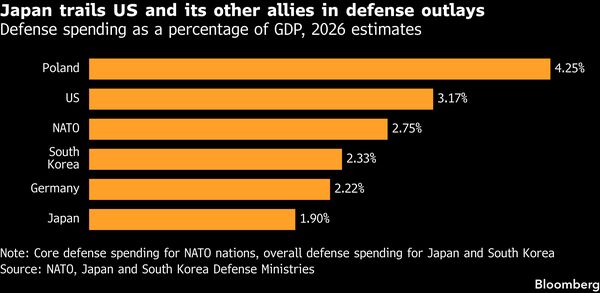
日本不愿明确设定目标,背后是对达到3.5%所需资金量的担忧。2022年底,日本表示将在五年内把防务开支提高到该财年GDP的2%。防卫大臣小泉进次郎4月表示,本财年防务开支及相关支出共计10.6万亿日元,相当于2022年名义GDP的1.9%。
Behind Japan’s caution over specifying a goal is concern over the amount of funding needed to reach 3.5%. In late 2022, Japan said it would lift defense spending to 2% of that fiscal year’s GDP in five years. Defense Minister Shinjiro Koizumi said in April that defense spending and related expenditures for this fiscal year of ¥10.6 trillion were equivalent to 1.9% of nominal GDP in 2022.
他指出,若按内阁府对本财年名义GDP的预测来衡量,这一比例将降至1.5%。按该预测计算,3.5%的预算将达到24万亿日元,是目前金额的两倍多。
Measured against the Cabinet Office’s nominal GDP forecast for this fiscal year, spending would come to 1.5%, he said. A budget of 3.5% using that forecast would amount to ¥24 trillion, more than double the current amount.
据当地媒体报道,美国国防部长皮特·赫格塞斯计划下月访问日本,届时东京可能面临关于其支出计划的提问。
US Defense Secretary Pete Hegseth is scheduled to visit Japan next month, according to local media reports, when Tokyo may face questions over its spending plans.
片山表示:“首相最近明确指出,旨在从根本上强化我国防卫能力的未来预算措施是一项重要目标,且必须基于日本自身的独立判断。这是第一原则。换句话说,这由日本来决定。”
“The prime minister recently made clear that future budgetary measures aimed at fundamentally strengthening our defense capabilities is an important objective and must be based on Japan’s own independent judgment,” Katayama said. “That is the first principle. In other words, it is for Japan to decide.”