编辑部稿件发布时间:2026-11-27 19:00:10+08:00正如美国消费者深有体会的那样,物价上涨仍是一个持续性问题。若美联储希望投资者相信其将通胀降至2%目标的承诺,就必须在下月加息。问题在于加息幅度多少。
By The Editors Published: 2026-11-27T19:00:10+08:00 As US consumers are all too aware, rising prices remain a persistent problem. If the Federal Reserve wants investors to believe its promise to get inflation back down to its 2% target, it’ll have to raise interest rates next month. The question is by how much.
彭博经济学估算,截止十月的全年,消费者价格指数上涨了3.9%。批发价格上涨了6.5%,美联储最青睐的指标——不含食品和能源的个人消费支出价格指数,上涨了3.3%。这三项同比通胀率均高于上月。投资者现在预期美联储将采取行动:金融市场已完全计入政策利率上调0.25个百分点,至4%至4.25%的区间,且投资者并未完全排除一次异常的0.5个百分点加息的可能。尽管情况复杂,但更大幅度加息的理由仍然充分。
In the year to October, Bloomberg Economics estimates, consumer prices increased by 3.9%. Wholesale prices rose by 6.5%, and the Fed’s favorite metric — prices for personal consumption expenditures excluding food and energy — climbed 3.3%. All three year-over-year measures of inflation were higher than the month before. Investors now expect the Fed to act: Financial markets have fully priced in a quarter-point increase in the policy rate, to a range of 4% to 4.25%, and investors haven’t entirely ruled out an unusual half-point hike. Despite complications, the case for the bigger move is strong.
通胀数据本就难以解读——此时尤为如此。不断变化的关税和与伊朗的战争已大幅推高物价,但这些影响大多是暂时的。若关税政策和能源成本趋于稳定,通胀应在不进一步加息的情况下回落;若关税被撤回且能源价格下降,通胀甚至可能快速下降。此外,利率变动需要时间才能传导至需求,因此现在加息可能会在刺激需求正需之际减缓经济。
Inflation data is always hard to read — never more so than now. Ever-shifting tariffs and the war with Iran have pushed prices sharply higher, but these effects are mostly temporary. If tariff policy and energy costs stabilize, inflation should moderate without any further increase in rates — and if tariffs are rolled back and energy prices fall, inflation could drop quickly. In addition, changes in interest rates take time to feed through to demand, so higher rates now might slow the economy just when stimulus is required.
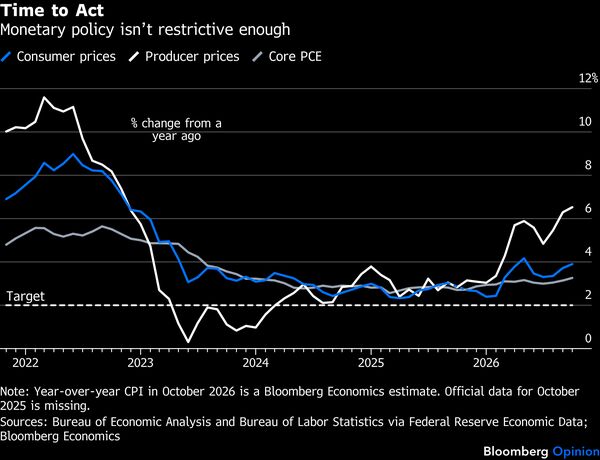
若仔细观察,最新的通胀数字仍显示情况可能在好转。令人失望的同比数据掩盖了一个事实:十月环比通胀略有放缓。如果美联储能够自信地宣称通胀真的在回落,那么维持现状的论点值得考虑。但在经历了五年的超预期通胀以及数月高于预期的数字后,这要求过于苛刻。央行的信誉如今正悬于一线。
Look more carefully, and the latest inflation numbers still suggest that things may be improving. Disappointing year-over-year figures obscure the fact that, month over month, inflation slowed a little in October. The case for standing pat would be worth entertaining if the Fed could say with conviction that inflation really is headed back down. But after five years of overshooting, and several months of higher-than-expected numbers, this is asking too much. The central bank’s credibility is now on the line.
投资者假设美联储下个月将加息,这本身就是对美联储的一种肯定。这意味着他们信任央行将聚焦于其主要目标。若无令人信服的新信息,维持利率不变的决定将动摇这种信心。考虑到美联储在10月会议上选择维持利率不变,尽管当时承认通胀比预期更顽固,那么在12月加息50个基点将是审慎之举。
Investors pay the Fed a compliment when they assume, as they do, that rates are going up next month. It means they trust the central bank to focus on its main objective. Without compelling new information, a decision to hold rates unchanged would rattle that confidence. And given that the Fed chose to hold steady at its October meeting, despite acknowledging that inflation was proving stickier than expected, an increase of 50 basis points in December would be prudent.
如果未来几个月通胀回落,这并不意味着美联储判断失误:它只是根据当时可获得的信息采取了适当行动。届时美联储仍可将利率推回低位。官员们应停止按一系列预设的未来利率路径思考,并维持该路径不变,直到某个重大事态发展要求突然改变方向。过度的固定性不利于数据依赖,而数据依赖意味着随着条件变化进行更小幅度、更频繁的调整。
What if inflation subsides over the next few months? This wouldn’t mean the Fed had misjudged: It would’ve acted appropriately given the information available. And it would still be free to push rates back down. Officials should stop thinking in terms of a sequence of presumed future rates that stays in place until some big development demands an abrupt change of course. Too much fixity militates against data dependence, which implies smaller and more frequent adjustments as conditions shift.
通胀过高的时间过长。其下降速度不如美联储所希望的那样快。应当加息。
Inflation has been too high for too long. It isn’t falling as quickly as the Fed hoped. Raise the rate.