加拿大最高法院将于周五对魁北克省一项具争议性的世俗化法律作出裁决——法律专家表示,这一结果的影响将远超该国的宗教表达。
Canada's Supreme Court will weigh in on Friday on a controversial secularism law in Quebec - and legal experts say the outcome will have an impact on much more than religious expression in the country.
此案的核心是魁北克省的《21号法案》,该法案禁止法官、警察和教师等公务员在工作时佩戴宗教标志。该法案于2019年由当时执政该省的政党魁北克未来联盟(CAQ)通过。
At the heart of the case is Quebec's Bill 21, which bars civil servants like judges, police officers and teachers from wearing religious symbols at work. It was passed in 2019, by the Coalition Avenir Quebec (CAQ), the party that governed the province at the time.
该案有可能对国家统一以及法院与民选官员之间的平衡构成考验,并被称为一代人中最具潜在重要性的宪法案件。
The case has the potential to test national unity and the balance between courts and elected officials, and has been called potentially the most important constitutional case in a generation.
为了帮助《21号法案》经受住法律挑战,立法者采用了一项独特的加拿大发明,即具争议性的“但书条款”。这一法律漏洞允许政府凌驾于某些宪法权利之上,包括宗教自由和平等权。
To help Bill 21 withstand legal challenges, legislators employed a unique Canadian invention, the controversial "notwithstanding clause". That legal loophole allows governments to override certain constitutional rights, including freedom of religion and equality rights.
加拿大公民自由协会(CCLA)称魁北克省在法庭上的论点“令人毛骨悚然”。
The Canadian Civil Liberties Association (CCLA) called Quebec's arguments in court "spine-chilling".
加拿大公民自由协会在法文报纸《模范报》3月的一篇专栏文章中写道:“政府会援引[该条款]来禁止堕胎吗?将批评政府的政治言论定为刑事犯罪吗?将酷刑合法化吗?”
"Could a government invoke [the clause] to ban abortion? To criminalise political speech critical of the government? To legalise torture?" the CCLA wrote in a March op-ed in French-language newspaper Le Devoir.
“按照魁北克政府的逻辑,即便在这样的情况下,法院不仅将无能为力,而且还必须保持沉默。”3月,最高法院就针对《21号法案》的宪法挑战举行了为期四天的听证会。包括联邦政府在内,有50多方法律介入方参与了此案。
"According to the Quebec government's logic, even in such cases, the courts would not only be powerless but also bound to silence." In March, the Supreme Court held four days of hearings on a constitutional challenge to Bill 21. More than 50 interveners became involved in the case, including the federal government.
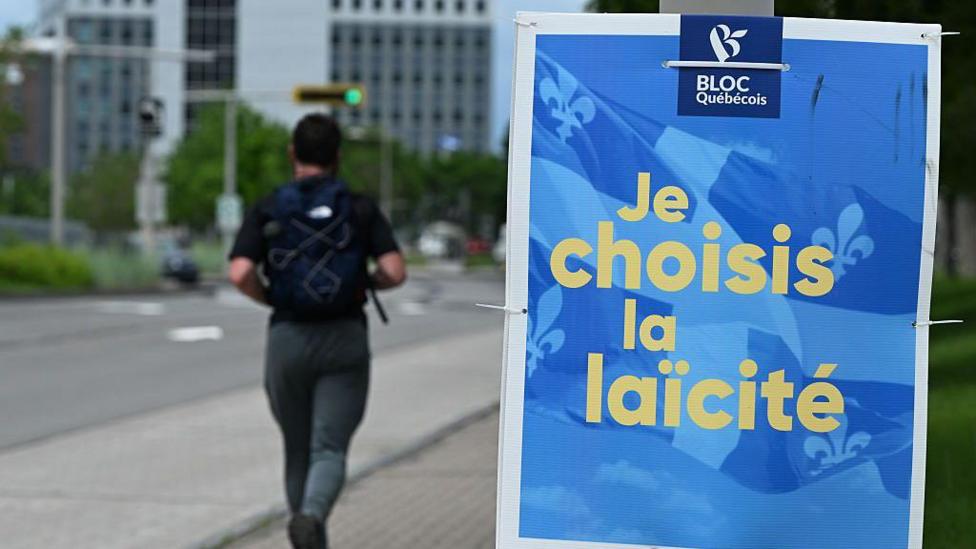
与法国一样,魁北克的国家世俗化——即世俗主义——是其身份的核心。
As in France, Quebec's state secularism - or laïcité - is central to its identity.
世俗主义的支持者认为,国家机构应当在宗教问题上保持中立——这很像美国的“政教分离”概念。但这在日常生活中意味着什么,已成为大量辩论的主题。
Proponents of laïcité believe that state institutions should be religiously neutral - much like the concept of America's "separation of church and state". But what that means in day-to-day life has become the subject of much debate.
第21号法案的支持者辩称,这是朝着在魁北克省确立政教分离迈出的合理一步。
Supporters of Bill 21 argue that it is a reasonable step towards enshrining the separation of church and state in Quebec.
但批评人士表示,该法案具有歧视性,使宗教少数群体更难融入社会,且不公平地针对穆斯林女性——尽管该立法并未点名任何特定宗教。
But critics say it is discriminatory, has made it more difficult for religious minorities to integrate, and that it unfairly targets Muslim women - though the legislation does not single out any religion.
为了使该立法免受法律诉讼的干扰,未来魁北克联盟党(CAQ)先发制人地将“但书条款”写入了法案中。
In an attempt to insulate the legislation from legal battles, the CAQ pre-emptively included the "notwithstanding clause" in the bill.
该条款是加拿大宪法第33条。它允许省政府或联邦政府推翻某些“基本自由”,包括宗教、言论和结社自由,以及法律和平等权利。该条款需要定期续签,理论上可以无限期延长。
That clause is section 33 of the Canadian constitution. It allows a provincial or federal government to override certain "fundamental freedoms" of religion, expression, and association; as well as legal and equality rights. It is subject to renewal, and in theory can be extended indefinitely.
20世纪80年代初,加拿大寻求从英国收回宪法,并纳入类似于美国《权利法案》的《权利与自由宪章》。
In the early 1980s, Canada was seeking to repatriate its constitution from the United Kingdom and to incorporate a Charter of Rights and Freedoms, similar to the US Bill of Rights.
该条款被用作一项“重大妥协”,以争取所有省份的支持,其中包括一些担心权利宪章会赋予法院权力大过民主选举产生之立法者的省份。
The clause was used as a "grand bargain" to get all the provinces on board, including some that were concerned a rights charter would give more power to courts than to democratically elected legislators.
它适用于宪章中的部分而非全部权利。例如,民主权利和语言权利就被排除在外。
It applies to some but not all charter rights. Democratic and language rights are excluded, for example.
“但书条款”最初是作为安全阀引入的。在过去的几十年里,魁北克省曾多次使用该条款,但其他省份也越来越多地利用它来推出有争议的立法。
The "notwithstanding clause" was brought in as a safety valve. It has been used several times by Quebec over the past few decades, but has also increasingly been employed by other provinces to introduce controversial legislation.
除了被用于魁北克的第21号法案外,安大略省近期也援引该条款缩减了多伦多市议会的规模,艾伯塔省用其下令罢工教师复课,萨斯喀彻温省则用其规定16岁以下学生在学校更改姓名或代词前须征得父母同意。
As well as being used in Quebec's Bill 21, the clause has been invoked in recent times by Ontario to cut the size of Toronto's city council, by Alberta to order striking teachers back to work, and by Saskatchewan to require parental consent before students under 16 could change their names or pronouns at school.
这导致一些批评人士辩称,该条款的使用已经超出了其仅作为最后手段的普遍共识。
That has led some critics to argue the clause is being used beyond the general understanding that it would only be used as a last resort.
渥太华大学法律教授埃罗尔·门德斯表示,他和其他人曾警告该条款过于宽泛且可能遭到滥用。门德斯同时也是国际法学家委员会加拿大分会在魁北克案中的诉讼介入人。
Errol Mendes, a law professor at the University of Ottawa who is also an intervener in the Quebec case for the International Commission of Jurists Canada, said that he and others warned the clause was overly broad and could be misused.
“我们的预言现在正在变成现实,因为该条款的使用慢慢开始变得越来越多。”3月的最高法院听证会是该法院自1988年以来首次审理针对该规定的挑战。
"And our predictions were coming true now, because there slowly started to be more and more use of the clause." The Supreme Court hearing in March was the first time that court had heard a challenge to the provision since 1988.
加拿大公民自由协会(CCLA)和伊克拉克·努雷尔·哈克——一名在魁北克戴头巾的穆斯林教师——是寻求上诉许可的各方之一。
The Canadian Civil Liberties Association (CCLA) and Ichrak Nourel Hak - a Muslim teacher in Quebec who wears a hijab - are among those who sought leave to appeal.
他们在3月的一份声明中辩称,在魁北克,“21号法案一直在侵犯在公共服务部门工作或渴望在公共服务部门工作的人的尊严、权利和自由”,并且“对特定的宗教少数群体(如穆斯林、锡克教徒和犹太人社区)产生了不成比例的影响”。
In a statement in March, they argued that in Quebec, "Bill 21 has been infringing on the dignity, rights and freedoms of individuals who work in or aspire to work in the public service" and "has a disproportionate impact on specific religious minority groups, such as Muslim, Sikh and Jewish communities".
在法庭上,加拿大公民自由协会、加拿大穆斯林全国委员会和哈克的律师辩称,不受限制地使用但书条款“可能允许一个简单的立法多数派通过后门有效地修改宪法”。
In court, a lawyer for the CCLA, the National Council of Canadian Muslims and Hak argued that the unrestrained use of the notwithstanding clause "could allow a simple legislative majority to effectively amend the Constitution through the backdoor".
魁北克政府辩称,该法案是否限制了自由并不是问题所在,因为它受到但书条款的保护。
Quebec's government argues that whether or not the bill restricts freedoms is not the issue as it is shielded by the notwithstanding clause.
魁北克方面曾辩称:“从某种程度上说,第33条构成了加拿大《宪章》的基石之一。”
"Section 33 constitutes, in a way, one of the cornerstones of the Canadian Charter," Quebec has argued.
该省表示,该法案的目的是保护国家的宗教中立性并支持共同的公民身份认同感。
It says the aim of the bill is to protect the religious neutrality of the state and support a sense of shared civic identity.
该省辩称,“但书条款”中的任何内容都没有阻止其被先发制人地使用,且其使用符合最高法院的先例。
The province argues nothing in the "notwithstanding clause" stops it from being used pre-emptively, and its use is in line with Supreme Court precedent.
摆在最高法院面前的有多个问题,包括21号法案本身是否具有宪法效力,以及在该案中是否正当地使用了“但书条款”。法院还被要求裁决该条款的使用是否存在限制。许多人,包括联邦政府,都在要求限制该条款的使用。
There are a number of questions before the Supreme Court, including whether Bill 21 itself is constitutionally valid and whether the "notwithstanding clause" was properly used in that case. It has also been asked to decide whether there are limits on the use of the clause. Many, including the federal government, are asking for limits on the use of the clause.
9月,联邦司法部长肖恩·弗雷泽表示,法院的裁决“将决定联邦和省级政府在今后多年里如何使用该条款”。他还称加拿大的权利宪章是“我们民主制度的支柱,也是我们共同价值观的体现”。
In September, federal Justice Minister Sean Fraser said that the court's decision "will shape how both federal and provincial governments may use the notwithstanding clause for years to come". He called Canada's rights charter a "pillar of our democracy and a reflection of our shared values".
在法庭文件中,联邦政府辩称,该条款不能被当作空白支票使用,但并未具体就21号法案的是非曲直置评。它敦促法院对该条款的援引方式设定限制,称该条款的初衷并非用于“扭曲或摧毁《宪章》所保障的权利和自由”,也不是将其缩减为“驴皮”,也就是萎缩得面目全非。
In court documents, the federal government has argued that the clause cannot be used as a blank cheque, without weighing in on the merits of Bill 21 specifically. It urges the court to set limits on how the cause can be invoked, saying it was not meant to be "used to distort or annihilate the rights and freedoms guaranteed by the Charter", or to reduce them to "des peaux de chagrin" - that is, to shrivel them beyond recognition.
联邦政府的这一论点迅速遭到各省反驳,其中许多省份也是该案的介入方。魁北克指责联邦政府发动了一场“对加拿大所有立法议会之议会主权的攻击”。五个省的领导人表示,渥太华应撤回其法律论点,他们称这些论点“试图削弱省立法机构的主权,从而威胁国家统一”。
That federal government's argument received rapid pushback from the provinces, many of whom are also interveners in the case. Quebec accused it of staging an "attack on the parliamentary sovereignty of the legislative assemblies of all of Canada". Five province leaders said Ottawa should withdraw its legal arguments, which they said "threaten national unity by seeking to undermine the sovereignty of provincial legislatures".
“事实上,联邦政府的立场无异于对联邦制和民主这两项基本宪法原则的直接攻击,”萨斯喀彻温省、阿尔伯塔省、安大略省、魁北克省和新斯科舍省的领导人在一份联合声明中表示。
"Indeed, the federal government's position amounts to a direct attack on the foundational constitutional principles of federalism and democracy," said the leaders of Saskatchewan, Alberta, Ontario, Quebec and Nova Scotia in a joint statement.
阿尔伯塔省在自身提交的文件中辩称,该条款是一个“经过艰苦斗争才达成的妥协”,其引入旨在“维护议会主权”。
In its own filings, Alberta argues the clause is a "hard-fought and hard-won compromise" brought in with the intent to "preserve parliamentary sovereignty".