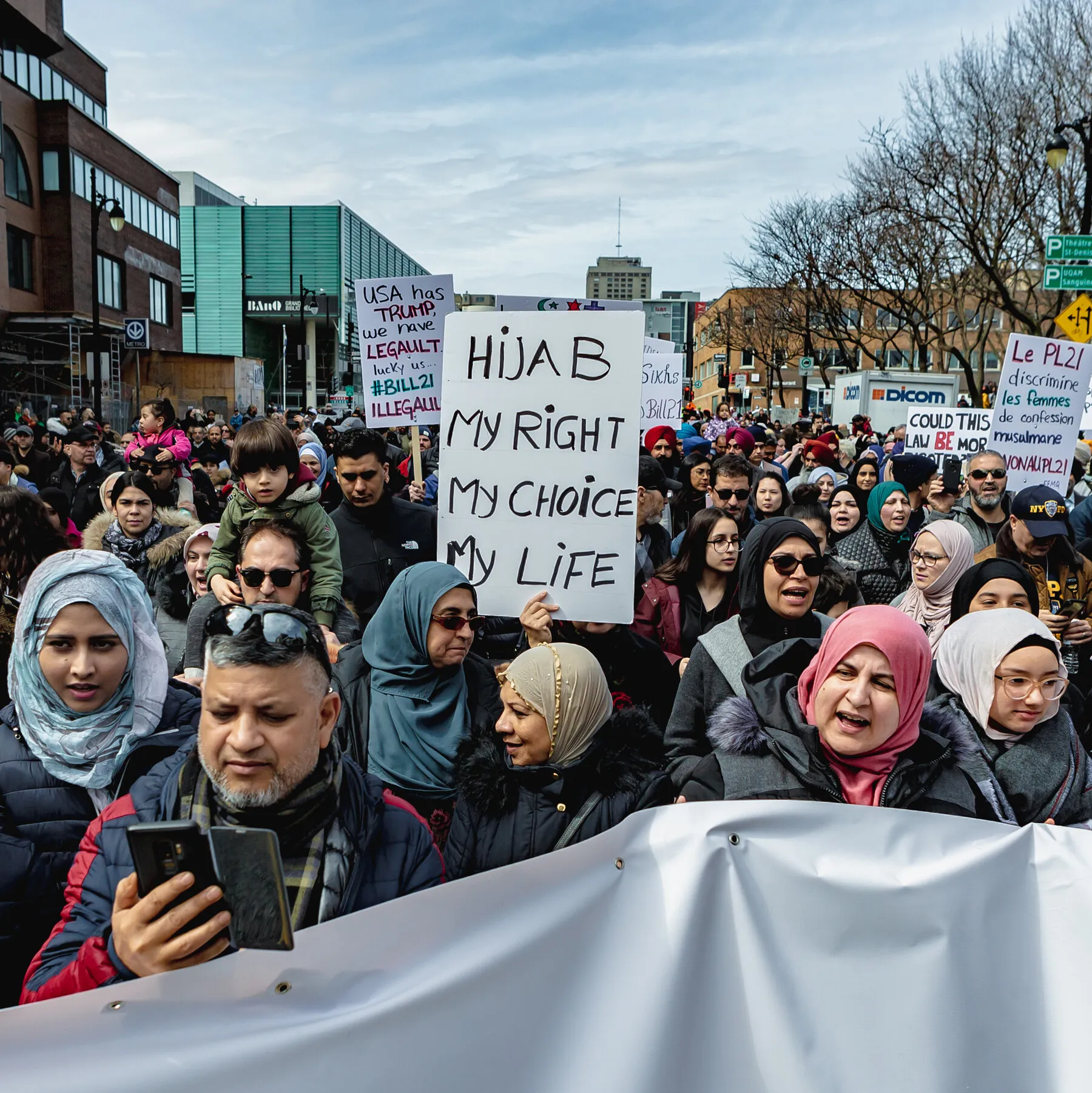
魁北克曾利用这一条款通过一项法律,禁止公立学校教师和警察等特定公职人员在执勤时佩戴宗教标志,批评者称该法律具有歧视性。
Quebec had used the measure to pass a law barring certain public workers, like schoolteachers and police officers, from wearing religious symbols on duty, which critics called discriminatory.
加拿大最高法院周五裁定,魁北克可以援引宪法中的一项法律条款,通过一项凌驾于部分权利之上的世俗主义法律。这一具有里程碑意义的裁决很可能使该国避免了一场迫在眉睫的政治危机。
Canada’s top court ruled on Friday that Quebec could use a legal provision of the Constitution to pass a secularism law that overrides some rights, a landmark decision that likely averts an immediate political crisis for the country.
最高法院表示,魁北克有权利用所谓的“但书条款”在2019年通过立法,在这个法语省份强化世俗主义。该法律禁止公立学校教师和警察等特定公职人员在执勤时佩戴宗教标志,导致一些语言和宗教少数群体称其具有歧视性,违反了加拿大宪法。
The Supreme Court said Quebec was within its rights to use the so-called notwithstanding clause to pass legislation in 2019 that reinforced secularism in the French-speaking province. That law prohibited certain public workers, like public schoolteachers and police officers, from wearing religious symbols while on duty — leading some linguistic and religious minorities to call it discriminatory and a violation of the Canadian Constitution.
但这一备受期待的裁决并非魁北克和其他省份的完全胜利,这些省份曾大力捍卫利用该条款来搁置宪法部分内容的做法。法院还裁定,即使此类立法得以维持,法院仍可宣布其侵犯了宪法权利。
But the long-anticipated ruling was a not a total victory for Quebec and other provinces that had fiercely defended using the clause to set aside parts of the Constitution. The court also ruled that, even as such legislation was allowed to stand, courts can still declare that they violate Constitutional rights.
这可能使此类立法在未来面临法律挑战,并提高政府使用该条款的政治代价。
That could open up such legislation to legal challenges in the future, and raise the political costs for governments using the provision.
但最高法院周五没有就魁北克2019年的法律本身是否违反加拿大宪法作出裁决,从而缓解了该省可能面临的强烈反对。
But the Supreme Court on Friday made no judgment on whether Quebec’s 2019 law itself had violated the Canadian Constitution, mitigating any strong pushback from the province.
就目前而言,周五的裁决似乎不太可能给总理马克·卡尼带来麻烦。卡尼一直强调加拿大要团结一致,应对来自美国的威胁,以及魁北克和阿尔伯塔的分离主义情绪。
For now, Friday’s ruling seemed unlikely to cause problems for Prime Minister Mark Carney, who has emphasized Canadian unity against threats from the United States and amid separatist sentiments in Quebec and Alberta.
魁人政团领袖伊夫-弗朗索瓦·布朗谢称该裁决是该省的一次胜利。魁人政团在联邦议会中拥有席位,但支持魁北克独立。
Yves-François Blanchet, the leader of the Bloc Québécois, a party that holds seats in the federal Parliament but supports independence for Quebec, described the ruling as a victory for the province.
“毫无疑问,”他说,“加拿大最高法院告诉魁北克:你们有权动用但书条款来保护自己的身份,这一点至关重要。”在魁北克,一些分离主义者曾希望,一项针对2019年法律的强硬裁决有助于激起该省的民族主义情绪。10月,分离主义的魁北克人党12年来首次重新掌权,承诺在2029年之后举行脱离加拿大其他地区的公投。
“Unequivocally,’’ he said, “the highest court in Canada told Quebec: You have the right, and it is crucial to resort to the notwithstanding clause to protect who you are.’’ In Quebec, some separatists had hoped that a strong ruling against the 2019 law would help stir nationalist sentiments in the province. In October, the separatist Parti Québécois returned to power for the first time in 12 years, promising to hold a referendum on separation from the rest of Canada after 2029.
魁北克新任省长保罗·圣皮埃尔·普拉蒙东上任头几周的重点是主张该省对抗联邦政府的权力。圣皮埃尔·普拉蒙东承诺进一步推进魁北克的世俗化,例如禁止公立小学学生佩戴宗教服饰或标志。
Quebec’s new premier, Paul St-Pierre Plamondon, has focused his first weeks in power on asserting the province’s authority against the federal government. Mr. St-Pierre Plamondon has pledged to push Quebec secularism further, for example by barring students at public primary schools from wearing religious clothing or symbols.
乔·奥托纳是英国蒙特利尔学校董事会的主席,该董事会是起诉魁北克政府的主要原告。他告诉记者,董事会“显然对这项裁决非常失望”,并补充说“明天太阳照常升起”。此案的核心是加拿大宪法中一项名为但书条款的规定。它允许政府通过推翻该国《权利与自由宪章》中部分权利的立法,并使其免受法律挑战。这一推翻条款有效期为五年,可以续期。
Joe Ortona, the chairman of the English Montreal School Board, a lead plaintiff against the Quebec government, told reporters that the board was “obviously very disappointed with the decision,” adding that “the sun comes up tomorrow.”At the heart of the case is a provision of Canada’s Constitution known as the notwithstanding clause. It allows governments to pass legislation that overrides some of the rights in the country’s Charter of Rights and Freedoms, and protects it from legal challenges. The override is valid for five years and can be renewed.
各省曾先发制人地使用该条款,试图在任何人能在法庭上挑战某项法律之前就对其加以保护。近年来,各省越来越多地使用该条款来通过迎合地方利益的法律。
Provinces have used it pre-emptively, trying to shield a law before anyone could challenge it in court. Provinces have increasingly used the clause in recent years to pass laws geared toward local interests.
阿尔伯塔省和萨斯喀彻温省使用了该条款,以保护禁止16岁以下儿童在未经父母同意的情况下在学校更改姓名或代词的法律,这些法律原本可能与言论自由和平等权利相冲突。安大略省使用了该条款,以保护一项限制选举广告的法律以及一项终止教育工作者罢工的法律,使其免受侵犯言论自由和结社权利的指控。
Alberta and Saskatchewan have used it to protect laws barring children under 16 from changing their names or pronouns at school without parental consent, laws that could otherwise conflict with the rights to free expression and equality. Ontario used it to protect a law limiting election advertising and another that ended a strike by education workers, shielding them from claims that they violated free speech and the right to organize.
全国加拿大穆斯林委员会首席执行官斯蒂芬·布朗表示,该裁决强化了不适用条款日益随意的使用。“它本应是最后的手段,如今已成为政府的常规工具,”他说。
Stephen Brown, the chief executive of the National Council of Canadian Muslims, said the ruling reinforces the increasingly casual use of the notwithstanding clause. “It was intended to be an instrument of last resort, and now it has become an ordinary instrument of government,” he said.
该条款的使用在魁北克省于2019年通过世俗主义法案(即第21号法案)后有所增加,该法案推翻了《权利与自由宪章》对宗教、良心和表达的保护。魁北克省的民族主义、右倾政府认为,该法案对于保护魁北克省的世俗主义至关重要。罗马天主教会曾在该省拥有巨大的政治影响力和控制权,包括对公共教育的控制。政府表示,一些公共雇员佩戴的宗教象征物将削弱国家的中立性,以及国家与宗教的分离。
The use of the clause grew after Quebec passed the 2019 secularism law, known as Bill 21, that overrode the Charter’s protections for religions, conscience and expression. Quebec’s nationalist, right-leaning government argued that the law was crucial to protecting secularism in Quebec. The Roman Catholic Church once held enormous political influence and control in the province, including over public education. Religious symbols worn by some public employees, the government said, would undermine the neutrality of the state, as well as the separation of state and religions.
在周五的裁决中,最高法院表示,魁北克省2019年的法律“根植于魁北克省在自由民主社会中确保国家世俗主义的合法且历史性的承诺。”世俗主义是魁北克省和法国用来指代世俗主义的术语。
In its ruling Friday, the Supreme Court said that Quebec’s 2019 law “is rooted in Quebec’s legitimate and historical commitment to ensuring the laicity of the state in a free and democratic society.”Laicity is a term used in Quebec and in France to refer to secularism.
但一些少数群体——包括英语蒙特利尔教育委员会,以及穆斯林和锡克教组织——起诉魁北克政府,认为该法具有歧视性,侵犯了他们根据加拿大宪法享有的宗教自由和平等待遇权利。该法案曾被两个下级法院维持,最终上诉至最高法院。为凸显此案的重要性,最高法院去年春天为此案安排了四天的听证会,这是其历史上最长的听证会之一。
But some minority groups — including the English Montreal School Board, as well as Muslim and Sikh organizations — sued the Quebec government, arguing the law was discriminatory and that it violated their rights to religious freedom and equal treatment under the Canadian Constitution. The law was upheld by two lower courts, ultimately reaching the Supreme Court. In a sign of the case’s significance, the Supreme Court last spring devoted four days to hearings on the case, one of the longest in its history.
在听证会上,原告敦促法院推翻2019年的法律,并限制不适用条款的使用。魁北克省及其他省份反对对该条款做任何改动。加拿大政府要求最高法院限制该条款的使用,并允许法院宣布根据该条款制定的法律构成对权利的侵犯。
At the hearings, plaintiffs pressed the court to strike down the 2019 law and restrict the use of the notwithstanding clause. Quebec and other provinces opposed any changes to the clause. The Canadian government asked the Supreme Court to restrict its use and let courts declare a law enacted under the clause to be a violation of rights.
除了对魁北克的影响之外,不适用条款的使用还触及加拿大一个历史上敏感的问题,即其联邦制中的权力平衡。
Beyond its implications in Quebec, the use of the notwithstanding clause touches upon a historically sensitive issue in Canada, the balance of power in its federation.
在20世纪80年代初,加拿大通过结束英国对其宪法剩余控制权来更新宪法。加拿大于1982年采用了现行宪法——以及新制定的《权利与自由宪章》——但这仅在一次政治妥协之后实现:即加入不适用条款,该条款安抚了担心将过多权力交给法官的省级领导人。
In the early 1980s, Canada updated its Constitution by ending Britain’s remaining control over it. Canada adopted its current Constitution — and a newly created Charter of Rights — in 1982 but only after a political comprise: the inclusion of the notwithstanding clause, which pacified provincial leaders who feared handing too much power to judges.