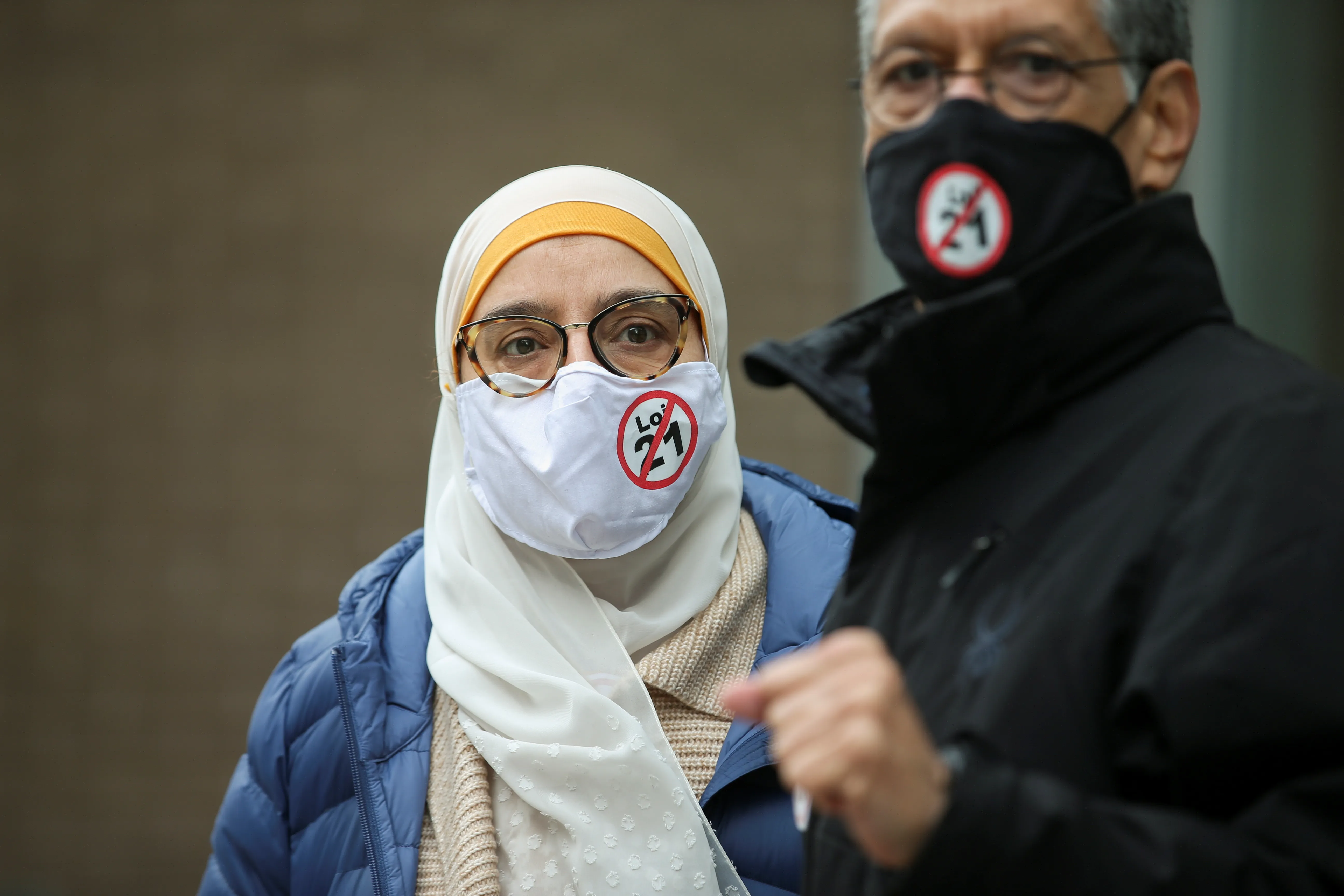
纳维恩·瓦利(Navien Waly)在自己孩子的学校做志愿服务已有十年,帮忙筹办义卖并参与毕业委员会的工作,直到她收到一封电子邮件,被告知不再欢迎她到场。
Navien Waly had been volunteering at her kids’ schools, helping out at bake sales and serving on graduation committees, for a decade when she received an email informing her that her presence was no longer welcome.
邮件称,根据魁北克省法律,佩戴宗教标志的家长不能再担任志愿者。瓦利在四年前、即40岁时开始佩戴头巾。
Under Quebec law, it said, parents who wore religious symbols could no longer volunteer. Waly had started wearing the hijab four years earlier, at age 40.
她说,这封电子邮件感觉像是一记“耳光”,当她两个习惯了母亲在学校出现的年幼孩子询问她做错了什么时,她很难回答。
She said the email felt like a “slap in the face” and that she struggled to respond when her two younger kids, who had got used to their mother’s presence at school, asked what she had done wrong.
“我和10年前是同一个人,”她说。“这并没有让我有任何不同。我从未谈论过我的宗教信仰。”
“I’m the same person I was 10 years ago,” she said. “It doesn’t make me any different. I’ve never spoken about my religion.”
这项法律还彻底打乱了她重返职场的计划。瓦利现年45岁,她曾放弃金融界的事业,去追求成为一名专业教育工作者的职业生涯。她本应于明年开始工作,但现在她表示,只要她继续佩戴头巾,她就无法从事她受过培训的工作。
The law also upended her plans to return to work. Waly, now 45, had left a career in finance to pursue a career as a specialised educator. She was supposed to start work next year, but now, she says she can’t do the work she was trained for as long as she continues to wear the hijab.
这封电子邮件背后的法律是第94号法案,它扩大了魁北克省最初在2019年通过第95号法案(注:原文为Bill 21)引入的限制。周五,加拿大最高法院将对针对该早期法律的一项诉讼做出裁决,该法律禁止公立学校教师、警察和某些其他公职人员在工作时佩戴宗教标志。
The law behind the email, Bill 94, expanded the restrictions that Quebec first introduced under Bill 21 in 2019. On Friday, Canada’s Supreme Court is set to rule on a challenge to that earlier law, which bans public school teachers, police officers and certain other public officials from wearing religious symbols on the job.
这一具有里程碑意义的裁决还可能阐明,政府在利用加拿大《权利与自由宪章》中的一项条款来保护法律免受某些权利诉讼挑战时,究竟可以行多远。“你的生计还是你最坚定的信念”在第21号法案通过以来的七年里,其影响在各个宗教少数群体中都能感受到,但对穆斯林女性而言尤其具有毁灭性。
The landmark ruling could also clarify how far governments can go in using a provision of Canada’s Charter of Rights and Freedoms to shield laws from certain rights challenges. ## ‘Your livelihood or your most deeply held convictions’In the seven years since Bill 21 passed, its impacts have been felt across religious minorities but have been particularly devastating for Muslim women.
在加拿大穆斯林全国委员会(NCCM)和约克大学研究员纳迪亚·哈桑(Nadia Hasan)的一份报告所开展的2022年至2023年调查中,接受调查的411名穆斯林女性中有73%表示,21号法案影响了她们的求职,同时48%的人认为她们因宗教身份而未能获得工作。
Advertisement In a survey conducted in 2022 and 2023 for a report by the National Council of Canadian Muslims (NCCM) and York University researcher Nadia Hasan, 73 percent of the 411 Muslim women surveyed said Bill 21 had impacted their job search, while 48 percent believed they didn’t get a job because of their religious identity.
加拿大穆斯林全国委员会首席执行官斯蒂芬·布朗表示,一些女性在上班时摘下头巾,下班后再戴上。他补充说,他曾与形容这种日常“极其羞辱”的女性交谈过。
Some women take their hijabs off when they get to work and put them back on when they leave, said National Council of Canadian Muslims chief executive Stephen Brown, adding that he’d spoken to women who described the routine as humiliating.
布朗说,被迫在“你的生计和你最深切的信念”之间做出选择,“是强加给人们的一种非人化且残酷的处境”。
Being made to choose between “your livelihood or your most deeply held convictions”, Brown said, “was a dehumanising and cruel situation to inflict on people”.
但该法律的影响不仅限于工作。在同一项调查中,88%的穆斯林女性表示,该法律使魁北克成为了一个不那么适宜居住的地方。
But the consequences of the law extend beyond work. In the same survey, 88 percent of Muslim women said the law had made Quebec a less welcoming place to live.
布朗表示,魁北克的一些穆斯林将这种氛围与他们在法国看到的情况进行了比较,在法国,“针对穆斯林的猎杀已经公开化”。
Brown said some Muslims in Quebec had compared the climate to what they see in France, where it’s “open season on Muslims”.
出生并在加拿大长大的瓦利表示,近年来,在魁北克关于宗教标志的政策出台以及她开始佩戴头巾的时期,“发生在我身上的事情是以前从未发生过的”。
Waly, who was born and raised in Canada, said in recent years, in the period coinciding with Quebec’s policies on religious symbols and her starting to wear the hijab, “things have happened to me that have never happened before”.
几个月前,她在一家杂货店结账时,身后的一个男人开始唱歌,内容是移民如何毁了他的生活。他唱着由于“像你这样的人”,他失去了工作,并在30岁时被迫退休。瓦利转过身去,用法语问他是不是在对她说话。她回忆说,那个男人的脸变红了。
A couple of months ago, she was at a grocery store checkout when a man behind her started singing about how immigrants had ruined his life. He sang that he’d lost his job and been forced to retire at age 30 because of “people like you”. Waly turned around and asked in French if he was talking to her. The man went red, she recalled.
近年来,她遇到了更多敌意的目光和种族主义言论,陌生人对她说:“回你的家去。”“什么家?这里就是我的家。”
In recent years, she’s encountered more hostile looks and racist comments, with strangers telling her: “Go back to your home.”“What home? This is my home.”
布朗表示,许多英语流利且能够到其他地方工作的魁北克穆斯林已经离开了该省,或者正计划离开。他说,对于只会法语的人来说,搬迁要困难得多。
Brown said many Muslim Quebecers who speak English and who can take their work elsewhere have left the province or are planning to. For those who only speak French, relocating can be much harder, he said.
人们也曾建议瓦利搬到另一个省。但她无法想象离开家人和自己长大的地方。她的父亲、兄弟、侄女和外甥都住在魁北克。
People have suggested to Waly that she move to another province, too. But she can’t imagine leaving her family and the place where she grew up. Her father, brothers, nieces and nephews all live in Quebec.
“在这里生活了45年之后,你不可能说走就走,连根拔起自己的整个生活。”第21号法案是如何出台的2019年魁北克推出第21号法案时,政府将其描述为解决该省长期关于世俗主义争论的温和方法。
“You can’t, after living here for 45 years, to just uproot your whole life.”## How Bill 21 came to be When Quebec introduced Bill 21 in 2019 , the government presented it as a moderate approach to settling the province’s long-running debate over secularism.
这场争论可追溯到20世纪60年代的寂静革命,当时魁北克开始将学校和医院等公共机构的控制权从天主教教会手中夺回。广告几十年后,关于这些机构应如何包容少数宗教群体的紧张局势催生了布沙尔-泰勒委员会。该委员会建议,禁止法官、警察和其他行使国家强制权力的人员在工作时佩戴宗教标志。
The debate goes back to the 1960s Quiet Revolution when Quebec began taking control of public institutions like schools and hospitals away from the Catholic Church. Advertisement Decades later, tensions over how those institutions should accommodate religious minorities led to the Bouchard-Taylor commission. The commission recommended that judges, police and others who exercise the coercive power of the state be barred from wearing religious symbols at work.
通过第21号法案,魁北克未来联盟政府将事态进一步推进,将公立学校教师也纳入了禁令范围。只要不更换工作或雇主,已经在职的人员可以继续佩戴宗教标志。
With Bill 21, the Coalition Avenir Quebec government took things further, bringing public school teachers under the ban. Those who were already in their posts could keep wearing religious symbols as long as they didn’t change jobs or employers.
在该法律通过几天后接受加拿大广播公司采访时,省长弗朗索瓦·勒戈尔为该法律进行了辩护,称多年来多数人在此问题上感到被忽视。“为了避免极端情况,你必须对多数人做出一些让步,”他说道,并暗示极右翼希望将事情推得更远,同时强调在街上仍然可以佩戴宗教标志。
In an interview with Radio-Canada days after the law passed, Premier Francois Legault defended it, saying the majority had felt ignored on the issue for years. “To avoid extremes, you have to give a bit to the majority,” he said, suggesting the far right would want to take things even further, and stressing that religious symbols could still be worn in the street.
该法律通过前的民意调查显示,64%的魁北克受访者支持该法案。
Polling ahead of the law passing found that 64 percent of respondents in Quebec supported the bill.
在布朗看来,这项在竞选期间制定的立法,旨在争取选票,利用人们长期以来对有组织宗教的不信任、反穆斯林情绪以及对魁北克法语文化未来的担忧。
In Brown’s view, the legislation, which was put together during an election campaign, was about getting votes, tapping into longstanding distrust of organised religion, anti-Muslim sentiment and fears about the future of Quebec’s French-speaking culture.
“把这些因素结合在一起,在选举期间推动选民支持该党时,它就成为一种非常有效的分裂手段,”他说。此后几年,魁北克将限制范围扩大到了法案21所涵盖职位之外。
“You combine those together, and it becomes a really effective wedge when it comes to driving support towards the party during elections,” he said. In the years since, Quebec has expanded the restrictions beyond the jobs covered by Bill 21.
2025年,法案94将宗教符号禁令扩展到学校支持人员和志愿者,包括像瓦利这样的家长。它还要求学生在学校保持面部不遮盖,并禁止在学校场所祈祷。
In 2025, Bill 94 extended the ban on religious symbols to school support staff and volunteers, including parents like Waly. It also required students to keep their faces uncovered at school and barred prayer on school premises.
今年早些时候,法案9将禁令扩展到托儿所工作人员,禁止在魁北克公立学院和大学遮盖面部,并限制人们在校园内祈祷的地点。新当选的魁北克党政府现在承诺禁止小学生在学校佩戴宗教符号。
And earlier this year, Bill 9 extended the symbols ban to include daycare staff, forbade face coverings at Quebec’s public colleges and universities, and restricted where people could pray on campus. The newly elected Parti Quebecois government has now pledged to ban elementary school students from wearing religious symbols in schools.
最高法院裁决的利害关系是什么?魁北克通过法案21时,使用了一项被称为“不适用条款”的规定,该条款允许政府维持一项法律,即使该法律侵犯了加拿大《权利与自由宪章》保护的某些权利,包括宗教信仰自由和平等权。该保护每次最长持续五年,可以续期。魁北克于2024年续期,称这是维护“社会和平”所必需的。
What’s at stake in the Supreme Court ruling? When Quebec passed Bill 21, it used a provision known as the notwithstanding clause, which lets governments keep a law in place even if it violates certain rights protected by Canada’s Charter of Rights and Freedoms, including freedom of religion and the right to equality. That protection lasts up to five years at a time and can be renewed. Quebec renewed it in 2024, saying it was needed to preserve “social peace”.
魁北克法院2021年裁定,该法律侵犯了佩戴宗教符号者的权利,但维持了该法的大部分内容,因为魁北克援引了不适用条款。魁北克上诉法院于2024年维持了该裁决,并推翻了对英语学校委员会的豁免。最高法院于3月审理了此案。
A Quebec court found in 2021 that the law infringed on the rights of people who wear religious symbols, but upheld most of the law because Quebec had invoked the notwithstanding clause. The Quebec Court of Appeal upheld the ruling in 2024 and reversed an exemption for English-language school boards. The Supreme Court heard the case in March.
加拿大全国穆斯林委员会、加拿大公民自由协会、世界锡克教组织及其他机构正在对该法律提出挑战。他们主张,尽管魁北克省动用了但书条款,该法律仍然违反了宪法权利。广告布朗表示,委员会希望法院判定在该案中动用该条款无效。
The NCCM, the Canadian Civil Liberties Association, the World Sikh Organization and others are challenging the law. They argue it violates constitutional rights despite Quebec’s use of the notwithstanding clause. Advertisement Brown said the council wants the court to invalidate the use of the clause in this case.
他表示:“但书条款应当是一项作为最后手段的非常权力,”并认为,在“政府为了政治利益而蓄意针对公民权利”的情况下,不应动用该条款。
“The notwithstanding clause is supposed to be an extraordinary power of last resort,” he said, arguing it should not be used in cases where “governments are deliberately targeting the rights of citizens for political gain”.
瓦利对法院会推翻该法律并不乐观,但她仍抱有一线希望,期盼自己不必从头来过。
Waly is not optimistic that the court will overturn the law, but is holding out hope that she won’t have to start over.
她说道:“在45岁的时候,开始考虑另一条路?我不知道自己该怎么办。总得有妥协的时候。”
“At 45 years old, to start thinking of another path? I don’t know what I’m going to do,” she said. “Something’s gotta give.”
但她为自己的孩子们感到担忧,他们现在正艰难应对这些限制对其未来可能意味着什么。她的大女儿曾谈到过有一天要戴希贾布(头巾),但现在她正在将此与自己可能想从事的工作进行权衡。
But she worries about her kids, who are now grappling with what the restrictions could mean for their future. Her oldest daughter had talked about wearing the hijab one day, but now she’s weighing it against jobs that she may want to do.
她回忆起女儿对她说的话:“‘要么我放弃所有这些我无法从事的不同职位,要么我就不戴希贾布。’”瓦利说:“一切都悬而未决。我对此没有答案。”
“‘Either I give up on all these different positions that I can’t do or I don’t wear the hijab,’” she recalled her daughter telling her. “And it’s just kind of up in the air,” said Waly. “I don’t have an answer for that.”