
无业增长通常是经济疲软的症状,但这一次经济因生产率提升而增长,劳动力却在萎缩,这改变了投资者应关注的重点。
Jobless growth is usually a symptom of a weak economy, but this time the economy is growing due to productivity gains even as the workforce shrinks, which changes what investors should watch.
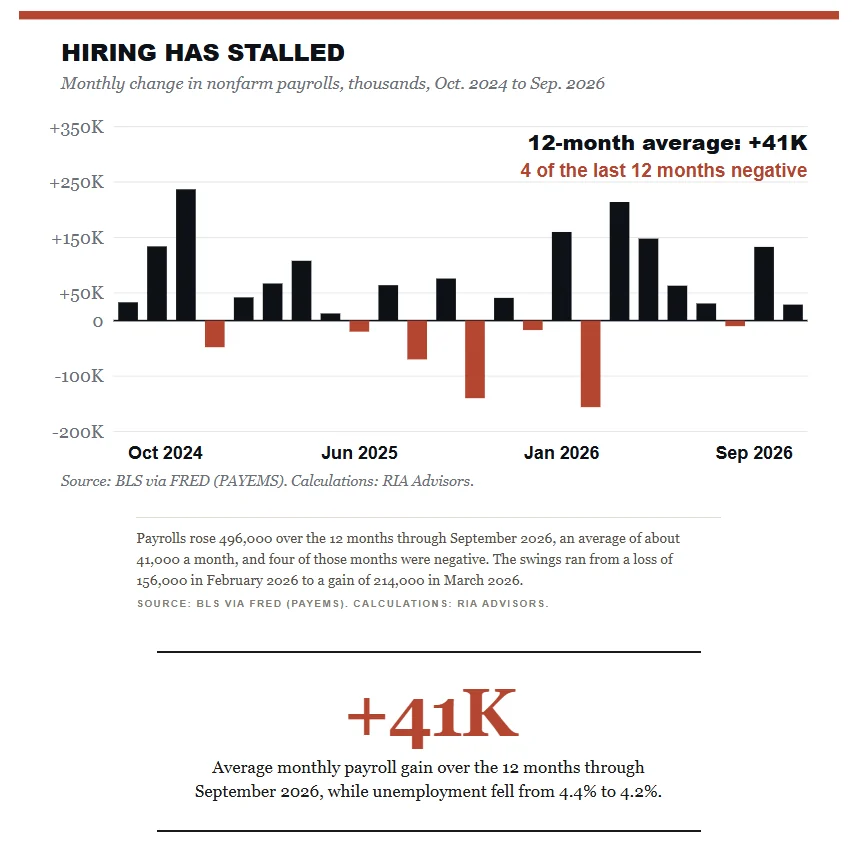
这是一种通常难以持久的组合。截至2026年第二季度的一年里,美国经济经通胀调整后增长了2.2%。大致同期,非农就业人数仅增长0.3%。截至9月的12个月里,平均每月新增就业约4.1万个,其中有4个月直接出现负增长。经济学家称之为“无业增长”,并视其为预警信号。
Here’s a combination that doesn’t usually last. Over the year to the second quarter of 2026, the U.S. economy grew 2.2% after inflation. Over roughly the same stretch, payroll employment grew 0.3%. Hiring averaged about 41,000 jobs a month over the 12 months through September, and four of those months were outright negative. Economists call this “jobless growth,” and it has a reputation as a warning sign.
这一名声并非空穴来风。历史上,无业增长出现在衰退之后,企业从更少的工人身上榨取更多产出,并拒绝招聘直到不得不招。再加上美国运通于10月23日宣布裁员3500人,“衰退将至”论调有了充足素材。然而,当你审视究竟是谁在离开劳动力市场时,这一版无业增长讲述了截然不同的故事,这对解读下一份就业报告至关重要。什么是无业增长?
The reputation is earned. Historically, jobless growth showed up after recessions, when companies squeezed more output from fewer workers and refused to hire until they had to. Add American Express announcing 3,500 job cuts on October 23 and the “recession is coming” crowd has plenty of material. However, when you look at who is actually leaving the labor force, this version of jobless growth tells a very different story, and it matters for how you read the next jobs report. What Is Jobless Growth?
无业增长顾名思义:经济按GDP衡量在扩张,而就业几乎不动。通常两者同步,因为更多产出需要更多工人。下图展示了六十年来这种关系。
Jobless growth is exactly what it sounds like: the economy expands, measured by GDP, while employment barely moves. Normally, the two travel together because more output requires more workers. The chart below shows that relationship over six decades.
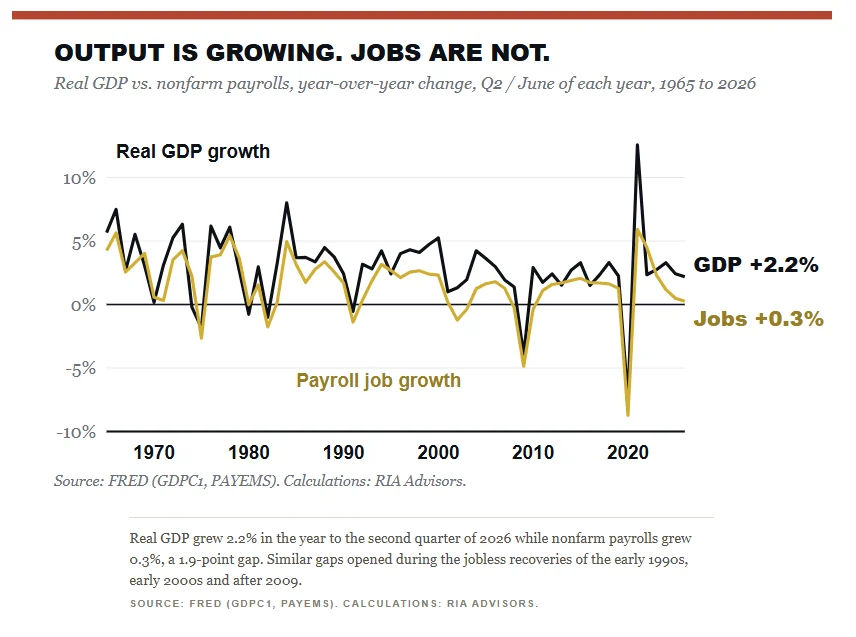
请注意上图中,金线通常追随黑线。差距出现在特定时期:1990年代初、2000年代初以及2009年后的几年。每一次都是“无业复苏”。企业刚经历衰退,需求疲软。企业通过让现有员工更努力工作来应对订单上升,而非增加人手。眼下的差距表面看相似。不同之处在于其下方的失业率。
Notice in the chart above that the gold line usually tracks the black one. The gaps open in specific places: the early 1990s, the early 2000s, and the years after 2009. Each of those was a “jobless recovery.”Businesses had just lived through a recession, and demand was soft. Companies met rising orders by working existing staff harder rather than adding headcount. Today’s gap looks similar on the surface. The difference is the unemployment rate sitting underneath it.
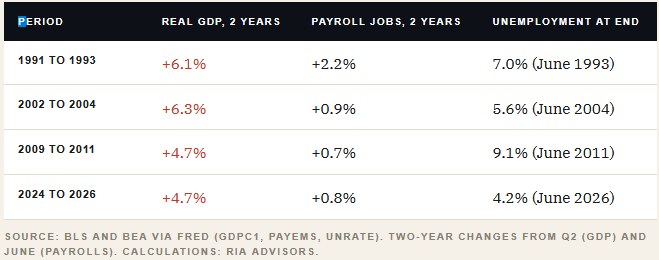
最后两行在增长和招聘方面几乎完全相同。2011年,“无就业增长”意味着数百万人想工作却找不到工作。2026年,它意味着找工作的人变少了。大多数关于“无就业增长”的报道都忽略了这一区别,而这完全改变了投资结论。
The last two rows are almost identical in growth and hiring. In 2011, jobless growth meant millions of people wanted work and couldn’t find it. In 2026, it means there are fewer people looking. Such is the distinction most of the “jobless growth” coverage misses, and it changes the investment conclusion entirely.
招聘停滞,但失业率未上升 如果疲软的招聘反映了对劳动力的疲软需求,失业率就会上升。但事实并非如此。
Hiring Stalled, But Unemployment Didn’t Rise If weak hiring reflected weak demand for workers, unemployment would be climbing. It isn’t.
失业率从2025年9月的4.4%降至2026年9月的4.2%。同期,文职劳动力减少约100万人,从约1.713亿降至1.703亿。当劳动力池在萎缩时,经济不需要创造太多新岗位就能维持失业率稳定。牛津经济研究院估计,维持失业率稳定所需的“盈亏平衡”就业增长速度现在接近于零。
The unemployment rate was 4.4% in September 2025 and 4.2% in September 2026. Over the same year, the civilian labor force shrank by roughly 1 million people, from about 171.3 million to 170.3 million. When the pool of workers is shrinking, an economy doesn’t need many new jobs to keep unemployment steady. Oxford Economics has estimated that the “break-even” pace of job growth needed to hold unemployment stable is now close to zero.
“那么,现在增加3万个就业岗位没问题吗?”孤立来看,这比劳动力仍在增长、新增劳动力需要新工作岗位时要不那么令人担忧。但未变的是趋势方向。萎缩的数字依然是萎缩的数字,正如我之前在《萨姆规则、就业与衰退指标》一文中所写,历史上标志着拐点的是失业率的变化,而非招聘水平。
“So a 30,000 jobs print is fine now?”In isolation, it’s far less alarming than it would have been when the labor force was still growing, and new workers needed new jobs. What hasn’t changed is the direction of travel. A shrinking number is still a shrinking number, and as I’ve written before in The Sahm Rule, Employment, And Recession Indicators, it’s the change in unemployment, not the level of hiring, that has historically marked the turn.
工人在消失,而非工作岗位 劳动力萎缩的最大原因是人口结构,且已积累多年。
The Workers Are Disappearing, Not The Jobs The biggest reason for the shrinking labor force is demographic, and it’s been building for years.
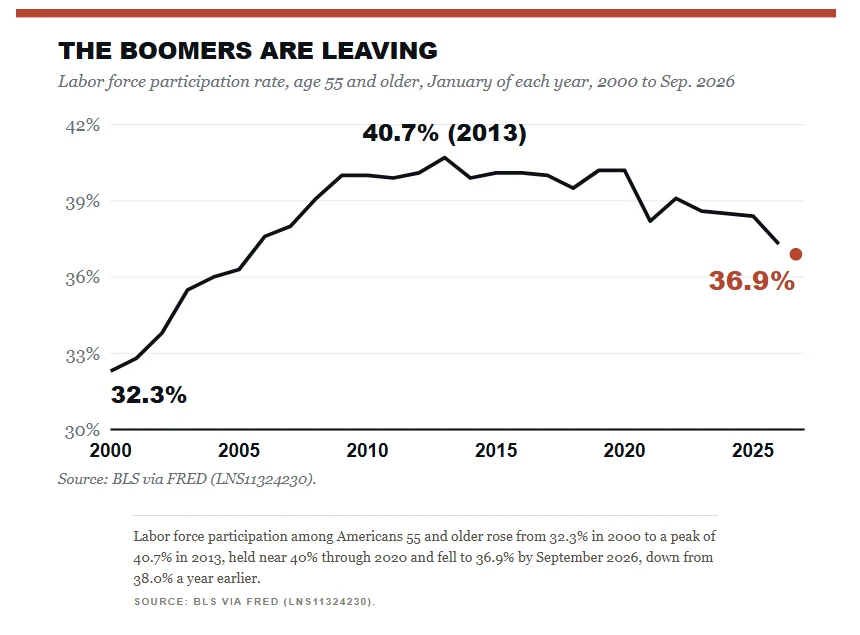
55岁及以上美国人的劳动力参与率从2000年的32.3%升至2013年峰值40.7%。婴儿潮一代的前沿群体比前几代人工作时间更长。该群体现在正在退出。参与率从一年前的38.0%降至2026年9月的36.9%。移民放缓加剧了这一趋势。牛津经济研究院预计,净流入可能降至每年仅16万人,而几年前曾超过300万。
Participation among Americans 55 and older climbed from 32.3% in 2000 to a peak of 40.7% in 2013. The leading edge of the baby boom was working longer than prior generations. That cohort is now leaving. Participation fell to 36.9% in September 2026, down from 38.0% just a year earlier. Slower immigration adds to it. Oxford Economics expected net inflows could fall to as little as 160,000 a year, from more than 3 million a few years ago.
这就是我与“无业务增长主要是AI故事”这一观点分道扬镳的地方。AI是真实存在的,且确实发挥了作用,但因果关系方向相反。当劳动力停止增长时,企业要想继续扩张,只有两条路:将工作转移到海外,或用技术取代劳动力。自动化是对劳动力萎缩的反应,而非其唯一成因。这两种反应从长远看都是抑制通胀的,这与我在《坏的通胀会自我治愈,好的通胀不会》一文中的宏观论点相吻合。
This is where I part company with the view that jobless growth is primarily an AI story. AI is real, and it plays a role, but the arrow runs the other way. When the labor force stops growing, businesses have only two ways to keep expanding: move the work offshore or replace it with technology. Automation is the response to a shrinking workforce, not the sole cause of it. Both responses are disinflationary over time, which fits the broader case I made in Bad Inflation Cures Itself. Good Inflation Doesn’t.
熊派观点站得住脚之处 另一方的论点确有道理。“低招聘、低裁员”的劳动力市场,只有在“低裁员”这一端守住的情况下才稳定。不招聘的企业也就没有积累缓冲垫,一旦开始裁员,招聘端缺乏动力去吸纳这些人员。
Where The Bears Have A Point The other side of this argument has real merit. A “low-hire, low-fire” labor market is stable only as long as the “low-fire” part holds. Companies that aren’t hiring also aren’t building a cushion, and if layoffs start, there’s little momentum in hiring to absorb them.
“劳动力市场是抵御衰退的主要防火墙。”——牛津经济研究院的Michael Pearce在接受《财富》杂志采访时表示,2026年2月 还有一个白领层面的细节。Burning Glass Institute的Gad Levanon发现,金融、保险、信息和专业服务业的就业人数在2022年11月见顶,尽管产出继续上升。他称AI赋能的自动化是“合理的促成因素”。
“The labor market is the main firewall against a recession.” – Michael Pearce, Oxford Economics, quoted in Fortune, February 2026 There’s also a white-collar wrinkle. Gad Levanon of the Burning Glass Institute found that employment in finance, insurance, information, and professional services peaked in November 2022, even as output continued to rise. He called AI-enabled automation a “plausible contributor.”
这些是高薪工作,其收入驱动着不成比例的消费支出份额。再加上过去一年中出现了四个月非农就业负增长,熊派并非捕风捉影。他们读的是和我一样的数据,只是从一个目前仍将失业率维持在4%左右的模式中,得出了更悲观的结论。生产率能否支撑经济?
Those are well-paid jobs, and their incomes drive a disproportionate share of consumer spending. Throw in four negative payroll months in the past year, and the bears aren’t making things up. They’re reading the same data I am. They just draw a darker conclusion from a pattern that, so far, has kept unemployment near 4%. Can Productivity Carry The Economy?

增长的数学逻辑很简单。产出等于工人数量乘以每个工人的产出。如果第一个数字持平或下降,一切就全赖第二个数字了。
The math of growth is simple. Output equals the number of workers times what each one produces. If the first number is flat or falling, everything rides on the second.


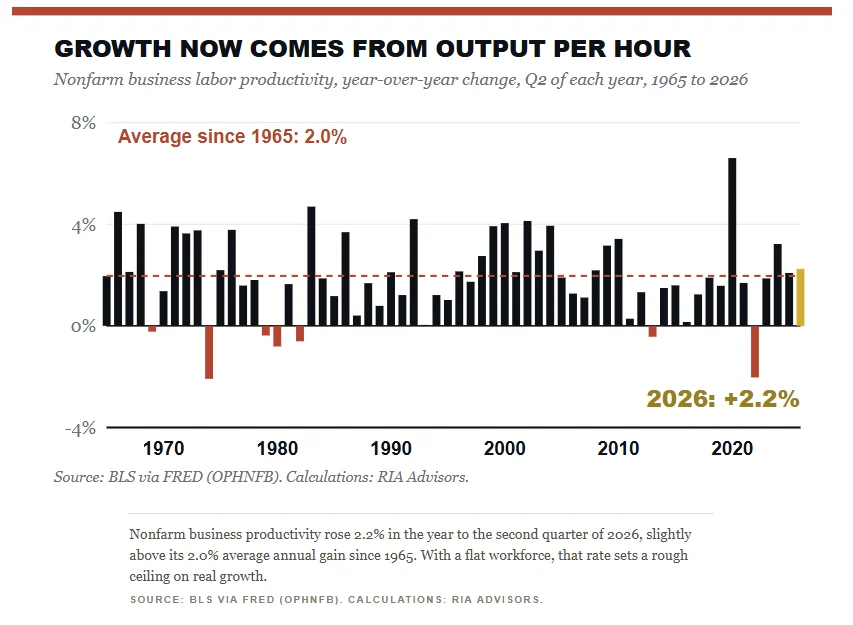
如图所示,截至2026年第二季度,生产率同比上升2.2%,略高于1965年以来2.0%的平均水平。这属于健康表现,但并非繁荣,且设定了一个上限。一个劳动力规模停滞、生产率增长2%的经济体,其真实增长的速度极限大约为2%,无论人工智能的头条新闻如何承诺。
As shown, productivity rose 2.2% over the year to the second quarter of 2026, slightly above its 2.0% average since 1965. That’s healthy, but it isn’t a boom, and it sets a ceiling. An economy with a flat workforce and 2% productivity growth has a speed limit of roughly 2% real growth, no matter what the AI headlines promise.
这一上限对市场双方都至关重要。对企业而言,在人数不变的情况下生产更多产品能改善利润率。对家庭而言,则是喜忧参半。当工资收入者数量不增长时,工资总收入增长放缓。消费支出随之更多地依赖现有工人的加薪和股市表现。夏威夷大学经济学家拜伦·甘尼斯(Byron Gangnes)在10月估计,人工智能建设对增长的直接贡献很小。他发现,更大的影响是通过股市的财富效应作用于消费支出。我在《财富效应增强与衰退风险》一文中分析了这一渠道有多脆弱。
That ceiling matters for both sides of the market. For corporations, producing more with the same headcount improves margins. For households, it’s a mixed bag. Total wage income grows more slowly when the number of wage earners isn’t growing. Consumer spending then leans harder on raises for existing workers and on the stock market. Economist Byron Gangnes at the University of Hawaii estimated in October that the AI buildout’s direct contribution to growth has been small. The bigger effect, he found, has come through the stock market’s wealth effect on spending. I covered how fragile that channel can be in Wealth Effect Increases And Recession Risks.
“过去‘无就业增长’意味着没人招聘。现在它意味着没人可招了,这是截然不同的问题。”——《无就业增长对投资者意味着什么》我有理由相信,劳动力萎缩是一个多年趋势,而非暂时波动。婴儿潮一代不会重返职场。这使得无就业增长在本十年剩余时间里更可能成为常态而非例外。我没那么有把握的是,经济能多平稳地完成调整。一个依赖资产价格支撑消费支出的市场,其稳定性仅取决于这些价格本身。
“Jobless growth used to mean nobody was hiring. Now it means nobody is left to hire, and that is a very different problem.”What Jobless Growth Means For Investors I’m reasonably confident the shrinking labor force is a multi-year trend, not a blip. Boomers aren’t coming back to work. That makes jobless growth more likely to be the norm than the exception for the rest of this decade. What I’m less confident about is how smoothly the economy adjusts. A market that depends on asset prices for consumer spending is only as stable as those prices.
从这一观点出发,有几个实际要点。首先,不要把疲弱的就业数据单独解读为衰退信号。由于盈亏平衡的就业增长接近零,失业率和失业救济申请才是更好的衡量指标。其次,要把经济与盈利区分开来。以生产率驱动的增长即使在招聘持平的情况下,也能支撑企业利润率。第三,要关注消费者。当收入增长缓慢时,支出对股市下跌的敏感度会提升,而这种反馈循环会双向运行。
A few practical points follow from that view. First, stop reading weak payroll numbers as a recession signal on their own. With break-even job growth near zero, the unemployment rate and jobless claims are far better gauges. Second, separate the economy from earnings. Productivity-driven growth can support corporate margins even when hiring is flat. Third, keep an eye on the consumer. When incomes grow slowly, spending becomes more sensitive to a drop in the stock market, and that feedback loop runs in BOTH directions.
权衡是真实存在的。依我看,通胀放缓、增长放慢的背景倾向于让高质量债券胜过激进的增长押注,但这也意味着如果冲击来临,经济的容错空间更小。这就是在没有新增劳动力的情况下增长的代价:通胀更为稳健,缓冲更为薄弱。
The trade-off is real. In my view, a disinflationary, slower-growth backdrop tends to favor high-quality bonds over aggressive growth bets, but it also means an economy with less room for error if a shock arrives. Such is the price of growing without new workers: steadier inflation, thinner cushions.
当日的失业人数增长更多反映的是劳动力规模在缩小,而不是经济崩溃,因此投资者应关注失业率、生产率和财富效应,而不是就业数据的标题。
Today’s jobless growth reflects a shrinking workforce more than a collapsing economy, so investors should watch unemployment, productivity, and the wealth effect rather than the payroll headline.
经济可以在没有新增劳动力的情况下继续增长,只是不能承受失去已有的劳动力。
The economy can keep growing without new workers. It just can’t afford to lose the ones it has.