10月的就业报告让头条衰退指标重新回到绿色,但“劳动力囤积”解释了为什么收益热潮仍未惠及全职员工。
October’s jobs report pushed the headline recession indicators back to green, but “labor hoarding” explains why the earnings boom still isn’t reaching full-time workers.
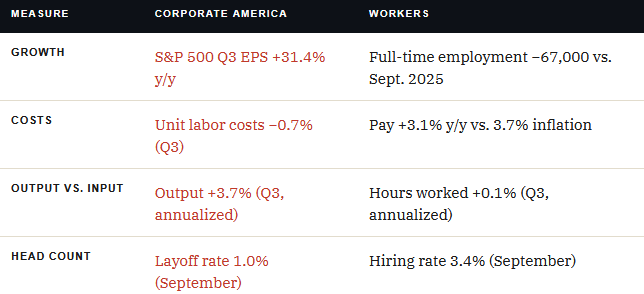
投资者目前面临的难题如下。标普500公司第三季度的收益增长预计将达到31.4%,这是连续第八个季度实现两位数增长。上周五,10月就业报告超越了所有预测,非农就业岗位增加16.5万个,失业率回落至4.1%。表面上看,衰退指标已转为绿色。但深入表面之下,就业质量讲述了另一个故事。值得回答的问题是:劳动力市场正在好转,还是公司仍在“囤积”劳动力,而利润承担了主要工作?
Here is the puzzle investors face right now. S&P 500 companies are on track to report 31.4% earnings growth for the third quarter, the eighth straight quarter of double-digit gains. Last Friday, the October jobs report beat every forecast, with payrolls up 165,000 and unemployment back down to 4.1%. On the surface, the recession indicators have turned green. Beneath the surface, the quality of the jobs tells a different story. Such is the question worth answering: is the labor market healing, or are companies still “hoarding” labor while profits do the heavy lifting?
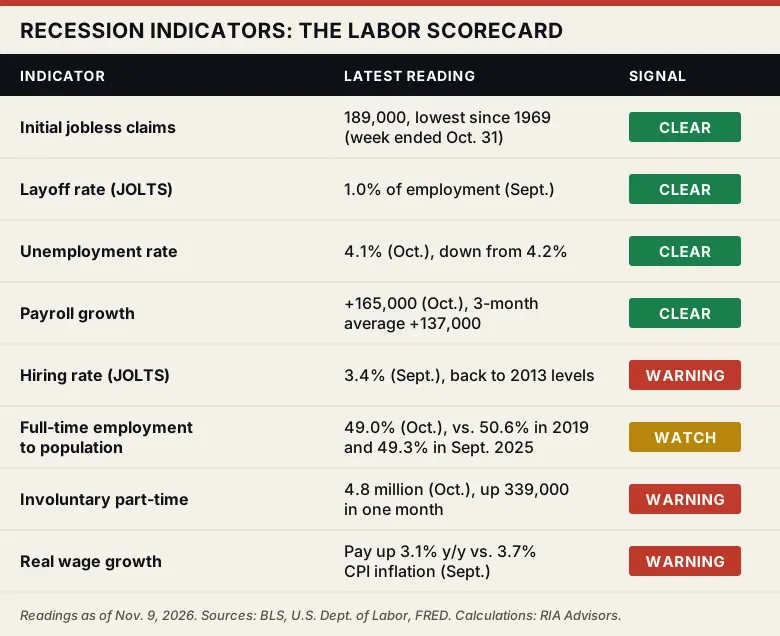
为什么衰退指标不一致让我们先从表示一切正常的经济指标开始。在最近的报告中:截至10月31日当周,初请失业金人数降至18.9万人,是自1969年以来的最低读数。
Why The Recession Indicators Disagree Let’s start with the economic indicators that say all is well. In the most recent reports: Initial jobless claims fell to 189,000 in the week ended October 31, the lowest reading since 1969.
职位空缺与劳动力流动调查(JOLTS)显示,9月的裁员率为1.0%,接近其25年历史的底部。10月非农就业岗位增加16.5万个,高于市场预期的6.5万个,且修正数据为8月和9月增加了8.4万个就业岗位。
The Job Openings and Labor Turnover Survey (JOLTS), which printed a layoff rate of 1.0% in September, near the floor of its 25-year history The October payrolls rose 165,000 against a consensus near 65,000, and revisions added 84,000 jobs to August and September.
换句话说,如果你唯一的衰退指标是裁员、失业金申请和头条非农就业人数,那么视野内根本看不到衰退。
In other words, if your only recession indicators are layoffs, claims, and the headline payroll count, there is no recession anywhere in sight.
现在看劳动力数据的另一半。JOLTS招聘率为3.4%,与2013年的平均水平持平,远低于2019年的3.9%增速。因找不到全职工作而从事兼职工作的人数在10月增加了33.9万人,达到480万人。失业六个月或更长时间的工人现在占失业者的27.6%。平均时薪较去年同期增长3.1%,仍低于3.7%的通胀率。
Now look at the other half of the labor data. The JOLTS hiring rate sits at 3.4%, in line with its 2013 average and well below the 3.9% pace of 2019. The number of people working part-time because they can’t find full-time work jumped by 339,000 in October to 4.8 million. Workers unemployed for six months or longer now make up 27.6% of the unemployed. Average hourly earnings grew 3.1% from a year earlier, still short of the 3.7% inflation rate.
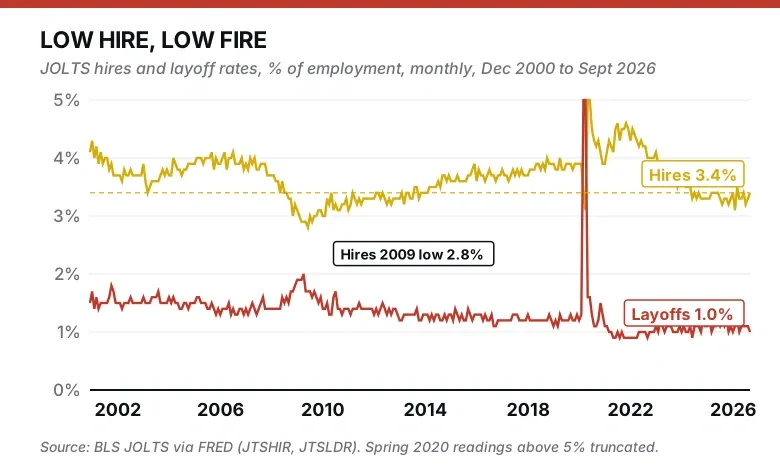
雇主并未裁员,且招聘的谨慎程度远超表面数据所暗示。这就是“低招聘、低裁员”经济,下图展示了这一组合的罕见程度。2009年,招聘崩塌,裁员激增,企业以最快速度裁减员工。如今,招聘放缓至2013年水平,而裁员接近历史低位。这两条曲线通常同向波动,但这一次并未如此。
Employers are not firing anyone, and they are hiring far more cautiously than the headline suggests. That is the “low hire, low fire” economy, and the chart below shows how unusual the combination is. In 2009, hiring collapsed as layoffs surged and companies shed workers as quickly as they could process paperwork. Today, hiring has slowed to 2013 levels with layoffs near record lows. The two lines usually move together. This time they are not.
劳动力囤积:我以前见过这出戏 2014年初,我撰文指出,表面就业数据忽略了核心问题。我的观点是,唯一重要的就业图表是全职就业占劳动年龄人口的比例。理由很简单:全职工作提供的工资支撑家庭组建、消费和税收。兼职工作和表面薪资总数则不然。
Labor Hoarding: I’ve Seen This Movie Before In early 2014, I wrote a piece arguing that the headline jobs data was missing the point. My view was that the only employment chart that mattered was full-time employment relative to the working-age population. The reason was simple. Full-time jobs pay the wages that support household formation, consumption and tax receipts. Part-time work and headline payroll counts don’t.
论点的核心在于一种我称为“劳动力囤积”的行为。金融危机后,企业已将成本压缩至骨子里,无法再进一步削减。原文写道:“此时,企业必须开始‘囤积’现有劳动力,最大化该劳动力的生产率(在劳动力成本极少增加的情况下提高产出),仅在需求迫使扩张时才增加劳动力,主要是临时工。”——兰斯·罗伯茨,《唯一重要的就业图表》,2014年将2014年的逆风替换为今天的关税和能源成本,上述描述几乎字字契合。
The argument centered on a behavior I called “labor hoarding.”Businesses had cut costs to the bone after the financial crisis and could cut no further. To wit: “At this point businesses have to begin to ‘hoard’ what labor they have, maximize that labor force’s productivity (increase output with minimal increases in labor costs) and hire additional labor, primarily temporary, only when demand forces expansion.”Lance Roberts, ” – The Only Employment Chart That Matters, 2014 Swap the 2014 headwinds for today’s tariffs and energy costs, and that description fits almost word for word.

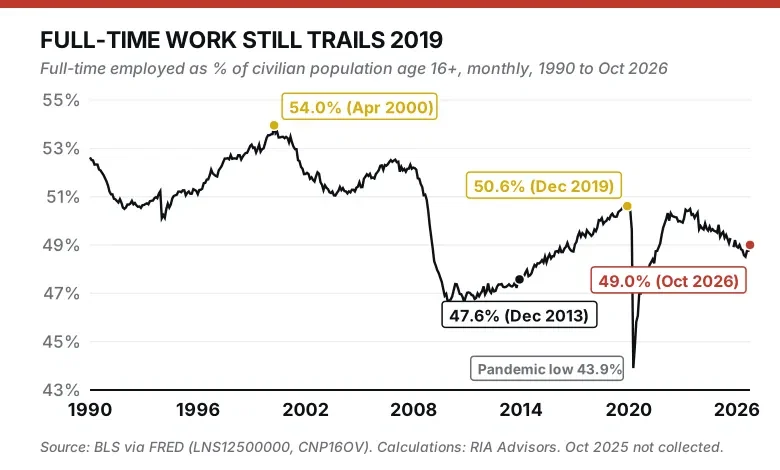
因此,让我们更新该图表。全职就业占16岁及以上平民人口的比例于2000年4月达到峰值54.0%。我撰文时为47.6%,至2019年底回升至50.6%。截至10月,该比例为49.0%,大致处于2016年水平,仍低于2025年9月的49.3%。
So let’s update the chart. Full-time employment as a share of the civilian population age 16 and over peaked at 54.0% in April 2000. It stood at 47.6% when I wrote that piece and recovered to 50.6% by the end of 2019. As of October, it’s 49.0%, roughly where it was in 2016 and still below September 2025’s 49.3%.
让我们深入剖析劳工统计局(BLS)10月的家庭调查。该报告显示全职工人增加了71.4万人,这是一个令人欣慰的迹象。然而,家庭调查月度波动幅度很大,单月数据不构成趋势。
Let’s dig into the BLS’s household survey for October. That report showed a jump of 714,000 full-time workers, a welcome sign. However, the household survey swings widely from month to month, and one month doesn’t make a trend.
该数据的关键在于:与2025年9月相比,全职工人仍减少了6.7万人。然而,同期劳动年龄人口却增长了近150万人。自2023年11月以来,全职就业仅增加了27.1万人,尽管劳动年龄美国人增加了790万。企业正在保住现有员工,极少增设新的全职岗位。称之为“正在复苏”的劳动力市场未免过于乐观。
What was important in that data was that there are still 67,000 fewer people working full-time than in September 2025. However, the working-age population has grown by nearly 1.5 million over the same period. Since November 2023, full-time employment has increased by just 271,000, even though there are 7.9 million more working-age Americans. Companies are protecting the workers they have and adding very few new full-time positions. Calling that a “healing” labor market is generous.
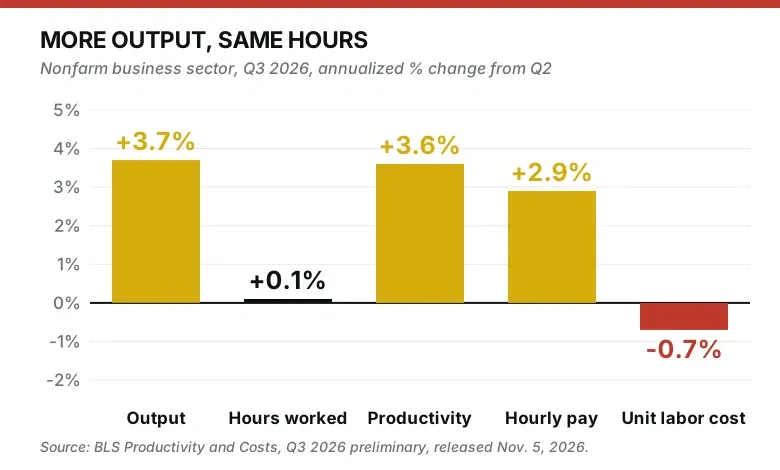
盈利激增究竟源自何处?如果企业没有增加全职工人,盈利为何能增长31%?部分答案上周揭晓。第三季度非农业生产率以3.6%的年化率上升,产出增长3.7%,工时仅增长0.1%。单位劳动力成本下降0.7%。换言之,企业在不增加工时成本的情况下生产了更多产品,差额直接转化为利润。
Where The Earnings Boom Actually Comes From If companies aren’t adding full-time workers, how are earnings growing 31%? Part of the answer arrived last week. Nonfarm productivity rose at a 3.6% annualized rate in the third quarter as output grew 3.7% and hours worked rose just 0.1%. Unit labor costs fell 0.7%. In other words, companies produced more without paying for more hours, and the difference dropped straight to the bottom line.
请关注这一数据。这是“囤积劳动力”教科书式的回报。剧本很简单:让利润率扩大。
Pay attention to this data. It is the textbook payoff from “labor hoarding.”The playbook is simple: Let margins expand.
对任何单一企业而言,这完全是理性行为。然而,当这种行为遍及整个经济时,意味着利润繁荣并未惠及工资单。
This is completely rational behavior for any single company. However, when it spans the entire economy, it means the profit boom is not reaching paychecks.
另一因素是集中度。本财报季,能源和信息技术板块带来最大的盈利超预期惊喜,截至10月中旬,美光科技和英伟达是标普500指数盈利增长的两大贡献者。油价高企推高了能源利润,而AI支出推高了芯片利润。
The other piece is concentration. Energy and Information Technology have delivered the biggest upside earnings surprises this season, and as of mid-October, Micron and NVIDIA were the two largest contributors to S&P 500 earnings growth. Elevated oil prices fattened energy profits, while AI spending fattened chip profits.
这两个行业的就业人数与其赚取的利润相比都不算多。正如我在《人工智能资本支出掩盖经济疲软》一文中所讨论的,狭窄的资本支出繁荣可以在更广泛的经济停滞时掩盖经济疲软。其中一些利润也因会计时点差异而被美化,这一点我在《人工智能资本支出折旧风险是创纪录盈利的隐患》一文中已指出。衰退要来了吗?
Neither industry employs many people relative to what it earns. As I discussed in “Capex Spending On AI Is Masking Economic Weakness,” a narrow capex boom can mask economic weakness while the broader economy stalls. Some of those profits are also flattered by accounting timing, a point I made in “AI Capex Depreciation Risk Is The Catch To Record Earnings.”Is A Recession Coming?
反驳我观点的理由这场辩论的另一方也有道理,10月的就业报告为其提供了更多弹药。非农就业人数超出所有预测,失业率回落至4.1%。9月职位空缺增加33.3万,空缺率升至4.5%。同期自愿离职人数升至18个月高点,通常意味着工人有足够信心跳槽。初请失业金人数处于57年低位,难以反驳。以下是一位策略师对周五数据的解读:“该报告有力反驳了经济正走向有意义放缓的担忧。”
The Case Against My View The other side of this debate has merit, and October’s jobs report handed it more ammunition. Payrolls beat every forecast, and unemployment fell back to 4.1%. Job openings rose by 333,000 in September, lifting the openings rate to 4.5%. Quits hit an 18-month high the same month, which usually means workers feel confident enough to leave. Claims at a 57-year low are hard to argue with. Here’s how one strategist read Friday’s numbers: “[The report] is a strong rebuttal to fears that the economy is heading into a meaningful slowdown.” – Seema Shah, Chief Global Strategist, Principal Asset Management Productivity growth is also good news in its own right.
——首席全球策略师Seema Shah,Principal Asset Management生产率增长本身也是个好消息。如果人工智能建设提高了每小时产出,经济就能在不增加工人、不增加通胀的情况下实现更快增长。
If the AI buildout is lifting output per hour, the economy can grow faster without adding workers or adding inflation.
“你在2014年也提出过同样的论点,结果经济又增长了六年。”是的,这是事实。然而,“囤积劳动力”本身不会导致衰退。它改变的是下一次衰退展开的方式。2014年,美联储将利率维持在零水平并实施量化宽松,这为企业赢得了数年时间来扩充员工队伍。10月28日,美联储将利率维持在3.75%-4.00%,且两名成员持不同意见,主张加息。周五报告发布后,投资者现在倾向于认为12月将加息。这一次没有零利率缓冲垫,无法为企业争取那种耐心。
“You made this same argument in 2014, and the economy kept growing for six more years.”Yes, that is true. However, the process of “labor hoarding” doesn’t cause a recession on its own. It changes HOW the next one unfolds. In 2014, the Fed held rates at zero and ran QE, which bought companies years to grow their workforces. On October 28, the Fed held rates at 3.75%-4.00%, and two members dissented in favor of a rate hike. After Friday’s report, investors now lean toward a December hike. There is no zero-rate cushion this time to buy companies that kind of patience.

对于投资者而言,让我们回到起点。请留意哪些衰退指标正在闪烁绿灯。它们是裁员人数和新闻标题计数。关键在于,薪资调查并不区分全职和兼职工作。在非自愿兼职工作激增33.9万的月份里,这一区别至关重要。此外,申请失业救济人数和裁员人数正是劳动力囤积所抑制的信号,因为囤积工人的公司在不得不裁员之前不会让任何人离职。一旦不得不裁,就会一次性裁掉很多人。当囤积结束时,申请人数不会缓慢上升,而是会跳升。
What These Recession Indicators Mean For Investors For investors, let’s go back to the beginning. Pay attention to which recession indicators are flashing green. They’re the layoff numbers and the headline counts. Crucially, the payroll survey doesn’t distinguish between full-time and part-time jobs. That distinction matters in a month when involuntary part-time work jumped by 339,000. Furthermore, both claims and layoffs are precisely the signals labor hoarding suppresses, because a company that hoards workers doesn’t let anyone go until it has to. Then it lets a lot of people go at once. When hoarding ends, claims don’t drift higher. They jump.


因此,最终迫使企业出手的将是利润率下滑。目前,生产率提升和单位劳动力成本下降正在保护利润。但3.1%的工资增速仍落后于3.7%的通胀率。正如我在《2026年实际工资:为何消费股首当其冲》中所阐述的,家庭正通过延长工时、减少储蓄和增加借贷来弥补缺口。
So, what will eventually force corporate hands is falling profit margins. For now, productivity gains and falling unit labor costs are protecting profits. But wage growth of 3.1% still trails inflation at 3.7%. As I laid out in “Real Wages 2026: Why Consumer Stocks Feel It First,” households are covering the gap with longer hours, less saving, and more credit.



风险正在于此。当需求疲软到产出停止增长、且再无生产率可供挖潜时,人数便成为唯一剩下的调节杠杆。一如既往,“低解雇”经济几乎一夜之间就会变成“高解雇”经济。
Therein lies the risk. When demand softens enough that output stops growing, and there’s no more productivity to squeeze, then headcount becomes the only lever left. As is always the case, a “low fire” economy turns into a “high fire” one almost overnight.
“劳动力囤积并不能阻止衰退。它只是推迟了裁员,然后一次性把所有裁员都释放出来。”对投资者而言,实际意义在于,支撑当前估值的盈利预期假设这种格局将持续下去。分析师预计第四季度增长28.4%,2026年全年增长33.3%。这些数字依赖于少数几个行业,以及依靠不招聘员工而建立起来的利润率。这使得现在成为一个好时机,来审视投资组合在那几家贡献这些盈利的公司上的集中程度。
“Labor hoarding doesn’t prevent a recession. It delays the layoffs, and then it delivers them all at once.”For investors, the practical point is that the earnings estimates underpinning today’s valuations assume this setup will persist. Analysts expect 28.4% growth in the fourth quarter and 33.3% for all of 2026. Those numbers depend on a narrow group of sectors and on margins built by not hiring. That makes this a good time to review how concentrated a portfolio is in the handful of companies producing those earnings.
提前知道哪个信号会让你改变看法也值得。对我来说,这个信号是每周申请失业金人数持续走高,尤其是持续申请失业金人数,该数字近期升至171.8万。申请失业金数据是最持久的衰退指标,因此当它们最终出现变动时,也是最重要的。
It’s also worth knowing in advance which signal would change your mind. For me, it’s a sustained break higher in weekly claims, particularly continuing claims, which recently ticked up to 1.718 million. Claims are the recession indicator that hoards the longest, which makes them the ones that matter most when they finally move.
底线 劳动力数据告诉你盈利繁荣能持续多久,答案是只能持续到公司能够继续避免招聘需求的时候。
Bottom Line The labor data tells you how long the earnings boom can last, and the answer is only as long as companies can keep avoiding the need to hire.
10月的就业报告为多头又争取了一个月。无论如何,还是要关注申请失业金数据。57年来最平静的裁员市场,也是容错空间最小的市场。本文回答的问题 目前最可靠的衰退指标是什么?
October’s jobs report bought the bulls another month. Watch the claims data anyway. The quietest layoff market in 57 years is also the one with the least room for error. Questions This Article Answers What are the most reliable recession indicators right now?
没有单一指标能单独发挥作用。目前,基于裁员的衰退指标(首次申请失业金人数为18.9万,裁员率为1.0%)以及总体非农就业和失业率数据看起来健康。招聘率、全职就业、非自愿兼职工作和实际工资则较弱。当这两组数据出现分歧时,从历史上看,招聘侧数据总是先转向。什么是劳动力囤积?
No single indicator works alone. Today the layoff-based recession indicators (initial claims at 189,000 and a 1.0% layoff rate) and the headline payroll and unemployment numbers look healthy. Hiring rates, full-time employment, involuntary part-time work, and real wages are weaker. When those two groups disagree, the hiring-side data has historically turned first. What is labor hoarding?
劳动力囤积是指公司保留现有员工而不裁员,但同时也避免招聘新员工,转而推动提高人均产出。它表现为低裁员、低招聘和生产率上升,这正是2026年数据中的模式。企业盈利为何在全职就业增长持平的情况下仍在上升?
Labor hoarding is when companies keep their existing workers rather than lay them off, but also avoid hiring new ones, and instead push for more output per worker. It shows up as low layoffs, low hiring, and rising productivity, which is the pattern in the 2026 data. Why are corporate earnings rising if full-time job growth is flat?
第三季度产出增长了3.7%,而工作时长仅增长了0.1%,因此生产率提升和单位劳动成本下降扩大了利润率。盈利增长还集中在能源和半导体行业,这些行业相对于其就业规模能够产生巨额利润。创纪录的低失业救济申请是否意味着不会出现衰退?
Third-quarter output rose 3.7% while hours worked rose just 0.1%, so productivity gains and falling unit labor costs widened margins. Earnings growth is also concentrated in energy and semiconductors, industries that generate large profits relative to their employment. Do record-low jobless claims mean no recession is coming?
未必。申请数据衡量的是裁员情况,而囤积劳动力的公司会等到利润率迫使它们裁员才会行动。这就是为什么在经济周期的后期,申请往往保持在低位,而一旦经济放缓到来,申请会迅速上升。
Not necessarily. Claims measure layoffs, and companies that hoard labor delay layoffs until margins force them. That is why claims often stay low late into a cycle and then rise quickly once a slowdown arrives.