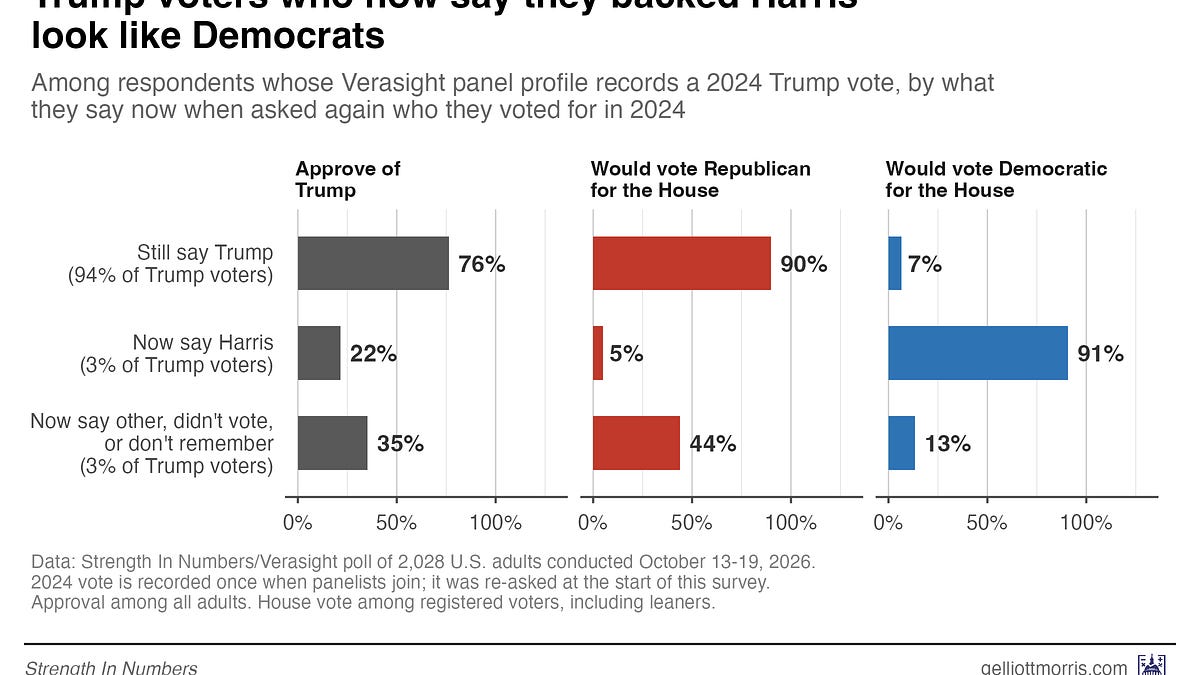
上个月,我指出美国人在报告自己2024年选举的投票情况时存在的错误,这种错误可能导致民意调查低估了民主党在众议院选举中的支持率。
Last month, I showed that error in how Americans report who they voted for in the 2024 election could be causing polls to underestimate support for the Democrats in the U.S. House generic ballot.
目前的情况是:许多民意调查机构会调整他们的样本数据,使得声称自己在2024年投票给特朗普的受访者比例与实际投票给特朗普的选民比例相匹配。然而,如果一些原本支持特朗普但后来对其失去信心的选民不再承认自己曾投票给他,那么那些仍然表示支持特朗普的受访者实际上比特朗普在2024年真正的支持者群体更加“忠诚”(即更倾向于支持他的政策)。如果将这些受访者的比例重新调整回特朗普在2024年实际获得的选票比例,就会人为地夸大选民中支持特朗普的群体的规模。
What’s going on here is that many pollsters now weight their samples so that the share of respondents who say they voted for Trump in 2024 matches the share of all voters who actually did. However, if some Trump voters who have soured on him stop saying they voted for him, the people still claiming a Trump vote are a more loyal group than Trump’s real 2024 coalition. Weighting them back up to Trump’s actual share of the 2024 vote would artificially inflate the size of the super-MAGA group of voters in the electorate.
当时,我只能推测这种影响的程度,并模拟其对民意调查结果的影响。根据我们8月份发布的《Strength In Numbers/Verasight》民意调查数据以及相关研究(这些研究探讨了人们误报自己过去投票行为的情况),我估计这种所谓的“回忆性投票偏差”使得民主党在众议院选举中的领先优势减少了约0.8个百分点。
At the time, I could only speculate about the size of the effect and simulate its effect on the polls. Using our August Strength In Numbers/Verasight polling data and published research on how often people misreport their past votes, I estimated this so-called “recalled vote bias” was shrinking Democrats’ lead on the generic congressional ballot by about 0.8 points.
本月,在我们10月份的《Strength In Numbers/Verasight》民意调查中,我们收集了更多数据来直接评估这种“回忆性投票偏差”的实际影响。由于Verasight平台会在受访者注册参与调查时记录他们的投票信息,因此我们可以将他们当前的回答(即他们“当时的回忆”)与他们个人资料中存储的投票信息进行比对,从而识别出那些改变了投票意向的受访者及其政治倾向。
This month, in our October Strength In Numbers/Verasight poll, we gathered the data to estimate the impact of recall bias directly. Because Verasight records each panelist’s 2024 vote when they sign up to take surveys on the platform, we can compare each person’s answer today (their “contemporaneous recall”) with their response stored in their panel profile (their “profile recall”), and identify any switchers and their political leanings.
我们掌握了所有 2,028 名受访者当时的投票记录以及他们的个人资料信息。其中大多数人两次给出的回答都是一样的;不过有一小部分受访者的投票意愿确实发生了变化(这一变化在统计学上具有显著性)。在我们的全国性样本中,约有 3% 的受访者原本表示自己投票给了特朗普,但现在却改称自己投票给了哈里斯——这一比例是那些原本表示投票给哈里斯的受访者改称投票给特朗普的比例的两倍多。
We have both the contemporaneous and profile recall for all 2,028 respondents in our poll. Most of them gave the same answer twice, but a small and statistically meaningful group did change their recalled past vote. In our national sample, about 3% of the people whose profile says they voted for Trump now say they voted for Harris, more than twice the rate at which Harris voters now claim Trump.
那些原本投票给特朗普、现在却改称投票给哈里斯的受访者,大多对特朗普的总统表现表示不满;几乎所有人都计划在今年秋季再次投票给民主党。
The Trump voters who now say they voted for Harris mostly disapprove of the job he is doing as president, and nearly all of them plan to vote for Democrats this fall.
下表展示了受访者们的投票意愿随时间的变化情况:约 96% 的哈里斯的支持者仍然表示自己投票给了哈里斯,只有 4% 的人改变了他们的投票选择(其中 1.4% 的人改投了特朗普)。而在那些原本投票给特朗普的受访者中,仍有 94% 的人坚持自己的选择,只有 6% 的人改变了投票意向(其中包括那 3.2% 从特朗普转而支持哈里斯的受访者)。
The table below visualizes how respondents are changing their vote recall over time. About 96% of Harris voters still say they voted Harris and 4% changed, with 1.4% now saying they voted for Trump. And 94% of 2024 Trump voters still say they voted for him, while 6% have changed, including those 3.2% that have gone from Trump to Harris.
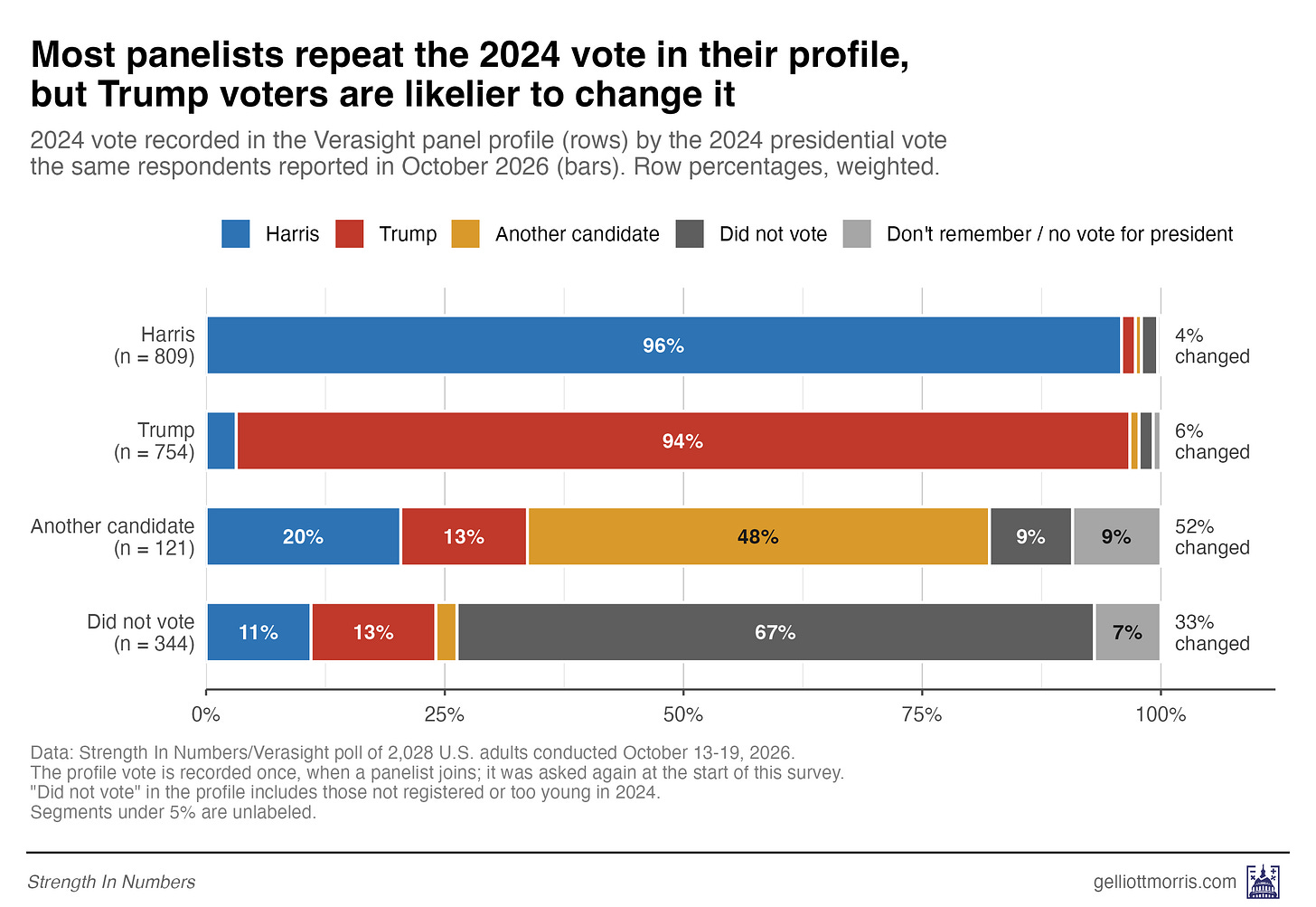
这些数据虽然数量较少(在我们的样本中,只有 22 人从特朗普转投哈里斯,另有 11 人从哈里斯转投特朗普),但相关数据仍具有一定的参考价值。无论是在加权数据还是未加权数据中,无论是在登记选民中,还是按年龄、性别和种族进行分类后,这一变化趋势都普遍存在。
Those are small numbers — 22 people moved from Trump to Harris in our sample, and 11 moved the other way — so the attitude figures below come with wide margins of error. But the pattern holds across the main cuts of the October data we looked at: weighted or unweighted, among registered voters, and by age, gender, and race.
那么,现在我们最想了解的是:这种变化会对我们关于 11 月大选的民意调查结果产生多大的影响?这种变化会导致总体投票意向出现多大程度的偏差呢?是 1% 的差距?2%?还是 3%?
But now for the question we all want answered: how much does this impact our poll’s topline vote intention for November? Are we talking about the generic ballot being one point off? Two? three?