英国政治的一大幻想是,该国无需增税即可维持类似当下的福利国家。看来,约翰·希利将成为最新一位在10月28日预算案中兜售这一虚构说法的财政大臣。税收占雇佣一名英国普通单身人士成本的32%,比富裕国家平均水平低三个百分点。然而,公民却指望享受全方位的福利国家待遇,包括免费医疗和全民养老金。本世纪以来,历届政府之所以能维持这桩“走运的买卖”,全靠对高收入者重税、在国防上吝啬、任由公共服务恶化——以及大举借债。
One of the great fantasies of British politics is that the country can sustain a welfare state similar to today’s without raising taxes. It looks as if John Healey will be the latest chancellor to peddle this fiction, at his budget on October 28th. Taxes account for 32% of the cost to employ an average single Briton, three percentage points less than the rich-world average. Yet in return citizens expect a full-service welfare state, including free health care and universal pensions. Successive governments this century have funded this jammy deal only by taxing high earners hard, skimping on defence, letting public services deteriorate—and borrowing a fortune.
这一策略已山穷水尽。疲软的增长与人口老龄化,加上日益动荡的地缘政治局势,正将公共财政推向近乎崩溃的边缘。未能正视这些现实,导致英国近几份预算案都笼罩着长期危机的气氛,一位接一位财政大臣忙于填补长期存在的缺口。希利的预算案正酝酿成该类剧目的经典之作:在整个体制都有缺陷的情况下,仅在小额增税上打转。艰难的抉择似乎将被推迟到明年的支出审查。
This strategy is running out of road. Poor growth and an ageing population, combined with increasing geopolitical turmoil, are stretching the public finances far too close to breaking point. Failure to reckon with these realities has given Britain’s past few budgets an air of perpetual crisis, with one chancellor after another scrambling to make up perennial shortfalls. Mr Healey’s budget is shaping up to be a classic of the genre, fiddling with small tax rises when in fact the whole system is flawed. Difficult decisions seem set to be postponed until a spending review next year.
背景黯淡。英国十年期借贷成本已升至5.4%,高于预算责任办公室(OBR)3月最新预测时的4.4%。这在一定程度上是因为伊朗战争推高了能源价格,但许多其他因素——从政府过度借贷到全球资本需求激增——意味着债券收益率短期内不太可能下降。智库“决心基金会”估计,与先前假设相比,政府在截至2030财年将需多支付140亿英镑(190亿美元,约占GDP的0.4%)的债务利息。
The backdrop is bleak. Britain’s ten-year borrowing cost has risen to 5.4%, from 4.4% at the latest forecast by the Office for Budget Responsibility (OBR) in March. That is partly because the Iran war has raised energy prices, but many other factors—from outsize government borrowing to surging global demand for capital—mean bond yields are unlikely to fall soon. The Resolution Foundation, a think-tank, reckons the government will need to spend £14bn ($19bn, or 0.4% of GDP) more on debt interest in the fiscal year to 2030 than previously assumed.
希利已承诺遵守财政规则,确保三年内日常开支完全由税收覆盖,届时债务占GDP的比例也将下降。3月份的预测显示,他将以240亿英镑的盈余空间遵守这些规则,但决议基金会估计仅剩120亿英镑。(其他预测则较为乐观。)财政大臣还表示,其预算将维持一笔应对不确定性的财务“缓冲”,并给民众留出一点“喘息空间”。
Mr Healey has signed up to fiscal rules ensuring day-to-day spending is fully covered by taxes in three years’ time, with debt also falling as a percentage of GDP by then. In March he was forecast to follow these rules with £24bn to spare, but the Resolution Foundation reckons only £12bn remains. (Other forecasts are sunnier.) The chancellor has also said his budget will maintain a financial “buffer against uncertainty” and give people a “bit of breathing space”.
这表明他将提供生活成本援助,例如通过针对性的能源账单补贴,或推迟原定的燃油税上调。视其具体选择而定,预计到2030年税收将适度上升,很可能通过对银行或赌徒征收更高税费等小幅措施实现。
This suggests he will dispense help with the cost of living, through targeted subsidies for energy bills, for instance, or by postponing a planned rise in fuel duty. Depending on his exact choices, expect taxes to rise modestly by 2030, probably via small-ish measures such as higher levies on banks or gamblers.
一份低调的预算案并非灾难。若希利沿用其前任雷切尔·里夫斯3月制定的计划,赤字将从上一财年的GDP的4.4%降至2030年的1.8%。相比之下,法国有望在2026年录得GDP的5.4%赤字,此前其目标为5%。
A low-drama budget would be no disaster. If Mr Healey stuck to plans made by his predecessor, Rachel Reeves, in March, the deficit would fall from 4.4% of GDP in the past fiscal year to 1.8% by 2030. France, in contrast, is on track to run a deficit of 5.4% of GDP in 2026, having aimed for 5%.
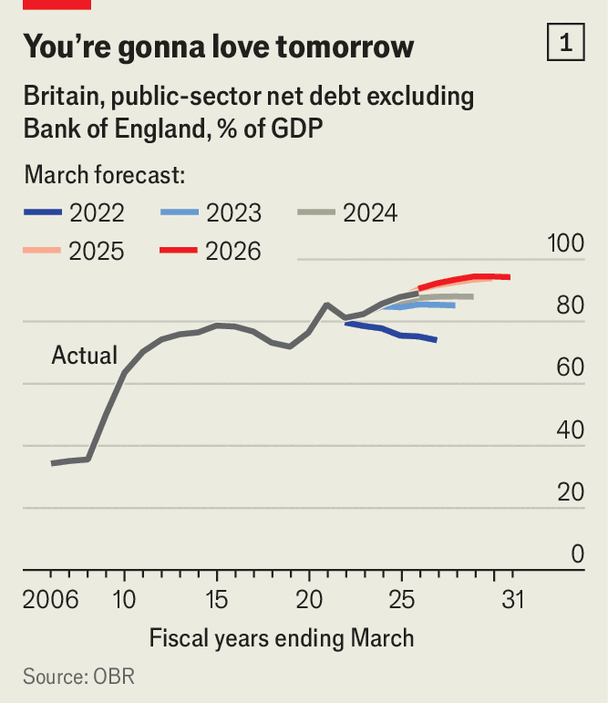
但英国应当力求做得比击败法国更多,遵守财政规则的字面要求并不意味着其公共财政状况良好。规则本身宽松得令人咋舌,从未要求赤字或债务实际下降。只需预测在三至五年内下降即可——因此财政部总能通过承诺随后却未能兑现的节制来规避艰难抉择(见表1)。这似乎很可能再次发生:计划依赖许多部门预算的实际削减,而鲜有人预期这些削减会真正落实。
But Britain should try to do more than beat the French, and abiding by the letter of the fiscal rules does not mean its public finances are in good repair. The rules themselves are eyebrow-raisingly loose, never requiring deficits or debts to actually fall. They need only be forecast to fall in three to five years—so the Treasury can always dodge hard choices by promising restraint that then fails to arrive (see chart 1). This looks likely to happen again: plans rely on real-terms cuts to many departments’ budgets that few expect to happen.
英国的债务问题就像一个“棘轮”一样:每当遇到危机时,债务就会急剧上升,而且很难再大幅下降。目前,不包括英格兰银行资产负债表在内的债务总额已占国内生产总值(GDP)的92%,而这一比例在新冠疫情之前为76%,在2007-2009年的金融危机之前仅为36%。由于债券收益率上升,偿还这些债务的成本变得非常高昂;政府的年度利息支出自疫情以来已经翻了一番多,达到了1090亿英镑,占政府总支出的8%,甚至超过了整个国防预算的规模。因此,下次遇到危机时,英国可能会难以通过举债来摆脱困境。
And so Britain’s debt is like a ratchet, jumping up at every crisis and never coming back down by much. Debt, excluding the Bank of England’s balance sheet, is now 92% of GDP, up from 76% before the covid-19 pandemic and 36% before the financial crisis of 2007-09. Higher bond yields have made servicing this debt painful. The government’s annual interest bill has more than doubled since the pandemic, to £109bn. That is 8% of government spending, more than the entire defence budget. When crisis next strikes, therefore, Britain may struggle to borrow its way out.
英国之所以无法偿还债务,根本原因在于民众对政府职能的期望与他们愿意支付的税款之间存在严重矛盾。到2027财年,政府支出将占GDP的45%,而这一比例在新冠疫情之前仅为39%。智库机构“财政研究学会”(Institute for Fiscal Studies, IFS)指出,上一次公共支出维持在如此高水平是在第二次世界大战期间。
The country’s failure to pay off its debts stems from a mismatch between the state Britons want and the taxes they are willing to pay. Government spending will constitute 45% of GDP in the fiscal year to 2027, up from 39% before covid. The Institute for Fiscal Studies (IFS), a think-tank, points out that the last time public spending was sustained at such a high level was during the second world war.
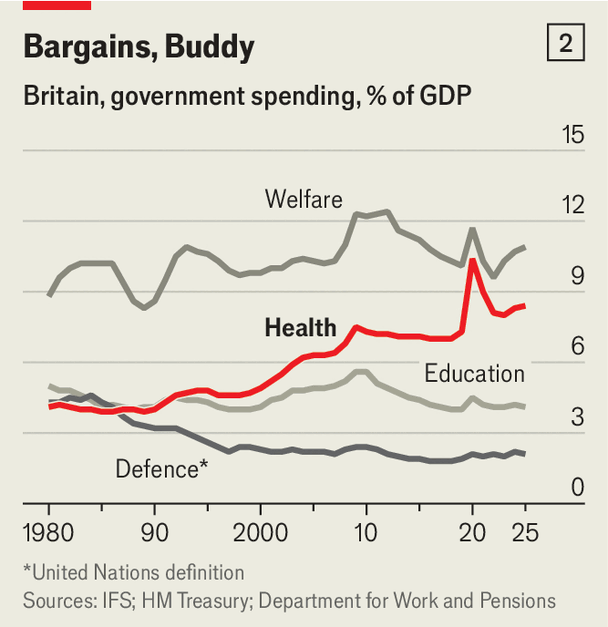
其中最大的问题在于英国的国民医疗服务体系(National Health Service, NHS)。目前,政府在医疗保健上的支出占GDP的8.4%,而这一比例在2000年仅为4.9%(见图表2)。随着人口老龄化以及医疗行业生产力的滞后,这一比例还会继续上升。英国预算办公室(Office for Budget Responsibility, OBR)预计,到21世纪70年代,医疗保健支出可能会占到GDP的13%。
The biggest culprit is the National Health Service. The state forks out 8.4% of GDP on health care, up from 4.9% in 2000 (see chart 2). As the population ages, and as the sector’s productivity lags behind the wider economy’s, this share will climb. The OBR reckons that health-care spending could reach 13% of GDP by the 2070s.
此外,越来越多的老年人需要食品、住房和社会关怀服务。英国预算办公室曾预测,仅养老金支出一项,从2031年起就可能从GDP的5%上升到21世纪70年代的9%。现任首相安迪·伯纳姆(Andy Burnham)表示,他将调整现有的养老金制度(该制度每年都会提高养老金金额),使其在2030年之后不再那么慷慨。不过,任何节省下来的资金都会被他提出的新国民护理服务计划(National Care Service)所消耗掉。
A growing cohort of geriatrics also needs food, accommodation and social care. In July the OBR thought spending on the state pension alone could rise from 5% of GDP by 2031 to 9% by the 2070s. Andy Burnham, the prime minister, has since said he will tweak the “triple lock”, which raises the state pension each year, to make it slightly less generous after 2030. But any savings will be swallowed by his plans for a new National Care Service.
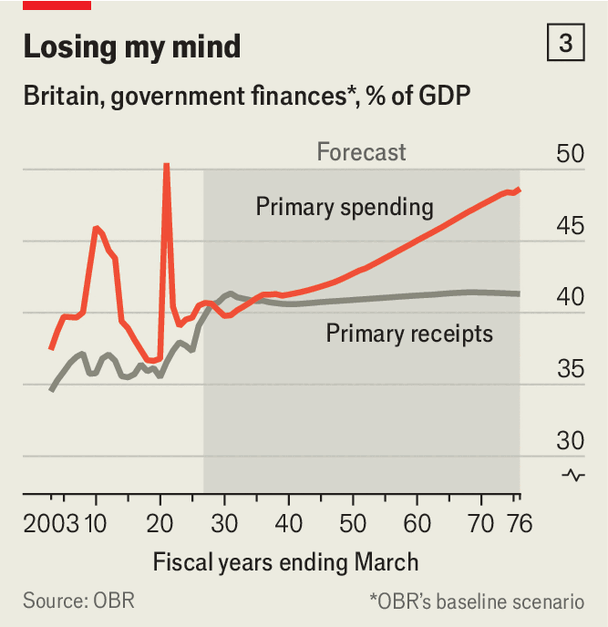
英国过去通过削减国防开支来为福利国家提供经费。来自俄罗斯和中国的威胁意味着这一做法已不再可行。政府承诺到2035年将国防支出提升至GDP的3.5%,高于截至2028财年的2.7%。英国预算办公室估算,除利息支付外的政府支出可能从2030年的GDP的40%上升至2070年代的49%。如果收入保持不变,英国债务将急剧膨胀(见图表3)。
Britain used to pay for its welfare state by spending less on defence. Threats from Russia and China mean that is no longer an option. The government has pledged to spend 3.5% of GDP on defence by 2035, up from 2.7% in the fiscal year to 2028. In total, the OBR thinks that government spending excluding interest payments could rise from 40% of GDP in 2030 to 49% by the 2070s. If revenues stayed constant, Britain’s debt would balloon (see chart 3).
如果债务危机迫在眉睫,政府将采取行动。但提前行动的动机较弱,因为没人知道危机何时会到来。一次增长冲刺,或许由人工智能推动,可能会推迟清算(尽管这可能也会提高借贷成本)。然而,英国人口老龄化意味着清算终将到来。届时,一个选项是大幅削减支出:比如降低国家养老金,或收紧残疾福利的资格。一个勇敢的政府甚至可能开始向患者收取预约医生的费用。
Should an imminent debt crisis loom, the government would take action. But the incentive to move early is weak because no one knows when this might happen. A growth spurt, perhaps fuelled by artificial intelligence, may postpone the reckoning (though it would probably also raise borrowing costs). The ageing of Britain’s population nevertheless means a reckoning is coming. When it does, one option would be drastic cuts to spending: reducing the state pension, say, or tightening eligibility for disability benefits. A brave government might even start charging patients to book a doctor’s appointment.
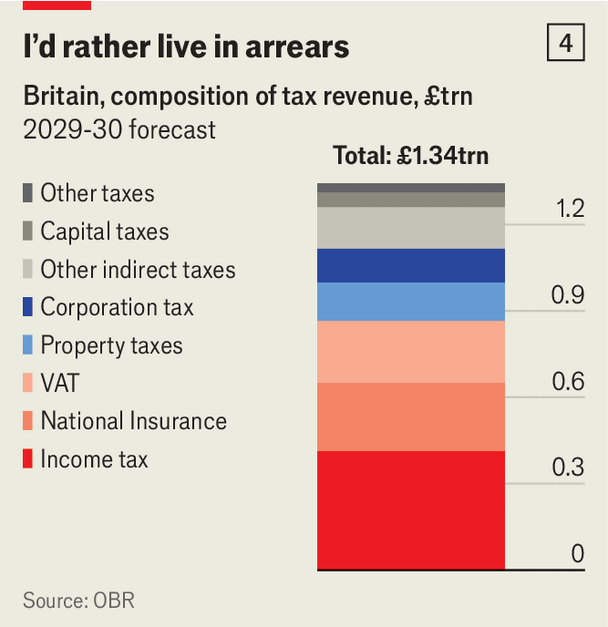
另一种选择是重新思考税收体系。自2024年执政以来,工党受到其愚蠢的宣言承诺——不提高所得税、国民保险、增值税或公司税——的限制。这些税种占税收收入的70%以上。工党已经打破了这一承诺,尤其是提高了雇主缴纳的国民保险。预计到2030年,税收总额将占GDP的38%,为自1940年代以来的最高水平。
The alternative is rethinking the tax system. Since coming to power in 2024 Labour has been constrained by its foolish manifesto pledge not to increase income tax, national insurance, value-added tax (VAT) or corporation tax. These account for over 70% of tax revenue. Labour has already broken its promise, notably by raising the national insurance paid by employers. The total tax take is forecast to be 38% of GDP by 2030, the highest since the 1940s.
希利先生将不愿再次违背工党的宣言承诺。但如果他的党不想削减长期支出,就必须重新考虑政府的收入来源。一部分资金可以来自对富人的更高税收。财政大臣可以,例如,重新调整资本利得税,以从异常高的投资回报中抽取更多。目前,他据报道已拒绝了一些工党议员提出的提高资本利得税的呼声。
Mr Healey will be loth to break Labour’s manifesto pledge again. But if his party does not want to cut long-term spending it will have to reconsider how the government raises revenue. Some cash could come from higher taxes on the rich. The chancellor could, say, rejig capital-gains tax to skim more from unusually high investment returns. For now, however, he has reportedly rejected calls from some Labour MPs to raise capital-gains tax.
无论如何,对财富征收更高的税,都无法为英国人已经习以为常的那种福利国家提供资金。要做到这一点,政客和选民就必须接受,社会中的广大群体需要开始多作贡献。这可能意味着取消一长串免征增值税的商品清单,例如许多服装和食品。这些豁免每年总共让国家损失700亿英镑。或者,政府也可以提高中低收入者缴纳所得税的水平。
In any case, higher levies on wealth would not fund the sort of welfare state Britons have become accustomed to. For that, politicians and voters would have to accept that broad swathes of society need to start contributing more. This could involve ditching the list of products, such as many clothing and food products, which are exempt from VAT. Altogether, these exemptions cost the state £70bn a year. Or the government could raise the level of income tax paid by low and middle earners.
这些选项在政治上都没有吸引力。但英国的财政清算可能宜早不宜迟。明年的支出审查将确定至少随后三年的部门预算。今年早些时候,当希利先生担任国防大臣时,他说到2030年将国防开支提高到GDP的3%至关重要。后来,由于财政部拒绝,他辞职了。财政研究所估计,要实现这一目标,同时增加医疗保健支出并避免其他实际削减,到2030年每年将额外花费350亿英镑。
None of these options is politically appealing. But Britain’s fiscal reckoning might come sooner rather than later. Next year’s spending review will set departmental budgets for at least the following three. Earlier this year, when Mr Healey was defence secretary, he said it was crucial for defence spending to rise to 3% of GDP by 2030. He then resigned when the Treasury refused. The IFS reckons that meeting this target, while raising health-care spending and avoiding other real-terms cuts, would cost an extra £35bn a year by 2030.
要理解这一成本的规模,可以想见,为其提供资金相当于将所得税基本税率从20%提高到约24%。如果——看起来很可能如此——希利先生在10月28日只是在边缘上做些小修小补,他或许还能在一段时间内蒙混过关。但最终,这笔账总是要还的。
To grasp the scale of this cost, consider that funding it would be equivalent to raising the basic rate of income tax from 20% to about 24%. If—as looks likely—Mr Healey instead fiddles at the edges on October 28th, he may get away with it for a while. Eventually, though, the bill will fall due.