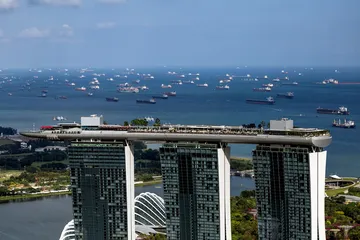
在晴朗的日子里,站在新加坡滨海湾金沙酒店顶上,你可以一眼看到这个城市国家的希望与危机。
Stand on a clear day atop Singapore’s Marina Bay Sands hotel, and you can see the city-state’s promise and peril in a single glance.
近处,一队船只停泊在锚地,这是一个有形的提醒,提醒人们新加坡是如何通过为挤过其狭窄海峡的大量全球贸易提供服务而致富的。在地平线上,你只能勉强辨认出印度尼西亚的海岸线。印尼的人口几乎是新加坡的50倍,土地面积是新加坡的2500倍。这种邻近性提醒人们,新加坡的繁荣仍然依赖于与比它大得多的邻国保持良好关系。
In the foreground, a flotilla of ships lies at anchor, a physical reminder of how Singapore grew rich servicing the immense volume of global trade squeezed through the chokepoint of its narrow strait. On the horizon, you can just make out the coastline of Indonesia, a country with almost 50 times Singapore’s population and 2,500 times as much land. Its proximity is a reminder about how dependent that prosperity remains on good relations with Singapore’s much larger neighbors.
这些问题目前是人们最关心的。数周以来,景色一直被从印度尼西亚婆罗洲和苏门答腊岛野火飘过水面的雾霾所遮蔽。正如我们此前所写,新加坡十年前就通过了法律,以应对这一反复出现的公共卫生灾难,但在邻国的不妥协态度下,一直难以执行这些法律。就在本月新加坡宣布针对10家印尼公司采取火灾相关措施几天后,雅加达开始削减对新加坡的管道天然气供应。
Such issues are top of mind right now. For weeks, the view has been obscured by a pall of haze drifting across the water from wildfires on the Indonesian islands of Borneo and Sumatra. Singapore passed laws a decade ago to combat this recurring public-health catastrophe, as we’ve written, but has struggled to enforce them amid intransigence from its neighbor. Just days after the city announced measures against 10 Indonesian companies over the blazes this month, Jakarta started cutting pipeline supplies of natural gas to Singapore.
这一决定可能有一个完全无辜的解释。近年来,新加坡积极转向液化天然气,减少对马来西亚和印度尼西亚管道能源的依赖,预计邻国随着经济发展将更多使用本国供应。一条让印尼能够将天然气转供国内的关键连接线几周前刚刚完工,受影响的出口不到每日需求的2%。
The decision may have a perfectly innocent explanation. Singapore has shifted aggressively toward liquefied natural gas and away from Malaysian and Indonesian piped energy in recent years, anticipating that its neighbors will use more of their own supplies as their economies expand. A key link allowing Indonesia to divert gas locally was completed just weeks ago, and the affected exports represent less than 2% of daily demand.
但雅加达能源分配部长最近的言论并不令人放心。他警告邻国,如果不想出口被切断,就“小心”不要惹恼印尼。
But recent comments from Jakarta’s energy distribution minister don’t inspire confidence. He warned neighboring countries to “be careful” about annoying Indonesia if they don’t want their exports cut off.
整个事件再次令人不快地提醒人们,新加坡的繁荣背后存在着脆弱性。两个多世纪以来,新加坡一直作为一个自由港蓬勃发展,而它所处的世界,贸易咽喉要道正被逐步拆除。这座城市由英国建立,目的是绕开荷兰在爪哇的据点;上世纪60年代和70年代,新加坡最重要的建国工程延续了这一模式,使其成为新兴商业网络的关键节点——从炼油到集装箱航运,再到长途航空。
The whole episode is another unpleasant reminder of the vulnerability underlying Singapore’s prosperity. For more than two centuries, it has thrived as a free port, in a world where chokepoints to trade have been progressively dismantled. The city was established by the British to bypass the Dutch stronghold in Java, and its most important nation-building projects in the 1960s and 1970s repeated the model by making it a key node of emerging commercial networks, from oil refining, to container shipping, to long-haul aviation.
然而,在这一切之中,新加坡始终清醒地意识到其较大邻国所控制的扼制点。1965年与马来西亚政治分离,引发了对供水中断的担忧。一项耗资巨大的海水淡化、回收、蓄水和水库建设计划,如今将使新加坡在危机中几乎实现自给自足。
Throughout all that, however, Singapore has remained acutely aware of the chokeholds its larger neighbors control. Political separation from Malaysia in 1965 raised fears of water supplies being cut off. A costly program of desalination, recycling, harvesting and reservoir-building would now allow near-self-sufficiency in a crisis.
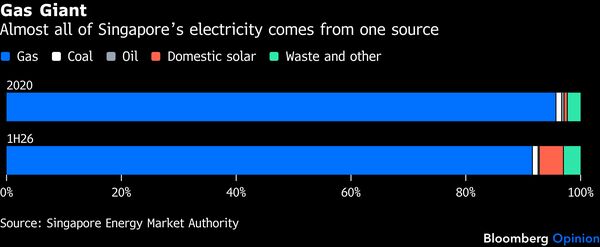
能源方面则不能这样说。即便是液化天然气供应,也可能轻易被海上封锁切断。多年来,核能时而被考虑,时而被搁置,但它自身也带来挑战:几乎整个国家都可以被容纳在福岛第一核电站事故后设立的20公里(12英里)强制疏散区内。正在推进的到2035年安装4吉瓦太阳能电池板的计划,可能使该国约5%的国土被硅和玻璃覆盖,而仍只能满足勉强十分之一的电力需求。
The same can’t be said for energy. Even LNG supplies could be severed easily by a naval blockade. Nuclear power has been considered on and off for years, but comes with its own challenges: You could fit almost the entire nation inside the 20-kilometer (12-mile) mandatory-evacuation zone established after the Fukushima Daiichi disaster. Plans underway to install 4 gigawatts of solar panels by 2035 could leave about 5% of the country under silicon and glass, and still meet barely a 10th of electricity demand.
另有计划开发可再生能源项目并铺设输电线路,延伸至越南、老挝、柬埔寨、马来西亚、印度尼西亚甚至澳大利亚,这至少可以分散电力供应来源。但理论上,这些连接只需轻轻一按开关便可被切断。新加坡在建立目前正在东南亚国家联盟范围内成形的电网中发挥的主导作用,最好被视为一种尝试,即通过一张相互依赖的网络来分散风险。
Separate plans to develop renewable projects and transmission lines stretching to Vietnam, Laos, Cambodia, Malaysia, Indonesia and even Australia would at least diversify electricity suppliers. But those connections could, in theory, be cut off with the flick of a switch. Singapore’s driving role in establishing the power grid now taking shape across the Association of Southeast Asian Nations can best be seen as an attempt to spread the risk across a web of mutual dependencies.
这是一幅充满希望的愿景。在一个多边主义、和平与贸易的世界里,小型海洋共和国可以作为全球商业和资本的节点而变得极其富有。作为新加坡建国一代的灵感来源,威尼斯遵循这一模式长达数个世纪。
That’s the hopeful vision. In a world of multilateralism, peace, and trade, small maritime republics can grow fabulously wealthy as nodes for global commerce and capital. Venice, an inspiration to Singapore’s founding generation, followed that model for centuries.
令人担忧的是随后发生的事情。随着欧洲的商业秩序让位于革命、大规模军队和民族主义的时代,威尼斯的财富被证明几乎无法抵御周围更大的强权。拿破仑在1797年终结了这个延续千年的共和国,此后数十年间,它像讨价还价的筹码一样在法国和奥地利之间被来回交易,直到1866年被并入现代意大利国家。
The worrying part is what came afterwards. As Europe's commercial order gave way to an age of revolution, mass armies and nationalism, Venice's wealth proved little protection against the larger powers surrounding it. Napoleon extinguished the thousand-year republic in 1797, and it was traded back and forth like a bargaining chip between France and Austria for decades before being subsumed into the modern Italian state in 1866.
我们可能正在进入一个类似的时刻。国际关系中崛起的力量是“咽喉要道最大化者”,它们寻求在计算机芯片、关键矿产、知识产权和贸易流动方面获得杠杆,以制伏对手。今年围绕霍尔木兹海峡的冲突就是一个典型例子。随着商业、移民和资本的壁垒不断升高,像新加坡这样的自由港正处于孤立无援的水域。
We could be entering a similar moment. The rising force in international relations is the chokepoint maximizer, looking for leverage over computer chips, critical minerals, intellectual property and trade flows to subdue its rivals. This year’s conflict over the Strait of Hormuz is a prime example. With barriers rising to commerce, migration, and capital, free ports like Singapore are in lonely waters.
“如果没有国际法和秩序,大鱼吃小鱼、小鱼吃虾米,我们就不会存在,”建国之父李光耀在2007年的一次采访中沉思道。“被围困?航道被控制?我们只会挨饿。”李光耀的继任者们必定希望,当今酝酿的大国冲突只是一场过境的暴风雨,而不是全球气候的永久性转变。
“If there were no international law and order, and big fish eat small fish and small fish eat shrimps, we wouldn't exist,” founding father Lee Kuan Yew mused in a 2007 interview. “A siege? Control of sea lanes? We'll just starve.”Lee’s successors must hope the great-power conflict brewing today is a passing storm, rather than a permanent shift in the global climate.