2049年10月1日,中华人民共和国迎来百年华诞,庆祝活动真可谓超凡脱俗。中国研究人员在全国各地的月球永久基地举行纪念活动,其中包括一座于2030年代在月球南极附近启用的旗舰站。这些前哨基地是中国对太空基础设施大规模投资的一部分,投资范围还包括轨道数据中心、太阳能电站和导航卫星。中国航天员甚至从火星发来周年纪念,实现了酝酿数十年的目标——在本世纪中叶之前将载人任务送上这颗红色星球。
Oct. 1, 2049, the centennial of the People’s Republic of China, and celebrations are truly otherworldly. Chinese researchers are marking the occasion at the nation’s permanent bases on the moon, including a flagship station that opened near the lunar south pole in the 2030s. The outposts are part of the country’s wide-scale investment in space infrastructure that includes orbital data centers, solar power stations and navigation satellites. Chinese astronauts are even commemorating the anniversary from Mars, achieving a decades-in-the-works goal to send a crewed mission to the red planet by midcentury.
至少,这是中国国家主席习近平和其他官员所设想的未来,他们正试图在当今的太空竞赛中超越美国。这场竞争主要集中在哪个超级大国将自1972年阿波罗最后一次任务以来首次把人送上月球。美国国家航空航天局的目标是2028年,早于中国载人航天工程办公室2030年前实现这一目标的时间表。然而,美国的计划取决于埃隆·马斯克的SpaceX和杰夫·贝索斯的蓝色起源公司制造的航天器,这些航天器面临艰巨的工程挑战,促使曾在唐纳德·特朗普总统第一任期内担任美国国家航空航天局局长的吉姆·布里登斯廷等批评者警告称,美国有将领先地位让给中国的风险。
At least, that’s the future envisioned by President Xi Jinping and other officials as they try to surpass the US in today’s space race, a competition that’s mostly centered on which superpower will send people to the moon for the first time since the final Apollo mission in 1972. NASA is targeting 2028, before the China Manned Space Agency’s goal of doing so by 2030. The US’s plans, however, hinge on spacecraft made by Elon Musk’s SpaceX and Jeff Bezos’ Blue Origin, which face daunting engineering challenges, prompting critics such as Jim Bridenstine, NASA chief during President Donald Trump’s first administration, to warn that the US is at risk of ceding its lead to China.
佐治亚理工学院萨姆·纳恩国际事务学院助理教授林肯·海因斯表示,击败美国将为北京的全球地位提供象征性的提振。他说,中国可以“以此作为自己是新晋技术超级大国的证据”,“这对中国共产党来说将是一场国内宣传上的胜利”。
Beating the US would provide a symbolic boost for Beijing’s global standing, says Lincoln Hines, an assistant professor at the Georgia Institute of Technology’s Sam Nunn School of International Affairs. China could “use it as evidence that it is the new technological superpower on the block,” he says, “which would be a domestic propaganda coup” for the Chinese Communist Party.
不过,中国寻求的不仅仅是公关胜利。乔治城大学安全与新兴技术中心高级研究分析师凯瑟琳·柯利表示,其目标是到2040年代成为“空间霸权”。这意味着中国希望具备制定地月空间活动议程和规则的能力,地月空间是指从地球大气层边缘到月球表面的广阔区域。
China, though, is looking for more than public-relations victories. Its goal is to be a “space hegemon” by the 2040s, says Kathleen Curlee, a senior research analyst at Georgetown University’s Center for Security and Emerging Technology. That means it wants to be capable of setting the agenda and rules for activity in cislunar space, the vast area from the edge of Earth’s atmosphere to the surface of the moon.
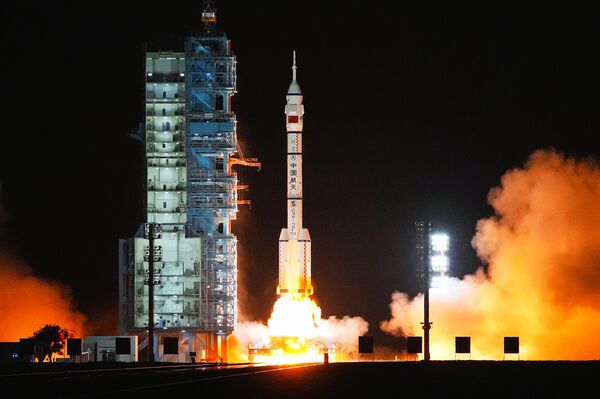
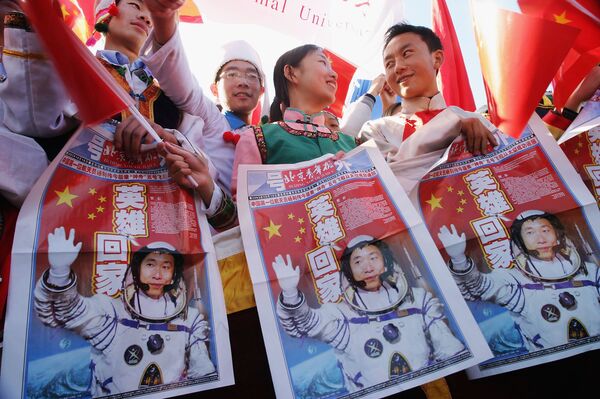
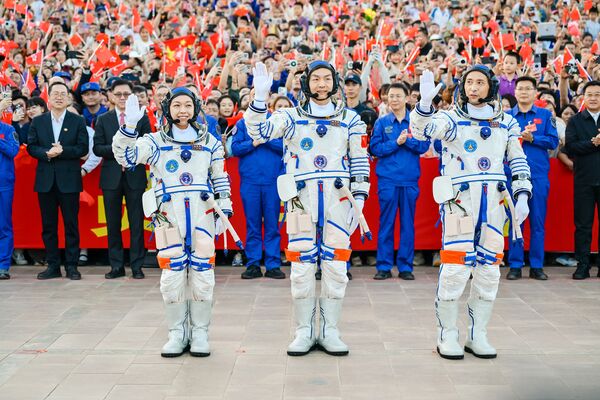
尽管目标雄心勃勃,但中国工程师拥有扎实的离地轨道记录。本世纪以来,中国在缩小与美国国家航空航天局(NASA)的差距方面取得了重大进展。2003年,杨利伟成为中国首位进入太空的男性;2012年,刘洋成为中国首位进入太空的女性。总计中国已派遣数十名航天员进入太空,其中许多人前往了“天宫”空间站,中国于2022年建成这一永久载人轨道空间站,此举是对美国拒绝其参与国际空间站的回应。
Although the targets are ambitious, China’s engineers have a solid off-planet track record. The nation has made major strides this century closing the gap with NASA. Yang Liwei became China’s first man to go to space, in 2003; Liu Yang was China’s first woman to go, in 2012. In total, China has sent dozens of astronauts to space, many to Tiangong, the permanent, crewed orbital station China completed in 2022 in response to the US denying it a role at the International Space Station.
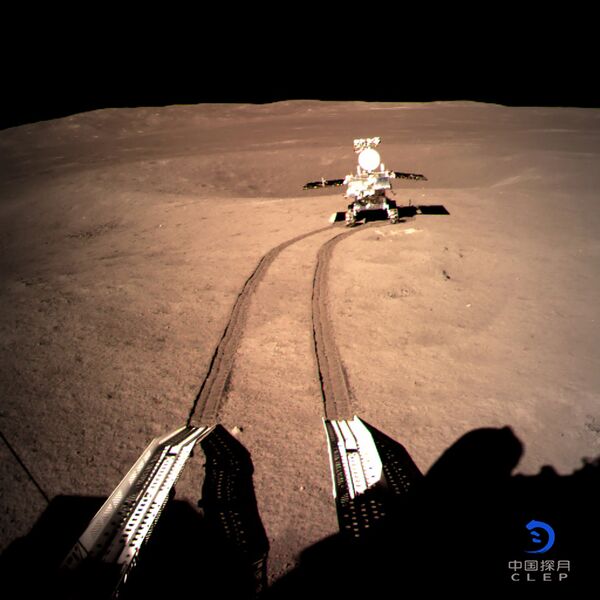
在深空探测方面,中国也已基本追平美国,2013年嫦娥三号探测器实现登月。2019年,中国成为首个实现登月背面这一更高难度任务的国家,而美国希望明年首次完成这一壮举。2021年,中国无人探测器登陆火星,正值中国共产党成立100周年之际。以色列理工学院天体物理学家埃胡德·贝哈尔表示,NASA倾向于青睐更雄心勃勃、更复杂的计划,而中国人在“按时按预算完成任务”方面“要好得多”。
China has mostly caught up to the US in deeper space too, landing on the moon in 2013 with the robotic Chang’e 3 spacecraft. In 2019 the nation became the first to achieve the even more difficult task of landing on the moon’s far side, something the US hopes to do for the first time next year. An uncrewed Chinese craft touched down on Mars in 2021, in time to mark the CCP’s 100th birthday. While NASA tends to favor more ambitious and complicated plans, the Chinese are “much better” at doing things on time and on budget, says Ehud Behar, an astrophysicist at Technion – Israel Institute of Technology.
中国国家航天局局长、相当于NASA掌门人的 Shan Zhongde(单忠德)于4月透露了中国其他一些航天优先事项,包括可重复使用火箭研发、载人航天任务、月球与行星探测,以及类似“星链”的卫星互联网服务。这位中国国家航天局负责人还表示,北京希望开展行星防御工作,利用空间资产保护地球免受“杀手级”小行星撞击。
Shan Zhongde, head of the Chinese equivalent of NASA, in April shared some of the country’s other space priorities, including reusable-rocket development, crewed spaceflight missions, lunar and planetary exploration, and Starlink-like satellite internet services. The China National Space Administration chief also said Beijing wants to work on planetary defense, using assets in space to protect Earth from killer asteroids.
尽管中国表示其雄心在于推动科学发展和国际合作,但争夺太空主导权也是中国人民解放军长期军事计划的一部分。2007年,中国成为继美国和苏联之后,第三个在太空测试反卫星武器的国家。据华盛顿安全世界基金会的一份报告称,2026年2月,中国发射了第四次可重复使用实验性航天器飞行任务,该航天器因具备在近地轨道释放、对接及机动操纵卫星等物体的能力,可能具有军事价值。
Although China says its ambitions are to further science and international cooperation, the race to own space is also part of the People’s Liberation Army’s long-term military plans. China in 2007 became only the third country, after the US and Soviet Union, to test an antisatellite weapon in space. In February 2026, China launched the fourth flight of a reusable experimental spacecraft that could be of military value thanks to its ability to release, dock and maneuver with objects such as satellites in low-Earth orbit, according to a report from the Secure World Foundation in Washington.
所有这些都在华盛顿引发了警觉,两党均警告称,中国寻求阻止美国进入月球上可能蕴藏资源的区域,这些资源对月球居住以及未来前往火星的旅行均至关重要。(其中最重要的资源是冰,如果极地附近存在足够大量的冰,理论上可用于制造呼吸用氧气和火箭燃料用氢气。)五角大楼官员也越来越公开地谈论中国在轨道上的威胁。美国太空军在4月发布的一份报告中表示,解放军“正在追求将外层空间从民用商业前沿转变为全面争夺的战场的战略”。
All this is raising alarms in Washington, where both major parties have warned about China seeking to deny the US access to places on the moon that could contain resources valuable for lunar habitation as well as for eventual travel to Mars. (The most important such resource would be ice, which, if it exists in large enough quantities near the poles, could in theory be used to make oxygen for breathing and hydrogen for rocket fuel.) Officials at the Pentagon are also becoming more outspoken about the threats of China in orbit. The PLA is “pursuing strategies to transform outer space from a civil commercial frontier into a fully contested battlespace,” the US Space Force said in a report published in April.
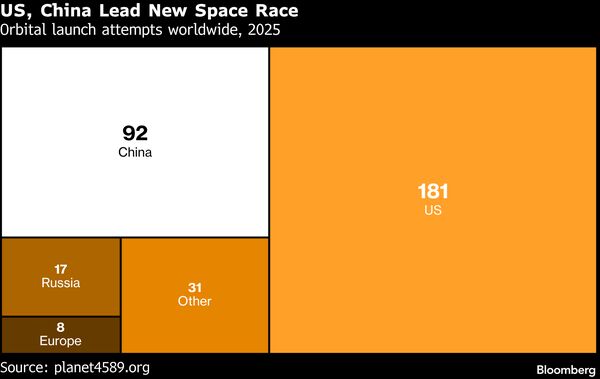
世界上最成功的航天公司也注意到了中国的迅速崛起。“说句公道话,他们拥有一个令人惊叹的航天计划,”SpaceX首席财务官布雷特·约翰森在9月高盛集团赞助的一次会议上表示。SpaceX已利用“猎鹰9号”火箭在近地轨道部署了11000多颗“星链”宽带卫星,并于9月取得突破,其有史以来最大的火箭“星舰”首次将卫星送入轨道。
The world’s most successful space company has noticed China’s rapid ascent too. “To their credit, they have got an amazing space program,” SpaceX Chief Financial Officer Bret Johnsen said at a Goldman Sachs Group Inc.-sponsored conference in September. SpaceX has used its Falcon 9 rockets to deploy more than 11,000 Starlink broadband satellites in low-Earth orbit and recorded a breakthrough in September when its Starship, the biggest rocket ever built, sent satellites to orbit for the first time.
中国国有和私营企业正在努力建造类似SpaceX的可重复使用火箭和卫星网络,并在2026年进行了成功测试。但尽管约翰森在关注中国的进展,他对马斯克的公司仍保持领先相当有信心。“我认为未来几年我们会看到一些进展,但短期内不会达到‘星舰’的水平,就这么说吧。”随着中国不仅寻求追赶美国,更要超越美国,未来25年的步伐可能会加快。
State-owned and private-sector Chinese companies are making progress on efforts to build their own reusable rockets like SpaceX’s, with successful tests in 2026, and satellite networks. But while Johnsen is watching China’s progress, he’s pretty confident Musk’s company is still ahead. “I do think in the years to come we will see things but not on a Starship level anytime soon, let’s put it that way.”The pace will likely pick up in the next 25 years as China looks not just to match the US but to surpass it.
中国的计划包括在2028年前后发射首个火星取样返回任务。美国国家航空航天局(NASA)也曾有自己的火星取样返回任务计划,但因预期成本飙升而被取消。
China’s plans include launching around 2028 the first mission to return samples from Mars. NASA also had plans for a Mars sample-return mission of its own, but the project was scrapped after expected costs soared.
与美国同行公开谈论太空竞赛不同,中国专家淡化了竞争的说法。北京大学国际关系学院教授王栋表示:“关于设定超越美国时间表的说法,其前提是零和的‘太空竞赛’,这与我们的战略理念不符。‘赢得’太空的想法完全误解了当今太空探索的目的。”
Unlike their US counterparts who openly talk about a space race, Chinese experts play down suggestions of a competition. “Regarding the notion of a timeline to surpass the United States, the premise of a zero-sum ‘space race’ does not align with our strategic philosophy,” says Wang Dong, a professor in the School of International Studies at Peking University. “The idea of ‘winning’ in space completely misunderstands the aim of today’s exploration of space.”
美国作家、太空政策专家纳姆拉塔·戈斯瓦米认为,中国政府将太空视为国家经济与地缘政治实力的重要组成部分。她说:“更大的奖赏是在新兴的地月经济中占据先发优势。谁先建立基础设施,谁就能影响技术标准、合作伙伴关系、资源开采方式、运输网络,并最终影响治理规则。”
The Chinese government sees space as integral to the country’s economic and geopolitical power, according to Namrata Goswami, author and space policy expert in the US. “The larger prize is first-mover advantage in the emerging cislunar economy,” she says. “Whoever establishes infrastructure early can influence technical standards, partnerships, resource extraction practices, transportation networks and eventually governance.”
太空领域的主导地位也可能帮助中国企业在全球各地竞争。波托马克政策研究所高级研究员成斌说:“你会拥有巨大的宣传优势。”其推销说辞将颇具说服力:“把足以支持月球生命的技术,用到你在玻利维亚、泰国、埃及的基础设施项目上。”
Dominance in space could also help Chinese companies compete on Earth. “You have a massive advertising advantage,” says Dean Cheng, a senior fellow at the Potomac Institute for Policy Studies. The pitch would be compelling: “Use the technology that’s good enough to support life on the moon for your infrastructure project in Bolivia, in Thailand, in Egypt.”