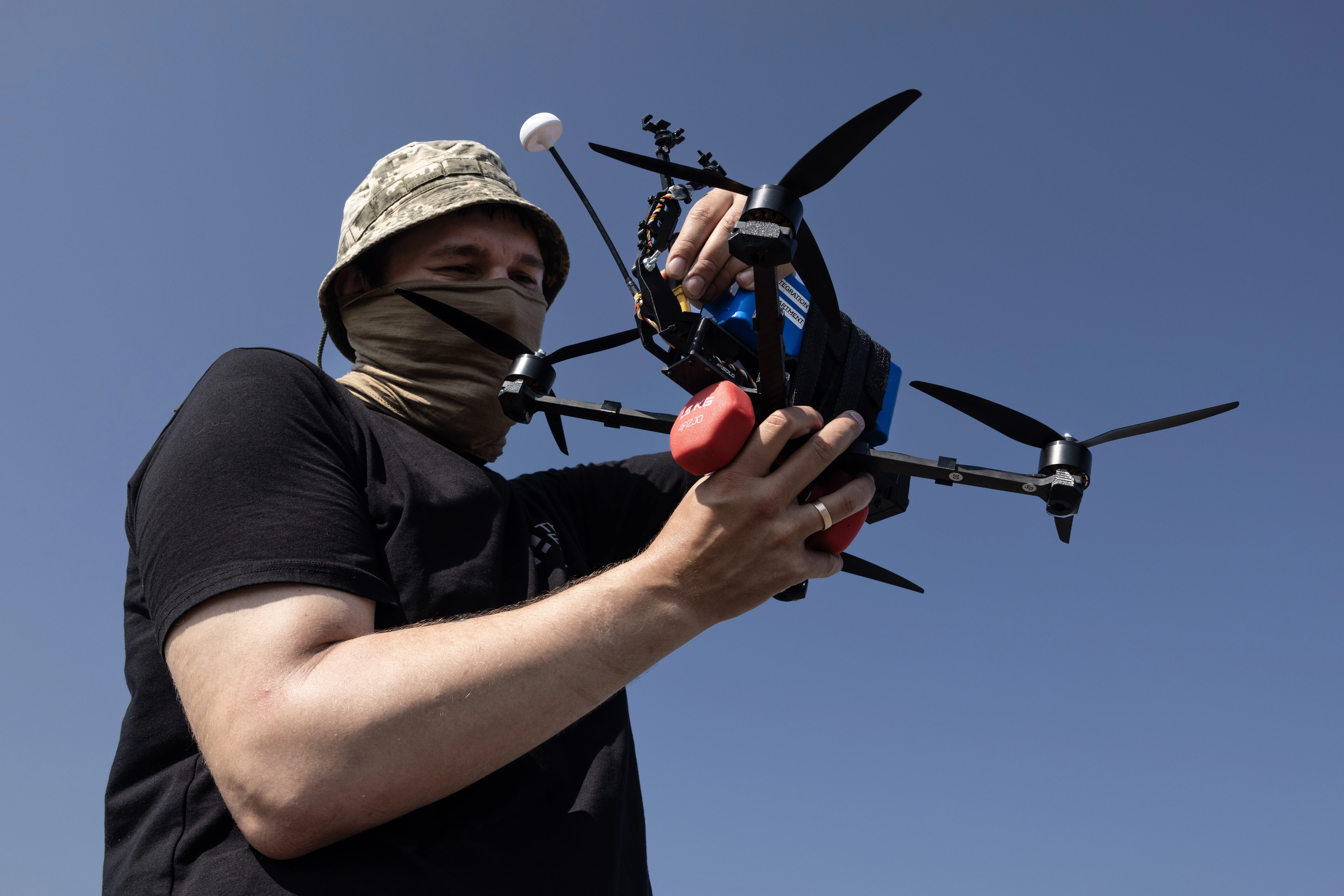
一名军用呼号为“教授”(Professor)的无人机操作员在乌克兰中部的一个测试场操作“第四定律”公司(The Fourth Law)生产的Lupynis-10-TFL-1型无人机。
A drone operator with the military call sign Professor operates a Lupynis-10-TFL-1 from The Fourth Law at a test site in central Ukraine.
宝拉·布龙斯坦(Paula Bronstein)/为NPR供图 乌克兰基辅——同乌克兰的许多科技创业者一样,雅罗斯拉夫·阿日纽克(Yaroslav Azhnyuk)在俄罗斯于2022年入侵后,转向了无人机作战的开发。
Paula Bronstein/for NPR KYIV, Ukraine — Like many tech entrepreneurs in Ukraine, Yaroslav Azhnyuk turned to developing drone warfare after Russia's 2022 invasion.
无人机已经改变了战争的作战方式。阿日纽克表示,人工智能正在让无人机速度更快、能力更强。
Drones have transformed the way wars are fought. Azhnyuk says artificial intelligence is making drones faster and more capable.
“当对方拥有高出几个数量级的能力时,它能为你提供非对称优势,”他说道。“它可以让你的人效提升1万倍。”阿日纽克经营着总部位于乌克兰的国防企业“第四定律”和“奇异系统”(Odd Systems)。它们是乌克兰生产人工智能驱动型无人机的顶尖企业。数十个乌克兰军事单位已经在使用他们名为Lupynis-10-TFL-1的自主无人机。
"When the other side has orders of magnitudes higher capabilities, it gives you an asymmetric advantage," he says. "It can make you 10,000 times more effective." Azhnyuk runs the Ukraine-based defense firms The Fourth Law and Odd Systems. They are among the top companies producing AI-powered drones in Ukraine. Dozens of Ukrainian military units already use their autonomous drone, called the Lupynis-10-TFL-1.
俄罗斯也一直在向乌克兰部署启用人工智能的无人机。人工智能战是一场高科技军备竞赛的一部分,这让许多人感到担忧,其中包括乌克兰总统泽连斯基。他曾警告称,人工智能最快可能在明年主导战场上的决策。
Russia is also deploying AI-enabled drones against Ukraine. AI warfare is part of a high-tech arms race that has many worried, including Ukrainian President Volodymyr Zelenskyy. He has warned that AI could lead decisions on the battlefield as soon as next year.
阿日纽克向NPR表示,他承认外界对毁灭性武器的担忧,但他认为这并非人工智能所独有。
Azhnyuk told NPR that he acknowledges the concern over destructive weapons but says it's not specific to AI.
“自从火或钢铁被发明以来,这种担忧就一直伴随着人类,”他说道。“任何工具都可以用于善途或恶途。到头来,是人类在决定如何使用这件工具。”能“投掷爆炸物”的摄像头阿日纽克现年37岁,是一位性格豪爽的计算机科学家,出身于学者和科学家家庭。NPR在基辅的一间会议室里见到了他;出于安全原因,他要求我们不要透露该地点的其他信息。
"It has been with humanity since the invention of fire or steel," he says. "Any kind of tool can be used for good or for bad. And in the end, it's the human that decides how to use that tool." Cameras that "fling explosives" Azhnyuk is 37, a gregarious computer scientist who hails from a family of scholars and scientists. NPR meets him in a conference room in Kyiv; for security reasons he asked us not to reveal much else about the location.
他曾在硅谷工作多年,并创办了多家公司,其中包括“宠物立方”(Petcube)——该公司制造由智能手机驱动的摄像头,利用人工智能在宠物独自在家时观察甚至娱乐宠物。
He worked for years in Silicon Valley and started several companies, including Petcube which makes smartphone-powered cameras that use artificial intelligence to watch and even entertain pets while they're alone.
“这些摄像头允许宠物家长在不在家时观察宠物,”他说,“还可以向它们抛洒零食,为它们照亮激光玩具。我们卖出了100万台这种在美国相当受欢迎的设备。”在俄罗斯发动全面战争后,当时住在乌克兰的阿日纽克转向了国防领域。
"These cameras allow pet parents to watch pets when they're not at home," he says, "and fling treats to them and shine a laser toy for them. We sold a million of these devices that are quite popular in the U.S." After Russia launched its full-scale war, Azhnyuk, by then living in Ukraine, pivoted to the defense space.
“当时我想,好吧,我得离开Petcube,做点什么来保护我的国家,”他说。“所以现在我们制造的不再是抛洒零食的摄像头,而是向来占领我们土地的人抛洒爆炸物的摄像头。”他所说的摄像头是集成在第一人称视角(即FPV)无人机中的图像识别系统的一部分。“我们是自主无人机和热成像摄像头领域的领导者,”他说。
"I was like, OK, I've got to move on from Petcube and do something to protect my country," he says. "And so now we're making not cameras that fling treats but cameras that fling explosives at people who came to occupy our land." The cameras he's talking about are part of an image recognition system incorporated into first-person-view or FPV drones. "We are leaders in autonomous drones and thermal cameras," he says.
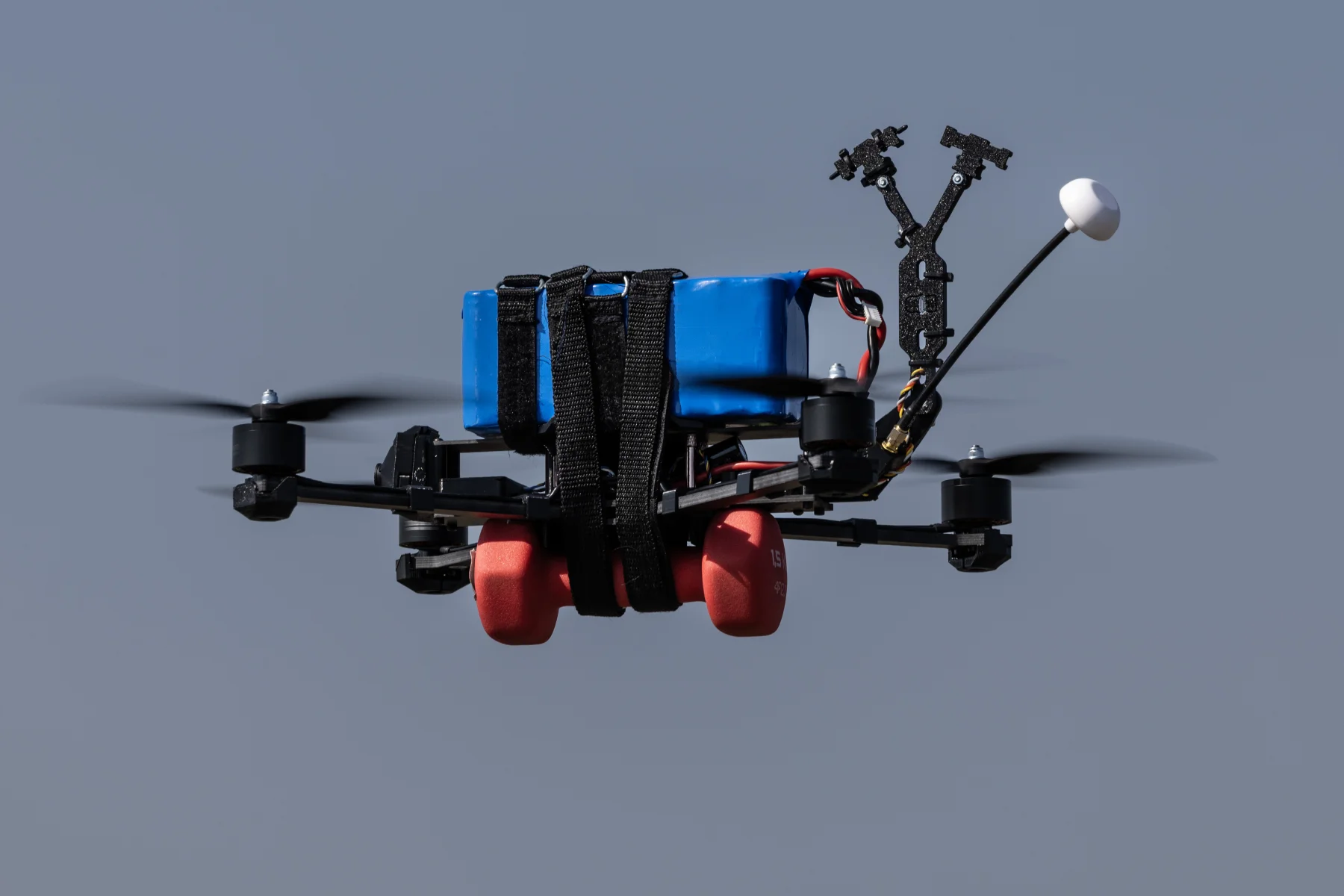
一架Lupynis-10-TFL-1无人机在乌克兰中部的一个测试场上空飞行。
A Lupynis-10-TFL-1 drone is seen in the air at a test site in central Ukraine.
一架以诗人命名的无人机 这款名为Lupynis TFL-1的自主无人机将小型、价格实惠的FPV无人机与自主末端引导单元结合在了一起。这意味着该无人机拥有机载计算机和人工智能技术,能够在飞行最后500米(或0.3英里)的过程中接管控制权。
A drone named after a poet The autonomous Lupynis TFL-1 drone combines a small, affordable FPV drone with an autonomous terminal guidance unit. That means the drone has an onboard computer and AI technology that takes control during the last 500 meters (or 0.3 miles) of the flight.
“但这与那些支持Claude的数据中心里的人工智能非常不同,”他说。“甚至也不同于为你的特斯拉提供自动驾驶的人工智能。”
"But it's very different from, say, the kind of AI that sits on those data centers that power Claude," he says. "Or even the kind of AI that does self-driving for your Tesla."
阿日纽克表示,这种人工智能技术使用简单的工具来识别图像并制作智能软件,“这随后能让你在没有人类的情况下自主导航,或者自主选择目标,或者自主朝目标飞去。”“第四定律”公司的自主无人机是以20世纪乌克兰诗人兼政治活动家阿纳托利·卢皮尼斯的名字命名的,他经受了数十年的苏联监禁和精神病折磨。该公司以在上个世纪被俄罗斯人杀害或迫害的乌克兰知识分子和艺术家为他们的所有武器命名。
Azhnyuk says this AI technology uses simple tools to recognize images and make smart software "which then allows you either to navigate autonomously without a human or to choose a target autonomously or to fly toward the target autonomously." The Fourth Law's autonomous drone is named after the 20th century Ukrainian poet and political activist Anatoliy Lupynis, who endured decades of Soviet imprisonment and psychiatric torture. The company named all its weapons after Ukrainian intellectuals and artists killed or persecuted by Russians in the last century.
“帮助让这些人复活对我们来说很重要,”阿日纽克说。“他们的思想依然与我们同在。现在他们正在进行反击。”“无人机正在自主完成所有事情”“第四定律”团队每天都在测试 Lupynis TFL-1 无人机。我们在基辅市郊的一片荒草丛生的田野里见到了其中一个团队。他们在树林和小蜂巢附近架起了一张折叠桌。
"It is important for us to help to resurrect those people," Azhnyuk says. "Their ideas are still with us. And now they're fighting back." "The drone is doing everything itself" The Fourth Law teams test the Lupynis TFL-1 drones every day. We meet one team in an overgrown field outside Kyiv. They've set up a fold-out table near a copse of trees and a hornets' nest.
一名身材瘦削、沙金色头发的男子从折叠桌旁站起来,自称是测试与集成团队的负责人。他使用的是军事呼号“斯塔布”。出于安全原因,“第四定律”要求美国国家公共电台不要透露这个地点以及这里工作人员的身份。斯塔布指着一架无人机。
A slight, sandy-haired man stands up from the fold-out table and says he's the head of the test and integration team. He uses the military call sign Stab. The Fourth Law asked NPR not to reveal this location or the identities of those who work here for security reasons. Stab points to a drone.
“所以你们看,这里是我们的摄像头,加上这个 3D 模型内部的微型计算机,”斯塔布说。“所有的‘大脑’都在这里,”他笑着补充道。
"So you see here is our camera, plus the microcomputer inside this 3-D model," Stab says. "All of the mind is here," he adds with a laugh.
无人机内部的微型计算机运行在一个深度学习神经网络上,该网络利用数小时的战斗画面来识别目标。“比如车辆、轻型装甲车、坦克和飞行物,”他说。
The microcomputer inside the drone runs on a deep-learning neural network that uses hours of combat footage to recognize targets. "Like vehicles, light-armored vehicles, tanks, and flying objects," he says.
无人机在一名飞行员的引导下开始飞行,该飞行员也要求我们使用他的呼号“教授”。他用控制杆操纵无人机。他选择了一个目标并查看视频监视器。然后他看到了一道红色的闪光。“那意味着它已经锁定,”斯塔布说。
The drone begins its flight guided by a pilot, who also asked us to use his call sign, Professor. He navigates the drone with a control stick. He selects a target and checks a video monitor. Then he sees a red flash. "That means it has locked," Stab says.
无人机已经锁定了目标:一辆员工正开着行驶在土路上的破旧汽车。教授松开了控制杆。无人机自行飞向汽车。里面的微型计算机不断运行算法以使其保持航向。
The drone has locked onto its target: a dilapidated car an employee is driving along a dirt road. Professor lets go of the control stick. The drone flies itself to the car. The microcomputer inside constantly runs algorithms to keep it on course.
“看,教授什么也没做,无人机正在自主完成所有事情,”斯塔布说。
"See, Professor is doing nothing, and the drone is doing everything itself," Stab says.
在战场上,无人机将携带爆炸物去打击这辆汽车。测试用的无人机则没有携带。
On the battlefield, the drone would carry an explosive to hit the car. The test drone doesn't have one.
斯塔布表示,人工智能无人机之所以有用,是因为它们很难被干扰。他还坚称,相关安全保障措施已经到位,因此“第四定律”的无人机不会失控。他说,目标是由人类来选择的。
Stab says AI drones are useful because they're hard to jam. He also insists safeguards are in place so The Fourth Law drones won't go rogue. Humans select the target, he says.
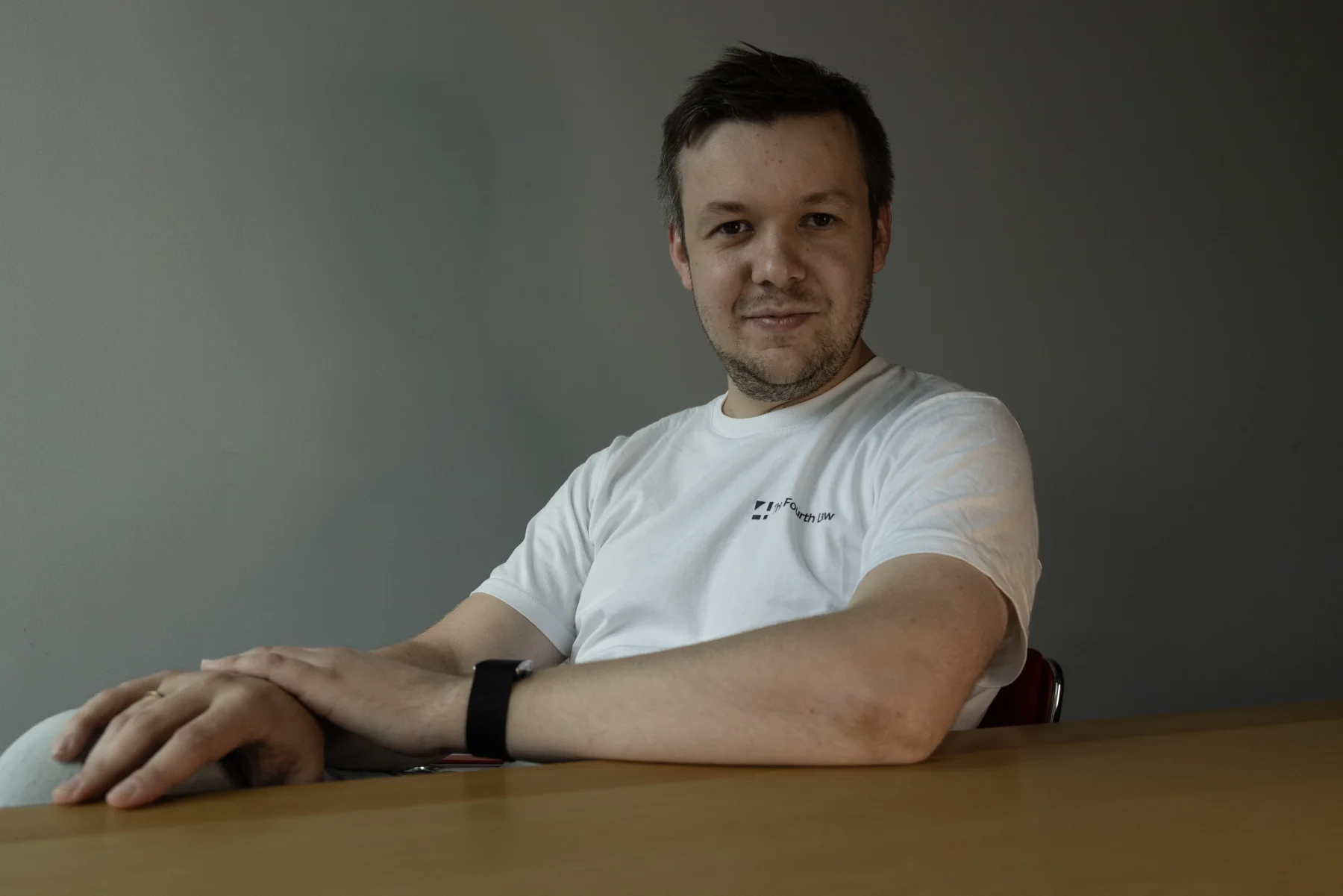
The Fourth Law(第四法则)AI无人机公司的创始人雅罗斯拉夫·阿日纽克(Yaroslav Azhnyuk)曾在硅谷工作,并创办过多家公司,其中包括一家制造智能手机驱动摄像头的公司,该摄像头利用人工智能在宠物独自在家时对其进行监看和娱乐。
Yaroslav Azhnyuk, the founder of the AI drone company The Fourth Law, previously worked in Silicon Valley and started several companies, including one that makes smartphone-powered cameras that use artificial intelligence to watch and entertain pets while they're alone.
生存与AI伦理 回到会议室,阿日纽克表示,他公司的AI无人机并非“杀人机器人”。
Survival vs. the ethics of AI Back in the conference room, Azhnyuk says his company's AI-powered drones are not killer robots.
“它们离‘终结者’那种场景还很远,对吧?”他说,“这些只不过是某种计算器。它们引发‘终结者’式起义的可能性,并不比一个堆满炮弹的仓库大多少。” 他确实承认,AI发展迅速。“想象在未来几年会出现能够自主决定是否指定目标的无人机,这并非不可思议,”他说,“那是未来。现在他专注于乌克兰今天的需求。”
"They're very far from a Terminator kind of scenario, right?" he says. "These are just sort of calculators. Like they're no more likely for a Terminator uprising than a warehouse with artillery shells." He does acknowledge, though, that AI is developing quickly. "It's not unthinkable," he says, "to imagine that some years in the future there will be drones that will be able to make their own decisions on designating targets or not." That's the future.
“我们的对手正在使用完全相同的技术,如果他们在进攻场景中使用AI进行决策,而我们拒绝在防御场景中使用AI进行决策,那我们就输了,对吧?”他说,“因为他们的系统能在微秒级做出决策,而人工控制需要几分钟、几小时,有时甚至几天。” 他说,如果乌克兰战败,“我们就没有任何方式去争论AI的伦理问题。” 他说,最重要的是别死。
Right now he is focused on what Ukraine needs today. "Our adversaries are using the very same technologies, and if they use AI for decision-making in an offensive scenario, and if we refuse to use AI in decision-making in a defensive scenario, we've lost, right?" he says. "Because their systems are capable of making decisions in microseconds, and human control takes minutes, hours and sometimes days." If Ukraine loses, he says, "there's no way for us to argue about the ethics of AI." The most important thing, he says, is don't die. NPR's Polina Lytvynova contributed to this story from Kyiv.