太空是否已成为俄乌战争的新前沿?俄罗斯军事卫星“宇宙-2612”号在10月15日至18日期间实施了一次机动,使其“危险地接近”乌克兰商业卫星“冰眼-X36”号。美国国务院军控与国际安全事务副国务卿将这一举动描述为“威胁性”的。
Has space become a new frontier in Russia's war with Ukraine? Russian military satellite Cosmos-2612 carried out a manoeuvre between October 15 and 18 that brought it “dangerously close” to Ukrainian commercial satellite, Iceye-X36. The move was described by US Under Secretary of State for Arms Control and International Security as "threatening".
“冰眼-X36”号由芬兰公司冰眼运营,是一颗芬兰-美国合作的民用卫星,配备合成孔径雷达(SAR),可为乌克兰武装部队提供卫星图像。美国国务院表示,俄罗斯的战术符合“在轨军事行动”的特征。
Operated by Finnish company Iceye, Iceye-X36 is a Finnish-American civilian satellite equipped with Synthetic-aperture radar (SAR) to provide satellite images to the Ukrainian Armed Forces. The US State Department said Russia's tactic was consistent with “in-orbit military operations”.
专门从事空间监视的分析人士自4月发射以来一直在跟踪“宇宙-2612”号。
Analysts specialising in space surveillance have been following Cosmos-2612 since its launch in April.
法国空间监视公司Aldoria的轨道分析师诺贝尔·普赞表示:“‘宇宙-2612’号是总共发射的六颗卫星之一。这显然不是一次经典的部署。一升空,这些卫星就开始变轨追踪‘冰眼’卫星。”
"Cosmos-2612 was one of six satellites launched in total. It was immediately apparent that this wasn't a classic deployment. As soon as they took off, the satellites started changing orbit to pursue Iceye satellites,” said Norbert Pouzin, an orbital analyst at Aldoria, a French space surveillance firm.
“宇宙-2612”号于2026年4月6日与“宇宙-2609”、“宇宙-2610”、“宇宙-2611”、“宇宙-2613”和“宇宙-2614”号一同发射。
Cosmos-2612 took off on April 6, 2026 alongside Cosmos-2609, Cosmos-2610, Cosmos-2611, Cosmos-2613 and Cosmos-2614.
专门从事卫星导航的网站KeepTrack.space可让观察者追踪它们的轨迹。
KeepTrack a site specialising in satellite navigation, enables viewers to track their paths.
这张地图显示了“宇宙-2612”号(在截图中以其北美防空司令部编号68762标识)及同时发射的其他“宇宙”系列卫星的轨道。© KeepTrack.space普赞解释说,轨道重规划——正如“宇宙”系列卫星所做的那样——是一项消耗大量燃料的举动。这也是接近另一颗卫星的第一步:“如果两颗卫星在同一轨道上运行,那么它们相互接近时就不需要那么多燃料。在太空中改变方向会消耗大量燃料。但一旦与另一颗卫星进入同一轨道,你就已经完成了燃料消耗最大的动作,如果之后你想实施接近的话。”
This map shows the orbit carried out by Cosmos-2612 (identified by its Norad number 68762 in the screengrab) and other Cosmos satellites launched at the same time. © KeepTrack.space Orbit re-routing – as has been the case of the Cosmos satellites – is a move that consumes a lot of fuel. It’s also the first step in approaching another satellite, Pouzin explains: "If two satellites are travelling in the same orbit, then they don’t need as much fuel to approach one another. Changing directions in space uses a lot of fuel. But once in the same orbit as another satellite, you’ve already executed the most costly move fuel-wise, if you then want to carry out an approach.”
从一公里到几百米之内正如卫星追踪器通过网站提供的成像数据所证实的,Cosmos-2612偏离了其原始位置——距Iceye-X36约400至500公里——以更接近这颗芬兰-美国卫星。
From a kilometre to within just a few hundred metres As the imaging data via site, Satellite Tracker corroborates, Cosmos-2612 diverted from its original position – around 400-500 km from Iceye-X36 – to get closer to the Finnish-American satellite.
“10月15日,Cosmos-2612距Iceye-X36在5公里以内。10月16日和17日,它的位置继续向该卫星逼近,最终进入到距Iceye-X36几百米至一公里的范围内,”Pouzin说。
"On October 15, Cosmos-2612 was within 5 kilometres of Iceye-X36. Its position continued to narrow in on the satellite on October 16 and 17, before finally getting to within a few hundred metres and a kilometre of Iceye-X36 ,” Pouzin said.
这张图显示了Cosmos-2612的高度(68762,以红色显示)和Iceye-X36的高度(59103,以蓝色显示)。可以看到Cosmos-2612改变了位置,移动到了与Iceye-X36相似的高度。© Satellite Tracker 卫星成像公司Vantor于10月22日发布了两颗卫星的照片,显示它们的轨道相距仅1.02公里。
This chat shows the Cosmos-2612’s altitude (68762, shown in red) and Iceye-X36 (59103, shown in blue). You can see that Cosmos-2612 changed its position, moving to an altitude similar to Iceye-X36. © Satellite Tracker Satellite imaging company Vantor published a photo of the two satellites on October 22, depicting their orbits withing just 1.02 kilometres of one another.
这张COSMOS-2612和ICEYE-X36的照片拍摄于2026年10月17日。来源:Vantor。
This photo of COSMOS-2612 and ICEYE-X36 was taken on October 17, 2026. Source: Vantor.
要显示来自X(Twitter)的此内容,您必须启用跟踪和受众测量功能。
To display this content from X (Twitter), you must enable tracking and audience measurement.
KeepTrack的数据还显示,Cosmos-2612和Iceye-X36后来进入了同一轨道,这意味着这颗俄罗斯卫星在“跟随”这颗芬兰-美国卫星。
Data from KeepTrack also revealed that Cosmos-2612 and Iceye-X36 later embarked on the same orbit, meaning the Russian satellite was “following” the Finnish-American satellite.
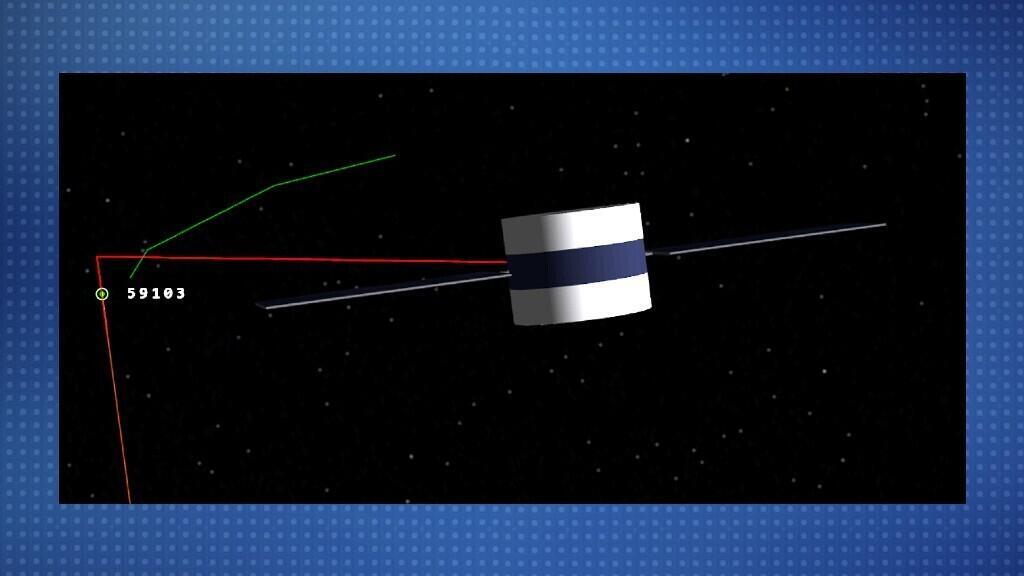
上图显示了Cosmos-2612(Norad编号68762)和Iceye-X36(Norad编号59103)的位置。下图为两颗卫星轨迹的3D视图 © KeepTrack.space 大胆之举那么,Cosmos-2612为何要实施这一“威胁性”机动?
Above is a map showing the positions of Cosmos-2612 (number Norad 68762 ) and Iceye-X36 (number Norad 59103). Below is a 3D view of a trajectory of the two satellites © KeepTrack.space A bold move So why did Cosmos-2612 carry out this “threatening” manoeuvre?
鉴于没有发现碎片,Iceye-X36似乎并非“动能”攻击的目标——即涉及碰撞或发射弹丸的物理打击。但据普赞称,Cosmos-2612的机动动作可以被解读为一种向乌克兰施压的方式,因为乌克兰是Iceye卫星所收集数据的直接接收方:“合成孔径雷达卫星有独特的观测计划[编者注:协调雷达卫星如何扫描地球特定区域的日程表。]如果操作者了解这些计划,那么他就可以——在短时间内——干扰该卫星的任务,从而可能对地面或海上行动等造成影响。”
Given the lack of debris, it doesn’t appear that Iceye-X36 was the target of a “kinetic” attack – that is, a physical strike involving a collision or the launch of a projectile. But according to Pouzin, the manoeuvre by Cosmos-2612 could be interpreted as a form of exerting pressure on Ukraine, as it is the direct recipient of the data gathered by the Iceye satellite: "SAR satellites have unique observation plans [Editor’s note: a schedule that coordinates how radar satellites can scan specific parts of the planet.] If an operator knows about these, then he could – for a short time – disrupt the satellite’s mission, potentially causing repercussions for ground-based or maritime operations, for example." Cosmos-2612’s move seemed to shock Western commentators
Cosmos-2612的举动似乎令西方评论人士感到震惊他补充说:“虽然俄罗斯经常在与美国机密军用卫星相同的轨道面上发射军用卫星;但在低轨道上对一颗商业卫星实施这种特定类型的抵近,却是新鲜事。此外,它在性质上似乎是不合作的:我们面对的是两个不属于同一阵营的行为体,而且这些卫星并非由同一实体运营。”
he added: "While Russia regularly launches military satellites in the same orbital planes as classified American military satellites; carrying out this particular kind of approach on a commercial satellite while in a low orbit is something new. Furthermore it seemed to be non-cooperative in nature: we are dealing with two actors who are not on the same side and these are satellites not operated by the same entity."
普赞总结说,这一举动还揭示了俄罗斯能力的一些情况:“这一动作展示了俄罗斯操作者的一定灵活性、对太空领域的娴熟知识,以及在此类导航方面极高的掌握水平。”
The initiative also revealed something about Russia’s capabilities, Pouzin concluded: "The move demonstrated a certain agility by the Russian operator, a skilled knowledge of the space domain, and a very high level of mastery in this type of navigation.”