阿里·阿尔-瓦齐尔(Ali Al-Wazir)可不是普通的商人。这位47岁的也门人绰号“王子”,在华南的广州做生意。这个繁忙的港口距离也门约7000公里(4500英里)。但距离并未阻止瓦齐尔在自己国家的长期内战中扮演角色。2024年,他被指控向胡塞武装提供物资,帮助他们制造武器;胡塞武装是统治也门大部分地区的伊朗支持的叛军。美国财政部对其实施了制裁。去年,美国还将其他几名与胡塞武装有关联的商人列入黑名单,因为他们也从事了同样的活动。
ALI AL-WAZIR is no ordinary businessman. The 47-year-old Yemeni, who is known as “Prince”, plies his trade in Guangzhou in southern China. The bustling port is about 7,000km (4,500 miles) from Yemen. But distance has not prevented Mr Wazir from playing a part in his country’s long civil war. In 2024 he was accused of supplying the Houthis, the Iran-backed rebels that rule much of Yemen, with materials to help them build weapons. America’s Treasury placed him under sanctions. Last year it blacklisted several more Houthi-linked traders for doing the same.
胡塞武装曾一度被视为乌合之众——穿着拖鞋的叛军,如今却成为中东最危险的民兵组织之一。自从十多年前控制也门北部以来,他们在瓦齐尔等人的部分协助下,建立了一个令人生畏的无人机和导弹库。胡塞武装的走私网络从非洲之角延伸至中国。最近几周,他们对支持也门国际承认的政府的沙特阿拉伯发动了一次又一次打击。在上周于德黑兰举行的一次峰会上,沙特施压伊朗约束胡塞武装,但该地区正在为更多的战争做准备。
Once dismissed as ragtag insurgents—rebels in flipflops—the Houthis are now one of the most dangerous militias in the Middle East. Since they took control of northern Yemen more than a decade ago, they have built up a formidable arsenal of drones and missiles—aided, in part, by the likes of Mr Wazir. The Houthis’ smuggling networks stretch from the Horn of Africa to China. In recent weeks they have hit Saudi Arabia, which supports Yemen’s internationally recognised government, with one strike after another. At a summit in Tehran last week Saudi Arabia put pressure on Iran to rein in the Houthis but the region is preparing for more war.
胡塞武装在2014年夺取也门首都萨那后,首次获得了重型装备。与前总统阿里·阿卜杜拉·萨利赫及其军队忠诚者短暂结盟,让他们得以获取苏式“飞毛腿”和“点”式导弹。与此同时,正在培植胡塞武装(同样信仰什叶派)作为其“抵抗之弧”一部分的伊朗,也加大了支持力度。2015年沙特军队干预也门时,伊朗向叛军提供了弹道导弹、无人机和其他重型武器。来自伊朗的顾问和黎巴嫩民兵组织真主党的特工则教会了他们如何使用这些武器。
The Houthis first got their hands on serious kit in 2014 after they seized Sana’a, Yemen’s capital. A short-lived alliance with Ali Abdullah Saleh, a former president, and his loyalists in the army gave them access to Soviet-style Scud and Tochka missiles. At the same time Iran, which was cultivating the Houthis (also Shia) as part of its “axis of resistance”, increased its support. When Saudi forces intervened in Yemen in 2015, Iran supplied the rebels with ballistic missiles, drones and other heavy weapons. Iranian advisers and operatives from Hizbullah, a militia in Lebanon, taught them how to use them.
如今,胡塞武装正在开发自己的战争机器。9月21日,该组织领导人阿卜杜勒·马利克·胡塞(Abdul-Malik al-Houthi)夸口称,他们现在“从零开始”制造武器。这或许是大话,但分析人士越来越确信,这群叛军的大部分军火都是在也门境内制造的。“胡塞武装军事生产的速度和雄心让许多观察人士感到意外,”追踪非法武器贸易的“冲突军备研究所”(CAR)的法比安·欣茨(Fabian Hinz)说。
Today the Houthis are developing a war machine of their own. On September 21st Abdul-Malik al-Houthi, their leader, boasted that they now build their weapons “from scratch”. That may be bluster but analysts are increasingly convinced that much of the rebels’ arsenal is built inside Yemen. “The speed and ambition of the Houthis’ military production has surprised a lot of observers,” says Fabian Hinz of Conflict Armaments Research (CAR), which tracks the illicit arms trade.
虽然该集团的大多数武器仍然基于伊朗的设计,但其中一些武器——例如中程无人机——在很大程度上可以在没有伊朗零部件的情况下建造。
While most of the group’s weapons are still based on Iranian designs, some—such as medium-range drones—can be built largely without Iranian parts.
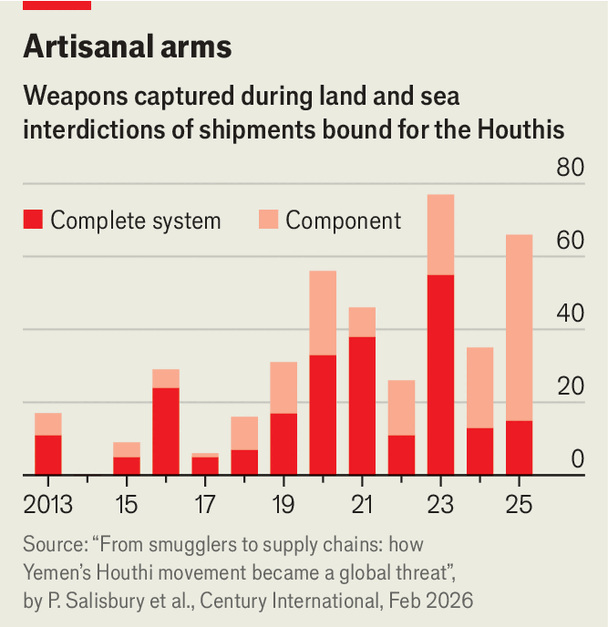
生产大多在也门高地的山洞中隐蔽进行,这使得监控变得困难。尽管如此,纽约智库“世纪基金会”(The Century Foundation)的数据显示,他们的活动发生了转变(见图表)。在2010年代,被截获的运往胡塞武装领土的大多数货物都包含即用型武器,例如枪支和火箭弹。在2010年代中期,伊朗是迄今为止最大的供应商。现在,这些货运绝大多数包含制造武器的零部件,例如马达、线缆和螺旋桨。中国已经取代伊朗,成为此类商品的最大来源。
Production mostly happens out of sight, in caves in the Yemeni highlands, making it hard to monitor. Data from The Century Foundation, a think-tank in New York, nevertheless point to a shift in their activities (see chart). During the 2010s most of the shipments that were seized going into Houthi territory contained ready-to-use weapons, such as guns and rockets. Iran was by far the biggest supplier in the mid-2010s. Now most of these consignments contain parts to build weapons, such as motors, wiring and propellers. China has overtaken Iran as the biggest source of such goods.
这些物品中有许多是“军民两用”的,这意味着它们显然既有民用也有军事用途。胡塞武装走私者有时会试图在无人机套件上贴上“工业设备”等无害标签,以此来瞒过也门当局。其他货物看起来则是为军火工业专门制造的。10月,CAR指出,在一处政府控制的亚丁港截获的一枚伊朗设计弹道导弹的零部件,是由一家中国公司按需定制的。沙特官员曾向中国抱怨,但收效甚微。“中国乐于对本国公民参与支持胡塞武装武器工业的贸易睁一只眼闭一只眼,”一名西方外交官说。
Lots of these items are “dual-use”, meaning they plausibly have civilian as well as military applications. Houthi smugglers sometimes try to outfox Yemeni authorities by slapping innocuous labels such as “industrial equipment” on drone kits. Other goods seem purpose-made for the arms industry. In October CAR suggested that parts for an Iranian-designed ballistic missile, seized in the government-held port of Aden, were made to order by a Chinese company. Saudi officials have complained to China, to little avail. “China is happy to turn a blind eye to its citizens participating in trade that supports the Houthis’ weapons industry,” says a Western diplomat.
打破这一供应链将十分困难。美国的制裁收效甚微:胡塞商人仍在中国继续运营。该叛军已被联合国实施武器禁运超过十年。但检查驶往胡塞控制港口的货船的任务力量薄弱。它向沙特及其盟友报告可疑船只,却没有权力自行拦截。
Breaking this supply chain will be hard. American sanctions have achieved little: Houthi businessmen continue to operate in China. The rebels have been under a United Nations’ arms embargo for more than a decade. But the mission that inspects cargo ships sailing to Houthi-held ports is feeble. It reports dodgy vessels to the Saudis and their allies, but has no powers to stop them itself.
即使能够拦截,也仍会有大量货物漏网。部分货物经阿拉伯联合酋长国和阿曼陆路运输。其他则通过吉布提和索马里走私。美国2021至2025年驻也门特使蒂姆·伦德金表示,胡塞武装将违禁品“从大船转到小船,再转到微型船,随后装上驮畜,甚至背在人员背上”。走私者把弹药藏在运送水果和蔬菜的卡车里。也门政府——一个由争斗不休的团体拼凑而成的联盟——在协调执法方面举步维艰。英国皇家联合服务研究所的巴拉·希班说:“不同的作战室由不同派系控制,这简直是噩梦。”
Even if it could, much would slip through. Some goods travel overland through the United Arab Emirates and Oman. Others are smuggled via Djibouti and Somalia. Tim Lenderking, America’s envoy for Yemen from 2021 to 2025, says the Houthis move contraband “from big boats, onto small boats, onto tiny boats, onto pack animals and onto people’s backs”. Smugglers hide ammunition in lorries carrying fruit and vegetables. Yemen’s government—a patchwork of squabbling groups—struggles to co-ordinate enforcement. “Different operation rooms are controlled by different factions,” says Baraa Shiban of the Royal United Services Institute, a think-tank in London.
自行制造武器帮助胡塞在伊朗供给中断时仍能继续作战。但伊朗伊斯兰共和国也从其自给自足中受益。根据其“马赛克防御”理念,伊朗政权试图使其武装力量的不同部门能够独立作战。类似的思想支撑着其抵抗轴心。“伊朗一直在努力使其盟友实现本土生产,”亨茨先生说。真主党已自行制造无人机,并尝试将火箭改装为精确制导导弹。但自巴沙尔·阿萨德倒台以来,该民兵组织已因以色列袭击和叙利亚走私路线受阻而被削弱。
“It’s a nightmare.”Making their own arms helps the Houthis keep fighting when supplies from Iran are disrupted. But the Islamic Republic also benefits from their self-reliance. Under its doctrine of “mosaic defence”, Iran’s regime has tried to make different parts of its armed forces capable of fighting independently. A similar idea underpins its axis of resistance. “Iran has made efforts to enable its allies to produce locally,” says Mr Hinz. Hizbullah has built drones and tried to convert rockets into precision-guided missiles by itself.
胡塞武装处于更有利的位置。虽然该武装仍从伊朗获得大量武器和情报,但它们对伊朗政权的依赖正在减弱。这或许能解释为何即使美国和以色列发动的战争削弱了其靠山,胡塞武装依然不屈不挠。该武装视自己不仅仅是伊朗的代理人,而是也门的真正统治者。它们已寻求俄罗斯的支持,并正在与非洲的武装团体建立联系。前美国外交官芭芭拉·利夫表示,胡塞武装想要成为“在自家小社区里的‘小伊朗’”。它们的野心与火力都在增长。■
But the militia has been weakened by Israeli attacks and disruption to its smuggling routes through Syria since the fall of Bashar al-Assad. The Houthis are in a better position. While the rebels still get plenty of weapons and intelligence from Iran, they are outgrowing their dependence on the regime. That may explain why the Houthis are unbowed even as the war launched by America and Israel has weakened their patron. The rebels see themselves as more than a mere Iranian proxy but as the real rulers of Yemen. They have sought support from Russia and are fostering connections with armed groups in Africa. The Houthis want to be a “little Iran in their own little neighbourhood,” says Barbara Leaf, a former American diplomat. Their ambition, as well as their firepower, is growing.■