
世界先进经济体可能正面临一场缓慢发生的列车相撞事故,而它们似乎无力阻止。我们不再生育足够多的婴儿。
The world’s advanced economies could be facing a slow-moving train wreck that they appear powerless to stop. We are no longer producing enough babies.
许多欧洲和东亚国家以及美国的生育率正处于令人担忧的轨迹上。有多令人担忧?在未来几十年里,人口问题对美国来说可能几乎与人工智能一样重要——但方向相反。如果人工智能增加经济增长,人口萎缩将削减增长,使我们没有足够资源来支持老龄化人口,并威胁到社会动荡,因为年轻人对不断增加的退休人员的福利成本感到反感,而他们分到的蛋糕份额却在缩小。
The fertility rates in many European and East Asian countries along with the US are on an alarming trajectory. How alarming? Demographics may become nearly as big a deal for the US as artificial intelligence in the decades ahead — but working in the opposite direction. If AI adds economic growth, a shrinking population will subtract growth, leaving us without the resources needed to support an aging population and threatening unrest as young people balk at the welfare costs of ever more retirees even as their share of the pie shrinks.
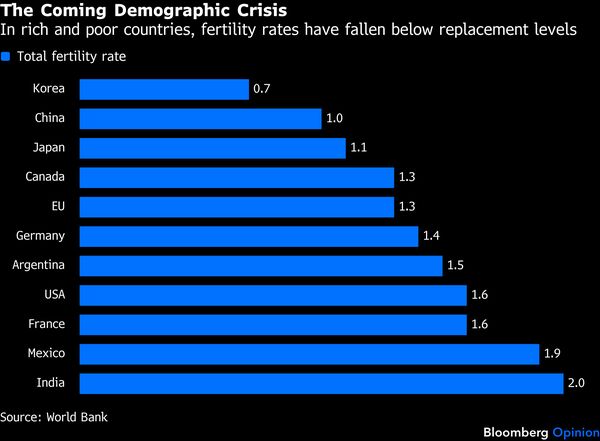
总和生育率,即一名女性一生中生育的子女数量,需要达到约2.1才能维持人口稳定。根据宾夕法尼亚大学的Jesus Fernandez-Villaverde和西北大学的Patrick Norrick的估计,全球生育率今年可能已低于更替水平。他们预计全球人口将在2056年达到约90亿的峰值,然后开始萎缩,“先是缓慢,然后迅速”。许多较富裕经济体的生育率已经令人担忧地低:韩国仅为0.7,中国为1,欧盟为1.3,美国为1.6。这不仅仅是富国的问题;印度和墨西哥也不再生育足够多的孩子来替代其人口。
The total fertility rate, the number of children a woman has in her lifetime, needs to be about 2.1 to maintain a stable population. The global rate is likely below the replacement level this year, according to estimates from the University of Pennsylvania’s Jesus Fernandez-Villaverde and Northwestern University’s Patrick Norrick. They expect the global population to peak at roughly 9 billion in 2056 and then start shrinking, “first slowly, then fast.”Fertility rates are already worryingly low in many richer economies: just 0.7 in Korea, 1 in China, 1.3 in the European Union and 1.6 in America. And it is not just a rich-country problem; India and Mexico are no longer having enough kids to replace their populations either.
对人口趋势的恐慌与现代史一样悠久。过去的严峻预测集中在对人口过多的担忧上。结果证明这并不是问题,因为人类通过学习如何提高生产力来适应。技术使我们能够用更少的物质资源生产更多产品,更好的教育使工人更聪明。我们需要再次适应,但同时萎缩和老龄化的人口构成了一个艰巨的挑战。
A freakout about population trends is as old as modern times. Dire predictions in the past centered on worries about too many people. This ended up not being a problem because humans adapted by learning how to become more productive. Technology enabled us to make more with fewer physical resources, and better education made workers smarter. We will need to adapt again, but a population that’s shrinking aging at the same time poses a difficult challenge.
经济产出(即国内生产总值)的增长由两部分组成:生产率增长(每人多生产多少)和劳动力增长。费尔南德斯-比利亚维德和诺里克指出,与本世纪初的数字相比,到2050年,美国人口萎缩将使年均GDP增长率降低1.5个百分点。
The growth of economic output, or gross domestic product, has two components: productivity growth (how much more each person produces) and labor growth. Fernandez-Villaverde and Norrick illustrate how a shrinking US population would take 1.5 percentage points off average annual GDP growth by 2050, compared with the numbers at the turn of the century.
也许人工智能会让我们的生产率大幅提升,以至于这个问题变得无关紧要。但即使对人工智能来说,每年弥补1.5个百分点的GDP损失也是一项艰巨的任务。增长经济学家估计,电力以及其后出现的所有创新,在上个世纪使GDP每年保持2%的增长。如果我们期望人工智能像电力一样具有影响力——这是一个很大的假设——那么人口萎缩将抵消这项技术带来的大部分好处,使我们陷入增长放缓。
Perhaps artificial intelligence will make us so productive that it won’t matter. But making up 1.5 percentage points of lost GDP annually is a tall order, even for AI. Growth economists estimate that electricity, and all the innovations that came after, kept GDP growing by 2% a year over the last century. If we expect AI to be as impactful as electricity — a big if — a shrinking population will cancel out much of the benefit from the technology and leave us with slower growth.
理论上,这未必是问题。人口萎缩对地球更有利,也意味着住房更多、拥挤更少,同时经济继续增长,尽管增速放缓。但为老龄化人口买单等其他问题将更加突出。
This need not be a problem in theory. It’s better for the planet and means more housing and less crowding, while the economy continues to grow, albeit more slowly. But other problems such as paying for an aging population will be accentuated.
当人口增长、生产率提高时,不断有更多工人加入进来,经济蛋糕越做越大。而当人口老龄化、劳动力萎缩时,蛋糕增长放缓,更多资源被分配给退休人员。留给年轻人的是更高的税收和更少的福利。
When we had a growing population and increased productivity, more workers were constantly being added to the mix, growing the economic pie. When you have an aging population and shrinking labor force, the pie grows more slowly and more resources are allocated to retirees. Young people are left with higher taxes and fewer benefits.
这可能会形成恶性循环。让人们生育更多孩子已经很难了——这在很多方面是我们经济成功的后果。在更富裕的社会,家庭在子女身上花费更多,觉得自己养不起太多孩子。更高的收入也意味着养育孩子的机会成本更大。工资和技能往往在20多岁和30多岁时积累得更快,这使得这些黄金生育年龄成为退出劳动力市场最糟糕的时期。
This can become a vicious cycle. It is already hard to get people to have more children — in many ways, a consequence of our economic success. Families spend more on their children in richer societies, and feel they can’t afford too many of them. Higher earnings also mean a bigger opportunity cost to children. Wages and skills tend to accumulate faster in your 20s and 30s, making these prime child-bearing years the worst time to be out of the labor force.
这或许可以解释为什么政府提高生育率的努力未能成功。包括带薪产假、婴儿津贴和育儿补贴在内的政策,旨在让生育孩子变得更容易、更便宜。这些政策或许能降低部分成本,但西欧国家慷慨的福利并未阻止其生育率进一步下滑。
This may explain why government attempts to increase fertility have not been successful. Policies including paid maternity leave, baby bonuses and subsidized childcare aim to make having kids easier and cheaper. They may reduce some costs, but the generous benefits of Western European countries have not prevented their fertility rates from declining even further.
原因可能在于,任何政府或雇主的福利都无法弥补在现代经济中养育一个孩子所需付出的时间和精力。人们花在孩子身上的时间比过去多得多。文化规范往往不仅决定人们如何养育孩子,也决定他们生育几个孩子。以中国为例,自放宽独生子女政策以来的十年里,中国发现重振人口增长非常困难。
It could be that no government or employer benefit can compensate for the time and energy it takes to raise a child in the modern economy. People spend much more time with their children than they used to. Cultural norms often dictate not only how people raise their children but also how many they have. China, for one, has found it very difficult to revive population growth in the decade since it relaxed its one-child rule.
当然,规范是可以改变的。超级富豪组建更大家庭的趋势正在兴起,回归有组织宗教也可能改变人们对养育子女的看法。
Norms can change, of course. There’s an emerging trend of very rich people having bigger families, and a return to organized religion could also shift views on parenting.
与此同时,政策制定者最可靠的做法是专注于提高我们现有劳动力的生产力。也许人工智能会取得成效,但这仍是未知数。更稳妥的做法是重现20世纪时我们在人力上的投资。
Policy makers’ best bet, in the meantime, is to focus on making the people we do have more productive. Maybe AI will pan out, but that remains uncertain. A more prudent move is to replicate the investment in people we made in the 20th century.
这比简单地扩大教育规模更难。我们不知道在人工智能时代哪些技能会取得成功,但投资于一支受教育程度更高、具有批判性思维的劳动力队伍,是重要的第一步。从这个角度看,自疫情以来数学和阅读成绩的下滑亟需关注。政策制定者可以寄希望于技术解决所有问题,也可以专注于培养一代人——他们经过更好的训练,能够伴随新技术蓬勃发展,也更有能力供养他们需要支持的日益老龄化的人口。
This will be harder than simply expanding schooling. We don’t know what skills will succeed in a world of AI, but investing in a workforce of better educated, critical thinkers is an important first step. In this light, the decline in math and reading scores since the pandemic requires urgent attention. Policy makers can hope technology will solve all our problems, or they can focus on developing a generation better trained to thrive alongside new technologies and better able to pay for the aging population they’ll need to support.