是一家汉堡巨头让美国企业界认识了“点心” —— 不是饺子,而是通常被称为“点心债”的离岸人民币债券。如今,在经历了两个动荡时代和多次重生后,轮到华尔街在香港发行此类债券了,尽管原因与麦当劳公司 16 年前发行这些债券时截然不同。
It was a hamburger giant that introduced corporate America to dim sum — not the dumplings, but the offshore yuan debt commonly known by that name. And now, after two turbulent eras and multiple rebirths, it’s Wall Street’s turn to tap the market in Hong Kong, though for reasons very different from when McDonald’s Corp. sold these bonds 16 years ago.
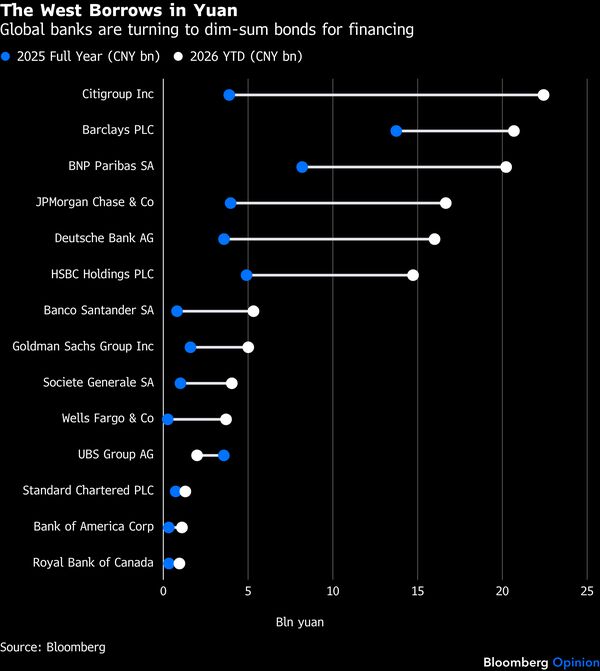
据彭博汇编的数据,全球系统重要性银行今年以来已发行 1340 亿元人民币(约合 200 亿美元)的点心债,几乎是 2025 年全年总额的三倍。花旗集团、巴克莱银行和法国巴黎银行是最大的发行方。富国银行的发行量增长了十倍多,而高盛集团的发行量大致增加了两倍。
The world’s systemically important banks have raised 134 billion yuan ($20 billion) in dim-sum bonds so far this year, nearly triple their total for all of 2025. Citigroup Inc., Barclays Plc and BNP Paribas SA are the biggest issuers, according to data compiled by Bloomberg. Wells Fargo & Co. has seen its issuance jump more than tenfold, while Goldman Sachs Group Inc. has roughly tripled its volume.
从地缘政治角度看,这显得多么不可思议。全球化据称正在退潮。美国和中国在从人工智能到全球货币体系未来等一切问题上陷入战略竞争。那么,为什么西方银行机构却拥抱中国货币?据美国银行称,其本身也是主要发行方,离岸人民币已超越英镑,成为全球银行第三大融资货币。
Consider how improbable this looks geopolitically. Globalization is supposedly in retreat. The US and China are locked in strategic competition over everything from artificial intelligence to the future of the global monetary system. So why are Western banking institutions embracing the Chinese currency? According to Bank of America Corp., itself a major issuer, the offshore yuan has overtaken the British pound to become the third-largest funding currency for global banks.
这一切感觉与以往的周期截然不同。在全球金融危机之后,投资者将人民币视为接近单边上涨的押注:他们预期人民币将稳步升值,因此愿意接受极低的票面利率。美国企业界成了意外的受益者。在华扩张的公司,如麦当劳,可以廉价借入人民币并在当地使用所得资金,使债务与本币收入相匹配。其他公司则可以将所得资金掉期换回美元,实际上将投资者对人民币升值的渴望转化为合成美元融资,成本远低于美国本土借贷成本。
This all feels very different from previous cycles. In the aftermath of the Global Financial Crisis, investors saw the yuan as close to a one-way bet: They expected it to steadily appreciate and were therefore willing to accept minuscule coupons. Corporate America was an unlikely beneficiary. Companies expanding in China, such as McDonald’s, could borrow cheaply in yuan and spend the proceeds there, matching their debt with local-currency revenues. Others could swap the proceeds back into dollars, effectively turning investors’ appetite for yuan appreciation into synthetic dollar funding at a steep discount to US borrowing costs.
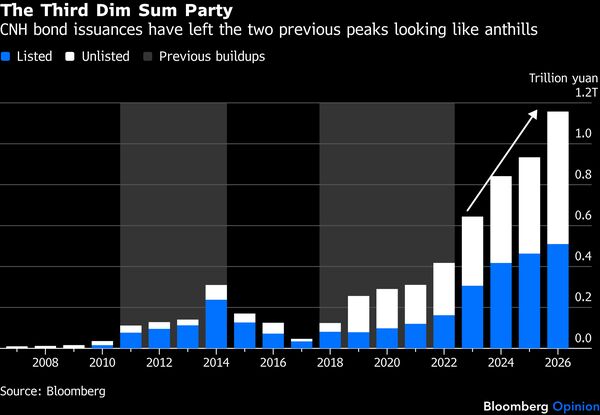
2015年人民币令人震惊的贬值终结了那波热潮。为防止交易更自由离岸人民币(CNH)成为投机者做空在岸人民币的武器,北京精心策划了一场残酷的流动性紧缩,在2016年一度将香港离岸人民币隔夜拆借成本推高至66.8%。第二波热潮由中国开发商寻求美元债务替代品所推动,最终以中国恒大集团的崩溃告终。
The shock 2015 devaluation of the yuan ended that craze. To prevent the more freely traded offshore currency — the CNH — from becoming a weapon for speculators betting against the onshore yuan, Beijing engineered a brutal liquidity squeeze, briefly driving overnight CNH borrowing costs in Hong Kong to 66.8% in 2016. A second boom, fueled by Chinese developers seeking alternatives to dollar debt, ended with the collapse of China Evergrande Group.
第三个时代建立在全新的基础之上。忘掉推动第一波热潮的金融工程吧:曾经将廉价人民币债务转化为更廉价美元融资的货币互换套利已基本消失。如今真正的吸引力在于进入中国庞大且受困的储蓄蓄水池。腾讯控股和阿里巴巴集团等中国科技巨头已在利用这一资金池为其人工智能扩张融资,票面利率远低于可比的美元收益率。华尔街也越来越希望进入这个资金池。
The third era rests on a very new foundation. Forget the financial engineering that drove the first boom: The currency-swap arbitrage that once turned cheap yuan debt into even cheaper dollar funding has largely disappeared. The prize today is access to China’s vast, captive reservoir of savings. Chinese technology giants such as Tencent Holdings Ltd. and Alibaba Group Holding Ltd. are already drawing on it to finance their AI expansion at coupon rates far below comparable dollar yields. Increasingly, Wall Street wants access to that pool of money too.
有准备的发行人正在找到愿意投资的买家。由于中国内地房地产深陷低迷、国内收益率接近历史低位,中国的保险公司、资产管理公司和富裕个人对回报如饥似渴。然而北京不能允许这些资金自由流向海外,否则将面临资本外流破坏稳定的风险。其解决方案是一个经过校准的压力阀:南向债券通,让内地投资者能够在离岸配置资金,同时在很大程度上将其保留在人民币生态系统内。
Ready issuers are finding willing investors. With mainland property in a deep funk and domestic yields near historic lows, Chinese insurers, asset managers and wealthy individuals are starved for returns. Yet Beijing cannot allow that money to flow freely overseas without risking destabilizing capital outflows. Its solution is a calibrated pressure valve: the Southbound Bond Connect, which lets mainland investors put money to work offshore while largely keeping it within the yuan ecosystem.
其后果正在改变这个处于西方与中国接触核心的金融中心。香港的银行首次有望安排的人民币债券发行量超过美元债券。随着北京在最近允许内地养老金储蓄南下后更充分地利用这座城市深厚的资本市场来扩大人民币作为国际融资货币的角色,这一转变可能会加速。
The consequences are transforming the financial center at the heart of the West’s engagement with China. For the first time, banks in Hong Kong are on course to arrange more bond sales in yuan than in dollars. The shift could accelerate as Beijing, having recently allowed mainland pension savings to flow south, makes fuller use of the city’s deep capital markets to expand the yuan’s role as an international funding currency.
将中国的储蓄在离岸市场进行循环利用,只是问题的一半。北京还想减少自身对西方制裁的风险敞口。俄罗斯提供了一个严酷的教训:入侵乌克兰后,七国集团及其伙伴冻结了约3000亿美元的俄罗斯央行储备。对中国而言,其中的含义难以忽视。在与西方的对抗中,对美元资产、代理银行和西方主导的支付网络的依赖可能成为一种战略脆弱性。
Recycling Chinese savings offshore is only half the equation. Beijing also wants to reduce its exposure to Western sanctions. Russia provided a harsh lesson: After the invasion of Ukraine, the G7 and its partners immobilized about $300 billion of Russian central-bank reserves. For China, the implication was difficult to ignore. In a confrontation with the West, dependence on dollar assets, correspondent banks and Western-dominated payment networks could become a strategic vulnerability.
替代性支付渠道提供了部分答案,例如多国央行平台“多边央行数字货币桥项目”(Project mBridge),它可以减少对美元主导的代理银行体系的依赖。但仅有基础设施还不够。随着中国鼓励更多贸易和能源合同以人民币结算,人民币的接收方需要有具有吸引力的地方来存放这些资金。这需要深厚且流动性充足的离岸人民币资本市场,让离岸财富无需先兑换成美元就能获得回报。
Alternative payment rails such as Project mBridge, the multi-central-bank platform that can reduce reliance on the dollar-dominated correspondent-banking system, offer part of the answer. But plumbing alone isn’t enough. As China encourages more trade and energy contracts to be settled in yuan, the recipients of that currency need somewhere attractive to put it. That requires deep, liquid yuan capital markets where offshore wealth can earn a return without first being converted into dollars.
这种情况已经在发生。香港、新加坡和台湾与内地有关联的投资者仍吸收了点心债的绝大部分,但“一带一路”市场上的主权财富基金、央行和其他买家正在扩大份额。交易平台Tradeweb的数据显示,亚洲以外的机构在2022年之前仅占一级配售的3%至4%,如今占新发行认购的8%至10%。
This is already happening. Mainland-linked investors in Hong Kong, Singapore and Taiwan still absorb the lion’s share of dim-sum notes, but sovereign wealth funds, central banks and other buyers across Belt-and-Road markets are gaining ground. Institutions outside Asia, which accounted for just 3% to 4% of primary allocations before 2022, now take 8% to 10% of new-issue books, according to trading platform Tradeweb.
人民币远未到挑战美元的地步。它在全球央行储备资产中的占比仅略高于2%。然而,寻找美元替代品的努力是真实存在的,其中的讽刺意味也不难察觉。就在华盛顿辩论金融脱钩、政策制定者为人民币不断扩大的国际角色而焦虑之际,美国的超大型银行却在利用那些正帮助深化香港离岸市场的人民币资金池。华尔街非但没有从全球化中退缩,反而在悄然帮助北京将人民币变成一种可行的融资货币——一笔点心债接着一笔点心债。
The yuan is nowhere near challenging the greenback. Its share of global central banks’ reserve assets is a little over 2%. However, the search for an alternative to the dollar is real, and the irony is hard to miss. Even as Washington debates financial decoupling and policymakers fret about the yuan’s expanding international role, America’s megabanks are tapping the very pools of Chinese capital that are helping deepen the offshore market in Hong Kong. Instead of retreating from globalization, Wall Street is quietly helping Beijing turn the yuan into a viable funding currency — one dim-sum bond at a time.