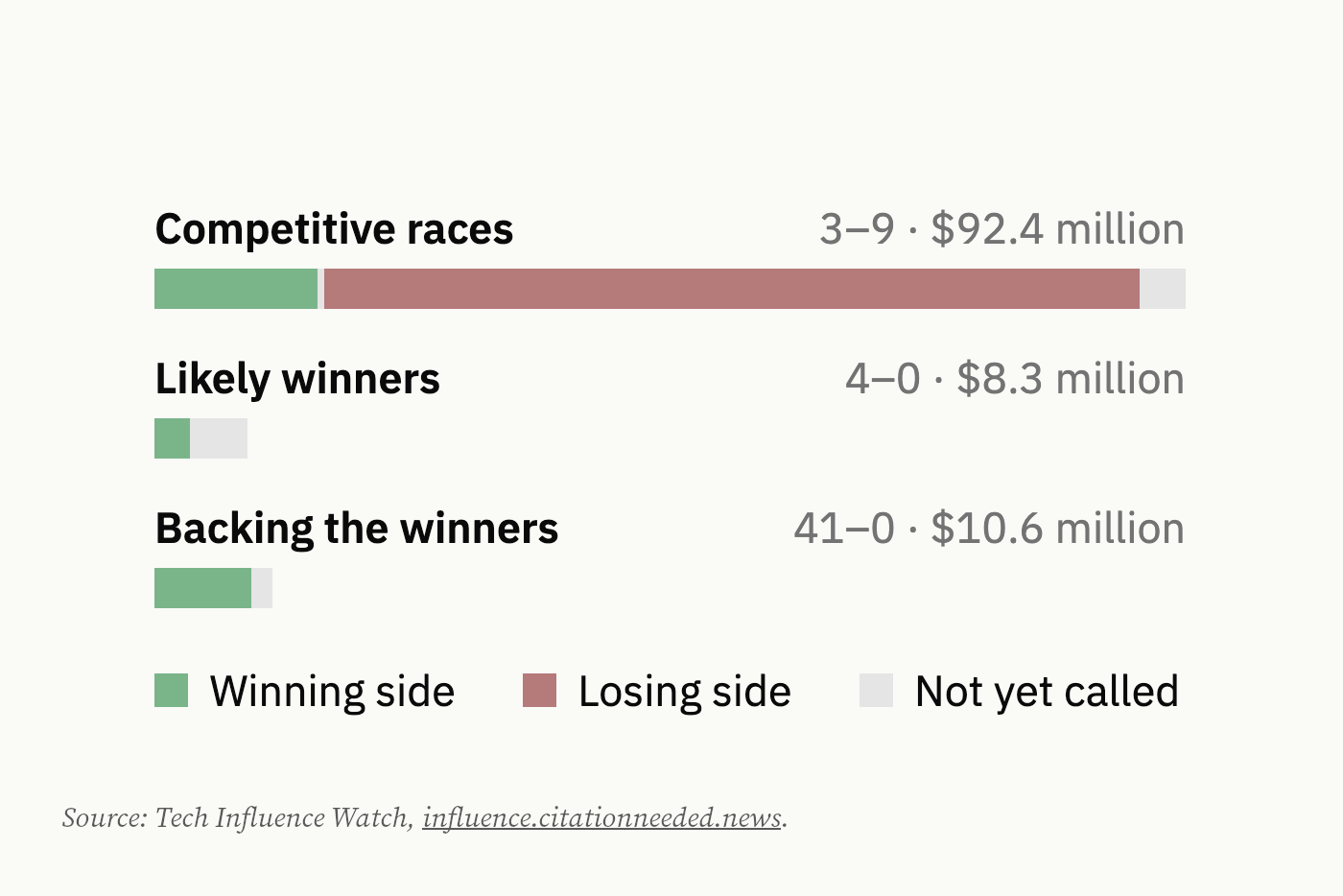
加密货币与人工智能行业的重注几乎全线落空。加密货币和人工智能公司在中期选举中斥资2.5亿美元,意在挑选将决定其行业如何——或是否——受到监管的议员。他们投入资金的大多数竞选属于安全席位,他们支持的候选人本就必胜无疑。但近四分之三的资金流向了竞争激烈的竞选,在那里,他们遭遇了惨败。
The industries’ biggest bets lost almost across the board. Crypto and AI companies spent $250 million in the midterms in hopes of picking the lawmakers who will decide how — or whether — their industries will be regulated. Most of the races they spent in were safe seats, where the candidates they backed were always going to win. But nearly three-quarters of their money went to the competitive races, and there, they got clobbered.
截至目前已有结果的十二场竞争激烈的竞选中,获得加密货币和人工智能超级政治行动委员会(超级筹委会)支持的一方输掉了九场。这些超级筹委会在落败的一方花费了7470万美元,而在获胜的一方仅花费了2830万美元。更详细的选后复盘将于下周发布。若想持续获取“科技影响力观察”的最新动态,请考虑注册付费会员。
Of the twelve competitive races called so far, the side backed by crypto and AI super PACs lost nine. The PACs spent $74.7 million on the losing side of those races, compared to $28.3 million on the winning side.a The longer postmortem will go out next week. and keeping Tech Influence Watch up to date, considerg up for a paid membership.
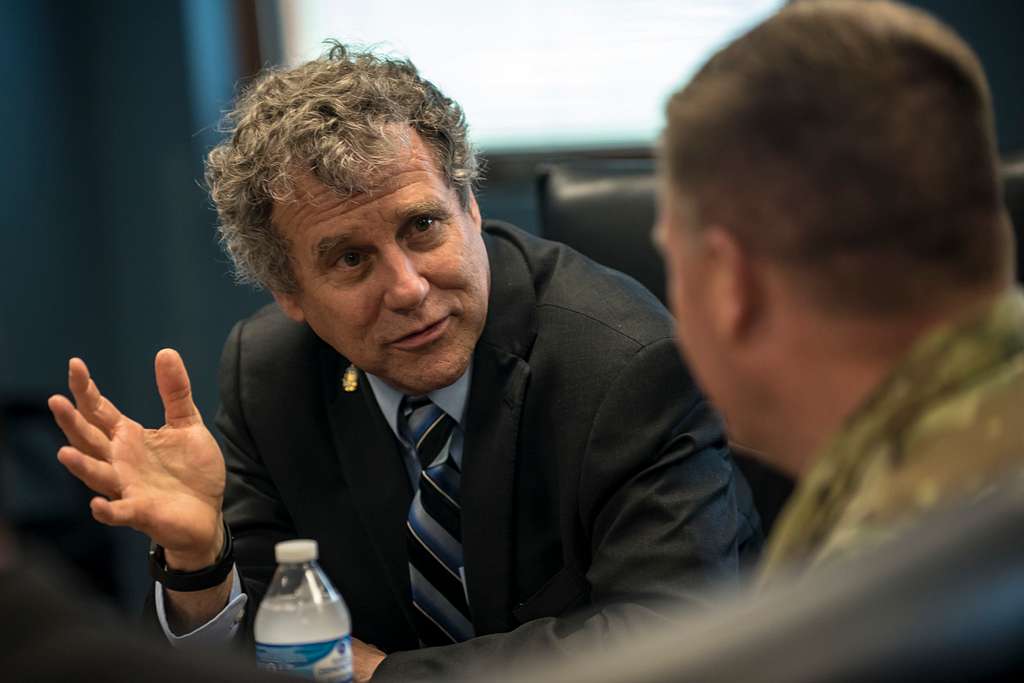
各场竞选的更多细节,请参阅我的2026年中期选举指南。失利详情俄亥俄州参议员:民主党人谢罗德·布朗克服了加密货币行业投入的超过6400万美元反对资金(用于反对他并支持乔恩·休斯特德)而获胜——这是该行业在单场竞选中投入的最多资金,也是本周期在任何其他单场竞选中投入资金的近五倍。这对加密货币超级筹委会而言是一次毁灭性的打击,其支持者如Coinbase首席执行官布莱恩·阿姆斯特朗曾在2024年夸口称“反加密货币是终结职业生涯的好方式”。
For more details on each of these races, see my 2026 midterms election guide. The losses Ohio Senate: Democrat Sherrod Brown overcame more than $64 million in crypto money spent to oppose him and support Jon Husted — the most the industry has ever spent on a single race, and nearly five times what it spent on any other race this cycle. This is a devastating defeat for the crypto PACs, whose backers like Coinbase’s Brian Armstrong crowed in 2024 that “being anti-crypto is a good way to end your career”.1 Brown’s career, it turns out, is doing just fine.
结果证明,布朗的职业生涯依然顺遂。Fairshake在国会的大量杠杆作用建立在议员们对其心存畏惧的基础上,如今议员们有了少得多的理由去恐惧它。
Much of Fairshake’s leverage in Congress depends on lawmakers being scared of it, and they have a lot less reason to be now.
南卡罗来纳州参议员:民主党人安妮·安德鲁斯击败了达琳·格雷厄姆,尽管后者在初选决选和大选中获得了近410万美元的人工智能资金支持。
South Carolina Senate: Democrat Annie Andrews beat Darline Graham, despite nearly $4.1 million in AI money that backed Graham through her primary runoff and general election.
威斯康星州第1国会选区:民主党人米切尔·伯曼击败了现任议员布莱恩·斯泰尔,后者担任众议院金融服务委员会数字资产小组委员会主席。加密货币行业斥资190万美元支持这位关键盟友并反对伯曼。
Wisconsin District 1: Democrat Mitchell Berman unseated incumbent Bryan Steil, who chairs the House Financial Services digital assets subcommittee. Crypto spent $1.9 million to support this key ally and oppose Berman.
密歇根州参议员:民主党人阿卜杜勒·埃尔-赛义德击败了迈克·罗杰斯,尽管来自卢米斯关联的加密货币政治行动委员会的81万美元以及来自保守派人工智能团体“美好未来联盟”的逾100万美元支持了罗杰斯。
Michigan Senate: Democrat Abdul El-Sayed beat Mike Rogers, despite $810,000 from a Lummis-linked crypto PAC and just over $1 million from the conservative AI group Alliance for a Better Future backing Rogers.
爱荷华州参议员:民主党人乔什·图雷克在对阵共和党人阿什利·欣森的竞选中获胜,克服了温克莱沃斯兄弟的亲加密货币“数字自由基金”投入的70万美元以及人工智能“美好未来联盟”投入的17.1万美元。
Iowa Senate: Democrat Josh Turek won his race against Republican Ashley Hinson, overcoming $700,000 in spending from the Winklevosses’ pro-crypto Digital Freedom Fund and $171,000 from AI’s Alliance for a Better Future.
得克萨斯州参议员:民主党人詹姆斯·塔拉里科击败了肯·帕克斯顿,尽管加密货币“数字自由基金”在最后关头推动支持帕克斯顿、反对塔拉里科。加密货币“奖学金政治行动委员会”也在帕克斯顿的初选决选中投入资金支持他。总体而言,加密货币在该竞选中花费了140万美元。
Texas Senate: Democrat James Talarico defeated Ken Paxton, despite a last-minute push by crypto’s Digital Freedom Fund to boost Paxton and oppose Talarico. Crypto’s Fellowship PAC also spent to support Paxton in his primary runoff. Altogether, crypto spent $1.4 million on the race.
缅因州参议员:人工智能团体“美好未来联盟”投入81万美元支持长期现任议员苏珊·柯林斯,但柯林斯仍被民主党人特洛伊·杰克逊击败。
Maine Senate: AI group Alliance for a Better Future spent $810,000 boosting longtime incumbent Susan Collins, who was ousted by Democrat Troy Jackson.
阿拉巴马州第2选区:加密货币助力民主党人肖马里·菲格斯在2024年当选,但这次却抛弃了他。尽管加密货币投入逾20万美元反对菲格斯、支持其共和党对手雷特·马奎斯;“公众优先”网络为聚焦人工智能领域,投入96万美元在马奎斯的初选中支持他;且选区重划有利于共和党,菲格斯仍然获胜。
Alabama District 2: Crypto helped elect Democrat Shomari Figures in 2024, but it abandoned him this time around. Despite more than $200,000 in crypto spending to oppose him and support his Republican opponent, Rhett Marques; $960,000 from the AI-focused Public First network to boost Marques in his primary; and a district redrawn to favor Republicans, Figures still won.
堪萨斯州参议员:人工智能方面投入8.1万美元支持罗杰·马歇尔,“美好未来联盟”购买广告宣传人工智能,但警告称亚历山德拉·奥卡西奥-科尔特斯和伯尼·桑德斯等政客会试图监管它“为其谋利”。显然堪萨斯州选民不买账,民主党人亚当·汉密尔顿翻盘夺得该席位。
Kansas Senate: AI spent $81,000 in support of Roger Marshall, with Alliance for a Better Future buying an ad that promoted AI but warned that politicians like Alexandria Ocasio-Cortez and Bernie Sanders would try to regulate it “for their benefit”. Apparently Kansans weren’t buying it, and Democrat Adam Hamilton flipped the seat.
北卡罗来纳州第1选区结果好坏参半:与OpenAI和安德森·霍洛维茨有关联的“引领未来政治行动委员会”在共和党人劳里·巴克豪特的初选中投入50.9万美元支持她。但在她与民主党人唐·戴维斯的大选对决中,“护栏联盟”——该组织自称是由工人和活动家组成、推动更强人工智能监管的团体——投入61.2万美元反对巴克豪特。戴维斯最终成功连任。
Mixed results North Carolina District 1: The OpenAI- and Andreessen Horowitz-linked Leading the Future PAC spent $509,000 boosting Republican Laurie Buckhout in her primary. But during her general election race against Democrat Don Davis, the Guardrails Alliance — which describes itself as a group of workers and activists pushing for stronger AI regulations — spent $612,000 opposing her. Davis ultimately won re-election.
内布拉斯加州参议员:现任共和党人皮特·里克茨在一场出人意料的激烈角逐中击败独立候选人丹·奥斯本,成功连任。作为参议院银行委员会成员,里克茨是加密货币行业的有力盟友——这很可能是该行业支持他而非同样对加密货币持积极态度的奥斯本的原因。“公平摇摆”网络在大选中花费1350万美元反对奥斯本。“奖学金”加密货币政治行动委员会和“公众优先”人工智能政治行动委员会分别花费35万美元和26.3万美元,在初选中支持里克茨。
Where their side won Nebraska Senate: Incumbent Republican Pete Ricketts retained his seat in an unexpectedly challenging contest against independent Dan Osborn. As a member of the Senate Banking Committee, Ricketts is a powerful ally to the crypto sector — which is likely why it favored him over Osborn, who has also spoken positively of crypto. The Fairshake network spent $13.5 million to oppose Osborn in the general election. The Fellowship crypto PAC and Public First AI PAC spent $350,000 and $263,000, respectively, to support Ricketts in his primary.
科罗拉多州第八国会选区:民主党人曼尼·鲁蒂内尔击败现任议员盖布·埃文斯,后者面临来自专注于人工智能的“公众优先”网络60万美元的反对性支出。鲁蒂内尔在初选中还获得了“你可以反击”超级政治行动委员会97.7万美元的支持,该超级政治行动委员会由加密货币亿万富翁克里斯·拉森资助,但主要关注人工智能监管。
Colorado District 8: Democrat Manny Rutinel unseated incumbent Gabe Evans, who’d faced $600,000 in opposition spending from the AI-focused Public First network. Rutinel also had $977,000 in primary support from You Can Push Back, a super PAC funded by crypto billionaire Chris Larsen but focused mainly on AI regulation. (Rutinel’s win came from the Anthropic-backed, self-described “AI safety” faction of AI money. The industry is split on how it wants to be regulated, so the other AI super PACs likely do not consider this a shared victory.)
(鲁蒂内尔的胜利来自安斯罗普公司支持的、自称“AI安全”派别的人工智能资金。行业在如何接受监管问题上存在分歧,因此其他人工智能超级政治行动委员会很可能不认为这是共同的胜利。)密歇根州第四国会选区、加利福尼亚州第三十四国会选区、蒙大拿州第一国会选区、亚利桑那州第一国会选区目前仍过于接近,难以宣布结果。
Still too close to call Michigan District 4, California District 34, Montana District 1, Arizona District 1.
你可以预期,从该行业传出的将是一个截然不同的故事。我之前曾撰文论述过这些政治行动委员会(PAC)的“押注赢家”策略:它们向几乎必胜的候选人投入相对少量的资金,既是为了购买(或回报)忠诚度,也是为了提高自己的胜率。2024年,Coinbase关联的倡导团体“Stand With Crypto”背书的候选人中,82%被给予至少75%的获胜几率;39人中有27人的获胜几率达到90%或更高,32人是现任议员[I68]。
You can expect a very different story out of the industry. I have written before about these PACs’ “back the winners” strategy, where they toss relatively small amounts of cash behind near-certain winners, both to buy (or reward) loyalty and to juice their win rates. In 2024, 82% of candidates endorsed by the Coinbase-linked advocacy group Stand With Crypto had been given at least a 75% chance of winning; 27 of the 39 had a 90% or better chance, and 32 were incumbents [I68].
Fairshake指着2024年的结果——他们声称胜率达91%2——作为获得授权的证据。“去年的选民已经很清楚地表达了意愿,”一位发言人在2025年7月表示。3 他们在本周期已经在重施故技。在大选前一个月,Fairshake吹嘘在“我们参与的57场竞选中赢了53场”(指本周期的初选)。4 在已有结果的40场有加密货币或AI政治行动委员会支出的稳赢竞选中,他们的选择40战全胜。预计这些稳操胜券的胜利将被同那些输掉的数百万美元豪赌一样计入战绩。
Fairshake pointed to the 2024 results — where they claimed a 91% win rate2 — as evidence of a mandate. “The voters last year were clear,” a spokesperson said in July 2025.3 They’re already running the same play this cycle. A month before the election, Fairshake was touting a record of winning “53 of the 57 races we engaged in” (referring to this cycle’s primaries).4 In the 40 safe races with crypto or AI PAC spending that have been called so far, their picks have gone 40 for 40. Expect those sure wins to be counted the same as the multimillion-dollar bets they lost.
我将持续更新“Tech Influence Watch”,随着结果继续陆续出炉。请留意下周将发布的更长篇复盘文章,届时更多胶着的竞选将有结果,行业也有了反应时间。
I’ll keep updating Tech Influence Watch as results continue to trickle in. Look out for a longer postmortem next week, once more of the close races are called and the industries have had time to react.
脚注 本次更新仅关注大选中的资金支出,因此总额低于初选和大选合计2.5亿美元的支出。 参考资料 Brian Armstrong的推文。“加密货币资金助推53名下届美国国会议员当选”,CoinDesk。“加密货币超级政治行动委员会Fairshake为2026年大选积聚1.41亿美元战争胸”,The Block。“加密货币超级政治行动委员会将在32个众议院选区支持候选人”,《国会山报》。
Footnotes For this update I’m just focusing on money spent in the general election, so overall totals are less than the $250 million spent across primaries and general races. References Tweet by Brian Armstrong. “Crypto Cash Fueled 53 Members of the Next U.S. Congress”, CoinDesk. “Crypto-focused PAC Fairshake amasses $141 million war chest ahead of 2026 elections”, The Block. “Crypto super PAC to back candidates in 32 House races”, The Hill.
有爆料?请通过Signal联系molly0xfff.07或发送邮件至molly@mollywhite.net(PGP)。我已就涉及加密货币的工作和写作进行了披露。
Have information? Send tips (no PR) to molly0xfff.07 on Signal or molly@mollywhite.net (PGP). I have disclosures for my work and writing pertaining to cryptocurrencies.
[noted]是Citation Needed的短文伴侣。你可以分别管理两者的邮件偏好设置。
[noted] is a short-form companion to Citation Needed. You can manage your email preferences for each separately.