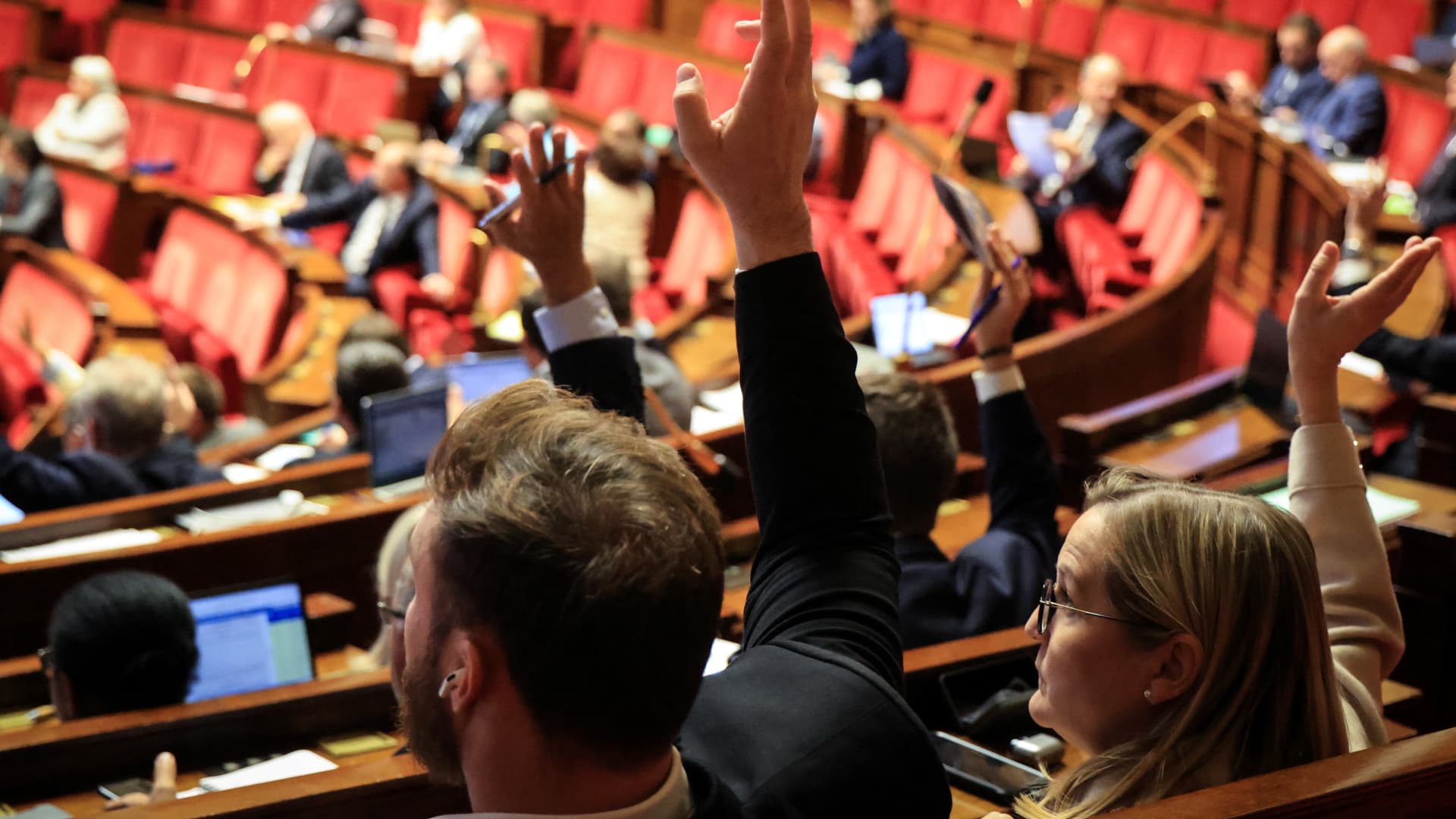
2026年11月4日,法国右翼政党共和党议员菲利普·朱万在巴黎国民议会出席2027年国家预算案一读审议会议时发言。
French right wing party Les Republicains MP Philippe Juvin speaks during a session at The National Assembly for the first-reading review of the 2027 state budget bill in Paris on Nov. 4, 2026.
Ludovic Marin | Afp | Getty Images法国议员周三晚间否决了政府的削减开支预算案,该国的财政状况正引发广泛抗议,并令债券市场感到担忧。
Ludovic Marin | Afp | Getty Images French lawmakers rejected the government's cost-cutting budget on Wednesday evening, as the country's finances fuel widespread protests and worry bond markets.
国民议会——法国议会下院——的议员一致投票反对通过总理塞巴斯蒂安·勒科尔尼政府起草的2027年预算计划。
Politicians in the National Assembly — the lower house of France's parliament — voted unanimously against adopting 2027 budget plans drafted by Prime Minister Sebastien Lecornu's government.
政府正试图通过大幅削减国家赤字、并说服议员批准大规模开支削减,来安抚法国的债权人——即法国债券的交易商。
The government is trying to appease France's creditors — traders in its bonds — by drastically reducing the country's deficit and convincing lawmakers to approve sweeping spending cuts.
勒科尔尼曾在9月表示,他的目标是将开支削减540亿欧元(618亿美元)。
Lecornu said in September that he was targeting spending cuts worth 54 billion euros ($61.8 billion).
但国民议会中没有任何一个政党占据多数席位,且各政治派别的议员都在其中,这使得就财政政策达成一致变得困难。
But no one party holds a majority in the National Assembly and lawmakers across the political spectrum sit in it, making agreements on fiscal policy difficult.
自2024年提前选举产生悬浮议会以来,历届政府都动用宪法第49.3条,在没有投票的情况下强行通过预算。
Since 2024's snap election delivered a hung parliament, successive governments have used Article 49.3 of the constitution to force budgets through without a vote.
但此前不信任动议的威胁曾迫使政府作出让步。如果政府被推翻,议员们就必须重新制定预算。
But threats of motions of no confidence have previously forced concessions. If a government is ousted, lawmakers must go back to the drawing board with the budget.
另一种选择是通过法令通过预算,而这在1958年成立的法兰西第五共和国历史上从未有过先例。如果政府在动用这一权力后被推翻,其强行通过的预算仍将继续有效。
Another option is to pass the budget by ordinance, which has never been done in the French Fifth Republic, created in 1958. If a government is ousted after using this power, the budget it forces through remains in place.
勒科尔尼在接替被推翻的总理弗朗索瓦·贝鲁后,通过宪法第49.3条确保了2026年预算的通过。
Lecornu secured the 2026 budget via Article 49.3, after replacing ousted Prime Minister François Bayrou.
对法国预算赤字的担忧——2025年该赤字占国内生产总值的5.1%——已导致法国政府债券(被称为OAT)今年承受极大压力。
Concerns about the French budget deficit, which measured 5.1% of gross domestic product in 2025, have seen French government bonds — known as OATs — come under extreme pressure this year.
随着借贷成本上升,该国国债——2025年占GDP的115.6%——也日益成为令人担忧的问题。
With borrowing costs rising, the country's national debt — which amounted to 115.6% of GDP in 2025 — is also increasingly a source of concern.
大规模动荡 自9月下旬以来,法国各地爆发暴力抗议,示威活动在10月下旬演变为骚乱和抢劫。这场最初由学生就教育经费问题发起的抗议,据信已造成超过10亿欧元(11亿美元)的损失。
Widespread unrest Since late September, France has seen violent protests across the country, with demonstrations dissolving into riots and looting in late October. What began with student protests over education funding is thought to have caused more than 1 billion euros ($1.1 billion) in damages.
周四预计将举行全国性罢工,数十万人料将参加示威,表达对生活成本上涨的不满。
Nationwide strikes were due to take place on Thursday, with hundreds of thousands of people expected to join demonstrations voicing discontent with the rising cost of living.
2026年11月5日,在南特,工会举行罢工并伴随学生领导的示威活动,抗议者在示威中举着标语牌。
Protesters hold placards during a demonstration as unions hold strikes alongside student-led demonstrations in Nantes on Nov. 5, 2026.
Sebastien Salom-Gomis | Afp | Getty Images 内政部长洛朗·努涅斯表示,将部署7万名警察和宪兵——一支军事警察部队——以努力平息任何爆发的暴力事件。
Sebastien Salom-Gomis | Afp | Getty Images Interior Minister Laurent Nuñez has said 70,000 police and gendarmes — a military police force — will be deployed in efforts to quell any outbreaks of violence.
法国媒体周四报道,一些示威活动中有人纵火,抗议者被发现举着写有“对市场操控的法国说不”的标语牌,而路透社报道称,里昂市已向示威者发射催泪瓦斯。
French media reported on Thursday that fires had been started at some demonstrations, with protesters spotted carrying placards that read "no to a France held by markets," while news agency Reuters reported tear gas had been fired at demonstrators in the city of Lyon.
“没有轻松的出路”分析人士对CNBC表示,周三预算案遭到否决,使得法国政府极有可能动用特殊权力,从而无需议会投票即可强行通过立法。
'No easy way out' Analysts told CNBC that Wednesday's rejection of the budget makes the French government highly likely to invoke special powers that allow legislation to be forced through without a parliamentary vote.
欧亚集团欧洲区董事总经理穆吉塔巴·拉赫曼周四在给CNBC的电子邮件中表示,这次投票“在很大程度上没有意义,因为这个分裂的国民议会从来就没有机会以正常方式通过预算”。他说:“这可以说对政府有利,因为这给了他们时间准备在下个月通过‘其他’手段强行推动预算,即利用宪法赋予的特殊权力。”
Mujtaba Rahman, managing director for Europe at Eurasia Group, told CNBC in an email on Thursday that the vote was "largely meaningless in the sense that there was never any chance of this divided National Assembly passing the budget in the normal way." "It arguably helps the government by giving them time to prepare to push through a budget next month by 'other' means, using special powers granted by the constitution," he said. Charlotte de Montpellier, senior economist for France at ING, agreed that the budget's rejection was "not a surprise at all." "No one believed that they could have validated the budget because ... the parliament is so fragmented.
ING法国高级经济学家夏洛特·德·蒙彼利埃也认为,预算案被否决“一点也不意外”。她在电话中表示:“没有人认为他们能够通过预算,因为……议会如此分裂。根本没有可能。”她补充说:“最终,预算需要在没有正式投票的情况下通过。”德·蒙彼利埃指出,法国媒体似乎确信政府会动用 ordinance 权力强行让明年的预算生效——但她表示,无论接下来发生什么,拟议的措施都不太可能大幅削减赤字。
There was no chance," she said on a call, adding: "In the end, the budget will need to pass without a formal vote." De Montpellier noted that the French press appeared convinced the government would use its ordinance powers to force next year's budget into place — but said that the proposed measures were unlikely to deliver a drastic reduction in the deficit regardless of what comes next. "It's clear that in any case, the budget target will not be reached," she told CNBC. "So even if we do see the draft budget [passed], we are not going to be at 5% of GDP next year. It's impossible because the growth is so much weaker than expected. They would need even more savings, which is not going to happen.
她告诉CNBC:“很明显,无论如何,预算目标都无法实现。所以即使我们确实看到预算草案[通过],明年我们也不会达到GDP的5%。这不可能,因为增长比预期弱得多。他们需要更多的节省,而这不会发生。所以明年的赤字将高于5%。”德·蒙彼利埃告诉CNBC,法国的前景“相当糟糕”,她指出经济增长低迷、信心下降、国内需求和投资疲软——更不用说席卷全国的骚乱已达到沸点。
So the deficit will be higher than 5% for next year." The outlook for France is "quite bad," de Montpellier told CNBC, pointing to low economic growth, falling confidence, and weakening domestic demand and investment — not to mention the unrest reaching boiling point across the country. "There is no easy way out because the usual way out of protests in France is to buy social peace, that's what has been done in the past," she said. "You use more money, and then things go back to a more normal situation.
她说:“没有轻松的出路,因为法国抗议的惯常出路是购买社会和平,过去就是这样做的。你花更多的钱,然后事情回到更正常的状态。但在这种情况下,这样做有点困难。所以不满或现在的情绪很可能会在未来一段时间内持续存在。”然而,她补充说,法国并没有濒临“崩溃”。“这是一个非常困难的局面,因为所有消息都是坏消息,[但]这并不意味着我们即将看到法国的崩溃。我们的债务没有[欧元区危机前的]希腊那么大。这更像是一个非常困难的阶段,但法国并没有完全注定失败,”德·蒙彼利埃说。
But in this case, it's a bit difficult to do that. So it's likely that unhappiness or the feeling right now will remain a bit going forward." However, she added that France was not on the verge of "collapsing." "It's a very difficult situation because all the news is bad, [but] it doesn't mean that we are about to see the collapse of France. We are not in as big a debt as Greece [before the euro zone crisis]. It's more like a very difficult phase, but France is not completely doomed," de Montpellier said.