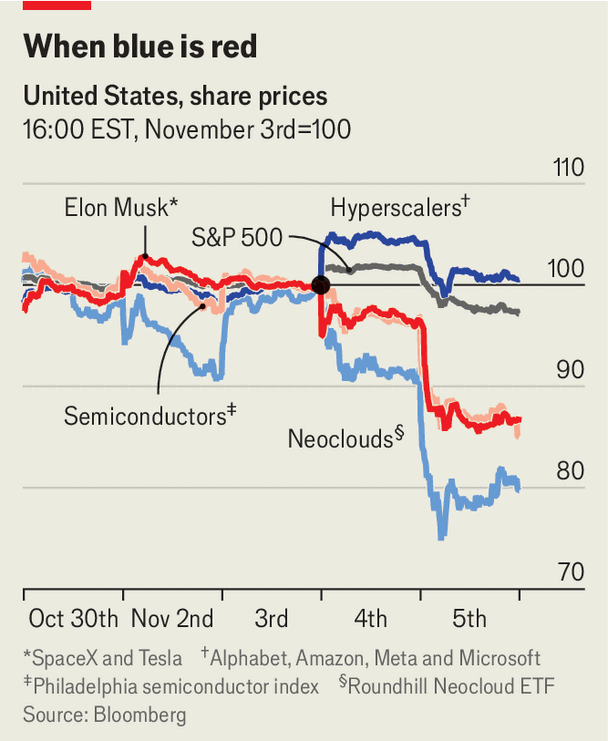
如果从市场讨论中剔除政治和人工智能,剩下的只会是一段简短的对话。而在11月5日,甚至连对话都没有了。在前一天经历了一波震荡的大选后交易时段后,投资者似乎得出结论:美国中期选举出现的“蓝色海啸”对AI不利。考虑到科技投资热潮在过去几年帮助推动了美国经济,且在AI主导几乎所有涨跌的市场中,这一结论导致股票全线下跌。基准标普500指数下跌4%。科技股云集的纳斯达克指数跌幅超过5%。
STRIP OUT politics and artificial intelligence from a discussion of markets and you would be left with a short conversation. Or, on November 5th, none at all. After a bouncy post-election trading session the day before, investors seemed to have concluded that America’s midterm election “blue-nami” was bad for AI. Given that the tech investment boom has helped propel the American economy in the past couple of years, and in a market where AI drives nearly all the ups and downs, this conclusion has sent stocks tumbling across the board. The benchmark S&P 500 index shed 4%. The tech-heavy NASDAQ index lost more than 5%.
投资者担忧并非无稽之谈。在得克萨斯州——未来两年左右美国规划新增产能约三分之一的目的地——当选民主党州长吉娜·伊诺霍萨已支持延长暂停批准新建项目,直到立法者能想出如何从科技公司榨取让步。她将在州议会拥有盟友,民主党在那里夺取了下议院控制权,这是20多年来首次。民主党还在佐治亚州和俄亥俄州赢得了州长职位,这两个州也是AI建设者有重大规划的地方,并在第三个州宾夕法尼亚州保住了州长职位。
Investors are right to worry. In Texas, the destination for around a third of the new capacity planned for America over the next two years or so, the Democratic governor-elect, Gina Hinojosa, has endorsed an extended moratorium on approving new construction until lawmakers can work out how to wring concessions from tech firms. She will have allies in the state capitol, where the Democratic Party wrested control of the lower house for the first time in more than two decades. Democrats also took the governorship in Georgia and Ohio, two other states for which AI builders had big plans, and kept it in a third, Pennsylvania.
最大的输家是AI宠儿中最昂贵的那些:CoreWeave等“新云”公司,它们代表客户运营数据中心;AMD、美光、英伟达等芯片制造商,它们提供硅片;芯片制造商的供应商,如应用材料;以及布鲁姆能源等电力公司,它们提供电力。承销前沿AI实验室上市(最近的是Anthropic)的投资银行,以及协助融资建设的私募市场巨头也遭重创。摩根士丹利市值蒸发6%。阿波罗跌超4%。而你真的不想成为埃隆·马斯克,他将旗下汽车、火箭和AI企业的命运押注在得克萨斯州——以及共和党身上。
The biggest losers were the dearest of the AI darlings: CoreWeave and other “neoclouds”, which operate data centres on behalf of clients; AMD, Micron, Nvidia and other chipmakers, which furnish the silicon; the chipmakers’ suppliers, such as Applied Materials; and power companies such as Bloom Energy, which provide the electricity. Investment banks underwriting the listings of frontier AI labs, most imminently Anthropic, and private-markets giants that help finance the buildout also took a beating. Morgan Stanley gave up 6% of its value. Apollo lost more than 4%. And you really don’t want to be Elon Musk, who has hitched his car, rocket and AI ventures’ fate to Texas—and to the Republican Party.
然而,并非所有AI股票都遭遇重创。四大科技“超大规模企业”——Alphabet、Amazon、Meta和Microsoft——的股价虽回吐了部分中期选举后的涨幅,但大体仍维持在选举日收盘前的水平(见图表)。数据中心建设放缓,反而可能令已拥有大量数据中心的公司受益(这些公司如今或许能减少用于新建数据中心的现金流支出,从而保住利润率)。作为AI大户的软件公司Salesforce和Workday同样跑赢大盘,尽管两者股价均有下跌。
Yet not all AI stocks got clobbered. The share prices of the four tech “hyperscalers”—Alphabet, Amazon, Meta and Microsoft—have given up some of their post-midterms gains but remain roughly where they were before markets closed on election day (see chart). A slowdown in data-centre construction may, after all, reward firms which already have lots of them (and which may now spend less of their cashflows on building new ones, preserving margins). Software firms such as Salesforce and Workday, which are big users of AI, also outperformed the market, though both declined.
这种分化指向“AI交易”发生的一项重大变化。研究机构Trivariate Research的Adam Parker指出,AI交易不再是同质化的。Trivariate考察了八篮子AI相关股票,涵盖从超大规模企业到公用事业及数据中心房地产投资信托基金。研究发现,数据中心硬件公司、芯片制造商及其供应商仍同步波动。但在过去几个月里,其他几组AI关联板块与半导体股同向下跌的频率降低了。
This divergence points to a big change in the “AI trade”. It is no longer homogeneous, notes Adam Parker of Trivariate Research, a research firm. Trivariate looked at eight baskets of AI-related stocks, from hyperscalers to utilities and data-centre real-estate investment trusts. It found that the data-centre hardware firms, makers of chips and their suppliers still move together. But over the past several months several other AI-linked groups have sold off alongside semiconductor firms less often.
尽管如此,许多投资者仍在寻求与AI股票拉开距离。部分人大举买入在下跌行情中往往跑赢大盘的“防御性”股票;批发零售商Costco的股价上涨近2%。另一些人转向国债;选举后两天,十年期国债收益率(与价格呈反向变动)下跌0.13个百分点,降至9月初债务恐慌前以来的最低水平。
Many investors are nevertheless seeking to put distance between themselves and AI stocks. Some loaded up on “defensive” shares that tend to outperform in slumping markets; the share price of Costco, a bulk-buyers’ paradise, rose by nearly 2%. Others picked up Treasuries; in the two days after the election yields on ten-year bonds (which move inversely to prices) fell by 0.13 percentage points, to their lowest level since before a debt-panic in early September.
为什么市场多花了一天才惊慌失措?毕竟,民主党大获全胜的史诗级规模在选后开盘前就已显而易见。也许投资者希望唐纳德·特朗普能从选民那里领会暗示,不再重燃与伊朗的对抗;又或许仅仅是松了一口气,因为结果大到连“首席选举否认者”都无力争辩,从而避免了一场潜在的宪法危机。这几乎肯定很大程度上与大型对冲基金平仓其选前持仓有关。
Why did the markets take an extra day to freak out? After all, the epic scale of the Democrats’ triumph was evident before trading began in the post-election morning. Perhaps investors were hoping that Donald Trump would take a hint from voters and not reignite his war with Iran, or simply felt relief that the result was too big for the election-denier-in-chief to contest, averting a potential constitutional crisis. A lot of it almost certainly had to do with big hedge funds unwinding their pre-election positions.
股市多头依然不为所动,认为市场恐慌并不预示着对人工智能革命的全面重新定价。标普500指数处于7月份的水平,仅比上月的历史高点低约6%,且仍比3月份的近期低点上涨了16%。“你觉得我们会因为吉娜·伊诺霍萨当选得克萨斯州州长就下跌60%吗?不会,”投资公司BCA Research的马尔科·帕皮奇说道。正在舔舐选后伤口的投资者恐怕会觉得这番话于事无补。■
Stock-market bulls are undeterred, arguing that the market panic does not herald a full repricing of the AI revolution. The S&P 500 is at its level in July, barely 6% off its record high last month and still up by 16% since a recent low in March. “Do I think we go down 60% because Gina Hinojosa is the governor of Texas? No,” says Marko Papic of BCA Research, an investment firm. Investors nursing a post-election bruising may find that to be cold comfort. ■