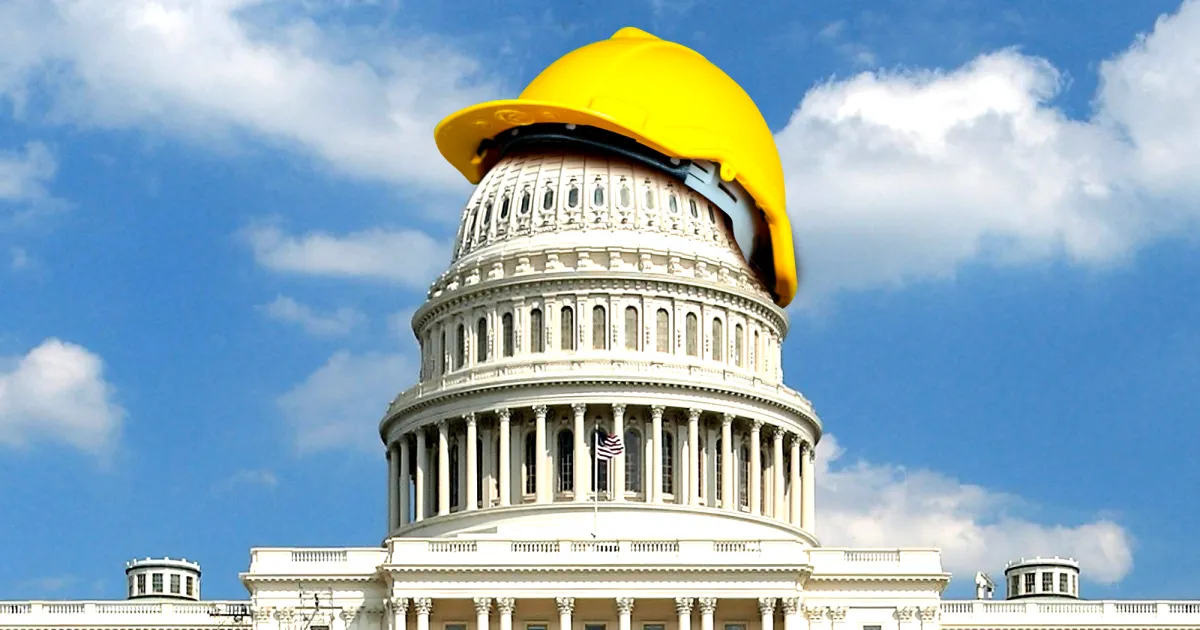
随着近年来最具历史意义的中期选举即将落下帷幕,新政治版图中一些看似平常却可能影响深远的议题正在浮现。其中一项——远不如德克萨斯州首位黑人女州长的“蓝色突破”以及共和党选区划分的“史诗级失败”那般引人注目——是一项颇具争议的许可改革协议,它有可能在未来几十年塑造美国能源基础设施建设的轨迹。若该措施获批,还可能加快唐纳德·特朗普总统对华盛顿特区的建设改造。
Now that the most historic midterm election in memory is almost over, some of the more mundane, and yet potentially significant, issues in the new political landscape are emerging. One of them—far less dramatic than a Blue Texas first Black woman Governor and the “epic fail” of Republican gerrymandering—is a controversial permitting reform deal that has the potential to shape the trajectory of the US energy infrastructure buildout for decades to come. Should this measure pass, it could also expedite President Donald Trump’s construction makeover of Washington, DC.
周一,跛脚鸭参议院将就《两党美国可负担与就业法案》(BAAJA)进行表决,该法案旨在消除一致被认为陈旧过时的许可制度中的监管障碍。该法案由一组两党参议员于9月提出——谢尔登·怀特豪斯(民主党-罗德岛州)、马丁·海因里希(民主党-新墨西哥州)、迈克·李(共和党-犹他州)和雪莱·摩尔·卡皮托(共和党-西弗吉尼亚州)——将全面改革联邦环境法规和审查标准,以加快输电线路、电网、发电厂和天然气管道的建设。
On Monday, the lame-duck Senate will vote on the Bipartisan American Affordability and Jobs Act (BAAJA) a measure aimed to ease the regulatory barriers of a permitting system that is unanimously considered antiquated. Introduced by a bi-partisan group of Senators in September—Sens. Sheldon Whitehouse (D-RI), Heinrich Martin (D-NM), Mike Lee (R-UT), and Shelley Moore Capito (R-WV)—the bill would overhaul federal environmental regulations and review standards to speed up the development of transmission lines, power grids, power plants, and gas pipelines.
但关于是否值得为了简化基础设施建设而削弱基础环境保护,在气候运动的不同派别间引发了一场“内战”。而现在,由于民主党即将控制国会,一些民主党人对明年能否达成更好的协议有了新的考量。
But questions over whether streamlining of infrastructure development is worth rolling back foundational environmental protections has erupted in a “civil war” between different factions of the climate movement. And now, because of the impending Democratic majority in Congress, the calculus has changed on whether some Democrats think a better deal can be struck in the new year.
围绕该法案最激烈的争论,或许集中在其拟加快关键能源基础设施项目审批的条款上。一方主要是可再生能源企业和智库,他们称赞这将带来海上风电或太阳能电站等可再生能源项目未来的繁荣,而这些项目往往因漫长的审查流程而停滞不前。另一方是活动人士、环保主义者和律师,他们警告该法案是一匹特洛伊木马:表面上看对环境友好,实则内含为化石燃料行业开绿灯的“钻吧,宝贝,钻吧”条款。
Perhaps the biggest debates over the bill have centered on its proposed acceleration of critical energy infrastructure projects. One camp, mainly renewable energy companies and think tanks, have praised a future boom in renewable energy projects such as offshore wind or solar farms, which often get bogged down by lengthy review processes. The other camp—activists, environmentalists, and lawyers—have warned the bill is a Trojan Horse: it may appear to be environmentally friendly, but contains within it a “drill-baby-drill” pass for the fossil fuel industry.
除了这项立法的能源影响之外,越来越多的批评者认为,该法案还将允许政府废除一系列现有的关键历史和文化法规,威胁部落主权和联邦公共土地,包括华盛顿特区的公共土地。
Aside from the energy impact of this legislation, a growing chorus of critics argue that the bill also would give the government permission to gut an array of existing critical historical and cultural regulations, threatening tribal sovereignty and federal public lands, including those in Washington, DC.
自第二次上任以来,特朗普似乎痴迷于各种所谓的“美化”工程——从在东翼废墟上建起的镀金白宫宴会厅,到阿灵顿国家公墓附近高耸的(且带有法西斯色彩的)凯旋门,再到海恩斯角他“梦想中的高尔夫球场”,那是一处深受华盛顿特区居民和游客喜爱的公共公园——而这一切都无视了国会批准的法定要求。
Since taking office for a second time, Trump has been seemingly obsessed with an assortment of so-called “beautification” efforts—from a gilded White House Ballroom born from the ashes of the East Wing to the towering (and fascistic ) Triumphal Arch near Arlington National Cemetery, to the “golf course of his dreams” at Haines Point, a public park beloved by DC residents and tourists—all while ignoring mandated congressional approval.
越来越多的法律变动推迟了大部分施工,最近的一次是联邦法官阻止了他那座拱门的建设。但他的一些项目,比如白宫东翼和倒影池,尽管面临法律挑战,仍在推进。历史保护组织认为,BAAJA将改写已实施六十年的《国家历史保护法》(NHPA),从而消除特朗普建设狂潮的一个关键障碍,而NHPA是BAAJA的一项条款。“这项法案里藏着一颗毒丸,它规定在任何项目启动之初,联邦机构负责人可以直接宣布其他考量重于历史保护。”
Mounting legal changes, most recently when a federal judge blocked construction of his arch, have delayed much of the construction. But some of his initiatives, such as the East Wing of the White House and the Reflecting Pool have proceeded despite legal challenges. Historic preservation groups argue that BAAJA would remove a key barrier to Trump’s construction frenzy by recasting National Historic Preservation Act (NHPA) that’s been on the books for six decades and is a provision of BAAJA“There is a poison pill in this bill that says, at the outset of any undertaking, a federal agency head can simply declare that other considerations outweigh historic preservation.”
该法于1966年由约翰逊总统签署,并由伯德·约翰逊夫人通过她的美化运动大力推动,保护了全国各地既受珍视、也几乎不为人知的历史和考古遗址。国家历史保护信托基金会高级副总法律顾问克里斯托弗·科迪帮助解释了这部法律当初为何出台。该基金会是一家私人资助的非营利组织,与政府合作保护美国的历史遗址。
Signed by President Johnson in 1966, and championed by Lady Bird Johnson through her beautification campaign, this act has protected both cherished and virtually unknown historical and archeological sites across the country. Christopher Cody, senior associate general counsel for the National Trust for Historic Preservation, a privately funded, nonprofit that works alongside government to save America’s historic sites—helped explain why the law was enacted in the first place.
“联邦政府在我们的社区和我们的州里做事,破坏了我们的历史资源,”他告诉我,“而美国人民想要更大的发言权。”20世纪50年代和60年代,一波城市更新项目摧毁了地方地标,并围绕汽车重新调整了地区优先事项,偏向修建主要道路和高速公路,地方和州政府领导人“希望在联邦政府进入[他们的]社区并破坏[他们的]历史资源之前,能有自己的发言权。”
“The federal government was doing things in our communities and in our states that destroyed our historic resources,” he told me, “and the American people wanted a bigger say.”When a wave of urban renewal projects in the 1950s and 60s gutted local landmarks and reorientated regional priorities around the automobile to favor major roadway and highway construction, local and state government leaders “wanted to have a voice before the federal government came into [their] communities and destroyed [their] historic resources.”
据科迪说,BAAJA将掏空NHPA第106条,该条款要求联邦机构既要考虑其行为对历史财产和场所的影响,也要与当地历史保护、考古和景观专家协商。
According to Cody, BAAJA would gut Section 106 of the NHPA which is part of the act that requires federal agencies both to consider the effects of their actions on historic properties and places, and consult with local historic preservation, archeological, and landscape experts.
“BAAJA将取消本届政府在华盛顿特区所有项目的第106条磋商,”科迪说。“这项法案里藏着一颗毒丸,它规定在任何项目启动之初,联邦机构负责人可以直接宣布其他考量重于历史保护。”
“BAAJA would eliminate all Section 106 consultation for all the administration’s projects in DC,” Cody said. “There is a poison pill in this bill that says, at the outset of any undertaking, a federal agency head can simply declare that other considerations outweigh historic preservation.”
科迪承认,这些担忧“只是这项法案的一小部分”。但即便只是小部分,它也会给建设项目的审批流程带来全面改变,包括政府被允许在何处建设。另一个根本性变化是联邦机构如何考量其项目的“不利影响”。换言之,就是拟议建设是否会通过其位置、设计、环境、材料,甚至与某地的关联,显著削弱一处遗址的历史完整性。
Cody acknowledges that these concerns “only a small part of this bill.”But even though small, it is one that would bring sweeping changes in the approval process for construction projects—including where the government is allowed to build. Another fundamental change is how federal agencies consider the “adverse effects” of their projects. In other words, if the proposed construction would significantly diminish the historic integrity of a site, through its location, design, setting, materials, or even the associated with a place.
虽然其中一些考量可能比另一些更主观,但一部被削弱的《国家历史保护法》将赋予政府完全自主权,由其判定什么算、什么不算有害。科迪指出,在这套新制度下,“华盛顿特区没有任何项目甚至会被认定具有不利影响。”
While some of these considerations might be more subjective than others, a watered-down NHPA would give the government full autonomy to determine what is or is not considered to be detrimental. Under this new system, Cody noted, “None of the projects in DC would even qualify as having adverse effects.”
以凯旋门为例,国家公园管理局认定它会在视觉上对附近40多处房产造成不利影响,其中包括阿灵顿国家公墓和林肯纪念堂等重要的历史遗址。科迪说,对于哪些实体、视觉和界定特征方面的影响值得保护、哪些可以被推土机铲平,BAAJA“会移动球门”。“这就是一项问题极其严重的法案,”他总结道,“它带来的问题将多于它解决的问题。”
Consider the Triumphal Arch which the National Park Service identified would have adversely visually affect more than 40 nearby properties, including such significant historical sites such as Arlington National Cemetery and the Lincoln Memorial. BAAJA “would move the goalpost,” Cody said, regarding what physical, visual, and character-defining impacts are considered worthwhile to preserve—and which can be bulldozed. “It’s just an incredibly problematic bill,” he concluded, “that is going to lead to more problems than it’s going to solve.”
近日,曾在克林顿、奥巴马和拜登政府担任气候变化与能源政策顾问的约翰·波德斯塔表示,这项拟议的许可法案将交给特朗普总统“不只是一把上了膛的枪”,而是一门“上了膛的榴弹炮”,用来对付公共土地。
Recently, John Podesta—former Clinton, Obama, and Biden advisor on climate change and energy policy—said that the proposed permitting bill would hand President Trump “not just a loaded gun” but a “loaded Howitzer” to go after public lands.
此外,该法案还将“允许一些即使违法也无法被法院推翻的东西”。据Heatmap报道,波德斯塔说:“他们将迎来前所未有的许可狂潮,并不真正关心是否走完了法律程序。”
Moreover, it would “permit stuff that even if it’s illegal can’t be reversed by the courts.”As reported by Heatmap Podesta said, “They’re going to have a permit gorge like you’ve never seen, not really caring about whether they’re going through the legal steps to do it.”
当然,破坏将远远超出国家首都建筑和空间的历史完整性。该法案的其他坚决反对者,如文化景观基金会(TCLF),该基金会是在华盛顿特区正在进行的建筑项目诉讼中的原告和共同原告,他们认为,其影响将波及部落土地,切断全国原住民的“文化生活方式”。“这对部落土地和部落保护来说确实是一种最坏的情况,”TCLF创始总裁兼首席执行官查尔斯·伯恩鲍姆说。
Of course, the devastation would extend well beyond the historic integrity of buildings and spaces in the Nation’s Capital. Other staunch opponents of the bill, such as the Cultural Landscape Foundation (TCLF), which is a plaintiff and co-plaintiff on ongoing D.C. construction project lawsuits, argue that the effects will be felt on tribal lands by severing “cultural lifeways” of Native people across the country. “This is really a kind of worst-case scenario for tribal lands and tribal preservation,” said Charles Birnbaum, Founding President and CEO of TCLF.
“这个国家以抹去故事而闻名,无论是部落土地,还是被划红线的非裔美国人社区。我真的看不出我们作为一种文化怎么能允许[政府]故意摧毁[这些]遗产。”
“This country has been known for its erasure of stories, whether it’s tribal lands, or African American communities that were redlined. I don’t really see how we as a culture could allow [the government] to purposely destroy [this] heritage.”
随着近几周对该法案的批评升级,以及选举后BAAJA在参议院通过的前景减弱,对于法案支持者和批评者之间的一个重要共识点——有意义的许可改革,这可能推动我们的能源基础设施进入21世纪——未来如何尚不确定。但科迪在讨论如果BAAJA在跛脚鸭会期被强行通过会有什么利害关系时直言不讳。“所提议的内容是反美国的,”他说,“因为它违背了我们作为一个社会、作为一种文化对自身的珍视。”
As criticism of the bill has escalated in recent weeks, and as the outlook for BAAJA’s passage in the Senate diminishes post-election, it’s uncertain what the future holds for a significant point of agreement for the bill’s proponents and critics: meaningful permitting reform which could propel our energy infrastructure into the 21st century. But Cody doesn’t mince words when he discusses what’s at stake should BAAJA get rammed through the lame-duck session“It’s un-American what is proposed,” he said, “because it is contrary to what we as a society and as a culture value about ourselves.”