法国的骚乱再次引发了一个老生常谈的抱怨:婴儿潮一代垄断了资源。这种抱怨认为,在舒适的职业生涯之后,出生于20世纪40年代中期至60年代中期的人拥有所有最好的房子和大部分股票,而且还领着丰厚的养老金。政客们知道这些老年人投票率很高,便争相向他们发放福利。年轻成年人则被困在昂贵的住房、不稳定的工作和崩溃的教育体系中。6月,耶鲁大学的塞缪尔·莫因出版了一本关于这一祸害的书,书名为《美国的老人统治》。
The riots in France gave another airing to a familiar grievance: that baby-boomers have cornered the market. After cushy careers, the gripe goes, people born between the mid-1940s and mid-1960s own all the best houses and most of the stock market, while receiving generous pensions to boot. Politicians, knowing that these oldies vote in large numbers, fall over themselves to hand them goodies. Younger adults are stuck with expensive housing, insecure work and a crumbling education system. In June Samuel Moyn of Yale University published a book about the scourge, titled “Gerontocracy in America”.
然而,莫因先生的书及其所反映的情绪可能已经过时。《经济学人》分析的一系列数据表明,世界已经过了婴儿潮一代的顶峰。老年人收入相对于劳动年龄人口正在下降,年轻人正在积累更多财富,各国政府也在推出更多有利于年轻人的政策。这种婴儿潮一代“共产主义”的消退——该现象被不那么友善地描述为如此——为负债累累的政府带来了一线希望,这些政府无力继续向老龄化人口大方提供福利。这也表明,西方政治体系并不像人们普遍认为的那样僵化。
Mr Moyn’s book and the sentiment it reflects may, however, be out of date. A range of data analysed by The Economist suggests that the world has passed peak boomer. Elderly incomes are falling relative to those of working-age people, the young are accumulating more wealth and governments are introducing more policies that benefit the stripling. The unwinding of boomer communism, as the phenomenon is less charitably described, is a ray of hope for indebted governments, which cannot afford to continue to lavish perks on an ageing population. It also suggests that Western political systems are less ossified than commonly assumed.
“婴儿潮一代共产主义”是战后安排的结果。20世纪50年代和60年代的福利制度对劳动男性照顾得不错,却忽视了其他所有人。许多老年人,尤其是女性,只能靠微薄的职业养老金度日,很快就花光了积蓄。老年等同于贫困。20世纪60年代中期,美国近30%的65岁以上人群收入低于满足基本需求所需的门槛,而劳动年龄人口中仅有10%。
Boomer communism was the result of the postwar settlement. The welfare system of the 1950s and 1960s treated working men well but ignored everyone else. Many older people, women in particular, made do with meagre occupational pensions and quickly outlived their savings. Old age was a synonym for destitution. In America in the mid-1960s close to 30% of people over the age of 65 had incomes below a threshold required to meet basic needs, compared with just 10% of working-age folk.
加拿大1976年(最早可用数据)中,47%的老年家庭处于贫困状态(采用较宽松的定义),而18至64岁人群中仅为15%。即使退休者并不贫困,他们也很少富有。1961年,英国中位数退休者在福利、税收和住房成本之后的收入,比中位数劳动年龄人士低30%。
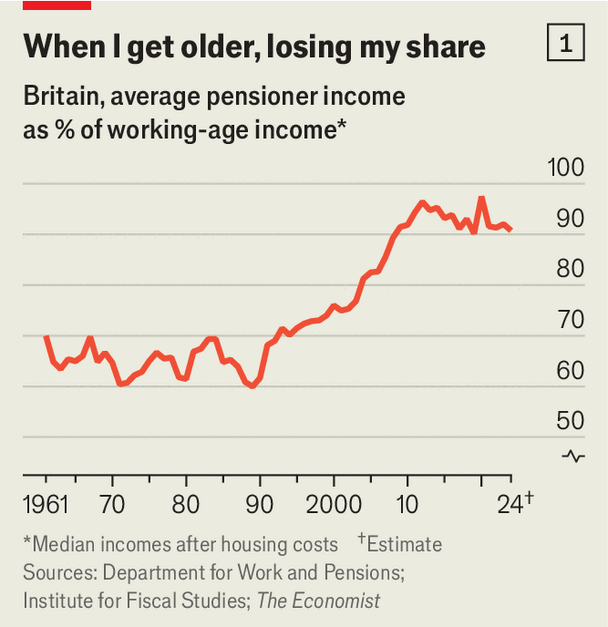
In Canada in 1976 (the earliest available data) 47% of elderly households were poor (under a looser definition), versus 15% of 18- to 64-year-olds. Even when pensioners were not poor, they were rarely rich. In Britain in 1961 the income, after benefits, taxes and housing costs, of the median pensioner was 30% lower than for the median working-age person.
到20世纪80年代,老年贫困在政治上已难以持续。英国报纸上充斥着退休者“冻死”的报道,他们将此归咎于吝啬的养老金。养老院丑闻在美国和法国引起轰动。那些在老年人少时可以安全忽视他们的政客,随着老年人数量激增,开始关注他们。当时强劲的经济增长为政府提供了充足的财政空间来讨好老年人。他们提高了养老金,并将其与工资或物价挂钩,扩大了医疗保健,并增加了针对性帮助(用于住房、取暖、公共交通和其他便利设施)。
By the 1980s elderly poverty became politically unsustainable. British newspapers were full of stories of pensioners “freezing to death”, for which they blamed stingy pensions. Scandals in nursing homes gripped America and France. Politicians who could safely ignore oldsters when there were few of them started paying attention as their ranks swelled. Strong economic growth at the time gave governments plenty of fiscal space to butter up the oldies. They made pensions more generous and indexed them to wages or prices, expanded health care and added targeted help (for housing, heating, public transport and other amenities).
拥有最完备历史数据的英国展示了事态的变化。在20世纪90年代和21世纪头十年,退休人员的收入大幅上升。到2010年代中期,退休者的收入几乎与英国劳动年龄人口持平(见图1)。其他国家的趋势也相似。我们估计,美国中位数老年家庭的税后及福利收入,从1979年的其他家庭收入的57%上升到2012年的90%。从2003年到2019年,意大利老年人的中位数可支配家庭收入相对于劳动年龄人口,从79%上升到92%。
Britain, which has the best historical data, shows how things changed. In the 1990s and 2000s incomes of pensioners soared. By the middle of the 2010s retirees were earning nearly as much as working-age Britons (see chart 1). The trends were similar elsewhere. We estimate that the income of the median elderly household in America, after taxes and benefits, rose from 57% of other households in 1979 to 90% in 2012. From 2003 to 2019 the median disposable household incomes of elderly Italians, relative to those of working age, rose from 79% to 92%.
到2015年,希腊退休者的收入已非常接近其年轻同胞。在许多富裕国家,劳动者的收入停滞不前或有所下降,尤其是在2007—2009年全球金融危机之后。
By 2015 Greek pensioners had come awfully close to out-earning their younger compatriots. In many rich countries, the earnings of working people stagnated or fell, especially in the aftermath of the global financial crisis of 2007-09.
政府的大错在于帮助了那些其实不需要帮助的老年人。许多婴儿潮一代已经从房地产和股票的长期牛市中获利颇丰。这笔财富还得到了慷慨的确定收益养老金计划收入的补充,这类计划大多将给付与最终工资挂钩。
Governments’ big mistake was to help oldies who did not really need it. Plenty of boomers were already reaping the windfall of long bull markets in property and equities. This wealth was supplemented by income from generous defined-benefit pension schemes, which mostly tied payouts to final salaries.
此外,几乎每个国家都向老年人提供一些按任何理性计算都不该提供的福利。大多数老年人都能享受博物馆和美术馆的折扣或免费入场。伦敦每位60岁及以上的居民,无论最贫穷还是最富有,都可以免费乘坐许多公交车和地铁。西班牙为退休人员的假期提供补贴。特朗普2025年的大规模减税法案为65岁以上的纳税人提供了额外每年6000美元的扣除额(大致相当于英国税务术语中的“个人免税额”)。
In addition, almost every country offers goodies to its elders that by any rational accounting it should not. Most oldies get discounted or free admission to museums and art galleries. Every Londoner aged 60 or over, from the very poorest to the poshest, can ride many buses and the tube free of charge. Spain subsidises pensioners’ holidays. Donald Trump’s giant tax bill of 2025 gave taxpayers over 65 an additional $6,000 annual deduction (roughly the same as the “personal allowance” in British taxspeak).
换言之,尽管有种种疼痛与不适,变老也可以是愉快的。但也许不会持续太久。我们收集了32个富裕国家中劳动年龄人口和退休人员收入的数据。在其中26个国家,老年人相对于年轻人的地位正在下降。希腊的劳动年龄人口现在收入比退休人员高出近20%。如果英国老年人从20世纪90年代初到2010年代中期的进步趋势延续至今,他们现在的收入应比劳动年龄人口中位数高出10%。事实上,他们收入低10%。
Despite the aches and pains, in other words, being old can be pleasant. But maybe not for much longer. We found data on working-age and pensioner incomes for 32 rich countries. In 26 of them, the elderly are now falling relative to the young. Working-age Greeks now earn nearly 20% more than pensioners. Had British oldies’ progress from the early 1990s to the mid-2010s continued, they would now earn 10% more than the working-age median. In fact they earn 10% less.
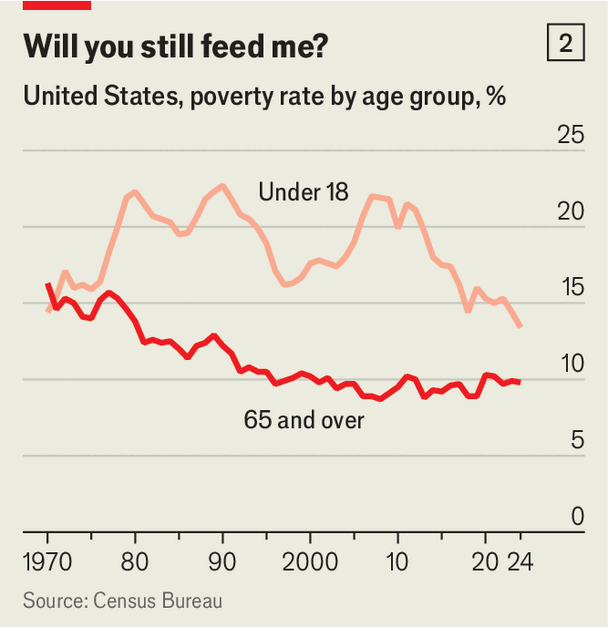
在美国,老年人的中位数收入超过十年没有相对于非老年人群体有所增长。近年来,儿童贫困率大幅下降,现在仅略高于老年人贫困率(见图2)。即使在巴西,那里的老年户主家庭中位数收入曾一度比劳动年龄户主家庭高出惊人的20%,现在也趋于平衡。
In America the median incomes of the elderly have not gained on the non-elderly for over a decade. Child poverty has sharply fallen in recent years, and now is only a bit higher than elderly poverty (see chart 2). Even in Brazil, where the median older household once earned an astonishing 20% more than working households, things are coming back into balance.
年轻人不仅收入更高。许多人也找到了质量更好的工作。经济学家长期认为,欧洲劳动力市场存在“内部人—外部人”动态,即老年人占据薪酬高且受保护的岗位,而年轻人则在不稳定的临时合同中挣扎。
Younger people are not just earning more. Many have also found better-quality work. Economists have long argued that European job markets are subject to “insider-outsider” dynamics, in which old people sit in well-paid and protected roles while younger ones suffer on insecure, temporary contracts.
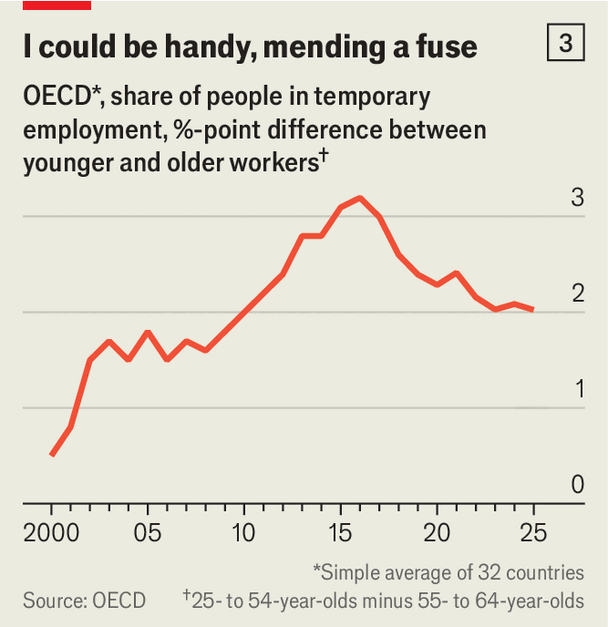
量化“内部人—外部人”动态的一种方法,是比较不同年龄群体中临时工作的普遍程度。在2000年代和2010年代的大部分时间里,经合组织国家的年轻工人越来越可能从事临时工作,这表明这个主要由富裕国家组成的俱乐部内,“内部人—外部人”动态正在加剧(见图3)。然而,最近这一差距正在缩小。
One way to quantify insider-outsider dynamics is to compare how common temporary work is among different cohorts. Throughout much of the 2000s and 2010s younger workers in the OECD were becoming relatively more likely to fill temporary roles, suggesting that insider-outsider dynamics were intensifying in the club of mostly rich countries (see chart 3). More recently, however, the gap has narrowed.
美国70岁以上人群占人口总数的13%,却持有美国全部私人财富的约三分之一,根据美联储数据。但自2010年代末以来,其财富占比增长速度慢于人口占比。年轻人中许多人已投资股市,表现令人意外地好。美国千禧一代(出生于80年代初至90年代中期)或许为自身处境而叹息,但在同龄人中,他们比历史上任何更早的世代都富有。早期迹象表明,Z世代正在以更快的速度积累财富(见图表4)。
Americans over 70, who make up 13% of the population, do hold a huge share of America’s overall private wealth—about a third, according to the Federal Reserve. But since the late 2010s their share of wealth has grown more slowly than their share of the population. Young people, many of whom have bought into the stock market, are doing surprisingly well. American millennials (born from the early 1980s to the mid-1990s) may mope about their lot but they are richer than any earlier generation in their country’s history at their age. Early signs provide some indication that Gen-Zers are accumulating wealth even faster (see chart 4).
老年人对住房市场的统治地位也不再如从前那样。截至2019年,美国房主的中位年龄从54岁升至58岁。但此后未再变化——尽管人口本身也在老龄化。英格兰虽然数据不够精确,但65岁以上房主占比自2017-18年以来一直维持在约36%的水平。这暗示着年轻人更容易登上“住房阶梯”。
The elderly’s dominance of the housing market is also not what it used to be. In the decade to 2019 the median age of American homeowners rose from 54 to 58. But since then it has not budged—even as the population has aged. In England, which has less precise data, the share of homeowners aged 65 and over has been flat at about 36% since 2017-18. This implies that younger people are finding it easier to get on the “housing ladder”.

经济老年统治已经达到了顶峰,原因有几个。其中一个与经济有关。排除2020年新冠疫情带来的短暂衰退,富裕世界二十年来没有经历同步的衰退。强劲的需求推动了工资上涨,进而使工人积累财富变得更加容易。
Economic gerontocracy has peaked for a few reasons. One relates to the economy. Excluding the short downturn of 2020, amid the covid-19 pandemic, the rich world has not experienced a synchronised recession for two decades. Strong demand for labour has boosted workers’ wages, which in turn has made it easier for them to accumulate wealth.
与此同时,后疫情时代的通胀可能比年轻人对老年人打击更大。工资与物价上涨基本保持同步,而大多数固定收益养老金支付的是固定的名义金额。通胀也吞噬了许多老年人的储蓄。欧盟委员会发表的一篇论文发现,近期的“生活成本危机”对退休家庭的影响几乎是劳动年龄家庭的近三倍。
Meanwhile, the post-covid bout of inflation probably hit oldies harder than youngsters. Wages have kept up reasonably well with rising prices, whereas most defined-benefit pensions pay a fixed nominal amount. Inflation has also eaten up the savings on which many oldies live. A paper published by the European Commission found that the recent “cost-of-living crisis” hit pension-age households nearly three times as hard as working-age ones.
即使政客们维持对老年人的偏爱,年轻人相对获益的趋势也会出现。事实上,政策也在变得不那么对婴儿潮一代友好。过去十年,许多欧洲政府放松了劳动力市场管制。这有利于年轻工人(因为如果企业能更容易地解雇员工,就更愿意冒险雇佣新人),但损害了老年人的利益(他们现在更容易被解雇)。经合组织发布的量化指标显示,近年来希腊和意大利的就业保护规则已变得不那么严格。法国使雇主解雇员工的行为更具可预测性,包括对不公平解雇的赔偿设上限。
These relative gains in favour of the young would have occurred even if politicians maintained their pro-oldie bias. In fact, policy is also turning less boomer-friendly. Over the past decade many European governments have liberalised labour markets. This benefits younger workers (since firms are more willing to take a chance on a fresh hire if they can sack people more readily) at the expense of the old (who are now easier to get rid of). Quantitative indicators produced by the OECD suggest that in recent years employment-protection rules in Greece and Italy have become less strict. France has made firings more predictable for employers, including by capping compensation for unfair dismissal.
公共支出方面可能是远离老人统治最明显的转变。宾夕法尼亚大学的研究人员将美国联邦支出分配给不同的年龄群体。采用他们的方法,我们估计,直到2010年代,美国65岁以上的人每人获得的联邦资金是其他年龄群体的十倍。社会保障和医疗保险(面向老年人的医疗保健计划)的支出远远超过了儿童福利支出(大部分教育支出由州和市政府负责,而非联邦政府)。
The clearest shift away from gerontocracy may be in public spending. Wonks at the University of Pennsylvania allocate federal spending in America to different age groups. Using their methodology, we estimate that until the 2010s Americans over 65 received ten times as much federal money per person as other age groups did. Outlays on Social Security and Medicare, the health-care programme for the elderly, vastly outweighed spending on child benefits (lots of education spending is the purview of states and cities rather than the federal government).
资金仍在持续流向老年人。但由于老龄化速度如此之快,个人老年人反而处于不利地位。到2024年,美国老年人获得的政府资助是年轻群体的六倍,而非十倍。在我们考察的其他29个富裕国家中,大多数国家也呈现类似趋势。在意大利,老年支出从疫情前几乎是家庭和儿童支出的15倍,下降到不到10倍。
Pots of money continue to flow to the elderly. But because so many people are ageing so fast, individual oldsters are losing out. By 2024 the American old were getting six times as much government largesse as younger cohorts rather than ten times. In the majority of the other 29 rich countries we examine, we find similar trends. In Italy old-age spending has gone from almost 15 times as high as spending on families and children before the pandemic to less than ten times as high.
部分缩小的慷慨差距与政府在老年人身上的挥霍程度有关。许多国家已对医疗保健支出设上限,而这部分支出不成比例地流向老年人。美国医疗支出在2000年代急剧上升后,占经济的比重已基本持平。经合组织的许多其他国家也抑制了医疗保健支出曲线,原因是广泛使用廉价仿制药、对医疗服务提供者支付更少以及其他成本控制措施。
Some of the narrowing of the largesse gap has to do with how much governments are splurging on the old. Many have put a lid on health-care spending, which disproportionately flows to the elderly. After soaring during the 2000s, American health spending has been roughly flat as a share of the economy. Many other countries in the OECD have also bent the health-care curve, thanks to expanded use of cheap generics, stingier payments to health-care providers and other cost control.
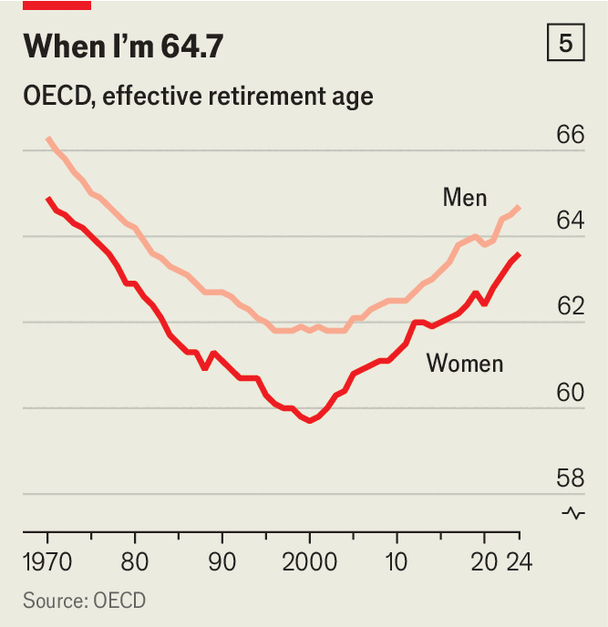
公共养老金也在发生变化。20世纪90年代的改革,出人意料地,在人口老龄化的情况下,将经合组织国家人们的平均退休年龄从约65岁降至61岁(见图5)。让更多老年人活得更久,推高了养老金体系的成本。现在各国政府鼓励人们继续工作。过去十年中,意大利男性的平均退休年龄提高了四年。即使在拥有世界上最慷慨养老金体系之一的法国,人们退休的年龄也在上升。
Public pensions are changing, too. Reforms in the 1990s had, bizarrely given ageing populations, reduced the average age at which people in the OECD retired from about 65 to 61 (see chart 5). Having more people in their dotage for longer raised the cost of the pension system. Now governments are encouraging people to stay in work. In the past decade the average age at which an Italian man retires has increased by four years. Even in France, which has one of the world’s most generous pension systems, the age at which people hang up their boots is rising.
国际货币基金组织维护的一个养老金改革新数据库显示,在多年的宽松之后,养老金改革正变得有些强硬。英国新任首相安迪·伯纳姆最近宣布,他的政府将改革国家养老金的“三重锁定”机制,该机制按通胀、收入增长或2.5%中的最高者提高养老金。2025年,在中国,大多数男性60岁退休,女性蓝领工人最早可在50岁退休,该国开始实施70多年来首次提高退休年龄(到2040年,男性退休年龄为63岁,女性为55至58岁)。
A new database of pension reforms, maintained by the IMF, suggests that after years of giveaways, pension reforms are becoming somewhat more hardnosed. Britain’s newish prime minister, Andy Burnham, recently announced that his government would reform the “triple lock” on the state pension that raises it by inflation, earnings growth or 2.5%, whichever is highest. In 2025 China, where most men retired at 60 and women in blue-collar jobs could do so as young as 50, began implementing its first increase in the retirement age in over 70 years (to 63 for men and 55-58 for women by 2040).
即使各国政府一直试图控制对老年人的支出,他们对年轻人却变得不那么吝啬了。许多国家增加了对家庭的补贴,往往是为了提高生育率。自2024年以来,德国、爱尔兰、日本、波兰和韩国已推出或扩大了儿童津贴。育儿假也变得更加慷慨。美国政府正为2025年至2028年间出生的儿童投资账户提供1000美元的种子资金。无论此类政策是否能显著提高出生率(经济学家对此持怀疑态度),它们无疑增加了年轻父母及其现有子女的收入。
Even as they have tried to contain spending on the old, governments have become less stingy with the young. Many have increased handouts to families, often in an attempt to boost fertility rates. Since 2024 Germany, Ireland, Japan, Poland and South Korea have introduced or expanded child allowances. Parental leave has grown more generous, too. Uncle Sam is chipping in $1,000 to seed investment accounts for children born in 2025-28. Whether or not such policies meaningfully boost birth rates (and economists are sceptical), they certainly increase the incomes of young parents and their existing offspring.
或许在几十年里一切似乎都对老年人有利之后,向年轻人回归某种程度是不可避免的。渥太华大学的Daniel Stockemer和Kamila Kolodziejczyk,以及哥德堡大学的Aksel Sundström管理着一个追踪世界各国政治内阁年龄的数据集。我们对其数据的分析表明,在2000年代和2010年代,老年人日益被过度代表。然而,最近这一趋势似乎正在扭转。
Perhaps some regression towards youth was inevitable after decades when everything seemed to go oldies’ way. Daniel Stockemer and Kamila Kolodziejczyk of the University of Ottawa, and Aksel Sundström of the University of Gothenburg manage a data set which tracks the ages of political cabinets across the world. Our analysis of their data suggests that in the 2000s and 2010s, old people were increasingly overrepresented. More recently, however, this trend appears to be turning.
在美国众议院,当前国会于2025年开幕时的平均年龄为57.9岁,低于2021年初的58.4岁。鉴于11月3日中期选举的结果,明年1月可能会更年轻。参议院肯定会变得不那么老迈:新当选的参议员比他们取代的现任议员年轻近15岁。在英国,2024年当选的议员平均年龄为49岁,而五年前为51岁。近年来,法国年龄在40岁或以下的部长比例已从大约十分之一上升到四分之一。埃马纽埃尔·马克龙总统48岁,39岁时首次就职。
In America’s House of Representatives the average age at the start of the current Congress in 2025 was 57.9 years, down from 58.4 in early 2021. It may be younger still next January, given the results of the midterm elections on November 3rd. The Senate will certainly get less geriatric: newly minted senators are nearly 15 years younger than the incumbents they replace. In Britain the average age of MPs elected in 2024 was 49, down from 51 five years earlier. In recent years the percentage of French ministers who are 40 or under has jumped from about one in ten to one in four. President Emmanuel Macron is 48, and first took office at the age of 39.
几乎各地的政策仍偏向养老金领取者。老年人拥有大量房产和金融资产,未来医疗和长期护理的压力将十分严峻。但几十年来,政府首次开始认识到,它们并非只为单一群体的需求服务。经济增长缓慢和高额公共债务使得养老金无法无限期提高。生育率低下使得将父母排除在劳动力之外的代价更加明显。而且,只要政客们照顾自己同类,这些转变可能会持续下去。老年人的黄金时代可能即将结束。■
Policy almost everywhere remains biased towards pensioners. The old hold a formidable stock of property and financial assets, and the coming pressure on health and long-term care will be severe. But for the first time in decades, governments are beginning to recognise that they do not exist to serve the needs of a single constituency. Slow growth and high public debt make it impossible to increase pensions indefinitely. Low fertility makes the cost of excluding parents from work more obvious. And to the extent that politicians look out for their own kind, these shifts may continue. The golden age of the golden oldie may be nearing its end. ■