阿斯特丽德·普兰热·德奥利维拉 2026年11月14日德国年轻人是否应该比20世纪80年代和90年代的“婴儿潮”一代更担忧自己的未来?还是说两代人应该走上街头共同抗议?德国之声核查了相关数据。
Astrid Prange de Oliveira November 14, 2026 Should young people in Germany be more worried about their future than Baby Boomers were in the 1980s and 1990s? Or should both generations take to the streets and protest together? DW checked the data.
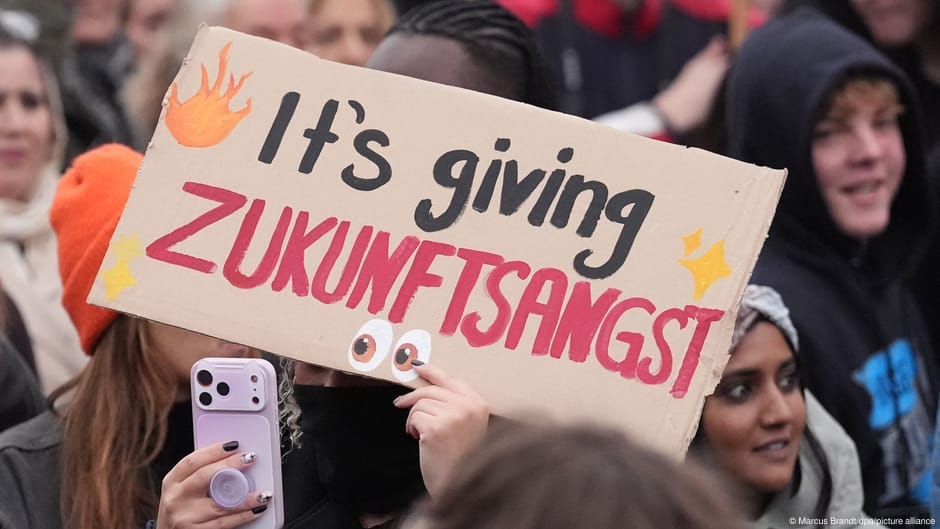
在谷歌上关注德国之声 “未来焦虑,拿捏了”,汉堡一场Z世代抗议活动的标语牌上写道。德国乃至整个欧洲的年轻人正走上街头,表达对黯淡前景的担忧。
Prefer DW on Google 'It's giving anxiety about the future,' reads the sign at a Gen Z protest in Hamburg Young people across Germany and Europe are taking to the streets, voicing fears of a bleak future.
但真的是这样吗?Z世代面临的挑战是否比20世纪90年代的婴儿潮一代更大?两代人有何共同点,经历又有何不同?
But is that really the case? Does Gen Z face greater challenges than Baby Boomers did in the 1990s? What do the two generations have in common, and where do their experiences differ?
青年研究者西蒙·施内策对德国之声表示:“当然,问一句‘你们那时候不也一样难吗?’是公平的。但年轻人看到现在对他们来说很困难,并表示这就是他们今天需要支持的原因。”
"Of course, it's fair to ask, 'Were things just as tough for you back then?'" youth researcher Simon Schnetzer tells DW. "But young people see that things are difficult for them now, and say that's why they need support today."
施内策撰写了年度《德国青年》研究报告。他强调,近期席卷欧洲的示威活动提出的一个关键问题是:“我们是否给了年轻人在此安心生活、工作并维持这一体系运转所需的条件?”他的直接回答是:没有。统计数据显示,Z世代和婴儿潮一代都受到重大社会变革的影响,但影响方式不同。德国之声梳理了养老金、教育、住房和气候变化方面的数据以探究究竟。
Schnetzer, who wrote the annual Youth in Germany study, highlights one key question raised by the recent demonstrations across Europe as: "Have we given young people the conditions they need to live and work here with confidence, and to keep this system funded?" His straightforward answer is no. A survey of the statistics shows that both Gen Z and the Baby Boomers are affected by major societal changes, but in different ways. DW surveyed data on pensions, education, housing and climate change to find out more.
养老金与老年贫困 事实指向一个明确趋势:越来越少的年轻人必须供养数量不断增长的退休人员。根据德国法定养老保险制度的数据,1957年每位退休人员对应3.73名缴费者。到2025年,这一数字已降至仅2.1名。
Pensions and poverty among the elderly The facts point to a clear trend: Fewer and fewer young people are having to support an ever-growing number of retirees According to the Germany's public pension insurance system, there were 3.73 contributors for every retiree in 1957. By 2025, that figure had fallen to just 2.1.
预计到2045年,这一数字将进一步降至每位退休人员仅对应1.73名缴费者。就绝对数字而言,这意味着3535万缴费者将为1682万退休人员的养老金买单。
By 2045, this number is projected to drop to just 1.73 contributors per retiree. In absolute terms, this means 35.35 million contributors will be financing pensions for 16.82 million retirees.
为了缓解这一趋势并保持缴费率稳定,养老金体系每年已获得约1180亿欧元(1310亿美元)的政府补贴。这大约占联邦预算的25%。这意味着,越来越多的人口将被要求帮助为养老金提供资金。
To cushion this trend and keep contribution rates stable, the pension system already receives around €118 billion [$131 billion] in annual government subsidies. This amounts to roughly 25% of the federal budget. That means an increasing share of the population will be called upon to help fund pensions.
也有迹象表明,许多人的养老金已不足以覆盖生活开支。依赖联邦基本收入支持的退休人员人数,从2003年的25.7万人上升至2024年的73.8万人。
There are also signs that many people's pensions are already falling short of covering their living expenses. The number of retirees relying on federal basic income support has risen from 257,000 in 2003 to 738,000 in 2024.
德国老少对养老金体系的看法 要观看此视频,以及 租金和住房成本 租金上涨对低收入家庭打击尤为严重。据德国经济研究所(DIW)的一份报告,低收入家庭用于支付租金的收入比例,从1990年的约24%上升至2021年的近36%。
What Germans young and old think about the pension system To view this video , and Rent and housing costs Rising rents hit low-income households particularly hard. According to a report by the German Institute for Economic Research (DIW), the share of income spent on rent by low-income households rose from around 24% in 1990 to nearly 36% in 2021.
这意味着,2021年,最低收入家庭平均将收入的14个百分点更多地用于支付租金,而高收入家庭则不然。
This means that in 2021, the lowest-income households spent an average of 14 percentage points more of their income on rent than high-income households.
据德国联邦统计局(Destatis)2025年的数据,平均有11%的人口将超过40%的可支配收入用于住房成本。在面临贫困风险的人群中,这一比例高达35%。
According to Germany's Federal Statistical Office (Destatis) in 2025, an average of 11% of the population spent more than 40% of their disposable income on housing costs. Among people at risk of poverty, the figure was as high as 35%.
然而,根据房地产平台Jacasa的计算,婴儿潮一代在未来几年实际上可能有助于缓解住房市场的压力。他们目前拥有约480万套自住房屋和公寓。
However, according to calculations by real estate platform Jacasa, Boomers could actually help ease pressure on the housing market in the coming years. They currently own around 4.8 million owner-occupied houses and apartments.
在未来几十年里,随着原居住者出售房产、搬入养老院或通过继承将房产传给后代,这些房产预计将易主。根据Jacasa的预测,在一些地区,这可能导致房产供应过剩,进而导致房价下降。
Over the coming decades, these properties are expected to change hands as former occupants sell them, move into assisted living, or hand them down through inheritance. In some regions, this could lead to an oversupply of properties and, consequently, lower prices, according to Jacasa's projections.
教育投资 根据联邦政府的《教育财政报告》,自2011年以来,针对30岁以下人群的公共教育支出已翻倍,从每人每年约4000欧元增至约8000欧元。
Investment in education According to the federal government's Education Finance Report, public spending on education for people under 30 has doubled since 2011, rising from around €4,000 to approximately €8,000 per person annually.
尽管支出增加,德国在国际比较中仍仅处于中游水平。联邦统计局(Destatis)数据显示,2022年德国公共教育支出占国内生产总值(GDP)的4.6%,而经合组织(OECD)平均水平为4.7%。
Despite this increase, Germany ranks only in the middle of the pack internationally. According to the Federal Statistical Office (Destatis), public education spending accounted for 4.6% of Germany's gross domestic product (GDP) in 2022, compared with an OECD average of 4.7%.
然而,追加资金无法解决教师短缺问题。根据文化部长会议的估算,到2035年德国将短缺约2.7万名教师。主要原因是婴儿潮一代退休潮以及出生率下降,导致年轻教师供给不足。
However, the additional funding cannot solve the problem of teacher shortages. According to estimates by the Standing Conference of the Ministers of Education and Cultural Affairs, Germany will be short of around 27,000 teachers by 2035. The main reasons are the wave of Baby Boomer retirements and declining birth rates, which have contributed to a shortage of young teachers.
气候变化 早在1972年,罗马俱乐部就在其里程碑式出版物《增长的极限》中警告全球变暖的后果。联合国指出,若按当前轨迹,到本世纪末全球升温将达工业化前水平以上2.6摄氏度。布鲁塞尔自由大学2025年的一项研究发现,如果世界维持现行气候政策,如今6岁的儿童一生中经历热浪的频率,将是婴儿潮一代的两到七倍。
Climate change Back in 1972, the Club of Rome warned of the consequences of global warming in its landmark publication The Limits to Growth According to the United Nations, the planet is on track for 2.6°C of warming by the end of the century compared with pre-industrial levels If the world maintains its current climate policies, children who are six years old today could experience heat waves two to seven times as often as Boomers did over their lifetimes.
极端天气的致命影响已体现在近期热浪期间死亡人数上升上。德国罗伯特·科赫研究所(RKI)估计,截至2026年9月中旬,德国因高温相关原因死亡约1.6万人。绝大多数——超过1.4万人——年龄在65岁以上。
That was the finding of a 2025 study by Vrije University in Brussels The deadly impact of extreme weather is already evident in rising death tolls during recent heatwaves. According to Germany's Robert Koch Institute (RKI) an estimated 16,000 people died from heat-related causes across Germany by mid-September 2026. The vast majority — more than 14,000 — were over the age of 65.
青年研究者施内策总结道:“Z世代和婴儿潮一代在同一条船上。我们需要把他们凝聚在一起,因为否则年轻一代没有繁荣前景,老一辈也没有。”
"Gen Z and Baby Boomers are in the same boat. We need to bring them together, because otherwise younger people have no prospects for prosperity, and neither do older generations," youth researcher Schnetzer concludes.
他建议两代人都走上街头,一起抗议,并补充说这仅仅是个开始。“接下来需要的是一个建设性的过程,来界定每个人都能支持的目标和措施,”他说。“即使这意味着要做出牺牲。”
He suggests that both generations take to the streets and protest together, adding that would just be the beginning. "What needs to follow is a constructive process to define goals and measures that everyone can support," he said. "Even if it means making sacrifices."