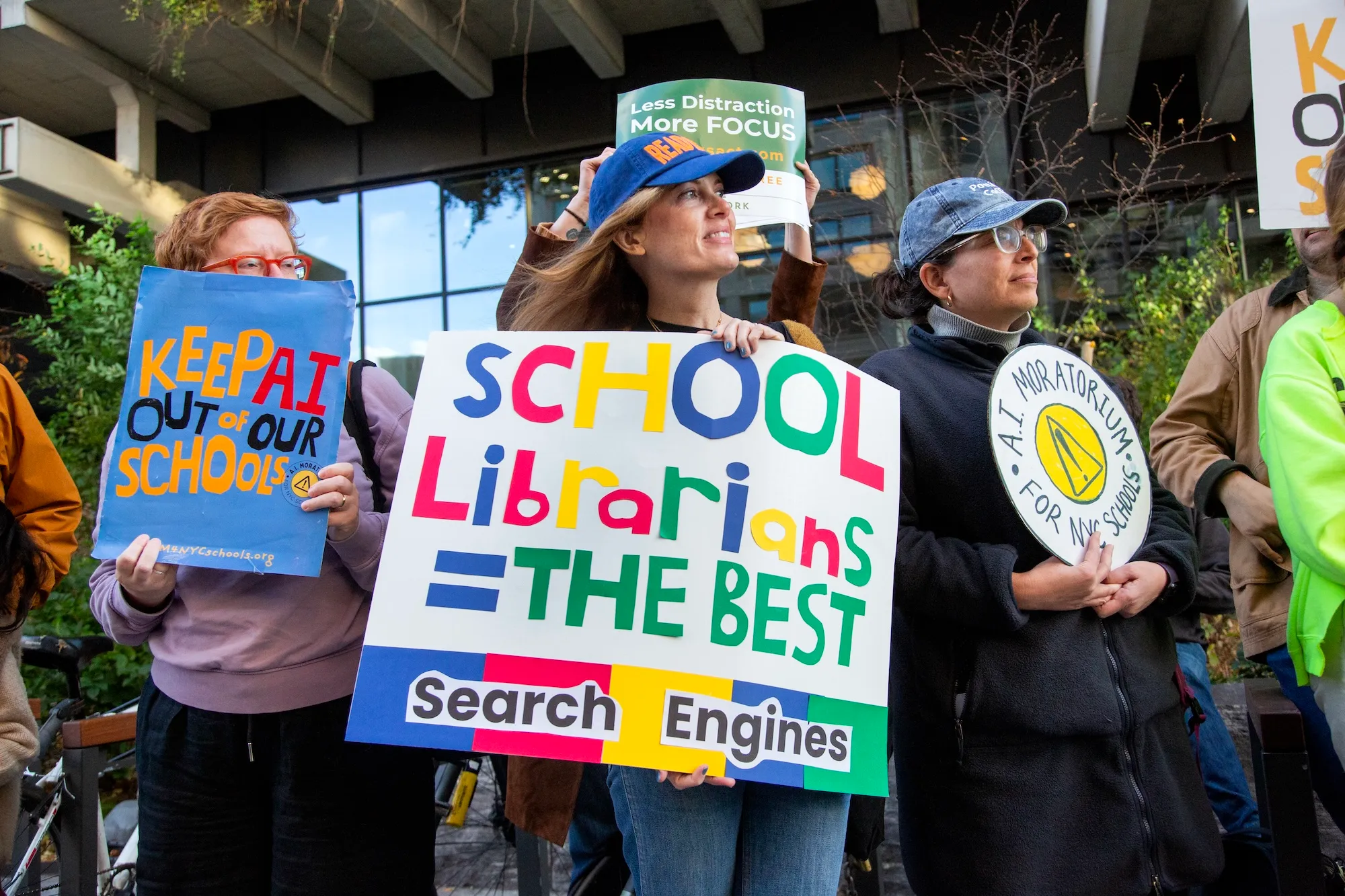
家长、学生、教育工作者、工会成员、艺术家、创意工作者和社区成员于周三下午聚集在谷歌位于纽约市的总部大楼外,抗议谷歌将其人工智能技术推向学校。这座大楼坐落在曼哈顿哈德逊广场社区那片阴森的写字楼区内。
Parents, students, educators, union members, artists, creatives, and community members stood outside Google’s New York City headquarters, located in the eerie corporate section of Manhattan’s Hudson Square neighborhood on Wednesday afternoon to protest Google pushing its AI technology into schools.
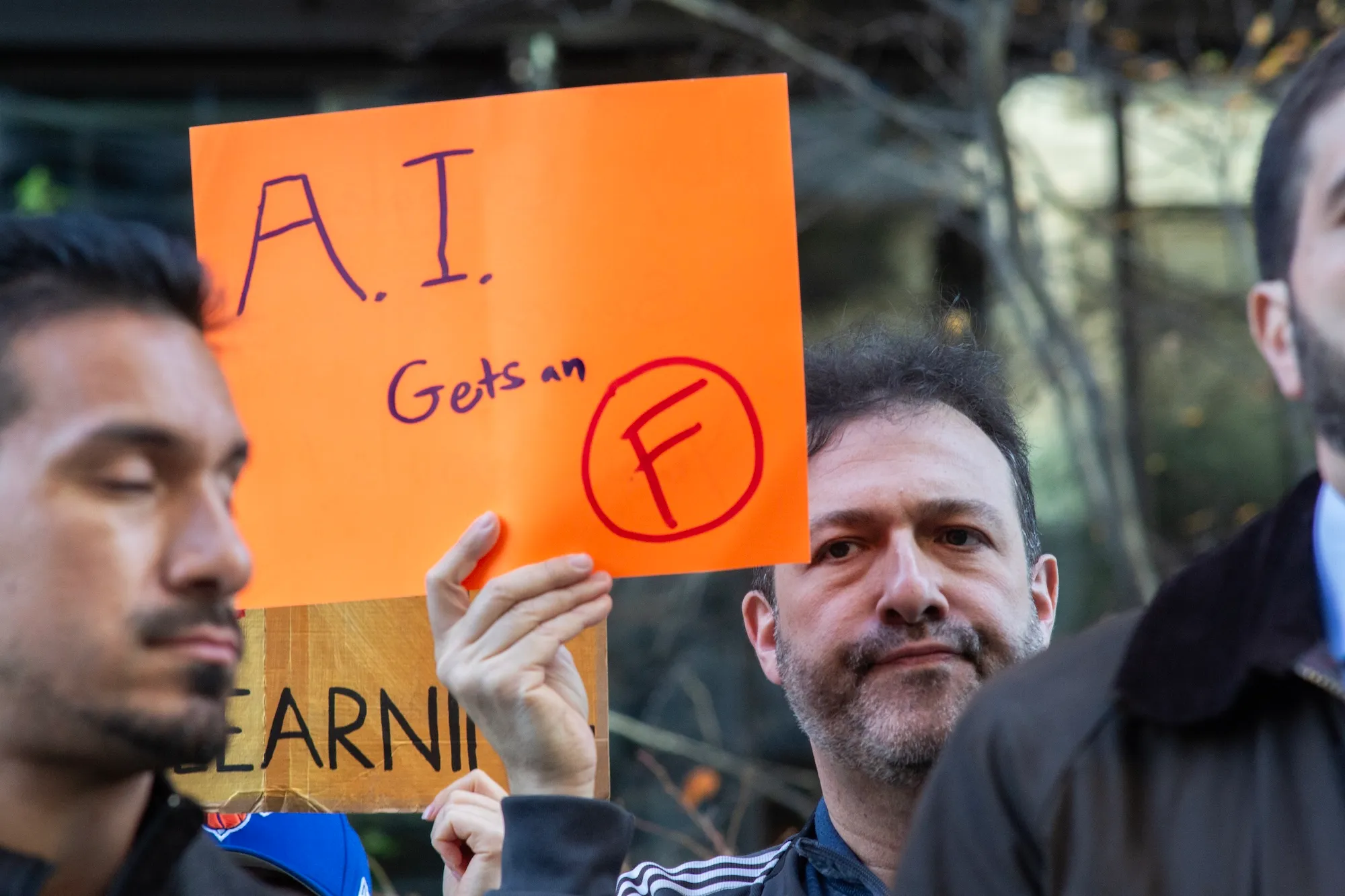
这是一场全家参与的活动:各年龄段的与会者手举标语,上书“我的学校不需要人工智能!”“人工智能不及格”、“别偷走我们的想象力”、“学校图书管理员 = 最好的搜索引擎”。一些学生向路人发传单,年幼的孩子则在一旁奔跑玩耍、画画。
It was a family event: Attendees of all ages held signs reading, “NO AI IN MY SCHOOL!”, “A.I. Gets an F,” “Stop stealing our imaginations,” and “SCHOOL Librarians = THE BEST Search Engines.”Some students handed out fliers to passersby while younger children ran around and drew pictures off to the side.
许多路过的汽车鸣笛表示支持,单行道对面的几名建筑工人也为抗议者加油鼓劲。
Many cars driving by honked their horns in support, and a few construction workers on the other side of the one-way street cheered the protesters on.
周三,在洛杉矶、芝加哥、波士顿、俄勒冈州波特兰、科罗拉多州博尔德和北卡罗来纳州达勒姆等其他六个城市也举行了集会,由一个全国性的家长倡导组织联盟发起组织。
Rallies also took place on Wednesday in six other cities—Los Angeles; Chicago; Boston; Portland, Oregon; Boulder, Colorado; and Durham, North Carolina—organized by a nationwide alliance of parent advocacy organizations.
就在一周多前的大选日,谷歌宣布,除非管理员主动选择开启,否则将为学校系统关闭其人工智能工具。但这些人工智能工具中包含谷歌搜索,后者已成为在互联网上检索信息的代名词。随着纽约市颁布为期一年的生成式人工智能禁令,禁止许多中小学生使用生成式人工智能,学校将完全失去谷歌搜索功能。洛杉矶联合学区等其他一些大型公立学区也已在校内设备上广泛限制学生使用生成式人工智能。
Just over a week earlier, on Election Day, Google announced that it would turn off its AI tools for school systems unless administrators choose to turn them on. But among these AI tools is Google Search, which has become synonymous with how to seek information on the internet. With New York City enacting a one-year AI moratorium on generative AI use for many elementary and middle school students, schools would lose Google’s search capacity entirely. Some other major public school systems, like the Los Angeles Unified School District, have also widely limited student access to generative AI on school devices.
纽约市和洛杉矶都是谷歌的客户。为了在新冠疫情早期迅速建立远程学习项目,许多学区投资购买了谷歌 Chromebook,其价格明显低于 Windows 和苹果电脑。将 Chromebook 引入课堂——据一些家长告诉我,也延伸到了许多学生用来做作业的家庭——已非常普遍,因为这些学校将硬件与谷歌课堂整合在一起,后者可管理作业、发布公告、与谷歌日历和谷歌云端硬盘同步,并内置了通过谷歌 Gemini 提供的 AI 工具。
Both New York City and Los Angeles are Google clients. In an effort to quickly set up remote learning programs during the early years of the Covid pandemic, many school districts invested in Google Chromebooks, which were notably more affordable than Windows and Apple computers. Incorporating Chromebooks in the classroom—and according to what some parents told me, into homes where many students use them for homework—is pervasive, as these schools integrate the hardware with Google Classroom, which manages assignments, posts announcements, syncs with Google Calendar and Google Drive, and includes built-in AI tools through Google Gemini.
在谷歌发布公告的第二天,谷歌成了一起诉讼的被告。诉讼指控,通过学校发放的 Chromebook 访问 Gemini 聊天机器人,诊断北卡罗来纳州 13 岁女孩 Emma 患有严重心理障碍,并在数月内协助她策划自杀和葬礼——据称还指导她向家人和朋友隐瞒自残行为。(学校的监控系统据报最终将该活动标记给了一位九个月前已离职的前校园辅导员。学校通知了 Emma 的父母,父母随即介入。)谷歌发言人上周告诉 Gizmodo,公司“非常重视”诉讼中的指控。
The day after Google’s announcement, Google became the subject of a lawsuit alleging that the Gemini chatbot accessed through her school-issued Chromebook diagnosed Emma, a 13-year-old girl in North Carolina, with severe psychological disorders, and assisted her in planning her suicide and funeral over a span of several months—allegedly coaching her to conceal self-harm from her family and friends. (The school’s monitoring systems reportedly flagged the activity eventually to a former school counselor who had left nine months prior. The school alerted Emma’s parents, who intervened.) A Google spokesperson told Gizmodo last week that the firm was taking the lawsuit’s allegations “very seriously.”
“我们与医疗专业人士和学术专家进行了广泛合作,”该发言人补充道。“当人们的查询表明他们可能正在经历危机时,我们会直接在搜索结果中显示热线信息,将他们与现实世界的支持联系起来。”三个孩子的家长 Kelly Clancy 组织一个联盟,呼吁在纽约市 K-12 公立学校暂停使用所有生成式 AI 两年,以便有时间通过有研究支持的流程评估 AI 产品应扮演的角色。
“We’ve worked extensively with medical professionals and academic experts,” the spokesperson added. “When people’s queries indicate they may be experiencing a crisis we show hotline information directly in Search to connect them with real-world support.”Kelly Clancy, a parent of three, organizes with a coalition calling for a two-year pause on all generative AI in New York City’s K-12 public schools to allow time for a research-backed process to evaluate the roles AI products should have.
她告诉我,她用自己的电脑登录孩子们的学校发放的谷歌账号,测试他们被允许访问的内容。据 Clancy 称,学生在学校的平板电脑和手机上仍可访问 Gemini,这会回退到谷歌的 AI 聊天功能。
She told me that she logged in to her kids’ school-issued Google profiles with her own computer to test what they were allowed to access. According to Clancy, students can still access Gemini on tablets and phones at school, which reverts to Google’s AI chat.
“当我儿子输入‘AI sucks’——因为他 12 岁——它开始表现得像个陪伴机器人,告诉他它在这里倾听,并且听到了他,”Clancy 说。
“When my son typed ‘AI sucks’—because he’s 12—it started behaving as a companion bot, telling him it was here to listen and that it heard him,” Clancy said.
住在布鲁克林、有一名二年级女儿的家长克雷格周三表示,虽然谷歌的技术带来了更广泛的问题——例如消耗的能源超过整个国家的用量,以及数据中心推高碳排放——但普通人仍然可以“停止使用谷歌产品”。
Craig, a parent with a daughter in second grade in Brooklyn, said on Wednesday that while Google’s tech poses wider problems—such as consuming more energy than entire countries and driving up carbon emissions with data centers—ordinary people can still “quit using Google products.”
曾任教师、有一名四年级孩子的萨姆在纽约市与“超越屏幕的学校”组织开展活动,这是一个由家长和教育工作者组成的全国性联盟,推动在课堂上基于证据地限制数字技术。她说,她发起了一份请愿书,目前已有超过600个签名。家长们提出的一个问题是:“为什么我们要信任并让亿万富翁们掌控孩子的教育、掌控他们的未来?”
Sam, a former teacher and mom to a fourth grader, organizes in New York City with Schools Beyond Screens, a national coalition of parents and educators pushing for evidence-based limits on digital technology in classrooms. She said she circulated a petition that now has over 600 signatures to that effect. One question parents raised: “Why are we trusting and enabling billionaires with our children’s education, with their futures?”
在周三的抗议活动中,纽约州参议员安德鲁·古纳德斯表示,当他的孩子入学时,他被“激进化”了。古纳德斯提出了《促进课堂最佳屏幕使用法案》(FOCUS Act),要求学校在很大程度上为学前班至五年级的学生提供无屏幕教学。
At Wednesday’s protest, New York State Sen. Andrew Gounardes said he was “radicalized” when his kids entered school. Gounardes proposed the Fostering Optimal Classroom Use of Screens (FOCUS) Act, where schools would largely be required to offer screen-free learning to students from pre-K to fifth grade.
纽约市教育委员会民选成员纳维德·哈桑告诉我,学校中人工智能技术问题的根源可以追溯到2002年,当时市长迈克·布隆伯格从州政府手中接管了城市公立学校系统,废除了管理全市32个社区学区的委员会,建立了一个“自上而下的体系”。
Naveed Hasan, an elected member of New York City’s board of education, told me that the groundwork for problems with AI tech in schools came when Mayor Mike Bloomberg took control over the city’s public school system from the state government in 2002, abolishing boards that govern the city’s 32 community school districts and creating a “top-down system.”
哈桑说:“不可能由一个人来指导针对90万名学生的政策。我们有几十个社区,拥有不同的种族、语言、诉求和需求。”他主张学校需要被允许“拥有一定的自由,为他们的社区做必要的事情”。
“There’s no way that one person can direct 900,000 students worth of policy. We have dozens of neighborhoods with different ethnicities and languages, wants and needs,” Hasan said, arguing that schools need to be allowed “some freedom to do the thing they need to do for their communities.”