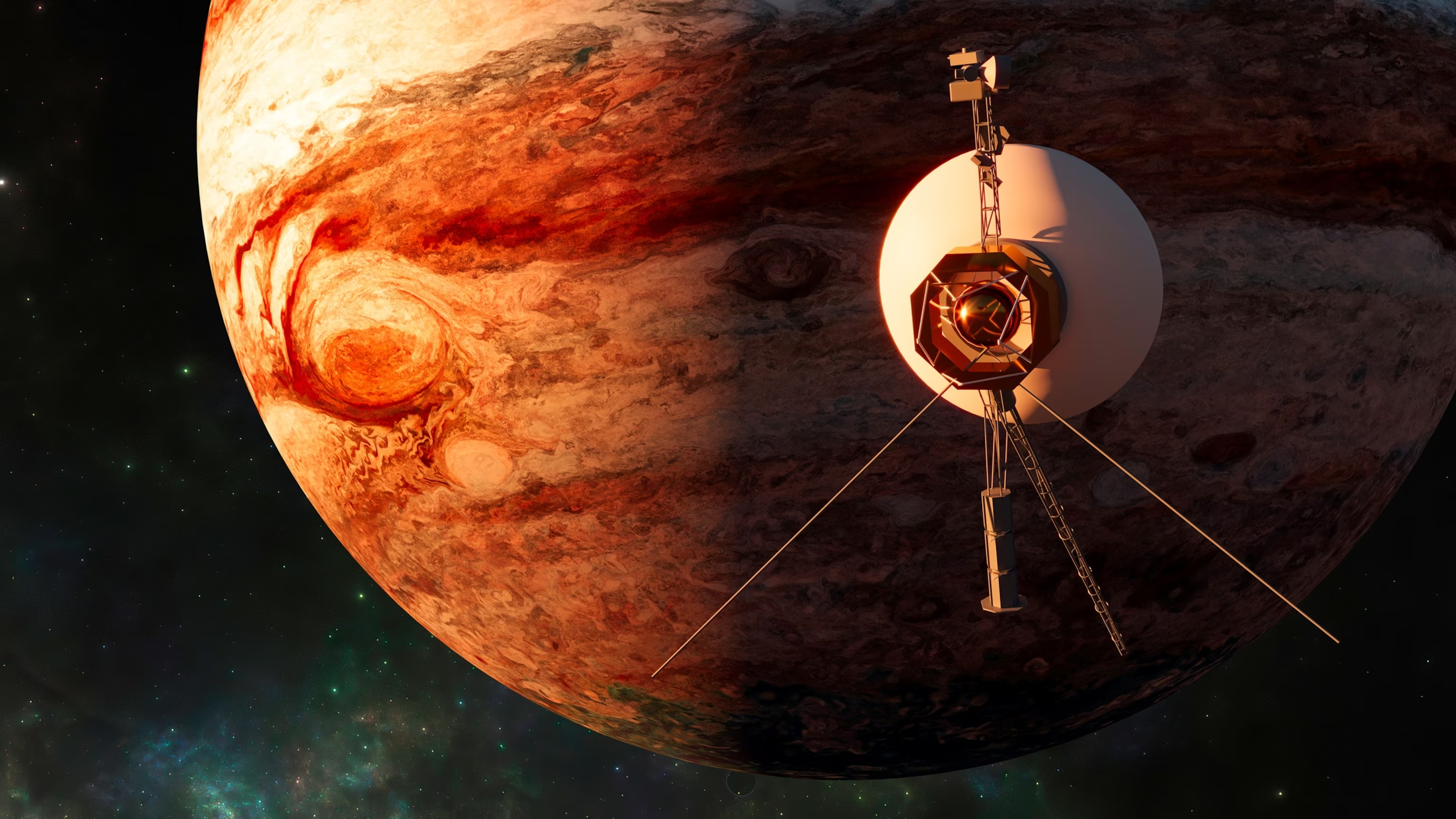
1977年,美国国家航空航天局(NASA)发射了“旅行者1号”,这是一艘旨在探索太阳系最远端的机器人太空探测器。原定任务为期5年。近50年后,它仍在飞行。
In 1977, NASA launched Voyager 1, a robotic space probe built to explore the farthest reaches of our solar system. It was supposed to be a 5-year mission.
美国东部时间周三上午5点16分,该航天器将距离地球一光日——即光在24小时内行进的距离。它距离家园超过160亿英里(约257亿公里),时速3.8万英里(约6.1万公里),将成为首个到达距地球一光日远度的人造物体。
Nearly 50 years later, it's still going.
“行星学会”太空政策主管凯西·德赖尔对美国广播公司(ABC)新闻表示:“这真实证明了人类能建造出什么,随着它不断深入星际空间,它每一秒都在真正开拓新疆域。这是人类发射的、仍能与我们通讯的物体到达的最远距离。这简直非同寻常。”如果你搜索木星、土星、海王星或天王星的照片,极有可能看到的图像是由“旅行者1号”或其姊妹探测器“旅行者2号”拍摄的。
On Wednesday at 5:16 a.m. ET, the spacecraft will be one light-day, the distance light travels in 24 hours, from Earth.
虽然该探测器近十台科学仪器收集的数据让科学家们忙碌了几十年,“旅行者”号 arguably 最大的遗产,是那些影像首次让数百万人领略到太阳系的美丽与神秘。
More than 16 billion miles away from home and traveling 38,000 mph, it will be the first human-made object to reach one light-day away from our planet.
“这是全彩色、精美、光面的照片,突然让这些光点变成了真实的世界和真实的系统,”德赖尔说。“它们告诉我们,我们对所居住的太阳系还有多少未知之处,而两艘‘旅行者’号探测器对我们理解自己在太空中的位置所做出的贡献,实在难以言过其实。”
"It's just a real testament to what humans can build, and it's truly breaking new ground every second as it progresses further and further into interstellar space," Casey Dreier, The Planetary Society's chief of space policy, told ABC News. "This is the furthest out that any human thing has been sent that is still talking to us. That is just truly remarkable." If you search for photos of Jupiter, Saturn, Neptune or Uranus, there's a good bet the image was taken by Voyager 1 or its sibling spacecraft, Voyager 2. And while the data collected by the probe's nearly dozen scientific instruments have kept scientists busy for decades, Voyager's greatest legacy is arguably the imagery that exposed millions of people to the beauty and mystery of our solar system for the first time.
虽然“旅行者”1号在“旅行者”2号之后发射,但其更快的轨道使其在离开地球后不久就超越了孪生兄弟。1979年,它抵达木星,并做出了首批发现之一:这颗行星周围存在一个微弱的环系统。尽管先驱者10号和11号两艘探测器此前曾飞越木星,但它们的成像能力极其有限。“旅行者”号的相机以前所未有的方式捕捉了这颗行星,展现了湍流的大气层,并在接近过程中每96秒拍摄一张照片,美国国家航空航天局(NASA)利用这些照片制作了一部木星运动的延时摄影影片。
"This was full-color, beautiful, glossy photos that suddenly made these points of light into real worlds and real systems," said Dreier. "It told us how much we didn't know about the solar system in which we inhabit, and it is hard to overstate the contributions of the two Voyager spacecraft to our understanding of where we live in space." Although Voyager 1 launched after Voyager 2, its faster route allowed it to overtake its twin shortly after it left Earth. It reached Jupiter in 1979 and made one of its first discoveries: a faint ring system around the planet. While two other probes, Pioneer 10 and 11, had previously flown past the planet, their imaging abilities were extremely limited. Voyager's camera captured the planet in a way never seen before, showing a turbulent atmosphere and taking a picture every 96 seconds during its approach, which NASA used to create a time-lapse movie of the planet in motion.
1980年,“旅行者”号抵达土星,发现了五颗新卫星和一个新环。探测器再次传回了土星及其六颗卫星的惊艳图像,提供证据表明这些卫星主要由水冰组成。来自土星最有趣的卫星之一——泰坦星的图像和数据显示,它拥有一层浓厚的大气层,主要成分是氮气,含有甲烷和烃类。这种化学混合物可能类似于数十亿年前的地球。美国国家航空航天局的“龙卷风”旋翼飞行器计划于2028年发射前往泰坦星,研究其宜居性。
In 1980, Voyager arrived at Saturn and found five new moons and a new ring. Once again, the probe sent back stunning images of the planet and six of its moons, providing evidence that those moons are largely made up of water ice. Images and data from Titan, one of Saturn's most interesting moons, showed it has a thick atmosphere composed mostly of nitrogen, with methane and hydrocarbons. This chemical soup may resemble what Earth was like billions of years ago. NASA's Dragonfly rotorcraft is slated to launch to Titan in 2028 to study its habitability.
1990年,在天文学家卡尔·萨根的建议下,“旅行者”1号从37亿英里(约59.5亿公里)外拍摄了著名的“淡蓝色小点”地球照片,萨根后来以此为名出版了一本书。与此同时,“旅行者”号还拍摄了太阳系六大行星的“全家福”。
In 1990, Voyager 1 took the famous pale blue dot photo of Earth from a distance of 3.7 billion miles, at the suggestion of astronomer Carl Sagan, who later named one of his books after it. At the same time, Voyager also took a "family portrait" of six of our solar system's planets.
旅行者1号如今正飞行在星际空间——恒星系统之间那片广阔、空旷的区域——但仍在向地球传回信息,如今这些信号需要24小时才能抵达。美国国家航空航天局(NASA)曾在10月短暂失去与该探测器的联络,48小时后恢复通讯。多年来,该机构还关闭了数件仪器以节省电力。
Now traveling in interstellar space, a vast, empty region between star systems, Voyager 1 still transmits information back to Earth, which will now take 24 hours to reach its destination. NASA briefly lost communications with the vehicle in Oct., but it came back 48 hours later. The agency has also shut down several instruments over the years to save power.
最终,旅行者号的钚动力源将耗尽,但物理定律将使其继续在深空飞行。由于那里几乎没有任何东西阻碍它的前进,它可能会在我们消失很久之后仍继续飞行。
Eventually, Voyager's plutonium power source will die, but physics will keep it moving through deep space. And since there's not much there to impede its progress, it could keep going long after we are gone.
但人类的印记将随旅行者号一同前行,形式是一张直径近12英寸(约30厘米)的镀金铜盘,上面刻有地球相对于若干脉冲星的位置。这张可播放的唱片收录了55种语言的问候语、人类与动物声音的音频片段、不同时期的90分钟音乐,以及地球生命的影像。
But our species' fingerprints will remain with Voyager in the form of a nearly 12-inch gold-plated copper disk inscribed with Earth's location relative to several pulsars. The playable record contains greetings in 55 languages, audio clips of human and animal sounds, 90 minutes of music from different periods and images of life on our planet.
“它带着人类及创造它的世界的一份小小见证。几十亿年后,当太阳吞没地球、这个世界上的一切不复存在时,旅行者号仍将存在,并将携带一份用金书写的、属于这颗星球及其人类的小小签名,”德雷尔解释道。
"It carries a little testament to the humans and the world that made it. That billions of years from now, when our planet is engulfed by the Sun and everything on this world no longer exists. Voyager will still exist, and it'll carry a little signature of gold written in gold of this planet and its humans," explained Dreier.