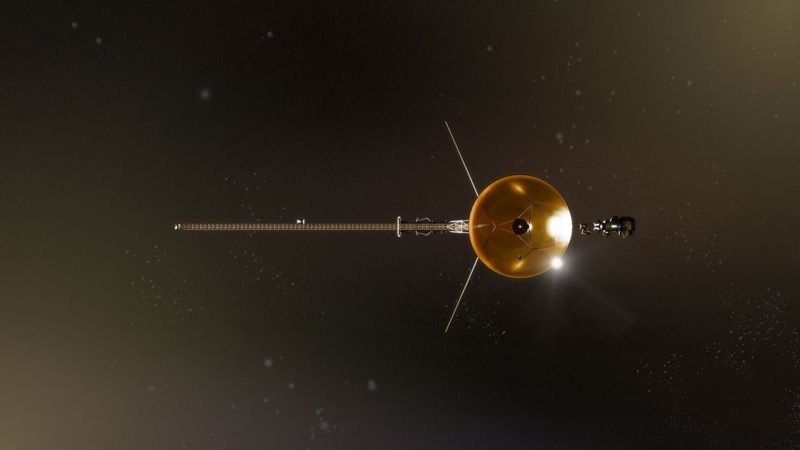
美国宇航局(NASA)著名的深空探测器“旅行者1号”已抵达距地球一光年的位置,这是其他任何人造物体都未曾达到的历史性里程碑。
Voyager 1, NASA’s celebrated deep-space probe, has reached one light-day from Earth — a historic milestone that no other human-made object has achieved.
一光年是无线电信号以光速传播24小时才能抵达该探测器所对应的距离,约合160亿英里(260亿公里)。这使旅行者1号成为距离最远的人造物体。自1998年超越NASA另一枚探测器“先驱者10号”以来,它一直保持着这一头衔。
One light-day is the distance at which a radio signal, moving at the speed of light, takes 24 hours to reach the spacecraft. That’s equivalent to roughly 16 billion miles (26 billion kilometers), making Voyager 1 the farthest human-made object — a title it has held since 1998, when it surpassed another NASA probe called Pioneer 10.
“这种情况以前从未发生过,而且可能永远不会再发生——就是这么非同寻常,”位于加利福尼亚州帕萨迪纳的NASA喷气推进实验室旅行者任务经理卡里姆·巴达鲁丁说。
“It’s never happened before, and it may never happen again — it’s that kind of extraordinary,” said Kareem Badaruddin, Voyager mission manager at NASA’s Jet Propulsion Laboratory in Pasadena, California.
自1977年9月升空以来,旅行者1号取得了一系列令人瞩目的成就。这枚探测器及其一个月后发射的孪生探测器旅行者2号,最初设计寿命只有五年,任务是探索木星和土星。两者的任务都已延长到远超预期的近十倍。
Since it lifted off in September 1977, Voyager 1 has racked up an impressive list of achievements. The probe and its twin spacecraft, Voyager 2, which launched a month later, were originally built to last just five years and explore Jupiter and Saturn. Both have extended their missions nearly 10 times longer than expected.
“它们在49年后仍能以具有科学价值的方式运行,这证明了那些设计和建造它们的人以及继续操作它们的人的奉献精神和才华,”艾奥瓦大学研究科学家威廉·库尔特说。他于1974年以研究生身份开始参与旅行者项目,现在领导旅行者等离子体波科学研究。
“That they are still operating in a scientifically useful way after 49 years is a testament to the dedication and talent of those who designed and built them and those that continue to operate them,” said William Kurth, a research scientist at the University of Iowa who started working on Voyager as a graduate student in 1974. He now leads the Voyager Plasma Wave Science investigation.
旅行者探测器目前正在研究星际空间,它们已分别于2012年和2018年飞出日光层——太阳磁场产生的巨大保护性气泡。
The Voyager probes are currently studying interstellar space, having left the heliosphere — a vast protective bubble generated by the sun’s magnetic field — in 2012 and 2018, respectively.
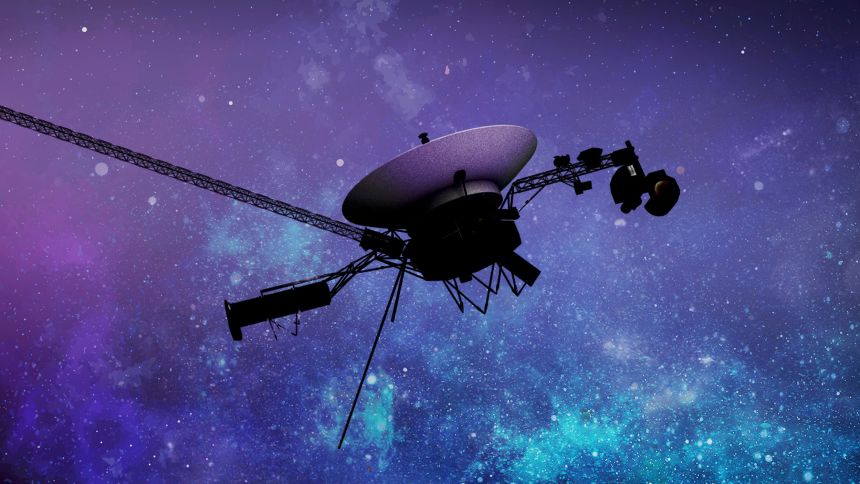
艺术家绘制的旅行者探测器概念图。这对孪生探测器于1977年升空。NASA/JPL-加州理工学院“我们不得不设法让这些机器飞行以探索星际介质,而它们当初实际上是为探索行星而设计的,”巴达鲁丁说。“我们正在用非常古老的机器去做它们并非真正被设计来做的事情。”
An artist's concept of a Voyager probe. The twin spacecraft lifted off in 1977. NASA/JPL-Caltech “We’re having to figure out how to fly these machines to explore the interstellar medium, when they were really designed to explore the planets,” Badaruddin said. “We’re using very old machines to do something they weren’t really designed to do.”Voyager 1, which reached one light-day just after 5:16 a.m.
“旅行者1号”于美国东部时间周三凌晨5点16分刚过达到一光日,目前正朝着距地球超过17光年的格利泽445恒星前进。
ET Wednesday, is now heading toward Gliese 445, a star more than 17 light-years away from Earth.
美国宇航局仍能利用深空网络向该航天器发送指令并接收数据。深空网络由一批大型地面射电天线组成。但信息传递并不算快。
NASA is still able to send commands to and receive data from the spacecraft using the Deep Space Network, a collection of large ground-based radio antennas. But messaging isn’t exactly snappy.
“我们可以把它想象成打电话,”巴达鲁丁说。他解释说,如果你给地球另一端的人打电话,以光速传播的电话信号不到十分之一秒就能到达对方。由于延迟如此微不足道,“你可以像对方就在同一个房间一样交谈”。
“One way we can think about it is a phone call,” Badaruddin said. If you called someone on the other side of the Earth, the phone signal — traveling at light speed — would take less than one-tenth of a second to reach them, he explained. With such an insignificant delay, “you can have a conversation as though they were in the same room.”
给“旅行者1号”打电话则是一次棘手得多的长途通话。“我们发给航天器的信号以同样的速度传播,也就是光速,但信号真正到达它那里需要24小时,”巴达鲁丁说,“这就是航天器离我们有多远。”
Ringing up Voyager 1 is a much trickier long-distance call. “Our signals to the spacecraft move at the same speed, the speed of light, but it literally takes 24 hours for them to get to it,” Badaruddin said. “That’s how far the spacecraft is from us.”
一旦信号到达“旅行者1号”,工程师还必须再等24小时,让回应一路传回地球。而这还是在理想条件下,即通信系统和航天器仪器都按预期工作。
Once a signal has reached Voyager 1, engineers must then wait another 24 hours for a response to travel all the way back to Earth. And that’s in ideal conditions, when telecommunications and the spacecraft’s instruments are working as expected.
“操作一个往返通信时间长达两天的远程设备,需要一种与我所能想象的其他任何操作场景完全不同的思维方式,”库尔特在一封电子邮件中说。
“Operating a remote device with a round-trip communication time of two days requires a totally different mindset than any other operational scenario I can imagine,” Kurth said in an email.
就在几周前,美国宇航局有两天没有收到探测器的消息,引发了对“旅行者1号”可能已经失联的担忧。
Just a few weeks ago, NASA didn’t hear from the probe for two days, stoking fears that Voyager 1 might have been lost.
为了让“旅行者”号航天器远远超出预期寿命继续运行,美国宇航局的工程师多年来不得不想出一些创造性的解决办法。“我觉得这就像海盗试图逃避陆地上的法律,”巴达鲁丁说,“我们在继续旅程时,也试图避开物理定律。”
To keep the Voyager spacecraft running well beyond their expected lifespan, NASA engineers have had to come up with some creative solutions over the years. “I think of it like pirates trying to avoid the laws of the land,” Badaruddin said. “We try to avoid the laws of physics as we continue our journey.”
主要问题一直是探测器船上电力不断衰减。每个探测器配备三台热电发生器,以放射性元素钚为燃料。钚的放射性衰变产生热量,这些热量随后被用来发电。
The main problem has been the probes’ constantly declining onboard power. They’re each equipped with three thermoelectric generators that use plutonium, a radioactive element, as fuel. The radioactive decay of the plutonium generates heat, which is then used to produce electrical power.
与航天器常用的太阳能电池板不同,这些发生器不需要阳光,但随着钚随时间自然衰变以及硬件老化,输出功率会下降。
Unlike solar panels, commonly used on spacecraft, these generators don’t require sunlight, but the power output decreases as the plutonium naturally breaks down over time and the hardware ages.
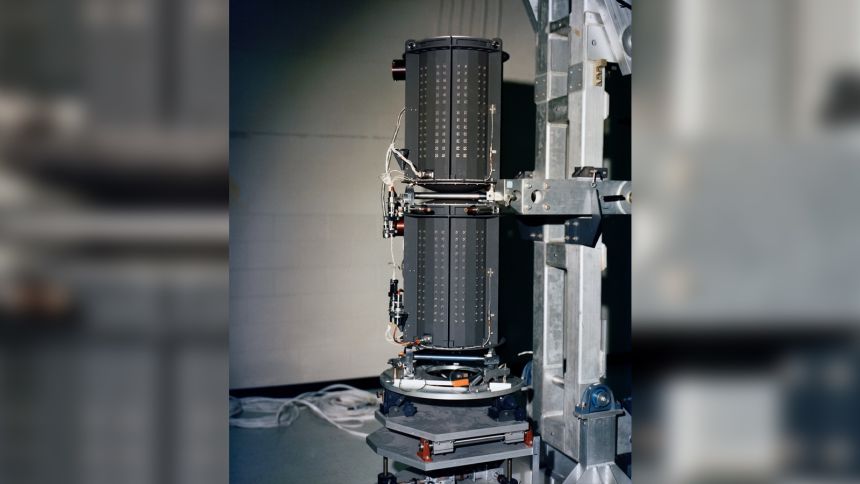
旅行者号探测器配备了三台放射性同位素热电发生器(RTG),图中所示即为其中之一。NASA/JPL-加州理工学院发射时,旅行者1号上的发生器提供470瓦电力,大致相当于搅拌机等小型家用电器。但探测器每年损失约4瓦,这意味着它目前产生的电力约为210瓦。
The Voyager probes are equipped with three radioisotope thermoelectric generators, or RTGs, including the one shown here. NASA/JPL-Caltech At launch, the generators onboard Voyager 1 supplied 470 watts of electrical power — roughly the amount of a small household appliance such as a blender. But the probe loses about 4 watts per year, which means it’s currently producing roughly 210 watts.
旅行者1号上的10台科学仪器中只有两台仍在运行并向地球传回数据,因为NASA多年来已逐步关闭了其他仪器。仍在运行的是分析磁场的磁强计和研究带电粒子密度的等离子体波子系统。两者都适合观测星际空间,探测器目前正以每小时38000英里(61155公里)的速度在其中飞行。
Only two of the 10 scientific instruments onboard Voyager 1 are still running and returning data to Earth, as NASA has progressively switched off the others over the years. Those still operating are the magnetometer, which analyzes magnetic fields, and the plasma wave subsystem, which studies the density of charged particles. Both are suited to observe interstellar space, where the probe is currently traveling at 38,000 miles per hour (61,155 kilometers per hour).
NASA最近对船上电力分配进行了一次大胆的重新调整,同时关闭一些非科学硬件组件,又开启另一些,以在维持必要热量的同时尽量省电。计算机必须足够温暖才能工作,用于控制探测器的推进剂也必须防止冻结,因为一旦冻结,就会妨碍重要操作,例如将天线指向地球以交换数据。
NASA recently performed a daring reshuffle of the power distribution onboard — simultaneously turning off some non-scientific hardware components while turning others on — to try to save electricity while maintaining essential heat. The computers have to be warm enough to work, and the propellant used to direct the probe must be kept from freezing, because that would prevent important maneuvers such as pointing the antenna toward Earth to exchange data.
“今年夏天我们做了一项改动,关掉了三个机载设备,它们耗电很多,同时打开了三个设备,它们加起来耗电比关掉的那三个少,”巴达鲁丁说。“我们挑选这些设备,是为了让它们分布在航天器各处,这样所有推进剂管路都能保持液态,并且足够温暖。”
“This summer we made a change where we turned off three onboard devices that used a lot of power, and turned on three devices that, in total, used less power than the three we turned off,” Badaruddin said. “We chose the devices so that they were distributed around the spacecraft, so that all the propellant lines remained liquid and warm enough.”
他说,这是一次激进的改动:“我们称之为‘大爆炸’,因为它是一下子把所有事情都做了。”
It was a radical change, he said: “We called it the ‘Big Bang,’ because it was everything all at once.”
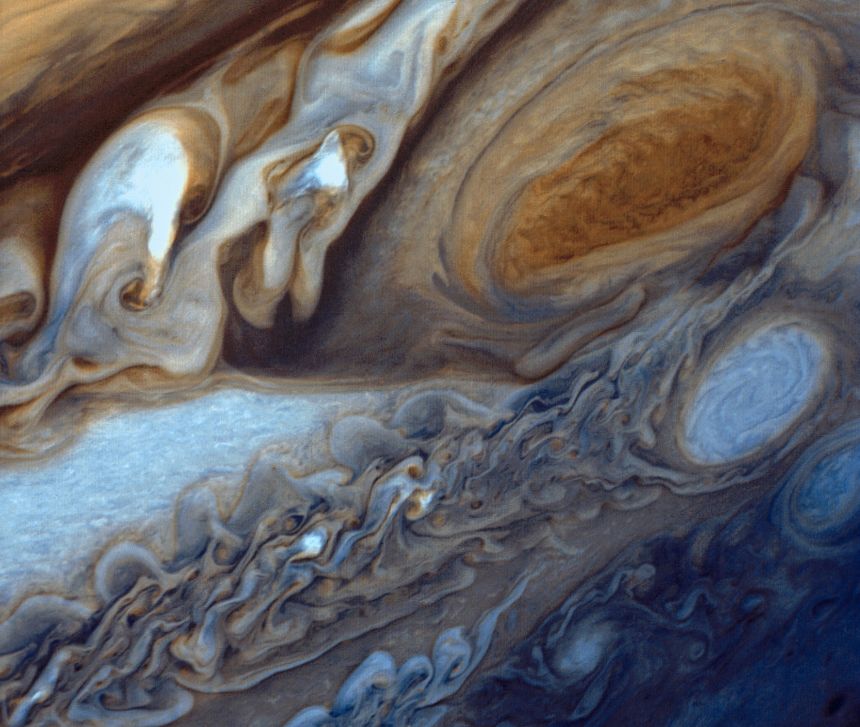
1979年旅行者1号拍摄的木星大红斑。探测器的相机已于1990年关闭。NASA/JPL-Caltech这一“大爆炸”式修复将让旅行者号剩余的科学仪器比原先的配置工作更长时间。巴达鲁丁说,尽管花了大约一年时间做准备,说服自己测试可能奏效,旅行者号团队成员仍然非常紧张,因为“有七条功率指令从未在飞行中使用过”。
Jupiter’s Great Red Spot in a view taken by Voyager 1 in 1979. The probe's cameras were turned off in 1990. NASA/JPL-Caltech This “Big Bang” fix will allow Voyager’s remaining science instruments to work for longer than the previous configuration. Badaruddin said that, even after about a year of preparation to convince themselves that the test might work, Voyager team members were very nervous because “there were seven power commands that had never been used in flight.”
“这将为我们节省10瓦,所以为我们争取了大约两年半的电力,”他补充说。“能在不必关掉一台仪器的情况下省出10瓦,这真是美妙、美妙的节省。我称之为从帽子里变出一只兔子。所以现在我们的手已经深深伸进帽子里,正四处寻找另一只兔子。”
“It’s going to save us 10 watts, so it bought us about two and a half years of power,” he added. “To find 10 watts without having to turn off an instrument, that’s just wonderful, wonderful savings. I call it pulling a rabbit out of a hat. So now we’ve got our arm deep in the hat and we’re looking around for another rabbit.”
但在10月下旬——就在那次大胆的仪器调换几周之后——旅行者1号遇到了另一个问题:一次暂时的通信中断。尽管它在48小时后自行恢复,这一事件仍是一个令人警觉而心酸的提醒:探测器的时间是借来的。
But in late October — just weeks after the daring instrument swap — Voyager 1 experienced a different issue: a temporary loss of communication . Even though it resolved itself after 48 hours, the incident was an alarming and poignant reminder that the probe is on borrowed time.
“这相当令人意外,我们仍在试图弄清发生了什么,”巴达鲁丁说。“我们知道我们的余量非常薄,这样的事件可能会变得更加频繁。”
“It was quite a surprise, and we’re still trying to understand what happened,” Badaruddin said. “We know that we are living in very thin margins, and episodes like that are probably going to become more frequent.”
很难准确预测“旅行者1号”还能运行多久。巴达鲁丁说,几十年来,任务管理人员一直估计该任务还会持续三到五年——“除非我们能再想出什么妙招,”他补充道。
It’s hard to predict exactly how much longer Voyager 1 can operate. For decades, mission managers have continued to estimate the mission would last three to five more years, Badaruddin said — “unless we can find another rabbit in the hat,” he added.
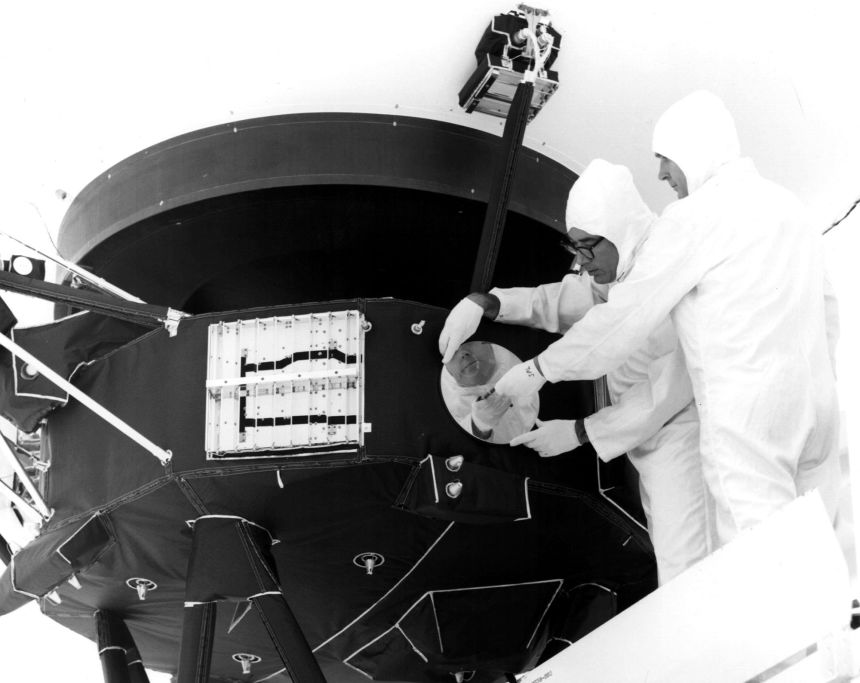
1977年的一张照片中,工程师们正在固定“旅行者1号”金色唱片的封盖。NASA/JPL-加州理工学院“旅行者1号”是目前处于太阳系之外轨道上的五艘航天器之一。“旅行者2号”预计将在2035年达到一光日的里程碑,但届时这对孪生探测器是否仍在运行并保持通信尚不清楚。另外两个探测器“先驱者10号”和“先驱者11号”也将飞出太阳系,但早已停止通信;第五个探测器“新视野号”目前正穿越柯伊伯带,这是海王星轨道之外一个由冰质天体构成的巨大环带。
Engineers secure the cover over the Voyager 1 Golden Record in an image from 1977. NASA/JPL-Caltech Voyager 1 is one of five spacecraft currently on trajectories that go beyond the solar system. Voyager 2 is expected to reach the one light-day milestone in 2035, but it’s unclear whether the twin vehicles will still be operating and communicating by then. Two other probes, Pioneer 10 and 11, will also head out of the solar system, but stopped communicating long ago; a fifth, New Horizons, is currently traveling through the Kuiper Belt, a vast ring of icy objects beyond Neptune’s orbit.
巴达鲁丁说,当“旅行者”号最终停止工作时,对天文学家 and 研究人员来说将是一个艰难的时刻。
It will be a tough moment for astronomers and researchers when the Voyagers finally give up, Badaruddin said.
“我们竭尽全力让这些航天器继续飞行。当最终这一切还不够时,将很难接受,”他说。“与此同时,‘旅行者’任务是人类完成的伟大成就之一,对地球上的每个人都意义重大。能参与其中,令人深感谦卑。”
“We fight with everything we have to keep these spacecraft flying. When ultimately that’s not enough, it will be difficult to come to terms with,” he said. “At the same time, the Voyager mission is one of the great things that humans have done, and it is meaningful to everyone on Earth. It’s deeply humbling to be a part of that.”
它们将留下一系列重大科学发现的遗产,包括土星和木星周围的新卫星、木星卫星木卫一上的活火山,以及土星最大卫星土卫六大气层的详细信息。“旅行者1号”还拍摄了著名的“暗淡蓝点”照片,让人们看清地球在浩瀚宇宙中的位置。
They will leave behind a legacy of major scientific discoveries, including new moons around Saturn and Jupiter, active volcanos on Jupiter’s moon Io, and details about the atmosphere of Saturn’s largest moon, Titan. Voyager 1 also took the famous “Pale Blue Dot” photograph, which put into perspective Earth’s place in the vastness of space.
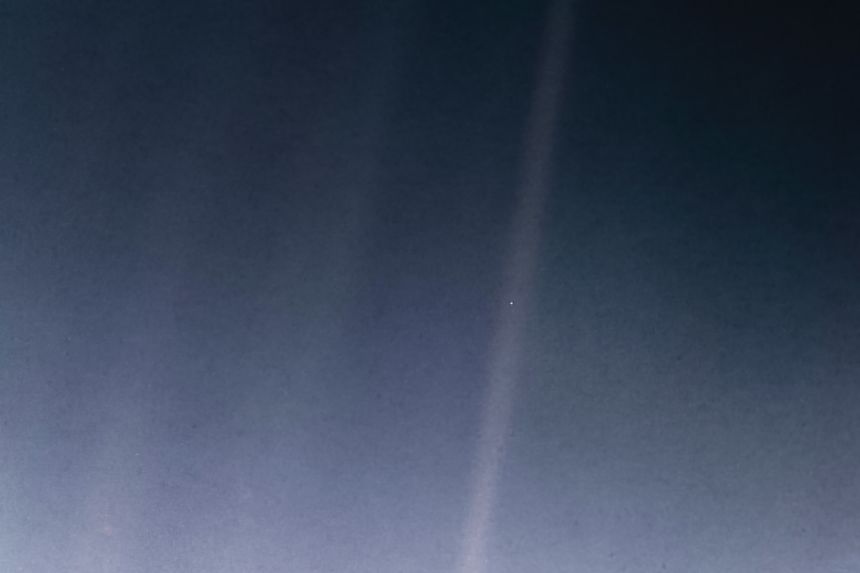
“暗淡蓝点”,1990年2月14日由NASA的“旅行者1号”在距太阳37亿英里(60亿公里)处拍摄的地球照片。NASA/JPL-加州理工学院两个探测器目前正在以任何望远镜都无法做到的方式收集关于星际空间的数据。
The Pale Blue Dot, a photograph of Earth taken on February 14, 1990, by NASA’s Voyager 1 at a distance of 3.7 billion miles (6 billion kilometers) from the sun. NASA/JPL-Caltech Both probes are now gathering data about interstellar space in a way no telescope ever could.
巴达鲁丁解释说:“我们用望远镜从地球上研究星际介质,但就像造访一颗行星一样,让设备真正置身于你所研究的介质之中,与从远处研究它,有着天壤之别。”
“We use telescopes to study the interstellar medium from Earth, but just like visiting a planet, there’s a huge difference between having a device actually in the medium that you’re studying versus studying it from a distance,” Badaruddin explained.
旅行者1号和2号还各自携带了一张“金唱片”。这是一张12英寸的镀金铜盘,收录了图像、自然声音、音乐、55种语言的问候语,以及美国前总统吉米·卡特和联合国前秘书长库尔特·瓦尔德海姆的留言。
Voyagers 1 and 2 also carry the Golden Record , a 12-inch gold-plated copper disk that contains images, natural sounds, music and spoken greetings in 55 languages, as well as messages from former US President Jimmy Carter and former UN Secretary-General Kurt Waldheim.
即便完全失去电力,这两个探测器仍会以相同的速度继续穿越太空,带着这些文化胶囊同行。旅行者1号大约需要4万年才能最接近格利泽445恒星,届时将从这颗遥远天体约1.7光年以内的地方掠过。旅行者号探测器。NASA/JPL-Caltech库尔特说:“旅行者号探测器已在飞行中存活了近50年,同时仍保留着向我们讲述银河系邻域情况的能力。”
Even if they lose all power, the probes will continue traversing through space at the same velocity, carrying these cultural capsules with them. It will take about 40,000 years for Voyager 1 to make its closest approach to the star Gliese 445, passing within about 1.7 light-years of the distant object. spacecraft-profile The Voyager spacecraft. NASA/JPL-Caltech “The Voyager spacecraft have survived nearly 50 years of flight while retaining the ability to tell us about our galactic neighborhood,” Kurth said.
他补充说:“任何追随旅行者号进入星际介质的可能性,都必然需要数十年的研发和飞行时间。我们必须在旅行者号静默地绕银河系运行之前,尽可能获取它们所能提供的一切。”
“Any possibility to follow the Voyagers into the interstellar medium will necessarily require decades in development and flight time,” he added. “We need to acquire as much as the Voyagers have to give before they go silently about their orbits around the galaxy.”
订阅CNN“奇迹理论”科学通讯,通过关于奇妙发现、科学进展及更多内容的新闻探索宇宙。
Sign up for CNN’s Wonder Theory science newsletter . Explore the universe with news on fascinating discoveries, scientific advancements and more.