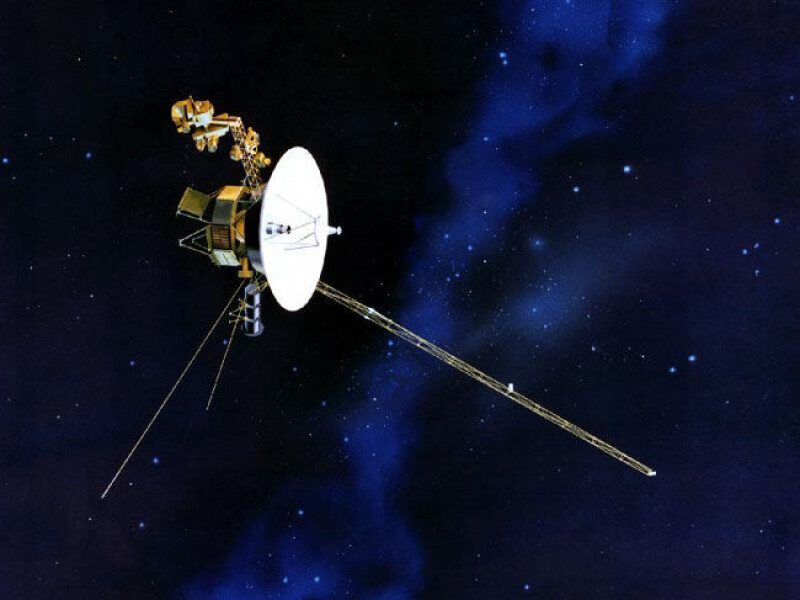
美国国家航空航天局(NASA)的“旅行者1号”探测器目前距离地球已超过一光日——距离遥远到无线电信号需要24小时才能到达。这艘老牌航天器花了近50年才飞抵此地。“旅行者1号”于1977年9月5日从佛罗里达州卡纳维拉尔角发射升空。任务规划始于20世纪60年代,当时NASA正全力以赴,要在苏联之前将人类送上月球。
NASA's Voyager 1 probe is now more than one light-day from Earth – so distant that a radio signal takes 24 hours to reach it. The veteran spacecraft has spent almost 50 years getting there. Voyager 1 was launched on September 5, 1977, from Cape Canaveral in Florida. Planning for the mission began in the 1960s, while NASA was working feverishly to put a man on the Moon ahead of the Soviet Union.
外行星的一次罕见排列使得木星、土星、天王星和海王星的大巡游成为可能。“旅行者2号”最终造访了这四颗行星;“旅行者1号”的航线优先考虑土星的卫星泰坦,因此排除了随后与冥王星的相遇。“旅行者1号”于1979年完成木星飞越,1980年掠过土星和泰坦。1990年的最后一次成像序列拍摄了太阳系“全家福”,其中包括著名的地球“淡蓝小点”照片。
A rare alignment of the outer planets made a tour of Jupiter, Saturn, Uranus, and Neptune possible. Voyager 2 eventually visited all four; Voyager 1's route prioritized Saturn's moon Titan, ruling out a subsequent encounter with Pluto. Voyager 1 completed a flyby of Jupiter in 1979, and passed Saturn and Titan in 1980. Its final imaging sequence in 1990 produced the solar system "Family Portrait," including the famous Pale Blue Dot image of Earth.
此后相机永久关闭。在那些最后照片拍摄36年后,“旅行者1号”仍与地球保持联系,两台科学仪器仍在运行:磁强计和等离子体波子系统。几十年来,为节省放射性同位素热电发电机(RTG)提供的日益减弱的电力,其他仪器已陆续关闭。“旅行者”号原成像团队成员加里·亨特博士告诉《泰晤士报》:“‘旅行者’号真正的成功在于它使用了可靠的设备。经过充分测试的‘水手’号设备,以及专门为它研制的新设备。我们在飞船上配备了故障保护。如果出现任何问题,它会自动切换到备份系统。所以永远有备份,永远有安全模式。我们必须在飞船上配备辐射防护……当我们设计它时,并不真正了解木星周围的磁环境,得知其强度是我们预期的1000倍,真的让一切都陷入混乱,因此必须应对这一挑战。”亨特向多年来接力让探测器持续运行的项目经理和工程师们致敬。
The cameras were then switched off for good. Thirty-six years after those final pictures, Voyager 1 remains in contact with Earth, with two science instruments still operating: the magnetometer and plasma wave subsystem. Others have been shut down over the decades to conserve the dwindling power supplied by its radioisotope thermoelectric generators (RTGs). Dr Garry Hunt, a member of Voyager's original imaging team, told The: "Voyager's real success is the way it used reliable equipment. Well-tested Mariner equipment, and special new things that had come about for it. "We had fault protection on board as well. If anything goes wrong, it automatically switches to a backup. So there was always a backup. There was always a safe mode. We had to have radiation protection on board … when we designed this, we didn't really know the magnetic environment around Jupiter, and to be told it was so strong, 1,000 times stronger than we anticipated, really threw everything up in the air, and so that had to be dealt with." Hunt paid tribute to the succession of project managers and engineers who have kept the probe running over the years.
他说:“我认为这是一个非常精彩的项目管理范例,体现了巧妙的工程管理,并由此产出了有趣的科学成果,这些成果已载入史册,并成为未来其他事业的催化剂。”旅行者1号现在可能需要两天时间才能回应来自地球的呼叫。在近50年之后,真正了不起的是它仍然会回应。®
"I think this was a really wonderful example of project management, of clever management of engineering, and interesting science coming out of it, which has made history books and gone to be a catalyst for other things in the future," he said. Voyager 1 may now take two days to answer a call from Earth. After almost 50 years, the remarkable thing is that it still answers at all. ®