不久前,人们曾认为,人工智能可以利用其超凡的智力,发现人类无法想到的气候解决方案,从而帮助地球避开全球变暖的最坏后果。不过,最近看来,如果人工智能还要拯救这个地球村,它似乎首先得把它毁掉。随着气候变化……麻烦在于,为运行支撑人工智能的数据中心而疯狂抢夺电子的竞赛,大多由那些正在让地球变暖的化石燃料来满足。
Not long ago, there was this idea that artificial intelligence could help the planet avoid the worst of global heating by using its superior brainpower to discover climate solutions humans couldn’t. Lately, though, it seems that if AI is still going to save the global village, it will first have to destroy it. With climate change.out The trouble is that the mad scramble for the electrons to run the data centers that make the AI that will ostensibly save the planet is mostly being satisfied by the very fossil fuels that are making the planet hotter.
彭博新能源财经周三发布的一份报告估计,到2035年,数据中心的电力需求将几乎翻四倍,届时将占全球能源使用的7%。彭博新能源财经警告称,这一预测可能仍是“下限”,因为新项目的管道已塞得满满当当。
Data-center electricity demand will nearly quadruple by 2035, Bloomberg NEF estimated in a report released Wednesday, at which point it will account for 7% of global energy use. And that forecast might still be the “lower bound,” BNEF warned, as the pipeline for new projects is jammed full.
最简单的解决方案是接入现有电网,但大多数电网并非为这种疯狂的需求而建。许多美国数据中心项目发现,它们要到2032年才能获得电网连接,到那时,亚历山德拉·奥卡西奥-科尔特斯总统可能正在竞逐第二个任期。试图满足大额算力合同的人工智能专家们等不了那么久。
The simplest solution would be connecting to an existing power grid, but most grids aren’t built for such frenzied demand. Many US data-center projects are learning they can’t get a grid connection until, say, 2032, at which point President Alexandria Ocasio-Cortez might be on her way to a second term. AI mavens trying to satisfy hefty contracts for computing power can’t wait that long.
对许多开发商来说,快速而粗糙的解决方案是跳过电网,在现场燃烧化石燃气,即“表后”发电。在美国,天然气相对便宜且充足,如果你不太在乎燃烧效率,就可以使用改装的喷气发动机或其他能临时拼凑起来的设备快速获得电力。据数据中心追踪机构Cleanview的数据,此类电厂大约两年就能投入运行,而电网连接则最多需要七年。
The quick-and-dirty solution for many developers is skipping the grid and burning fossil gas on-site, or “behind the meter.”Gas is relatively cheap and plentiful in the US, and if you don’t care too much about burning it efficiently, you can get quick power using repurposed jet engines or whatever else you can jerry-rig together. Such plants take only two years or so to get up and running, according to data-center tracker Cleanview, compared with up to seven years for a grid connection.
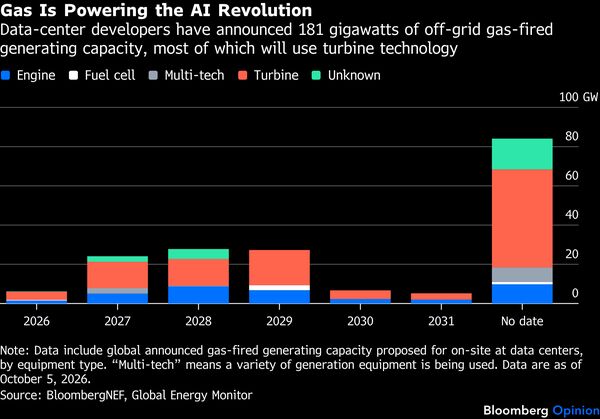
根据Cleanview的数据,到2025年底,仅在美国,开发商就已宣布了50吉瓦的离网燃气产能,而2024年底仅为2吉瓦。这种增长在今年持续飙升:BNEF估计,当前全球管道中所有离网发电产能总计达181吉瓦,大约相当于纽约州一年的用电量。
It’s little wonder that, by the end of 2025, developers had announced 50 gigawatts of off-grid gas capacity in the US alone, according to Cleanview, up from just 2 GW at the end of 2024. That growth just kept skyrocketing this year: The capacity of all off-grid generation in the global pipeline today totals 181 GW, BNEF estimates. That’s about a year’s worth of consumption for New York state.
幸运的是,其中大部分可能不会建成,原因不仅仅是黄仁勋的花招。BNEF统计中,只有约97吉瓦的电力附有具体的启动日期,这表明其余部分可能只是投机性的。但97吉瓦仍是一个巨大的数字,且大部分预计将在2030年前投入运营。
Fortunately, much of this probably won’t be built, and not just because of Jensen Huang’s shenanigans. Only about 97 GW of the power in BNEF’s count has a specific startup date attached to it, suggesting the rest could be speculative. But 97 GW is still a lot, and most of it is scheduled to come online by 2030.
名为《两党美国可负担性和就业法案》(BAAJA)的许可改革法案的目标是加快电网连接,这有助于阻止部分燃气污染大气。现场燃气常被描述为仅在项目能够接入电网之前的临时解决方案。
Faster grid connection, the goal of the permitting-reform bill called the Bipartisan American Affordability and Jobs Act, or BAAJA, help keep some of this gas from polluting the atmosphere. On-site gas is often described as merely a temporary solution until projects can get on the grid.
但BNEF警告称,许多开发商将继续燃烧自有燃气,而不愿面对即使是更快电网连接所带来的繁文缛节。而且,并非所有电网电力都将来自可再生能源。BNEF预测,如果美国管道中所有数据中心产能在2035年前接入电网,那么电厂燃烧的燃气将比现在多28%。到那一年,燃气将满足接入电网的数据中心需求的76%,而2026年这一比例为65%。
But many developers will keep burning their own gas instead of dealing with the red tape of even a faster grid connection, BNEF warns. And not all of that grid power will come from renewables. If all the data-center capacity in the US pipeline connects to the grid by 2035, then power plants will burn 28% more gas than they do now, BNEF has projected. Gas will meet 76% of grid-connected data-center demand that year, up from 65% in 2026.
所有这些燃气都在让地球变暖。化石燃料爱好者称其为“天然气”,因为这样听起来更清洁。但它并不比煤更“天然”。在某些情况下,一旦计入开采、运输和储存过程中泄漏的所有甲烷,它产生的捕热排放量甚至比煤更多。短期内,甲烷加热地球的效力是二氧化碳的80倍,在一个世纪内则是28倍。
All of this gas is making the planet hotter. Fossil-fuel enthusiasts call it “natural” gas because that sounds cleaner. But it’s no more natural than coal. And in some cases it produces more heat-trapping emissions than coal once you include all the methane that gets leaked in the process of extracting, transporting and storing it. Methane is 80 times more effective at cooking the planet than carbon dioxide in the short term and 28 times more over a century.
如果该国的数据中心建设热潮按计划推进,到2030年,该行业可能向大气中额外排放6.18亿吨二氧化碳当量,美国环保组织“塞拉俱乐部”估计,这将抵消美国电网减少碳污染15年来的进展。其中大部分排放量(4.6亿吨)将来自未接入电网的燃气电厂,大致相当于墨西哥的年排放量。
If this country’s data-center frenzy goes as planned, the sector could belch 618 million extra tons of CO2 equivalent into the atmosphere by 2030, the Sierra Club has estimated, wiping out 15 years of progress in cutting the US power grid’s carbon pollution. Most of those emissions, 460 million tons, would come from gas plants that aren’t connected to the grid, roughly matching the annual output of Mexico.
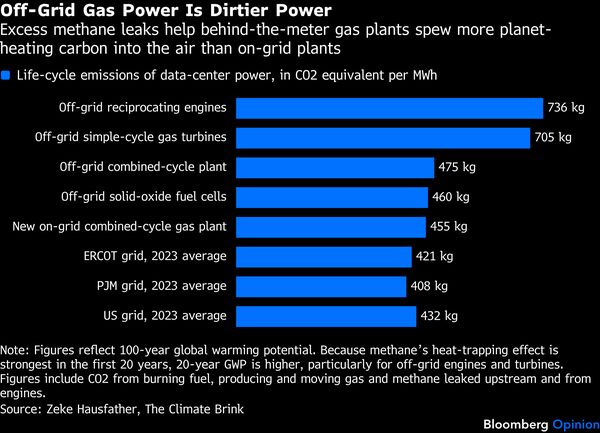
加州大学伯克利分校非营利研究机构“伯克利地球”的气候科学家泽克·豪斯法瑟估计,这些离网电厂泄漏的甲烷远多于接入电网的电厂,因为它们通常使用效率较低的技术。离网电厂的甲烷泄漏量比接网电厂高出63%至80%。
Those off-grid plants also leak far more methane than grid-connected ones because they typically use less-efficient technology. Methane leaks are 63% to 80% higher for off-grid plants, Zeke Hausfather, a climate scientist at the nonprofit research group Berkeley Earth, has estimated.
豪斯法瑟指出,计划中的离网发电中80%将采用往复式发动机和简单循环燃气轮机,这是所有技术中最浪费的。一台离网往复式发动机每兆瓦时排放736千克二氧化碳当量,比美国最大电网PJM的平均污染率高出80%。
And 80% of planned off-grid generation will be in the form of reciprocating engines and simple-cycle turbines, Hausfather notes, which are the most wasteful of all. An off-grid reciprocating engine emits 736 kilograms of CO2 equivalent per megawatt-hour, 80% higher than the average pollution rate for the PJM grid, the biggest in the US.
据从粪便中捕获废弃甲烷的公司Frost Methane Labs创始人兼首席执行官奥利亚·伊尔扎克估计,总的来说,这些用户侧电厂仅在未来几年内就可能向大气中排放3.8亿吨二氧化碳当量。这意味着人工智能的气候影响不仅将持续时间长,而且将严重前置。
All told, these behind-the-meter plants could pump 380 million tons of CO2 equivalent into the atmosphere in just the next , Olya Irzak, founder and CEO of Frost Methane Labs, a company that captures waste methane from manure, has estimated. This implies that AI’s climate impact will not only be long-lasting but also heavily front-loaded.
如果大型科技公司最美好的梦想成真,这种破坏将呈指数级上升。人工智能高管曾表示,世界需要100倍的算力。格拉斯哥大学计算机科学教授维姆·范德鲍德估计,满足这一目标所需的能源将在2035年产生每年3吨二氧化碳,到2045年累计达300亿吨。考虑到2035年全球碳预算总共只有220亿吨,范德鲍德写道,这些排放“将是彻头彻尾的灾难性后果”。
And if Big Tech’s fondest dreams are realized, then this damage will rise exponentially. AI executives have suggested the world needs 100 times more computing power. The energy required to meet that goal would produce 3 tons of CO2 a year by 2035, or 30 billion tons by 2045, Wim Vanderbauwhede, a professor of computer science at the University of Glasgow, has estimated. Given the world’s entire carbon budget for 2035 is 22 billion tons, these emissions “would be downright catastrophic,” Vanderbauwhede wrote.
而这一切还没有计入人工智能当下正在造成的环境危害。数据中心因用水冷却服务器而备受诟病,但它们为发电而消耗的水量呈指数级增长,每年在2110亿加仑到4万亿加仑之间,具体数字取决于你信哪项研究。它们将“永久性化学品”及其他污染物排入水体和土地。为给数据中心供电而燃烧煤炭和天然气,将颗粒物排入大气。它们还在皆伐森林。
And none of this accounts for the environmental harm AI is doing as we speak. Data centers get a lot of grief for the water they use to cool servers, but they’re using exponentially more water to generate power, somewhere between 211 billion and 4 trillion gallons of it each year, depending on which study you believe. They’re spilling “forever” chemicals and other pollutants into the water and land. Burning coal and natural gas to power them spews particulate matter into the air. They’re clear-cutting forests.
地球因这种虐待得到了什么回报?人工智能已经改善了气候研究,帮助人类处理海量数据,找出更热星球的模式与影响。它可以说正在构建更好的模型来预测破坏性天气,尽管目前这些模型仍跟不上日益混乱大气层的变化。它理论上可以帮助电网、建筑、家庭、农场和工厂更高效地运行。它理论上能找出从空气中捕获碳的方法。也许未来的机器人超级天才终将造出“家用聚变能反应堆”。
What does the planet get in exchange for this mistreatment? AI has already made climate research better, helping humans crunch data mountains to find patterns and impacts of a hotter planet. It’s arguably building better models for predicting destructive weather, though at the moment they’re still not able to keep up with the changes in an increasingly chaotic atmosphere. It can theoretically help grids, buildings, homes, farms and factories run more efficiently. It can theoretically figure out ways to capture carbon from the air. Maybe some future robot super-genius will finally build the Mr. Fusion Home Energy Reactor.
但这些应用许多仍主要停留在白板上。与此同时,化石燃料行业已在利用人工智能更高效地开采和销售其产品。其爪牙正用人工智能散布气候虚假信息。《自然》杂志8月的一篇论文估计,除非可再生能源增长速度比化石燃料快达四倍,否则人工智能带来的任何经济生产力提升,都将导致比不使用人工智能时更多的碳排放。
But many of these applications still exist mainly on whiteboards. Meanwhile, the fossil fuel industry is already using AI to get better at extracting and selling its product. Its minions are using AI to spread climate disinformation. Any economic productivity gains from AI will lead to more carbon emissions than not, unless renewables grow up to four times faster than fossil fuels, an August paper in Nature estimated.
算总账来看,AI 正在制造一笔“碳债”,因为“AI 排放当下正在增长,而 AI 带来的减排效果需要时间才能显现”,麻省理工学院研究人员 John Sterman 和 Jennifer Turliuk 在一篇关于 AI 净气候影响的近期论文中写道。“即使这笔债最终能由 AI 气候解决方案偿还,额外造成的变暖和气候破坏也将持续数十年至数千年。”我们至少可以让数据中心运行得更清洁,从而缩小这笔债务。特朗普政府当然不会费心去做这件事,实际上正在鼓励数据中心燃烧化石燃料。
Tally it all up, and AI is creating a “carbon debt” because “AI emissions are growing today, while AI-enabled emissions reductions will take time,” MIT researchers John Sterman and Jennifer Turliuk wrote in a recent paper on AI’s net climate impact. “Even if that debt is eventually repaid by AI climate solutions, the additional warming and climate damage will persist for decades to millennia.”We can make that debt smaller by at least making data centers run cleaner. President Donald Trump’s government certainly won’t bother doing that and is in fact encouraging them to burn fossil fuel.
但许多州和地方政客刚刚在充满反数据中心情绪的选举中获胜,47 项投票提案中有 46 项倾向于禁止或监管数据中心。爱尔兰要求数据中心自行供电,其中 80% 必须来自可再生能源。如果我们想在等待 AI 拯救村庄的同时让村庄存活下去,将需要更多此类政策。
But many state and local politicians just won elections rife with anti-data-center sentiment, with 46 of 47 ballot measures coming down on the side of banning or regulating them. Ireland makes them supply their own power, 80% of which must be renewable. We’ll need more such policies if we want to keep our village alive while we wait for AI to save it.