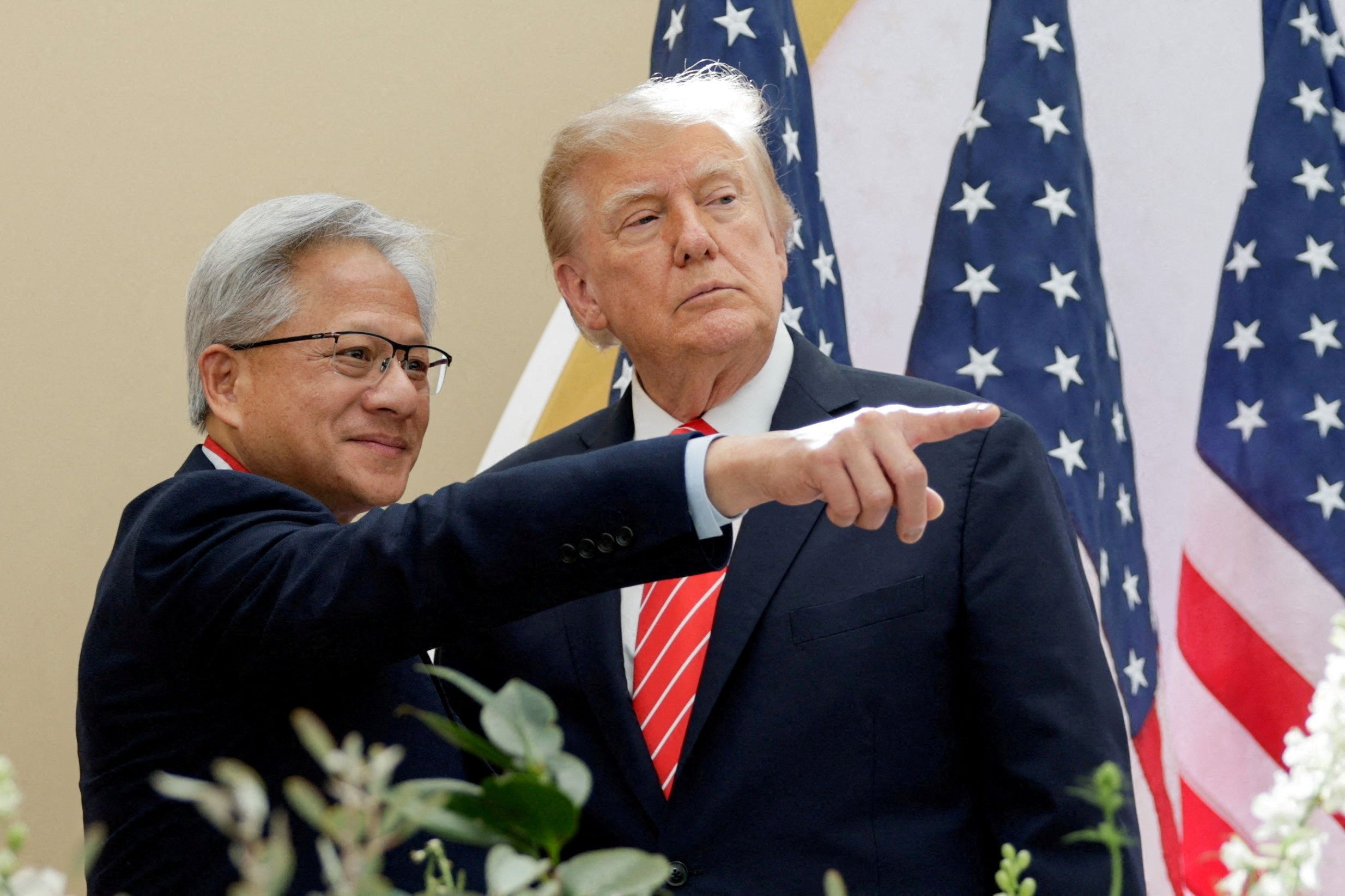
黄仁勋去年宣称,做中国“鹰派”是“耻辱柱”。这位英伟达前首席执行官自诩为坚定的“鸽派”,并在美国总统唐纳德·特朗普身上找到了一位志同道合的鸽派伙伴——确切地说,是在商业意义上。二人结成联盟,旨在向中国销售高端英伟达芯片,并由美国政府从中分得利润。
To be a China “hawk,” Jensen Huang declared last year, is a “badge of shame.”The former Nvidia CEO was a proud dove, one who found a dovish partner in US President Donald Trump — quite literally, in a business sense. Together, they formed an enterprise that aimed to sell high-end Nvidia chips to China, with the US government taking a cut of the profits.
这一联盟标志着中美缓和关系的最高水位——鸽派立场达到顶峰,白宫的一项首要考量是扩大英伟达的市场份额,而非遏制中国的AI雄心。当CNN问及谁赢得AI超级大国竞赛是否重要时,黄仁勋回答:“我不认为这有关系。”那个时刻已成往事。一项不仅通过合法渠道将强大芯片输往中国,还通过东南亚的中国资助公司非法输送数十亿美元硬件的贸易——其中最活跃的一家Megaspeed(美极速)由一名涉嫌中国情报人员创立,黄仁勋与该人有染——正正面撞上中美战略竞争的硬现实。
Their alliance represented the high-water mark of a Sino-US détente — peak dovishness, where a prime consideration in the White House was expanding Nvidia’s market share, not blocking China’s AI ambitions. Asked on CNN if it mattered who won the AI superpower race, Huang replied “I don’t think it does.”That moment has come and gone. A trade that not only sent powerful chips into China via legal channels, but also billions of dollars of hardware illicitly through Chinese-funded companies in Southeast Asia — one of the most active, Megaspeed, set up by a suspected Chinese intelligence asset with whom Huang was having an affair — has run headlong into the hard realities of US-China strategic competition.
两国超级大国的竞争是结构性的。其核心聚焦于技术,无论黄仁勋如何表态,AI已使这场斗争关乎生存。
Their superpower rivalry is structural. Its main focus is technology and, whatever Huang says, AI has made the struggle existential.
有时特朗普似乎对地缘战略利害关系感到困惑。在主张对前沿AI模型开发采取“任其发展”的做法时,他多次援引“中国威胁论”,坚称“谁赢得AI,谁就赢得一切”。然而他却将黄仁勋和对华芯片销售推至其对华外交的最前沿。
At times, Trump has seemed confused about the geostrategic stakes. In arguing for a let-it-rip approach to frontier AI model development, he has several times invoked the China bogeyman by insisting that “Whoever wins AI, wins.”Yet he pushed Huang and chip sales to China into the forefront of his diplomacy with Beijing.
5月,特朗普在最后一刻将黄仁勋召上“空军一号”,随其商业随行团前往北京参加中美峰会,据报道尽管其情报机构知悉英伟达CEO与一名涉嫌中国情报人员的潜在关联。
In May, Trump scrambled Huang onto Air Force One at the last minute to join his business entourage in Beijing at a Sino-US summit, reportedly despite knowing that his intelligence services were aware of the Nvidia CEO’s potential links to a suspected Chinese intelligence asset.
随后在9月,黄仁勋在华盛顿的一场国宴上,与中国领导人习近平同坐主桌。
Then in September, Huang was at the head table with Chinese leader Xi Jinping at a state banquet in Washington.
如果不是被迫辞职,黄仁勋本周本应随特朗普出席在深圳举行的亚太领导人会议。
Huang would likely be with Trump in Shenzhen this week at a meeting of Asia-Pacific leaders if he hadn’t been forced to resign.
取而代之的是,美国国会加码对华科技制裁的前景将笼罩特朗普今年第三次与习近平会晤,并可能危及他们脆弱的贸易休战。
Instead, the prospect of the US Congress ratcheting up tech sanctions against China will hang over Trump’s third meeting this year with Xi, and could endanger their fragile trade truce.
北京至少对其与华盛顿竞争的本质看得很清楚。尽管从长远看,黄仁勋的惊天跌落可能会拖累美国创新和经济活力——这对中国是个利好——但短期内,对半导体和芯片制造设备收紧禁运将造成巨大损害。尽管在关键行业取得诸多进展,中国仍严重依赖美国的知识产权。
Beijing, at least, is clear-eyed about the nature of its competition with Washington. Although over the longer term Huang’s spectacular fall may hold back US innovation and economic dynamism — a plus for China — the short-term consequences of a tightening embargo on semiconductors and chipmaking equipment would be immensely damaging. For all its advances in critical industries, China remains heavily dependent on American IP.
回顾起来,正如我的同事里德·阿尔伯戈蒂所言,黄仁勋的错误在于在华盛顿卷入政治,那里早已给他画好了靶子。他的支持者认为,这是美国情报机构为打倒美国最坚定支持与中国接触的商界领袖而策划的阴谋。埃隆·马斯克在X上发帖称,他将签署请愿书要求恢复黄仁勋职务。Epic Games创始人蒂姆·斯威尼表示,他的离职显示出“苹果解雇史蒂夫·乔布斯级别的愚蠢”。
In retrospect, as my colleague Reed Albergotti argued, Huang’s mistake was to get mixed up in politics in Washington, where he had a target on his back. His defenders see a conspiracy involving the US intelligence services to bring down America’s foremost business supporter of engagement with China. Elon Musk posted on X that he would sign a petition reinstating Huang. Epic Games founder Tim Sweeney said his exit showed an “Apple firing Steve Jobs level of idiocy.”
更宏大的问题是,美国商界领袖在塑造竞争对手超级大国关系中应扮演何种适当角色,尽管两国经济通过创新网络、金融渠道和人才流动深度交织。哥伦比亚大学国际与公共事务学院学者朱利安·盖维茨写道:“美国战略在非同寻常的程度上,依赖于强大的私营部门行为体,而政府不能简单假设他们的激励会与国家利益保持一致。”在特朗普的跛脚鸭总统任期内,这一问题将由愤怒的国会接手,推动针对中国的两党法案。鸽派已有机会塑造美中议程。现在,地缘政治引力接管一切。
The broader question is the appropriate role for US business leaders in forging a relationship between rival superpowers whose economies are nevertheless deeply entwined through innovation networks, finance channels, and human talent. US strategy, writes Julian Gewirtz, a scholar at Columbia University’s School of International and Public Affairs, “has come to depend, to an extraordinary degree, on powerful private-sector actors whose incentives the government cannot simply assume will align with the national interest.”In Trump’s lame-duck presidency, that issue will be taken up by an incensed Congress pushing bipartisan bills aimed at China. The doves have had their time to shape the US-China agenda. Now, geopolitical gravity takes over.