罗莎·穆尼奥斯·利马 2026年11月18日 萨尔瓦多的超级监狱已成为拉丁美洲各国政府打击有组织犯罪的模仿对象。但专家质疑这种做法是否有效、可持续,或是否符合人权标准。
Rosa Muñoz Lima November 18, 2026 El Salvador's mega-prison has become a model for governments across Latin America seeking to combat organized crime. But experts question whether the approach is effective, sustainable or compatible with human rights.
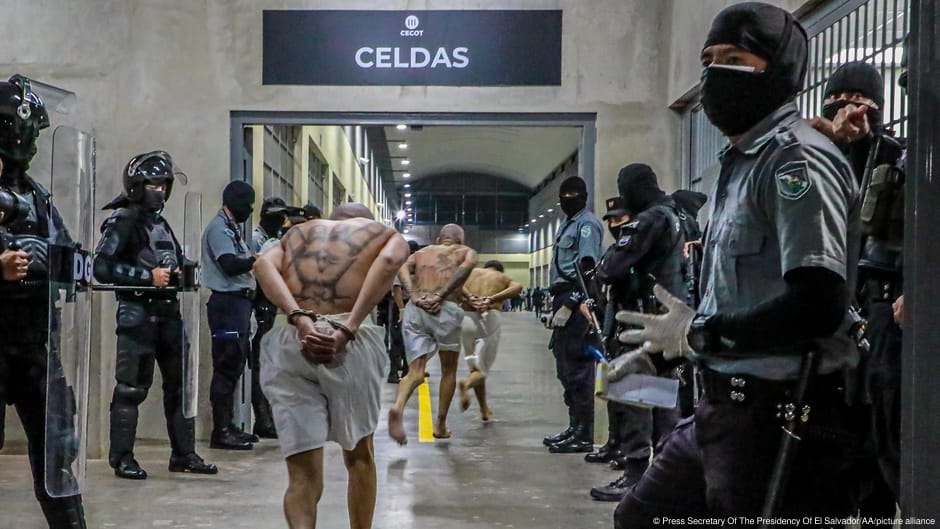
优先在谷歌上关注DW 深入萨尔瓦多恐怖主义拘留中心(CECOT)。 2023年落成典礼后,萨尔瓦多总统新闻办发布的图片 约1.5万名囚犯,最多可容纳4万人,最高判刑达1000年,严格的安保措施和极端的隔离制度。摆拍照片显示,理着光头、满身纹身的囚犯被全副武装的狱警制服。
Prefer DW on Google Inside El Salvador's Terrorism Confinement Center (CECOT). Image released by the El Salvador presidential press office following its inauguration in 2023 Around 15,000 inmates and a capacity of up to 40,000, prison sentences of up to 1,000 years, strict security measures and an extreme isolation regime. Staged images show inmates with shaved heads and tattoos being subdued by heavily armed guards.
这些只是关于萨尔瓦多恐怖主义拘留中心(CECOT)流传的一些事实,它是纳伊布·布克莱总统安全政策的象征,也是其他拉美国家打击有组织犯罪时可能效仿的模式。该地区十多个政府提出建设类似的“超级监狱”,尽管大多数容量要小得多。DW咨询的多位专家对这些举措的有效性和可持续性提出质疑。什么是超级监狱?
These are just some of the facts circulating about El Salvador's Terrorism Confinement Center (CECOT), a symbol of President Nayib Bukele's security policy and a possible model for other Latin American countries seeking to combat organized crime More than a dozen governments in the region have proposed building similar "mega-prisons," although most would have a far smaller capacity. A range of experts consulted by DW question the effectiveness and sustainability of these initiatives. What is a mega-prison?
犯罪学家、秘鲁前国家监狱学院院长、前内政部长何塞·路易斯·佩雷斯·瓜达卢佩表示,事实上的超级监狱——即超员严重、囚犯人数过多的监狱——在布克莱上台前很久就已存在于拉丁美洲。例如,利马的卢里甘乔监狱设计容量为3000人,几十年来却关押了近1.1万人。
De facto mega-prisons — that is, overcrowded prisons with excessive inmate populations — existed in Latin America long before Bukele, says criminologist Jose Luis Perez Guadalupe, former president of the National Penitentiary Institute and former interior minister in Peru. Lurigancho Prison in Lima, for example, designed to hold 3,000 inmates, has housed nearly 11,000 for decades.
但自2023年CECOT启用以来,“超级监狱”概念主要与最高安保设施挂钩。智利大学政府学院专门研究监狱体系的学者奥尔加·埃斯皮诺萨认为,这种关联存在问题,因为它暗示整个囚犯群体都需要“极其严厉”的惩罚。高昂成本与存疑的过往记录据埃斯皮诺萨称,将全部囚犯关押在最高安保设施中,将构成低效且成本极高的“过度干预”。这些设施需要在基础设施、技术、专业人员、反腐败措施和社会再融入项目上投入巨资。
But ever since CECOT was launched in 2023, the concept of a "mega-prison" has been primarily linked to maximum-security facilities. For Olga Espinoza, an academic specializing in prison systems at the School of Government of the University of Chile this association is problematic because it implies that the entire prison population requires "extremely severe" punishment. High costs and a questionable track record According to Espinoza, placing the entire prison population in maximum-security facilities would amount to inefficient and extremely costly "over-intervention." These facilities require substantial investments in infrastructure, technology, specialized staff, anti-corruption measures and social reintegration programs.
这也将是无效的,因为“国际证据表明,当不同类型的人员被关押在同一空间时,犯罪行为扩散的风险极高”,这位智利专家补充道。
It would also be ineffective because "international evidence indicates that when people with different profiles are placed in the same space, there is a high risk of the spread of criminal behavior," the Chilean expert adds.
该地区多个犯罪集团的根源甚至可以追溯到过度拥挤的监狱:委内瑞拉的阿拉瓜火车帮;厄瓜多尔的“狼帮”、“乔内罗斯帮”和“老虎帮”;巴西的首都第一指挥帮和红色指挥帮。
Several criminal groups across the region even have their roots in overcrowded prisons: Tren de Aragua in Venezuela; Los Lobos, Los Choneros and Los Tiguerones in Ecuador; and Primeiro Comando da Capital (PCC) and Comando Vermelho (CV) in Brazil.
即使提议仅仅是建设大规模设施,考虑到拉美地区发展公共基础设施的困难,投资单一建筑似乎颇具吸引力。
Even when the proposal involves simply building large-scale facilities, investing in a single structure may seem attractive given the difficulties of developing public infrastructure in Latin America.
然而,“没有足够证据支持建设超级监狱更具成本效益这一说法”,打击跨国有组织犯罪全球倡议组织高级分析师雷纳托·里韦拉表示。
However, "there is insufficient evidence to support the claim that building mega-prisons is more cost-effective," says Renato Rivera, a senior analyst at the Global Initiative Against Transnational Organized Crime (GI-TOC).
利马太平洋大学教授佩雷斯·瓜达卢佩解释说,联合国1955年通过的《囚犯待遇最低标准规则》“建议建设关押1000至2000名囚犯的中型监狱,而非超级监狱”。
United Nations Standard Minimum Rules for the Treatment of Prisoners, adopted in 1955, "the recommendation has been to build medium-sized prisons housing between 1,000 and 2,000 inmates rather than mega-prisons," explains Perez Guadalupe, a professor at the Universidad del Pacifico in Lima.
瓜达卢佩表示:“超级监狱除了缺乏人性化,还可能变得极其危险。”作为例子,全球倡议组织的里韦拉强调了2021年厄瓜多尔广受关注的监狱大屠杀,这些事件发生在该国规模最大、关押人数最多的设施中。安全、宣传与人权专家承认,大规模监禁与萨尔瓦多暴力犯罪的大幅下降同时发生,并增强了公众对安全的感知。尽管有关于任意逮捕、虐待以及该国羁押期间死亡人数超过500人的报道,但新建超级监狱的宣告,投射出一个强大国家正在整个地区对抗有组织犯罪的形象。
"Mega-prisons, apart from being impersonal, can become extremely dangerous," says Guadalupe. As an example, the GI-TOC's Rivera highlights the widely reported prison massacres in Ecuador in 2021 that took place in the country's largest and most populated facilities. Security, propaganda and human rights Experts acknowledge that mass incarceration has coincided with a dramatic decline in violence in El Salvador and has strengthened the public's perception of safety. Despite reports of arbitrary arrests, abuses and more than 500 deaths in state custody in the country, announcements of new mega-prisons project an image of a strong state confronting organized crime across the region.
然而,他们警告,这种政治和象征性影响并不保证可持续的结果。埃斯皮诺萨表示,要实现这些结果,需要“对外部监督、人权保护和社会再融入计划做出明确承诺”,而各国政府尚未展现出这种承诺。
However, they warn that this political and symbolic impact does not guarantee sustainable results. Achieving them would require a "clear commitment" to external oversight, human rights protections and social reintegration programs, which governments have yet to demonstrate, Espinoza says.
佩雷斯·瓜达卢佩对萨尔瓦多模式尤为批评,将其描述为“纯粹的宣传”。他认为,从“反恐怖主义拘留中心”(CECOT)发布的画面侵犯了人类尊严。他还主张,国家必须展现出“超越违法者的道德优越性”。萨尔瓦多总统纳伊布·布克勒的强硬手段包括大规模逮捕、长期紧急状态以及建设该国规模巨大的“反恐怖主义拘留中心”。萨尔瓦多模式能否输出?
Perez Guadalupe is particularly critical of the Salvadoran model, describing it as "pure propaganda." He believes the images released from CECOT violate human dignity He also argues that the state must demonstrate "moral superiority over those who break the law." El Salvador's President Nayib Bukele's hardline approach has included mass arrests, a prolonged state of emergency and the construction of the country's massive CECOT prison Can the Salvadoran model be exported?
尽管跨国有组织犯罪代表着整个地区日益增长的挑战,但这位秘鲁犯罪学家认为萨尔瓦多的案例属于例外情况。
Although transnational organized crime represents a growing challenge across the region, the Peruvian criminologist considers El Salvador's case exceptional.
在布克勒推行的紧急状态下实施大规模逮捕后,该国拥有世界上最高的监禁率之一。“反恐怖主义拘留中心”旨在永久关押“救世帮”(MS-13)和“18街帮”等被视为极度危险的帮派成员。
Following the mass arrests carried out under the state of emergency introduced by Bukele, the country has one of the highest incarceration rates in the world. CECOT was designed to permanently detain members of gangs such as MS-13 and Barrio 18, which are considered extremely dangerous.
然而,其他拉美国家监狱系统的现实情况不同。佩雷斯·瓜达卢佩指出,问题不在于把被剥夺自由的人永远关在哪里,而在于“我们希望他们如何离开:变得更坏还是更好”,因为大多数人最终都将重返社会。有哪些替代方案?
However, the reality of other Latin American prison systems is different. The question is not where to lock people deprived of their liberty away forever, but rather "how we want them to leave: worse or better," Perez Guadalupe argues, pointing out that most will eventually return to society. What are the alternatives?
理论上,官方的替代方案由联合国《纳尔逊·曼德拉囚犯待遇最低限度标准规则》提供,该规则于2015年更新。这些规则确立了现代监狱管理的原则,包括尊重人格尊严、绝对禁止酷刑和有辱人格的待遇,以及将社会再融入作为监禁的核心目标。
In theory, the official alternative is provided by the UN Nelson Mandela Rules for the treatment of prisoners, updated in 2015. They establish principles for modern prison management, including respect for human dignity, an absolute prohibition on torture and degrading treatment and social reintegration as a central goal of imprisonment.
在实践中,拉丁美洲在这一方向上开发了创新方法。这些方法包括巴西的APAC模式,该模式运营无狱警、无武器、无暴力的设施;阿根廷的冲突预防与解决委员会;以及墨西哥索诺拉州的替代刑事司法中心。
In practice, Latin America has developed innovative approaches in this direction. These include the APAC model in Brazil which operates facilities without guards, weapons or violence; Conflict Prevention and Resolution Committees in Argentina; and the Alternative Criminal Justice Center in the Mexican state of Sonora.
专家还指出,针对特定囚犯群体,有建设最高戒备监狱的必要,但规模应更小,并对囚犯群体进行更精准的分类。
Experts also point to the need for maximum-security prisons for specific inmate profiles, but on a smaller scale and with more precise classification of the prison population.
最后,他们强调,监狱(包括超大型监狱)主要解决的是有组织犯罪的后果,而非其根源。贫困、社会排斥和缺乏机会需要以就业、教育和社会融入为重点的公共政策,以减少使犯罪得以在世界上最不平等的地区之一蔓延的条件。
Finally, they emphasize that prisons, including mega-prisons, primarily address the consequences of organized crime rather than its root causes. Poverty, social exclusion and a lack of opportunities require public policies focused on employment, education and social integration to reduce the conditions that enable crime to expand in one of the world's most unequal regions.