在人工智能淘金热中,美国芯片设计公司英伟达一直是铲子的主要销售商。但实际制造铲子的公司是台积电。这家台湾公司制造英伟达的所有AI芯片。其在AI供应链中的核心地位改变了其命运。自2023年以来,台积电的市值已增长六倍,超过2万亿美元,成为全球第七大最有价值公司。
In the artificial-intelligence gold rush, Nvidia, an American chip designer, has been the chief seller of shovels. But TSMC is the company actually making them. The Taiwanese firm manufactures all of Nvidia’s AI chips. Its central role in the AI supply chain has transformed its fortunes. Since 2023 TSMC’s market value has risen sixfold, to over $2trn, making it the world’s seventh-most valuable firm.
台积电占据了代工芯片制造市场近四分之三的份额,代工芯片制造是指企业为他人设计的半导体进行制造。对于为AI模型和智能手机提供动力的最先进芯片,其份额超过十分之九。不过,到2027年,其在先进芯片制造领域的近乎垄断地位将面临竞争。
TSMC accounts for almost three-quarters of the market for foundry chipmaking, in which firms manufacture semiconductors designed by others. For the most advanced chips, which power AI models and smartphones, its share exceeds nine-tenths. In 2027, though, its near-monopoly in advanced chipmaking will face competition.
第一个挑战者是英特尔,美国的半导体旗舰企业。该公司大约十年前将芯片制造的领先地位让给了台积电,目前正竭力追赶。英特尔首席执行官陈立武将英特尔的代工业务称为“国宝”,并希望其能在美国本土引领先进芯片制造的复兴。一次关键考验将出现在2027年底,届时英特尔将开始使用其14A技术制造芯片,该技术是行业最先进的技术之一。
The first challenger is Intel, America’s semiconductor champion. The company ceded its lead in chipmaking to TSMC around a decade ago and is racing to catch up again. Lip-Bu Tan, Intel’s boss, calls Intel’s foundry business a “national treasure” and wants it to lead a revival of advanced chipmaking on American soil. A crucial test will come in late 2027, when Intel starts making chips using its 14A technology, among the industry’s most advanced.
特朗普政府正在敦促美国科技公司使用英特尔的工厂;据传闻,电子产品制造商苹果可能是14A的潜在客户之一。英特尔还将其技术提供给特拉法布,这是埃隆·马斯克为其公司SpaceX和特斯拉建设大型芯片工厂的项目。
The Trump administration is pressing American technology firms to use Intel’s factories; Apple, a gadget-maker, is rumoured to be among the prospective customers for 14A. Intel is also supplying its technology to Terafab, Elon Musk’s project to build vast chip factories for his companies, SpaceX and Tesla.
第二个挑战者是三星。这家韩国电子巨头与英特尔一样,既设计芯片也制造芯片,长期在代工业务中落后于台积电,位居第二。它也一直面临自身的制造问题。尽管如此,它仍在推进:2027年,其位于得克萨斯州泰勒的工厂将开始大规模生产先进的两纳米(2nm)芯片。
Second is Samsung. The South Korean electronics giant, which, like Intel, designs and makes chips, has long run a distant second to TSMC in foundry work. It has also struggled with manufacturing problems of its own. Nonetheless, it is pressing ahead: in 2027 its factory in Taylor, Texas, will begin mass-producing advanced two-nanometre (2nm) chips.
一个更不太可能的挑战来自Rapidus,这是一家由日本政府和国内产业巨头支持的初创公司。它计划于2027年开始大规模生产尖端2纳米芯片,并押注日本的电子制造历史能帮助它直接跃升至技术前沿。Rapidus计划以低于台积电的价格竞争,并争取那些难以从这家台湾巨头那里获得产能的小型公司。
A more unlikely challenge comes from Rapidus, a Japanese startup backed by the government and by domestic industry heavyweights. It plans to start mass-producing cutting-edge 2nm chips in 2027, and is betting that Japan’s history of electronics manufacturing can help it jump straight to the technological frontier. Rapidus plans to undercut TSMC on price and to court smaller firms that struggle to secure capacity from the Taiwanese giant.
目前,这家新兴公司的雄心还很有限。Rapidus计划2027年开始每月生产6000片晶圆——芯片被蚀刻在上面的硅片——到2028年增至25000片。与台积电相比,这并不算多,台积电预计到2026年底,其2纳米工艺每月将生产约90000片晶圆,3纳米工艺将生产超过180000片。即便如此,Rapidus仍是数十年来首个进入前沿芯片制造领域的新进入者。
For now, the upstart’s ambitions are modest. Rapidus plans to start producing 6,000 wafers—the silicon discs on which chips are etched—per month in 2027, rising to 25,000 by 2028. That is not many compared with TSMC, which will be producing around 90,000 wafers a month on its 2nm process and over 180,000 on its 3nm process by the end of 2026. Even so, Rapidus is the first new entrant in frontier chipmaking for decades.
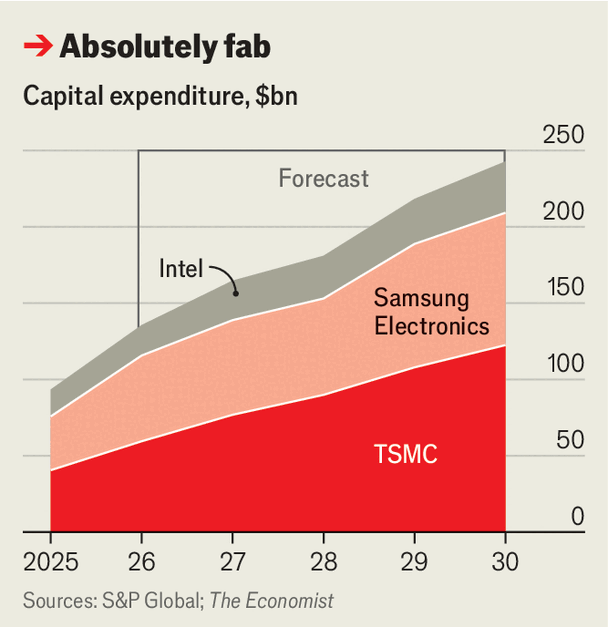
要追上台积电将非常困难。先进芯片制造是一个漫长且昂贵的过程:一家先进的晶圆厂建设和设备投入约需200亿美元,且需要两到三年才能完全投入运营。台积电正在大力投资扩大自身产能。2026年,它将投资约600亿美元,是2025年的一倍半,分析人士预计它2027年将投资约750亿美元。作为这一推进的一部分,它还承诺投入超过2600亿美元扩大在美国的业务。其位于亚利桑那州的一些工厂已经在为英伟达和苹果生产芯片。
Catching up with TSMC will be hard. Advanced chipmaking is a lengthy and expensive process: a leading-edge fab costs around $20bn to build and equip, and takes between two and three years to become fully operational. TSMC is spending heavily to expand its own capacity. In 2026 it will invest around $60bn, one and a half times as much as in 2025, and analysts expect it to spend around $75bn in 2027. As part of that push it has also pledged more than $260bn to expand its operations in America. Some of its plants in Arizona are already churning out chips for Nvidia and Apple.
科技高管私下承认,其他晶圆代工厂不如台积电好合作。该公司拥有满足一些最大科技公司需求的工具、支持和规模,新进入者很难复制这一点。然而,人工智能需求激增正在给供应链带来压力,迫使公司寻找替代方案。英伟达首席执行官黄仁勋表示,制造产能限制了该公司的增长。即使台积电不断增加资本支出,也未能满足希望其投入更多的客户。竞争对手有机会填补这一空白。
Tech bosses privately concede that other foundries are not as easy to work with as TSMC. The company has the tools, support and scale to match the needs of some of the biggest tech firms, and that will be difficult for newcomers to replicate. Yet booming demand for AI is straining supply chains and forcing firms to seek alternatives. Jensen Huang, Nvidia’s boss, has said that manufacturing capacity constrains his company’s growth. Even TSMC’s rising capital spending has not satisfied customers who want it to invest more. Rivals have a chance to fill the gap.
后果不仅限于商业领域。台积电在芯片制造领域的主导地位,且其大部分产能位于台湾,使得该岛的半导体行业对全球科技行业至关重要。台湾的先进晶圆厂,主要是台积电的,有时被认为构成了抵御中国侵略的“硅盾”。但到2027年,随着部分产能转移到海外——既因为台积电自身在美国的扩张,也因为其他地方出现新的供应商——该岛曾经坚不可摧的盾牌将开始削弱。台湾可能不得不习惯于变得不再不可或缺。台积电也可能不得不习惯竞争。■
The consequences go beyond business. TSMC’s dominance in chipmaking, with much of its capacity in Taiwan, has made the island’s semiconductor sector vital to the global technology industry. Taiwan’s cutting-edge fabs, primarily TSMC’s, are sometimes said to form a “silicon shield” against Chinese aggression. But in 2027, as some of that capacity shifts overseas—both with TSMC’s own expansion into America and because of new suppliers emerging elsewhere—the island’s once-impregnable shield will start to weaken. Taiwan may have to get used to being less indispensable. TSMC may also have to get used to competition. ■