发布时间:2026-11-19T03:30:27+08:00 六年多前,印度政府做出了一项决定,如今这项决定正回过头来困扰它。在批准对印度耶士银行有限公司进行救助时,政府删除了印度储备银行提出的一项条款,该条款涉及该贷款机构的额外一级资本债券。政府从未解释过原因。
Published: 2026-11-19T03:30:27+08:00 More than six years ago, the Indian government made a decision that has come back to haunt it. In approving the rescue of Yes Bank Ltd., it removed a provision proposed by the Reserve Bank of India that dealt with the lender’s Additional Tier 1 bonds. It never explained why.
这一遗漏是目前一场法律纠纷的核心,该纠纷可能迫使耶士银行及其股东(包括持股24.9%的三井住友银行)承担损失。这也给印度带来了一个更广泛的问题。如果投资者无法确信在金融危机中谁来承担损失的规则会得到一致应用,他们就无法确定自己购买的是什么风险。
That omission lies at the heart of a legal battle now threatening to impose losses on Yes Bank and its shareholders including Sumitomo Mitsui Banking Corp., which owns 24.9%. It has also created a broader problem for India. If investors cannot be sure that the rules governing who takes losses in a financial crisis will be applied consistently, they cannot be sure what risks they’re buying.
印度总理纳伦德拉·莫迪领导的政府现在还有一次最后的机会,来清理它帮助制造的烂摊子。
Prime Minister Narendra Modi’s government now has one last chance to clean up the mess it helped create.
这个问题听起来晦涩难懂,但原则很简单。AT1证券被称为债券,但其设计初衷是当银行陷入严重麻烦时吸收损失。它们向投资者支付更高的回报,作为交换,投资者接受其持仓可能被减记或转为股权的风险。
The issue sounds arcane, but the principle is simple. AT1 securities are called bonds, but they are designed to absorb losses when a bank gets into serious trouble. They pay investors higher returns in exchange for accepting the risk that their holdings can be written down or converted into equity.
这正是耶士银行发生的情况。到2020年初,多年累积的不良贷款、资产质量恶化和信心崩塌已将该贷款机构推向存亡未卜的境地。印度储备银行接管了该银行,其AT1债券被减记。
That is what happened at Yes Bank. By early 2020, years of mounting bad loans, deteriorating asset quality and collapsing confidence had pushed the lender to the point where its survival was in doubt. The RBI seized the bank and its AT1 bonds were written down.
通常情况下,事情可能就此结束。但当年3月,当政府批准央行的重组计划时,它做出了一项关键修改。它删除了关于AT1债券减记或转为股权的条款。它没有提供任何替代方案,且从未公开解释过这一遗漏。
Ordinarily, that might have been the end of it. But when the government approved the central bank’s reconstruction plan in March of that year, it made one crucial change. It removed a clause providing for the AT1 bonds to be written down or converted into equity. It offered no alternative and has never publicly explained the omission.
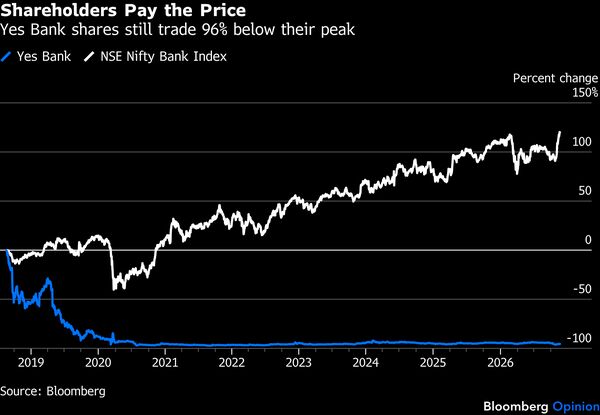
六年的诉讼随之而来,令投资者动荡不安。尽管这家贷款机构已重回盈利并增强了资产负债表,但 Yes Bank 的股价仍比 2018 年的峰值低 96% —— 同期 Nifty Bank Index(印度银行指数)已翻倍多。债券持有人被拒还本金,而股东面临近 9 亿美元可能被拿去支付 AT1 投资者的风险。Yes Bank 表示,如果确认最高法院裁决的影响,该行第二季度将由盈转亏。
Six years of litigation followed and roiled investors. Yes Bank’s shares still trade 96% lower than their 2018 peak — while the Nifty Bank Index has more than doubled — despite the lender returning to profitability and strengthening its balance sheet. Bondholders have been denied their principal, while shareholders face the possibility that almost $900 million will now be taken from them to pay AT1 investors. Yes Bank said it would would have swung to a second-quarter loss if it had recognized the impact of the Supreme Court ruling.
印度并非唯一面临 AT1 资本法律模糊地带的国家。2023 年瑞信倒闭时,瑞士监管机构注销了约 165 亿瑞郎(按 2023 年汇率约合 180 亿美元)的 AT1 债券,而股东在 UBS Group AG 的救助中仍获得了一定价值,引发投资者愤怒并导致多年诉讼。瑞士法院推翻了监管机构的注销令,裁定其缺乏法律依据。该裁决目前正处于上诉阶段。这与 Yes Bank 案极为相似:两起案件的争议核心都是监管机构在让 AT1 投资者吸收损失时是否遵循了法律。
India isn’t alone in confronting the legal ambiguities of AT1 capital. When Credit Suisse collapsed in 2023, Swiss regulators wiped out about 16.5 billion francs (about $18 billion in 2023) of AT1 bonds even as shareholders received some value in its rescue by UBS Group AG, provoking outrage among investors and leading to years of litigation. A Swiss court overturned the regulator’s write-down order, ruling that it lacked a legal basis. The decision is now under appeal. The parallel with Yes Bank is striking: In both cases, the dispute is over whether regulators followed the law when making AT1 investors absorb losses.
印度最高法院下令恢复 Yes Bank 的债券,因为下令注销的管理人缺乏法律授权。Yes Bank 已请求法院复议该裁决,而债券持有人因该行未恢复其证券而寻求启动藐视法庭程序。
India’s Supreme Court has ordered Yes Bank’s bonds restored because the administrator who ordered the write-down lacked the legal authority to do so. Yes Bank has asked the court to review that ruling, while bondholders have sought contempt proceedings over the bank’s failure to restore their securities.
法院的裁决关乎正当程序。其基本金融原则保持不变:AT1 投资者之所以获得溢价,正是因为他们同意在类似情况下吸收损失。
The court’s ruling is about due process. The underlying financial principle remains intact: AT1 investors were paid a premium precisely because they agreed to absorb losses in circumstances such as these.
因此,辩论的核心应当是政府,而非最高法院。印度储备银行(RBI)从一开始就支持完全减记,后来又支持将债券转为股权,现在正寻求对法院裁决进行复审。相比之下,政府既没有撤销其最初的疏忽,也没有对此作出充分解释。
Which is why the government, rather than the Supreme Court, should be at the center of the debate. The RBI supported a complete write-down from the outset, later backed converting the bonds into equity, and is now seeking a review of the court’s order. The government, by contrast, has neither reversed its original omission nor adequately explained it.
原则上存在一个显而易见的解决方案:找到一种合法有效的方式,保留最初的减记。但经过六年的诉讼和最高法院的判决,这可能已不再可行。次优的结果是将这些证券转为股权。政府应在法院批准下牵头,召集各方达成和解,以维护AT1资本的经济功能。
There is an obvious solution in principle. Find a legally valid way to preserve the original write-down. But after six years of litigation and a Supreme Court judgment, that may no longer be possible. The next-best outcome is to convert the securities into equity. The government should take the lead, with the court’s approval, in bringing the parties together and finding a settlement that preserves the economic purpose of AT1 capital.
有一项原则不容妥协。印度Yes银行现有股东和纳税人不应被迫为政府2020年未加解释的决定所造成的问题,向AT1投资者进行补偿。AT1持有人购买这些证券是因为它们提供更高回报,代价是承担更大风险。这些风险现已兑现。
One principle should be non-negotiable. Yes Bank’s existing shareholders and Indian taxpayers should not be forced to compensate AT1 investors for a problem created by the government’s unexplained 2020 decision. AT1 holders bought securities that offered higher returns because they carried greater risks. Those risks materialized.
利害关系远超一家银行或一群债券持有人。瑞信(Credit Suisse)一案表明,关于银行资本一个鲜为人知角落的争端,如何迅速演变为对金融体系公信力的考验。投资者需要知道,当危机来临时,约定谁来吸收损失的合同条款将得到可预测且合法的执行。
The stakes go beyond one bank or one group of bondholders. Credit Suisse showed how quickly disputes over an obscure corner of bank capital can become a test of a financial system’s credibility. Investors need to know that when a crisis comes, the contractual terms governing who absorbs losses will be enforced predictably and legally.
允许Yes银行的AT1投资者在其证券设计用于吸收的事件发生后仍能全额获偿,同时将账单转嫁给股东或纳税人,传递的恰恰是相反的信息:规则可以在风险兑现后再改变。
Allowing Yes Bank’s AT1 investors to emerge whole despite the event their securities were designed to absorb, while shifting the bill to shareholders or taxpayers, risks sending precisely the opposite message: that the rules can change after the risks have come true.