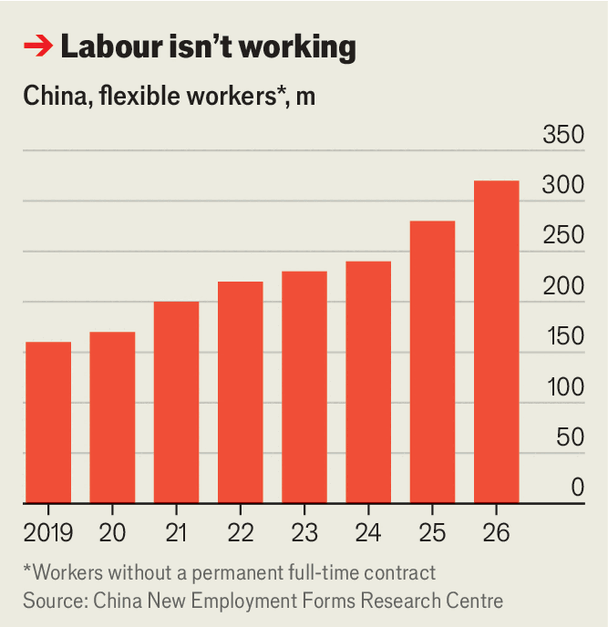
如果说2026年中国放缓的经济中裂痕变得更加明显,那么到2027年,发展不均衡和人工智能将加剧社会紧张。一方面,技术、先进制造业和出口部门一路领先。另一方面,旧的经济增长引擎,尤其是房地产,继续运转不畅,把劳动者推入不断膨胀的零工经济。据中国新就业形态研究中心的数据,今年零工劳动者预计将增至3.2亿。即便政府更为保守的估计——2025年为2亿——也相当于城镇劳动力的五分之二以上。随着零工经济扩张,中国的双层经济正变得根深蒂固。
IF Rifts in China’s slowing economy were becoming more apparent in 2026, uneven development and AI will worsen social strains in 2027. On the one hand, the technology, advanced manufacturing and export sectors are racing ahead. On the other, old engines of growth, especially property, continue to sputter, sending workers into the ballooning gig economy. This year it is expected to swell to 320m workers, according to the China New Employment Forms Research Centre. Even the government’s more conservative estimate of 200m in 2025 is equivalent to more than two-fifths of the urban workforce. As the gig economy expands, China’s two-tier economy is becoming entrenched.
进入政府更愿意称之为“灵活就业”的人群中,有许多聪明人:随着应届毕业生人数创下历史新高,青年失业率接近20%。总体而言,中国官方失业率约为5%,但清华大学李稻葵在7月估计,采用更宽泛的定义,真实水平可能是这一数字的两倍。在劳动者和官员对失业日益焦虑之际,政策制定者将更加重视安全网和再分配。但鉴于正在发生的剧变,他们的提议并不充分。
Among those entering what the government prefers to call “flexible employment” are many bright minds: with the number of new graduates at a record high, youth unemployment is running at nearly 20%. Overall, China’s official unemployment rate is around 5%, though Li Daokui of Tsinghua University estimated in July that the true level, using a broader definition, could be twice that. Amid growing anxiety among workers and officials over unemployment, policymakers will place greater emphasis on safety-nets and redistribution. But their proposals are inadequate given the sweeping changes afoot.
在3月的一次讲座中,浙江大学李实指出,财富基尼系数(衡量财富不平等)从1995年的0.45跃升至2023年的0.7以上。他说,中国正艰难地既要做大蛋糕,又要分好蛋糕。部分问题在于,政府力图主导的战略部门并非劳动密集型。尽管2027年蛋糕可能不会增大多少,但如何分蛋糕将成为一个更加紧迫的问题。
At a lecture in March, Li Shi of Zhejiang University pointed to a jump in the wealth Gini coefficient (which measures wealth inequality) from 0.45 in 1995 to more than 0.7 in 2023. China is struggling to increase the size of the cake and to divide it, he said. Part of the problem is that the strategic sectors that the government aims to dominate are not labour-intensive. Though the cake will probably not grow much in 2027, dividing it will become a more urgent issue.
首先,政策制定者将尝试让更多零工劳动者纳入中国传统的社会保障体系。职工与雇主共同缴纳约占工资35%的保费;但许多低收入劳动者不愿参保,因为他们更倾向于拿到手的现金。企业没有义务为零工劳动者缴纳社保,但现在提供这一选项的企业越来越多。10月,政府承诺利用数据识别未参保人员。这在网上引发愤怒,民众抱怨不得不放弃部分收入缴纳养老保险,而养老基金可能会耗尽。
For a start, policymakers will try to bring more gig workers into China’s traditional social-security system. Employees and their employers together pay about 35% of salary in premiums; but many low-income workers do not enroll because they prefer ready cash. Firms are not required to enroll gig workers, but more now offer the option. In October the government vowed to use data to identify unenrolled workers. That prompted outrage online, as people complained about having to give up some of their income in order to pay into a pension fund that may run out of money.
上海金融与法律研究院(一家智库)的聂日明表示,在当今僵化、并非为零工劳动者设计的体制下,“强制缴纳社保感觉更像是一种义务,而非权利”。
Under today’s rigid system, which is not built for gig workers, “mandating social-security contributions feels more like an obligation than a right,” says Nie Riming of Shanghai Institute of Finance and Law, a think-tank.
城市也在削减繁文缛节,让零工劳动者(他们往往是农民工)享受更多福利待遇。例如,9月政府提出为期三年的行动,将更多零工劳动者纳入职工基本医疗保险。但随着人工智能应用加速、经济增长放缓,更多工作将变得不稳定。为当今劳动者构建一套严肃的保障网,正成为一项更迫切的任务。
Cities are also removing red tape to grant gig workers, who are often rural migrants, more welfare benefits. In September the government proposed a three-year campaign to include more gig workers in basic medical-insurance schemes for employees, for example. But as AI adoption accelerates and economic growth slows, more jobs will become precarious. Building a serious safety-net fit for today’s workers is becoming a more pressing task.
在北京一家新建的补贴宿舍楼外(这是一家外卖平台为展示其改善福利所做的努力之一),来自河南的27岁骑手李先生显得悲观。他说,中国的大公司都在外包劳动力:“真正能提供保障的越来越少,所有人都被迫像我们一样从事零工。”随着涌入外卖行业的人越来越多,他的收入下降了,但他仍庆幸不必进厂打工,拥有自由。“阶层已经固化了,”他说,“我们这些后来者几乎没有出路了。” ■
Parked outside a new subsidised dormitory in Beijing (part of a food-delivery company’s efforts to show that it is improving welfare), Mr Li, a 27-year-old driver from Henan, is pessimistic. China’s big companies are all outsourcing their labour, he says: “Fewer and fewer can really offer protections, and everyone is forced to do gig work like us.”His earnings have fallen as more and more workers have piled into food delivery, though he remains grateful for the freedom of not having to work in a factory. “Class has already been solidified,” he says. “There is little road left for us latecomers.” ■