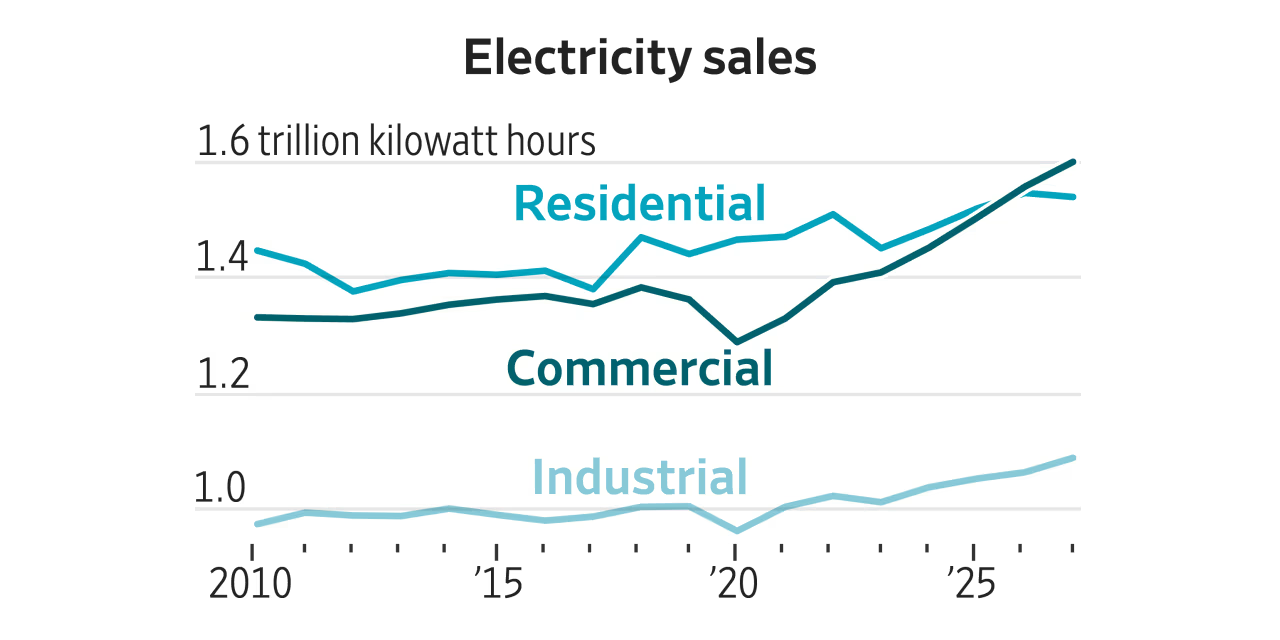
针对数据中心建设的反弹正引发关于美国人工智能建设未来的疑问。对于电网而言,前景并不模糊——数据中心是迄今为止最大的增长引擎。
Backlash against data-center construction is raising questions about the future of America’s AI build-out. For the power grid, the picture isn’t as murky—data centers are by far the biggest growth engine.
它们正以历史性的速度吸纳电力,终结了数十年的电力使用停滞,并重塑了接入电网的主体。
They are vacuuming up electricity at a historic clip, ending decades of static power usage and reshaping who is plugging into the grid.
根据美国能源信息管理局(EIA)的数据,全国范围内,商业客户用电量——一个涵盖数据中心的广泛类别——有望今年首次超过居民用电需求。
Nationally, electricity use by commercial customers—a broad category that includes data centers—is poised to surpass residential demand this year for the first time, according to the U.S. Energy Information Administration.
用于人工智能、云计算和加密货币挖矿的数据中心,以及办公楼和购物中心,均归属于EIA的商业类别。居民用电和工业用电——包括工厂、炼油厂和农业等——是另外两大主要类别。以下是人工智能繁荣如何重塑美国电力行业的格局。
Data centers for artificial intelligence, cloud computing and cryptocurrency mining, as well as offices and shopping centers, fall in the EIA’s commercial division. Residential and industrial—including things like factories, refineries and agriculture—are the other big categories. Here’s how the AI boom is reshuffling the U.S. power industry.
根据EIA数据,2010年至2017年间,电力消费基本持平。此后几年情况开始发生变化。2018年至2025年,市场增长了6%,由商业用电9%的增幅领涨。
Electricity consumption was essentially flat between 2010 and 2017, according to EIA data. That began to change over the following years. From 2018 to 2025, the market grew 6%, led by a 9% jump in commercial use.
最大增幅部分出现在北达科他州和得克萨斯州等州,计算产业的繁荣以及石油行业油田作业的电气化推动了大部分增幅。新墨西哥州也在将其油田接入电网。爱荷华州拥有庞大的数据中心市场和工业增长,而俄勒冈州则拥有主要的数据中心走廊。
Some of the biggest gains occurred in states like North Dakota and Texas, where a boom in computing and the oil industry’s electrification of its field operations drove much of the increase. New Mexico is hooking up its oil field to the grid, too. Iowa is home to a large data-center market and industrial growth, while Oregon has a major data-center corridor.
截至去年,商业用电需求已在23个州和华盛顿特区超过了居民用电。得克萨斯州、俄亥俄州和内华达州——均为不断增长的数据中心市场——是最新出现这一逆转的州。它们分别继2024年的俄克拉荷马州,以及2023年的俄勒冈州和内布拉斯加州之后。
Commercial demand already outpaced residential in 23 states and Washington, D.C., as of last year. Texas, Ohio and Nevada—all growing data-center markets—were the latest states to flip columns. They followed Oklahoma in 2024 and Oregon and Nebraska in 2023.
在弗吉尼亚州——全球数据中心最密集的聚集地——商业客户用电量自2011年起已超过住户,目前约占该州售电总量的59%。
In Virginia, home to the world’s largest concentration of data centers, commercial customers have consumed more power than households since 2011 and now account for about 59% of all electricity sold in the state.
从2023年开始,联邦政府和公用事业公司开始将许多数据中心和加密货币矿场从工业类别重新归类为商业领域——此前一些因巨大的用电量被归入工业类别。
Beginning in 2023, the federal government and utilities began reclassifying many data centers and crypto mines from the industrial category—where some had been grouped because of their massive power draw—to the commercial sector.
据电力研究院称,数据中心目前占美国用电量的估计4%至5%,该机构预测这一比例到2030年可能增长至9%至17%。
Data centers currently account for an estimated 4% to 5% of electricity consumption in the U.S., according to the Electric Power Research Institute, which forecasts that share could grow to 9% to 17% by 2030.
据数据追踪机构Cleanview统计,美国约有58吉瓦的数据中心产能正在577个地点建设中。这是一笔巨大的电力,相当于纽约市用电高峰期用电量的约六倍。
The U.S. has about 58 gigawatts of data-center capacity under construction across 577 locations, according to data tracker Cleanview. That is an enormous amount of power, equivalent to roughly six times as much electricity as New York City uses during periods of peak demand.
其中占大多数的约38吉瓦数据中心在截至10月的12个月内破土动工,其中20%以上位于得克萨斯州。
Data centers accounting for the majority of that sum—about 38 gigawatts—broke ground in the 12 months that ended in October, and more than 20% is in Texas.
然而,建设开工在夏季停滞。这种放缓与针对人工智能的广泛抵制同时发生,部分原因是对数据中心巨大用电需求的担忧。
Yet construction starts stalled over the summer. The slowdown coincided with a broad backlash against AI, driven partly by worries about data centers’ massive electricity appetite.
在11月的中期选举中,选民对人工智能建设热潮予以谴责,投出选票支持将禁止或减缓数据中心开发的候选人和投票议案。电力板块股票(从电厂所有者到设备制造商)随之下跌。
In November’s midterm elections, voters delivered a rebuke of the AI build-out, casting their votes for candidates and ballot measures that would ban or slow data-center development. Stocks across the power sector, from plant owners to equipment makers, fell in response.
Cleanview创始人迈克尔·托马斯表示:“未来几个月将显示夏季是暂停,还是真正放缓的开始,后者可能对全球经济和股市产生深远影响。”
“The next few months will show whether the summer was a pause or the start of a real slowdown that could have far-reaching consequences for the global economy and stock market,” said Michael Thomas, the founder of Cleanview.
[视频] 人工智能繁荣可能在中期选举后放缓的三个州 公用事业公司一直在升级和加固老化基础设施以应对风暴,也在重写其支出计划以满足不断飙升的电力需求。
[video] Three States Where the AI Boom Could Slow After the Midterms Utilities, which have been upgrading and storm-hardening aging infrastructure, are rewriting their spending plans to meet the soaring demand for power, too.
包括美国电力公司、总部位于威斯康星州的WEC能源集团和总部位于密歇根州的DTE能源公司在内的部分在大型数据中心和工业市场运营的公司,正将其五年资本预算上调20%至30%。
Some companies operating in big data-center and industrial markets, including American Electric Power, Wisconsin-based WEC Energy Group and Michigan-based DTE Energy, are raising their five-year capital budgets by 20% to 30%.
美国电力公司业务遍及得克萨斯州、俄亥俄州等11个州,最近将其支出计划从780亿美元增至1000亿美元。
AEP, which operates across 11 states, including Texas and Ohio, recently boosted its spending plan to $100 billion from $78 billion.
该公用事业公司拥有35吉瓦“拿或付”电力合同——大致相当于35座核反应堆的发电量。这些协议使数据中心等大型能源用户承担起为其申请的产能付费的责任,即使其增长计划后来落空。
The utility has 35 gigawatts of “take-or-pay” power contracts—roughly the output of 35 nuclear reactors. Those deals leave big energy users like data centers on the hook to pay for the capacity they request even if their growth plans later fizzle.