发布时间:2026-11-19T20:00:00+08:00 人工智能热潮正推动全球一些最大的科技公司涉足一项新业务:为其数据中心自行采购电力。
Published: 2026-11-19T20:00:00+08:00 The artificial-intelligence boom is pushing some of the world’s biggest technology companies into a new business: sourcing their own electricity for their data centers.
数据中心的主要瓶颈之一是确保有足够能源来运行数千块计算机芯片,以及防止其过热的冷却系统。面对接入美国电网需要排队数年,以及因其对电力系统造成的压力而日益引发的反弹,数据中心开发商越来越多地转向“自带电力”模式——至少在短期内如此。
One of the main bottlenecks for data centers is securing enough energy to run thousands of computer chips and the cooling systems that prevent them from overheating. Faced with a yearslong queue to connect to US electric grids, and now growing backlash against the demands they’re placing on the power system, data center developers are increasingly turning to the “bring-your-own-power” model — at least in the short term.
更多项目正在采用所谓的“表后发电”设计,即在数据中心内部或附近生产电力,绕过电网,使人工智能设施能更快投入运营。这包括拥有最大数据中心组合的超大规模运营商的项目管线,如 Amazon.com Inc.、Microsoft Corp. 和 Oracle Corp.。
More projects are being designed with so-called behind-the-meter generation that produces electricity at or near data centers, bypasses the grid and allows AI facilities to come online sooner. That includes the pipelines of hyperscalers with the largest data-center portfolios, such as Amazon.com Inc., Microsoft Corp. and Oracle Corp.
如果数据中心只满足自身需求而不为电网改进做贡献,普通消费者可能会因此处境更糟。据研究公司 Cleanview 统计,截至 2026 年年中,美国所有规划中数据中心产能中约四分之一将配备某种形式的表后发电。
There is a risk that ordinary consumers could end up worse off if data centers serve their own needs and don’t contribute to grid improvements. As of mid-2026, around a quarter of all planned data center capacity in the US was set to have some form of behind-the-meter generation, according to research firm Cleanview.
从电网取电通常比自建和运营电源对数据中心而言更便宜、更简单。
Drawing power from the grid is generally a cheaper and simpler option for data centers than building and running their own power source.
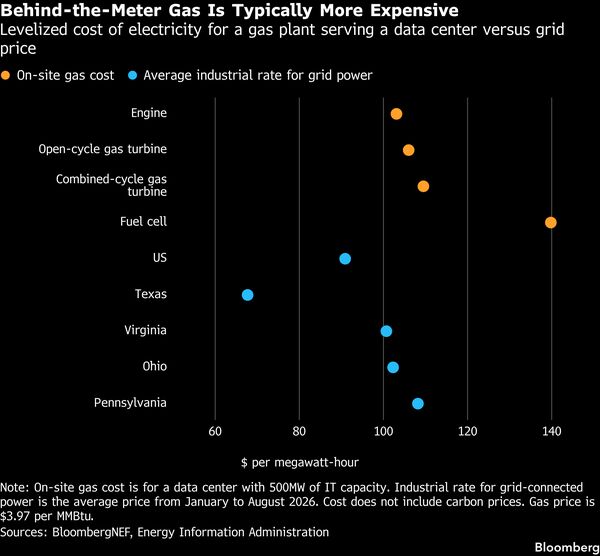
以拥有 500 兆瓦 IT 产能的数据中心为例。据彭博新能源财经(BloombergNEF)数据,现场燃气电厂全生命周期的平均发电成本超过 100 美元/兆瓦时。相比之下,根据美国能源信息署(Energy Information Administration)最新的年初至今数据,工业客户支付的电网电价全国平均水平接近 90 美元/兆瓦时。
Take a data center with 500 megawatts of IT capacity. The average cost of producing electricity over the lifetime of an on-site gas plant is more than $100 per megawatt-hour, according to BloombergNEF. By comparison, the national average tariff that industrial customers pay for grid power is closer to $90 per megawatt-hour, based on the latest year-to-date data from the Energy Information Administration.
但电网并非为适应数据中心的巨大负荷而设计。公用事业公司难以足够快地建设变电站、输电线路和发电容量,以满足新增需求。据 Evercore ISI 统计,数据中心接入电网的平均等待时间接近四年,在需求旺盛的地区甚至长达 10 年。
But the grid wasn’t designed to accommodate the enormous loads of data centers. Utilities are struggling to build substations, transmission lines and generation capacity quickly enough to meet the new demand. Data centers face average wait times of just under four years for a grid connection, according to Evercore ISI, stretching to as long as 10 years in regions with heavy demand.
科技公司依赖这部分算力基础设施尽快建成,以支撑其 AI 业务增长并提升利润。这使得企业愿意支付更高费用购买离网电力,以加快设施投入运营的进程。
Tech companies are relying on this computing infrastructure to be completed as soon as possible to underpin the growth of their AI businesses and boost their bottom lines. That’s left firms willing to pay more for off-grid electricity to speed up the process of turning their facilities on.
数据中心“自带电源”市场仍处于非常早期的阶段。据 Cleanview 数据,截至 6 月,在运行的在场发电装机仅约 2 吉瓦,相当于两座常规核反应堆。规划装机最多的是得克萨斯州,该州拥有最大规模的数据中心项目储备,且能从二叠纪盆地获得廉价且充足的天然气。
The bring-your-own-power market for data centers is still in its very early stages. There was only about 2 gigawatts of on-site generation in operation as of June, according to Cleanview, equivalent to two conventional nuclear reactors. The most planned capacity was in Texas, which has the biggest pipeline of data centers and access to cheap and abundant gas from the Permian Basin.
天然气已成为一种热门技术,因为它能满足数据中心全天候用电的需求。例如,SpaceX 计划在得克萨斯州建设一座燃气电厂和“超级计算设施”,初始成本为 240 亿美元。
Natural gas has emerged as a popular technology because it can meet data centers’ need for around-the-clock power. SpaceX, for example, plans to construct a gas-fired power plant and “super-compute facility” in Texas at an initial cost of $24 billion.
BNEF 追踪到美国已宣布的、与数据中心共址的燃气发电项目达 165 吉瓦。即便全部建成——这远非确定——也将相当于 2025 年美国在运燃气机组总装机的四分之一。
BNEF has tracked 165 gigawatts of announced gas-fired generation projects co-located with data centers in the US. If all of this actually gets built, which is far from certain, it would equate to a quarter of the country’s operating gas fleet in 2025.
虽然在场燃气发电让数据中心得以跳过电网接入的排队,但它们仍面临燃气发电设备漫长等待的可能性。公用事业规模电厂使用的大型燃气轮机供应短缺,部分原因是数据中心项目需求上升。头部燃气轮机制造商 GE Vernova Inc. 10 月表示,其燃气设备客户中有 20% 来自数据中心。
While on-site gas offers a way for data centers to skip the queue for a grid connection, they still face the possibility of a lengthy wait for gas-fired generation equipment. The large turbines used in utility-scale plants are in short supply, in part due to rising demand from data center projects. Top turbine maker GE Vernova Inc. said in October that 20% of its customers for gas equipment are data centers.
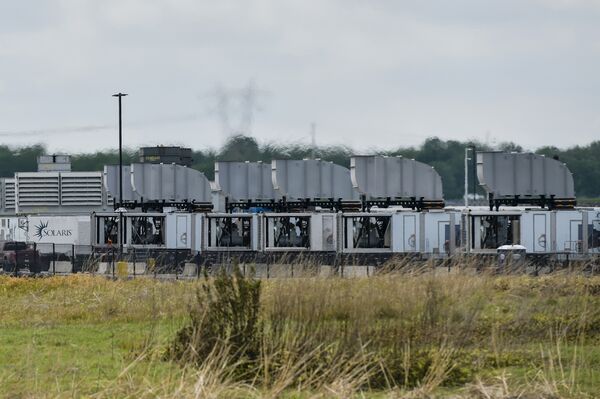
美国燃气轮机的成本近年来翻了一倍多,而从下单到交付的时间现在可能长达五年以上。这促使一些数据中心开发商转向更容易获得——尽管非传统——的选项来生产燃气电力,例如最初为飞机设计的燃气轮机,以及通常用于船舶和汽车的所谓往复式发动机。
The cost of gas turbines in the US has more than doubled in recent years, while the time from order to delivery can now stretch more than five years. That’s prompted some data center developers to turn to more readily available — albeit unconventional — options to produce gas power, such as turbines that were originally designed for planes and so-called reciprocating engines that are normally used in ships and cars.
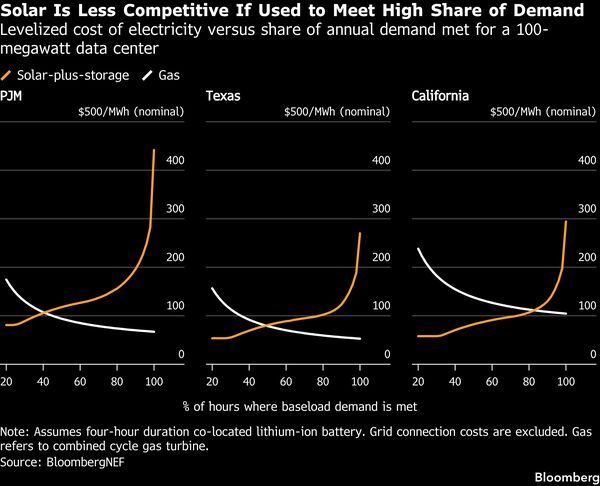
根据彭博新能源财经(BNEF)的说法,太阳能电池板配合电池储能是一种零排放替代方案,其成本可能低于燃气——但仅限于一定程度。为了在接近100%的时间里满足数据中心的需求,所需的光储电站规模将不具备成本竞争力。
Solar panels coupled with battery storage are a zero-emissions alternative that can be cheaper than gas — but only up to a certain point, according to BNEF. The size of the solar-plus-storage plant needed to meet data centers’ demand close to 100% of the time wouldn’t be cost-competitive.
土地限制是一个问题。彭博新能源财经估计,要在德克萨斯州为一个相对较小的100兆瓦数据中心供电,使其全年98%的时间都能运行,需要近1800公顷的光储设施。要达到100%,土地需求将激增,因为太阳能和电池容量必须大幅超配,以应对冬季等发电量较低的时期。
Land constraints are an issue. To power a relatively small 100-megawatt data center in Texas for 98% of the year, almost 1,800 hectares of solar-plus-storage would be needed, BNEF estimates. To get to 100%, the land requirements would balloon because the solar and battery capacity has to be significantly oversized to account for periods of lower generation such as winter.
一些开发商选择组合多种技术。谷歌在6月宣布了一个数据中心项目,计划在德克萨斯州与风能、太阳能、电池储能和燃气设施选址共建。其他公司则在追求小型模块化反应堆形式的现场核能,尽管这项技术距离商业化部署可能仍需数年。
Some developers are opting for a combination of technologies. Google announced a data center project in June that’s set to be co-located with wind, solar, battery storage and gas in Texas. Others are pursuing on-site nuclear power in the form of small modular reactors, although this technology is likely still years away from commercial deployment.
仅依赖现场发电存在风险。电网拥有更多冗余,因为它从众多发电厂和输电线路汲取电力,当单个设备发生故障时,电力仍能持续输送。
Depending on on-site generation alone is risky. The grid has more redundancies built in as it draws on numerous power plants and transmission lines, allowing electricity to keep flowing when individual equipment fails.
许多数据中心项目计划建设比实际需要更多的燃气发电容量,以降低停电风险。处理AI工作负载会导致电力需求在几秒钟内出现巨大波动。一些数据中心的现场发电设备已因这种波动而受损。
Many data center projects include plans to build more gas capacity than they actually need to mitigate the risk of outages. Processing AI workloads can drive massive swings in power demand that appear and disappear in seconds. Some data centers have already experienced damage to their on-site generation equipment from this volatility.
对可靠性的担忧是许多数据中心开发商将“自备电力”模式视为临时解决方案的原因之一,直到他们能够接入电网。这引发了一个问题:一旦接入电网,电表后的电力容量会怎样。它可能继续作为数据中心的主要电源,由电网补充;也可能被降级为备用电源;或者被转移到另一个站点使用。一些运营商可能会选择将电力出售给电网,以获得另一条收入来源。
Concerns about reliability is one reason why lots of data center developers see the “bring-your-own-power” model as a temporary solution until they can plug into the grid. That raises the question of what happens to the behind-the-meter capacity once that connection arrives. It could remain the primary power source for the data center and be supplemented by the grid, it could be downgraded to a backup, or it could be moved to serve another site. Some operators may choose to export electricity to the grid to earn another revenue stream.
随着公众对数据中心的反对声浪增长,政策制定者正推动开发商承担其电力需求的成本,以免公用事业公司从家庭和企业那里收回电网升级的投资。这些政策努力部分聚焦于数据中心自备电力,尽管更多关注已投向大负荷客户的单独电价。
As public opposition to data centers grows, policymakers are pushing for developers to shoulder the cost of their electricity needs so that utilities don’t recover their investment in grid upgrades from households and businesses. These policy efforts have partly focused on data centers supplying their own power, although more attention has been devoted to separate tariffs for large-load customers.
美国总统唐纳德·特朗普的“费率保护者承诺”——已有数十家数据中心开发商签署,包括超大规模云服务商——要求公司承诺“自建、引进或购买所需的新发电资源和电力”。该倡议不具约束力。
President Donald Trump’s “Ratepayer Protection Pledge” — which has been signed by dozens of data center developers, including hyperscalers — entails a commitment for companies to “build, bring, or buy the new generation resources and electricity” they need. The initiative is non-binding.
在宾夕法尼亚州,民主党州长乔什·夏皮罗提出了标准,对希望获得许可证的开发商提出同样的承诺。该州拥有美国第五大数据中心管道,并是美国最大的区域电网PJM Interconnection LLC的一部分。在民主党在11月的中期选举中掌控宾夕法尼亚州立法机构两院后,他们可能会寻求将数据中心的能源要求写入法律。
In Pennsylvania, Democratic Governor Josh Shapiro introduced standards that lay out the same commitment for developers that want to secure a permit. The state has the fifth-largest data center pipeline in the US and is part of the country’s biggest regional grid, PJM Interconnection LLC. After Democrats secured control of both chambers of Pennsylvania’s legislature in November’s midterms, they may seek to codify energy requirements for data centers into law.
在特拉华州,这是一个较小的数据中心市场,民主党州长马特·迈耶在8月签署了一项法律,规定大型能源用户必须生产或确保其所需100%的电力。
In Delaware, a smaller data center market, Democratic Governor Matt Meyer signed a law in August that mandates large energy users must produce or secure 100% of the power they need.
将数据中心移出电网可能不符合其他消费者的最佳利益。这有可能造成一种两级制体系:资金雄厚的科技公司能够负担得起昂贵的燃气涡轮机及其他设备以满足自身需求,而公用事业公司则因高昂成本被迫推迟电网扩建计划。如果大负荷电价结构合理,它们可以覆盖系统升级的费用,这些升级既能满足数据中心的需求,也能惠及更广泛的电网。
Pushing data centers off the grid may not be in the best interest of other consumers. It risks creating a two-tier system where deep-pocketed tech companies can afford expensive gas turbines and other equipment for their own needs, while utilities are forced to delay their grid expansion plans due to the high costs. If large-load tariffs are structured properly, they could cover the expense of system upgrades that both serve the needs of data centers and benefit the wider grid.
中期选举的结果可能会使在现场建设燃气发电设施以及更广泛的数据中心建设工作变得复杂。目前,大约十几个州的州长或州长当选人已经实施或支持对新建数据中心实施暂停令。
The outcome of the midterms could complicate efforts to build on-site gas generation, as well as data centers more broadly. Around a dozen states now have a governor or governor-elect who has already imposed or supports a moratorium on new data centers.
新的政治格局可能会使为现场燃气发电设施获得空气许可证变得更加困难,特别是如果民主党州长引入更严格的环境要求以鼓励使用清洁能源。
The new political landscape may make it more difficult to secure an air permit for on-site gas generation, particularly if Democratic governors introduce stricter environmental requirements to encourage the use of clean energy.
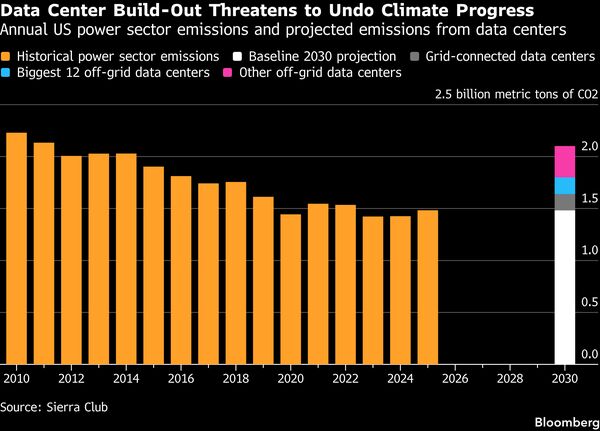
环保非营利组织塞拉俱乐部的内部分析表明,到本世纪末,脱离电网的数据中心可能会推动美国电力部门排放大幅上升,扭转过去二十年来呈现的下降趋势。
Internal analysis by environmental non-profit Sierra Club suggests that by the end of the decade, off-grid data centers could drive a major step-up in US power sector emissions, reversing the downward trend seen over the past two decades.
彭博新能源财经估计,如果所有计划中的数据中心背后电表燃气发电设施全部建成,到2035年,这些电厂每年将排放约3.45亿公吨碳排放量。这比这些数据中心由电网供电高出1.52亿吨。这也相当于美国2025年电力部门排放量的近四分之一。
If all planned behind-the-meter gas generation for data centers goes ahead, BNEF estimates these plants would emit around 345 million metric tons of carbon emissions annually by 2035. That’s 152 million tons higher than if those data centers were supplied by the grid. It’s also equivalent to almost a quarter of US power sector emissions in 2025.
开发商计划使用的一些燃气发电设备,其效率低于并网的公用事业规模发电厂,且排放强度更高。而且,如果数据中心运营商打算在拥有电网连接后仍继续运行其现场燃气发电设备,这可能会长期锁定化石燃料发电。
Some of the gas power equipment that developers plan to use is less efficient and more emissions-intensive than the utility-scale power plants connected to the grid. And if data centers operators intend to keep running their on-site gas even once they have a grid connection, this could lock in fossil-fuel generation for the long term.