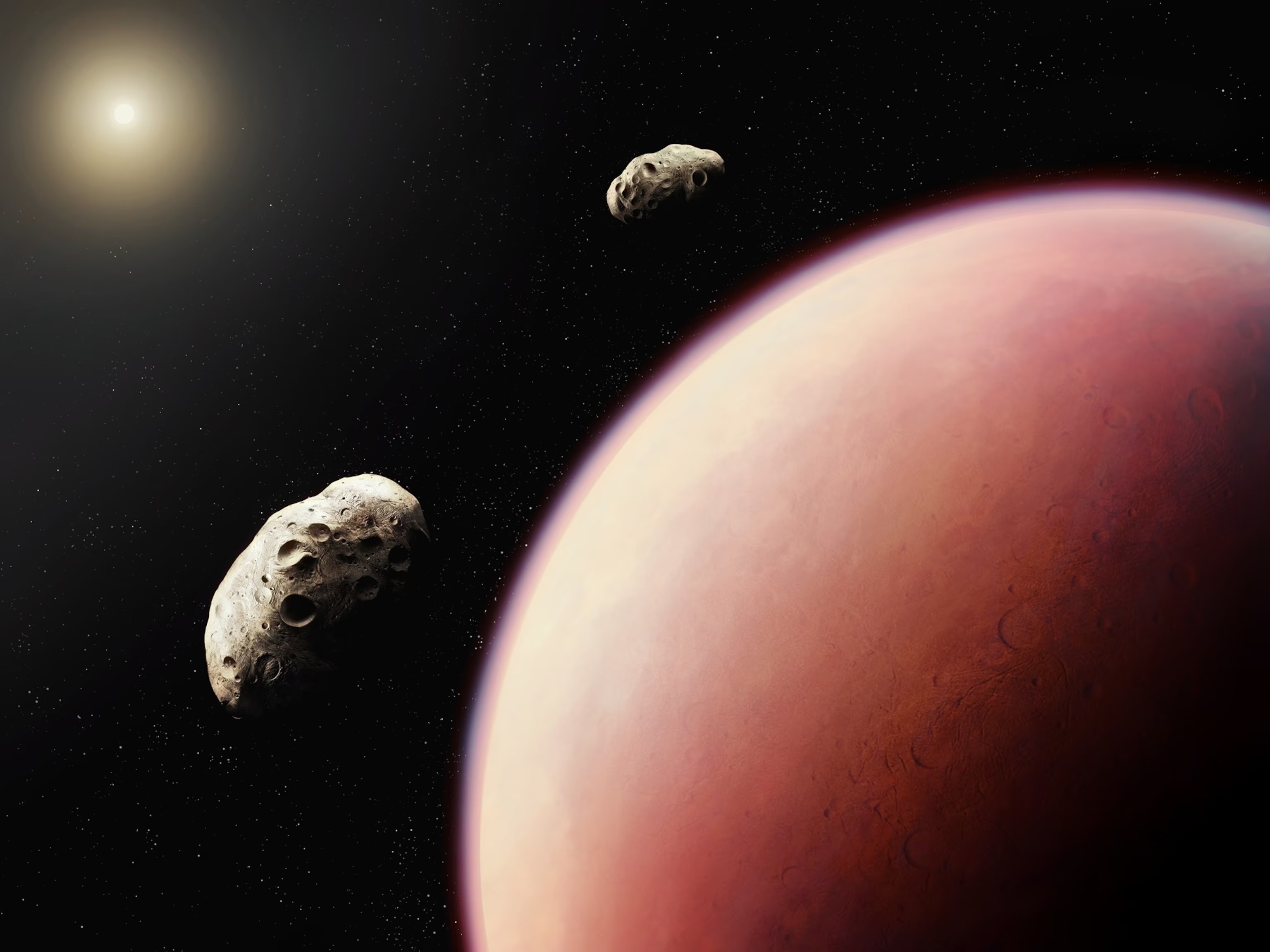
轨道器将于2027年8月抵达火星。作者:马修·格拉瑟 自1965年水手4号拍摄了火星的首张特写照片以来,我们对火星有了很多了解。自那次任务以来,轨道器、着陆器和漫游车一直在探索火星表面,扩展了我们对这颗行星的认识。
The orbiter will arrive at Mars in August 2027. By Matthew Glasser We've learned a lot about Mars since Mariner 4 took the first close-up photos of the red planet in 1965. Since that mission, orbiters, landers and rovers have explored the Martian surface, expanding our understanding of the planet.
但我们对火星的卫星——福博斯和戴莫斯知之甚少,包括它们是如何形成的。
But we know very little about Mars' moons, Phobos and Deimos, including how they formed.
日本宇宙航空研究开发机构(JAXA)的火星卫星探测(MMX)任务有望揭开这些卫星的一些谜团,帮助科学家更好地了解火星的历史以及我们自己的星球。
Japan Aerospace Exploration Agency's (JAXA) Martian Moons eXploration (MMX) mission could unlock some of the moons' mysteries and help scientists better understand Mars' history and our own planet.
“MMX将是有史以来首个从火星系统返回地球的航天器,”NASA的MMX项目执行官兼科学家汤姆·斯塔特勒在发射前的新闻发布会上表示。“福博斯样本将具有历史意义。这是首次从地球以外的卫星采集样本,”他补充道。
"MMX will be the first spacecraft ever to return to Earth from the Mars system," said Tom Statler, NASA's MMX program executive and scientist, during a pre-launch press conference. "The Phobos samples will be historic. The first samples from a moon other than Earth's moon," he added.
MMX计划于美国东部时间周一10月19日下午3点41分最早从JAXA种子岛航天中心发射,这是一项首创任务,不仅将研究火星的卫星,还将把样本带回地球。
Scheduled to lift off as early as Monday, Oct. 19, at 3:41 p.m. EDT from the JAXA Tanegashima Space Center, MMX is a first-of-its-kind mission that will not only study the moons of Mars but bring samples back to Earth.
该任务由JAXA牵头,与NASA、欧洲航天局以及法国和德国航天局合作。轨道器将于2027年8月抵达火星,一个月后将注意力转向福博斯。NASA表示,MMX实际上不会绕月运行;相反,它将采用“准卫星轨道”,沿着一条使其始终靠近福博斯的路径绕火星运行。
Led by JAXA in partnership with NASA, the European Space Agency, and the French and German space agencies, the orbiter will arrive at Mars in August 2027, then turn its attention to Phobos a month later. NASA says MMX won’t technically orbit the moon; instead, it will use a "quasi-satellite orbit," circling Mars in a path that keeps it near Phobos.
MMX搭载了13台科学仪器,其中包括美国宇航局的MEGANE仪器。据该机构介绍,该仪器能帮助MMX“观测”火星卫星表面的元素构成,从而推断其可能的起源。在从太空对火卫一进行观测后,MMX还将尝试在火卫一表面实现一次或两次着陆。每次着陆后,探测器预计会在表面停留两到两个半小时。在此期间,它将借助一种名为“气动采样器”的装置采集至少10克火卫一表面的土壤样本。2031年,MMX将把这些样本送回地球,并通过专门设计的再入舱将其安全投放至澳大利亚境内。
MMX is equipped with 13 scientific instruments, including NASA’s MEGANE instrument, which, the agency says, “will let MMX ‘see’ the elemental composition of the moon’s surface and help peg the likely origin of the moon.”After studying Phobos from space, MMX will then attempt one or two landings on the Martian moon's surface. The spacecraft is expected to spend two to two and a half hours on the ground during each stop. While there, it will use a device called a Pneumatic Sampler to collect at least 10 grams of soil from Phobos. MMX will then deliver that material back to Earth in 2031, depositing it in Australia by using a capsule designed to survive re-entry into our planet's atmosphere.
“此次任务将帮助我们更深入地了解火卫一以及整个火星系统的演化过程。其科学成果与采集到的样本不仅能为数十年来对火星的探索研究提供补充,还能为未来的相关发现乃至未来人类登陆火星的任务提供重要参考,”美国宇航局行星科学部门代理主任林赛·海斯说道。
"It will help us better understand Phobos and the evolution of the Mars system. The mission's science and return samples will complement decades of Mars exploration and help inform future discoveries, and perhaps even in the further future, crewed missions to the red planet," said Lindsay Hays, NASA's acting director of the Planetary Science Division.
长期以来,科学家们一直在探讨火星卫星的起源。它们或许最初是被火星引力捕获的小行星,也可能是某个巨大天体撞击火星表面后产生的碎片。目前两种假说均有有力的证据支持,因此难以定论。科学家们认为,通过对从火卫一采集到的样本展开研究,终能解开这一谜题。
Scientists have long speculated on the origins of Mars' moons. They may have started as asteroids that Mars pulled into its orbit. Or they could be debris remnants flung into orbit after a giant object struck the Martian surface. The challenge is that there's compelling evidence for both possibilities. By studying the samples collected on Phobos, scientists believe they can finally solve that question.
“通过近距离考察火星卫星并带回样本,我们就能判断火卫一的物质成分究竟更接近小行星还是火星碰撞产生的碎片。要解答这类问题,就必须借助位于探测目标处的仪器,并对实际样本进行详尽的实验室分析,”斯塔特勒解释道。
"By going to the Martian moons, studying them up close and bringing samples back to Earth we'll be able to determine whether Phobos material is more consistent with an asteroid composition or with debris created by a collision involving Mars. That's the kind of question that we need to have instruments right there at the object and have the detailed laboratory analysis of the actual material to answer," explained Statler.
为何火星卫星的起源如此重要呢?斯塔特勒指出,弄清这些卫星的来源有助于我们了解太阳系乃至地球的形成过程。
Why does it matter how Mars' moons came to be? Statler said that knowing where the moons came from can reveal how the solar system, and our own planet, took shape. "For years, we've been asking questions like, 'Well, how did water get delivered to the Earth?
“多年来,我们一直在探讨诸如‘水是如何被带到地球上的?同样的过程是否也把水带到了火星、金星和水星?有机物质又从何而来’等问题,”斯塔特勒说道,“弄清楚火卫一和火卫二的起源,就能了解当时太阳系的状况以及各类物质的来源。”这艘航天器并不会在火星表面着陆,因为与火卫一不同,火星拥有大气层且重力更强,这使得着陆与起飞都变得极为困难,需要采用不同类型的航天器才行。不过,由于火卫一距离火星很近,此次任务仍有可能将火星样本带回地球。
Did the same processes deliver water to Mars, to Venus, to Mercury? Where did organic materials come from, and so on,'" said Statler. "Understanding where Phobos and Deimos came from goes to understanding what was going on at that time and where that stuff was coming from." The spacecraft won't land on Mars because, unlike Phobos, the red planet has an atmosphere and significantly more gravity. This makes landings and liftoffs much more challenging and would require a different kind of vehicle. But that doesn't mean the mission won't return Martian samples to Earth because of Phobos's proximity to Mars.
“火卫一与火星距离很近,因此完全有可能发生这样的情况:大型陨石撞击火星表面后,会将部分物质抛向太空,其中一部分便可能落在火卫一上,”斯塔特勒解释道,“目前学界普遍认为,火卫一表面的土壤中极有可能混有极少量来自火星的物质。”即便只有微量火星物质混入火卫一的土壤中,这也将是一大意外收获:原本旨在探测火星卫星的任务,最终或许能为我们带回一块真正的火星样本。
"That proximity to Mars means that it is conceivable that meteor impacts on Mars, large ones, can blast material up off the surface of Mars and some of that can find its way to Phobos," said Statler. "The general consensus is there is a very good chance that there is a tiny fraction of Mars material mixed in with the regolith, the soil, on the surface of Phobos." If even a trace of Mars is mixed into the Phobos soil, it would be an unexpected bonus: a mission aimed at Mars’ moons could end up delivering a piece of Mars itself.
NASA将获得至少15%的返回样本供科学界研究。最终能发现什么尚不可知,但这些发现或许能引发关于火星历史及太阳系形成的新疑问。
NASA will receive at least 15% of the returned samples for the scientific community to analyze. What they'll find remains to be seen, but it could raise new questions about Mars' history and the formation of our solar system.
“这将是解开诸多谜题的关键线索,能帮助我们提出更精准的探测问题,并确定合适的探测方向,”斯塔特勒说道。
"It's a piece of the puzzle that will enable us to ask smarter questions about how to explore and where to explore," Statler said.