在铃木爱理经历过的那么多次身份重塑中——这位日本歌手先是转型模特,后又成为演员——有一次格外引人注目。在今年早些时候日本财务省发布的一则广告宣传中,一身粉色装扮的铃木女士向普通日本民众推销政府债务。她肩上栖着“零售国债Plus”计划的官方吉祥物:国债老师,一个卡通教授形象,其造型取自日语中“国债”一词的某部分;还有他少女模样的伙伴可可酱。这对搭档鼓励储户通过“Plus-Plus”来“增添安心”。
OF THE MANY reinventions Suzuki Airi, a Japanese singer-turned-model-turned-actress, has undergone, one stands out. In an ad campaign released earlier this year by Japan’s finance ministry, an all-pink Ms Suzuki hawks government debt to ordinary Japanese. Perched on her shoulder are the official mascots of its “retail government bonds plus” programme: Kokusai-sensei, a cartoon professor shaped like part of the Japanese word for government bond, and Koko-chan, his girlish companion. The pair encourages savers to “add peace of mind” with “plus-plus”.
对于那些以交易日本国债为生的人来说,安心可是稀缺品。上月,十年期国债收益率自1996年以来首次突破3%,高于1月份的2%。投资者担心通胀持续——这在直到不久前还多年受物价下跌困扰的日本可是新鲜事。在许多债券涌入市场之际,这让他们不那么热衷于持有政府债务。
Peace of mind is in short supply for those trading Japanese government bonds (JGBs) for a living. Last month the yield on ten-year bonds surpassed 3% for the first time since 1996, up from 2% in January. Investors worry about persistent inflation—a novelty in a country until recently plagued by years of falling prices. This makes them less eager to hold government debt at a time when lots of bonds are hitting the market.
首相高市早苗承诺到2040年新增120万亿日元(约7000亿美元,相当于去年GDP的18%)的公共投资。她支持从造船到芯片制造的战略产业,同时增加国防开支并削减食品销售税。她承诺在不通过新发债券为政府预算赤字融资的情况下做到这一切,但人们对此深表怀疑。高盛银行预计,若“基本”赤字(付息前)达到GDP的1.5%,2027财年日本国债总发行量将增加19万亿日元。而且投资者还有公司债可选——截至3月的12个月内,公司债发行量达到创纪录的17万亿日元。
Takaichi Sanae, the prime minister, has pledged ¥120trn ($700bn, or 18% of last year’s GDP) in new public investment by 2040. She is backing strategic industries, from shipbuilding to chipmaking, while raising spending on defence and cutting sales taxes on food. Her promises to do all this without funding government budget deficits through new bonds are taken with a generous pinch of salt. Goldman Sachs, a bank, expects that a “primary” deficit (before interest payments) of 1.5% of GDP would raise total JGB issuance by ¥19trn in fiscal year 2027. And investors also have their pick of corporate bonds, a record ¥17trn-worth of which was sold in the 12 months to March.
谁来买下所有这些?惯常的大买家已不如从前可靠。寿险公司在3月份新的资产会计准则生效前曾大量买入,如今已归于沉寂。持有全部日本国债44%的日本央行正在缩减因十多年购债而膨胀的资产负债表。
Who will buy all that? The usual big buyers are not as reliable as they once were. Life-insurance companies, which bought loads before new accounting rules for assets took effect in March, have gone quiet. The Bank of Japan (BoJ), which owns 44% of all JGBs, is unwinding a balance-sheet bloated by more than a decade of bond-buying.
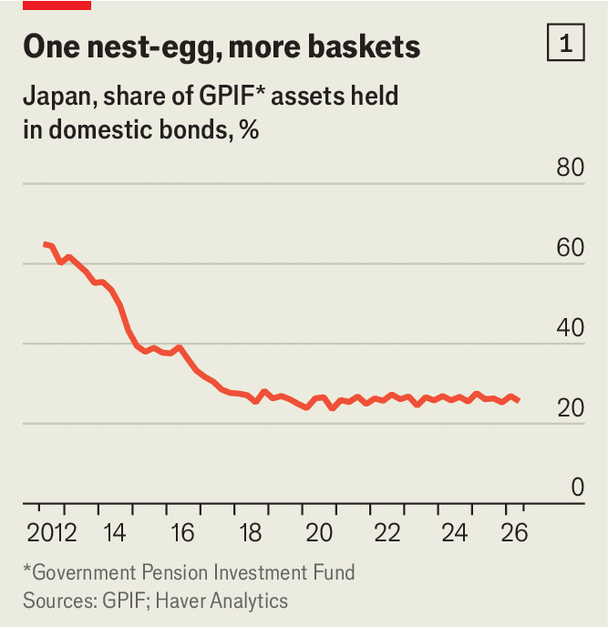
为帮助消化不断增加的供应,政府正瞄准新的需求来源。其中之一是政府养老金投资基金(GPIF),这是该国1.9万亿美元的养老储备金。2014年一系列经济改革后,低收益的国内债券在其投资组合中的占比降至四分之一,低于2012年的三分之二(见图1)。财政大臣现在表示,GPIF应“大幅增加”对国内资产的投资。另一家银行摩根士丹利估计,如果GPIF按照现行规则允许,将国内债券配置比例提高到30%左右,那可能创造另外18万亿日元的日本国债需求。
To help digest the rising supply, the government is targeting new sources of demand. One is the Government Pension Investment Fund (GPIF), the country’s $1.9trn nest-egg. After a raft of economic reforms in 2014, low-yielding domestic bonds fell to a quarter of its portfolio, down from two-thirds in 2012 (see chart 1). The finance minister now says that GPIF should make “substantially greater investments” in domestic assets. Were it to raise its domestic-bond allocation to 30% or so, as the current rules allow, that could create another ¥18trn in JGB demand, estimates Morgan Stanley, another bank.
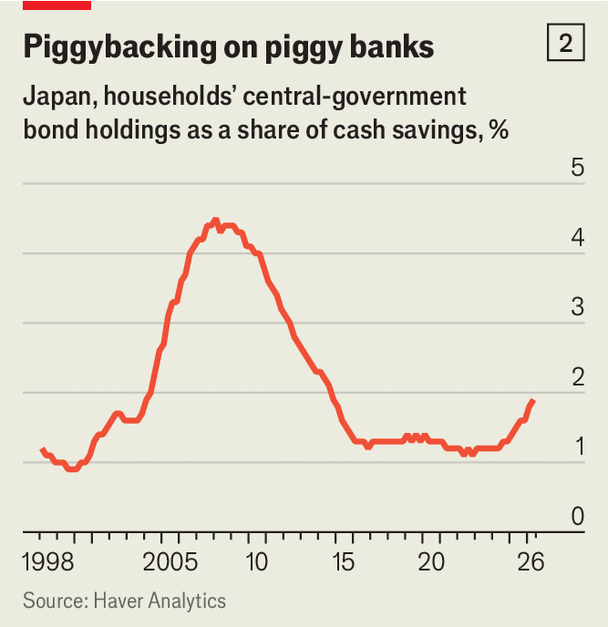
更大的潜在买家群体是被铃木和她的两个助手吸引的普通投资者(见图2)。他们持有超过1100万亿日元(约占GDP的165%)的银行存款现金储蓄,而日本国债持有量为22万亿日元。鉴于两年期锁定存款现在的年回报率约为0.7%,家庭很可能被零售日本国债提供的2%收益率所吸引。如果他们将日本国债配置比例从目前的2%提高回2000年代末4%的储蓄水平,那可能创造约20万亿日元的新需求。
The bigger potential pool of buyers are the everyday investors wooed by Ms Suzuki and her two sidekicks (see chart 2). They hold more than ¥1,100trn (around 165% of GDP) in cash savings in bank deposits, against ¥22trn in JGBs. Given that a two-year lock-up deposit now returns around 0.7% a year, households may well be tempted by the 2% on offer from retail JGBs. Were they to raise their JGB allocations back to 4% of savings, the level in the late 2000s, from 2% today, it could create perhaps ¥20trn in fresh demand.
然而,这两个需求来源都面临障碍。GPIF的目标是约5%的名义投资回报率,甚至高于收益率最高的日本国债(40年期)的4%。因此,增加日本国债配置可能会削弱GPIF的目标。就储蓄者而言,他们怀疑零售日本国债能否保护他们的现金免受通胀侵蚀。日本金融网红洋平在社交媒体上警告说:“国家试图制造通胀,以便收回其债务,同时鼓励普通民众购买政府债券。这实际上是一个陷阱。”
Yet both of these sources of demand face barriers. GPIF targets nominal investment returns of around 5%, higher than even the 4% from the highest-yielding JGBs (with a maturity of 40 years). A bigger JGB allocation therefore risks undercutting GPIF’s goals. Savers, for their part, are sceptical that retail JGBs will protect their cash from inflation. “The state is trying to generate inflation so it can recover its debt while encouraging ordinary people to buy government bonds. It’s a trap, really,” warns Yohei, a Japanese fin-fluencer, on social media.
政府推动零售国债的做法似乎也与NISA存在张力,NISA是免税股票投资账户,自2024年改革以来越来越受欢迎。虽然一些政客希望将国债纳入NISA,但这会模糊该计划旨在创造更多日本近年来所缺乏的本土风险资本的目标。
The government’s retail-JGB push also appears in tension with NISA, tax-free stock-investing accounts that have gained popularity since they were reformed in 2024. Though some politicians want to make JGBs eligible for NISA, that would muddy the programme’s aim of creating more homegrown risk capital that Japan has lacked lately.
那么,日本可能别无选择,只能依赖变化无常的外国需求。对冲基金和其他海外投资者在二级市场购买了60%的国债,而2019年这一比例为36%(不包括卖给中介的国债)。一般来说,他们讨价还价更狠(债券价格下跌,收益率上升)。不过,幸运的是,他们被日本的“收益率曲线”所吸引,即政府在不同时间段借款的利率,这是世界上最陡峭的收益率曲线之一。日本的十年期收益率比三个月期收益率高出1.7个百分点。在美国,这一差距大约只有其一半。
Japan may, then, have little choice but to rely on the flightier foreign demand. Hedge funds and other overseas investors are buying 60% of JGBs on the secondary market, up from 36% in 2019 (excluding those sold to middlemen). In general they drive a harder bargain (yields rise as bond prices fall). Thankfully, though, they are drawn by Japan’s “yield curve”, the interest rates at which the government borrows over different time periods, which is one of the world’s steepest. Japan’s ten-year yield is 1.7 percentage points higher than its three-month yield. In America, the gap is around half that.
陡峭的收益率曲线对外国投资者很有吸引力。债券的本币回报取决于其收益率,而更长期限国债的收益率正在上升,而对冲货币风险的成本部分取决于短期利率差异,这些差异尚未足以抵消日本更高收益率带来的收益。美国银行的拉尔夫·普雷瑟(Ralf Preusser)估计,一名对冲货币风险的美国投资者购买日本国债,现在可以获得相当于美国国债额外约0.8个百分点的回报。对于习惯了平静债券市场的国家来说,不得不争夺变化无常的外国资本可能感觉不舒服。但至少日本有东西可以提供。■
A steep yield curve is appealing for foreign investors. A bond’s local-currency returns depend on its yield, which is rising for longer-duration JGBs, whereas the cost of hedging currency risk is set in part by differences in short-term rates, which have not moved enough to offset the gains from higher Japanese yields. A currency-hedged American investor buying JGBs would now earn about 0.8 percentage points of additional returns above the equivalent Treasury bond, estimates Ralf Preusser of Bank of America. Having to compete for flighty foreign capital may feel uncomfortable for a country accustomed to sleepy bond markets. But at least Japan has something to offer. ■