无论是石油还是房地产,关键都是地段、地段、地段。石油市场从未真正实现全球化,而只是一个松散连接的区域性供应集合。当价格出现分歧时,原油桶会被运往最有利可图的目的地。但随着运费飙升至高得令人望而却步的水平,区域间的流动已被打断。结果?石油市场正在碎片化。
With oil, as with real estate, it’s all about location, location, location. The petroleum market has never been truly global, but rather a loosely connected collection of regional sources. When prices diverged, barrels were shuttled to the most lucrative destination. But with freight rates ballooning to prohibitively expensive levels, the region-to-region flow has been disrupted. The result? The the oil market is fragmenting.
历史上决定所谓全球油价的全球供需平衡,不再具有同样的影响力。取而代之的是,各地区的特殊情况正在决定当地价格,原油在短缺地区贵得惊人,在过剩地区却按廉价交易。因此,石油可以同时既昂贵又便宜。
The worldwide supply-and-demand balance, which has historically set what one could call the global price of oil , no longer has the same influence. Instead, the idiosyncrasies of each region are dictating local prices, with crude eye-wateringly expensive in places where there’s a shortage and trading at bargain rates where there’s a surplus. Thus oil can be both expensive and cheap at the same time.
从各地一桶油的价格就能清楚地看到这种影响。交付鹿特丹的北海布伦特原油?大约 125 美元。墨西哥湾的美国页岩油?约 100 美元。美国中西部的加拿大原油?约 70 美元。而运往中国南方的阿曼原油?接近 150 美元。
The effect is clear from looking at what a barrel costs where. North Sea crude delivered in Rotterdam? That’s $125, give or take. US shale oil in the Gulf of Mexico? That’s about $100. Canadian crude in the US Midwest? Around $70. And Omani crude shipped to southern China? That’s closer to $150.
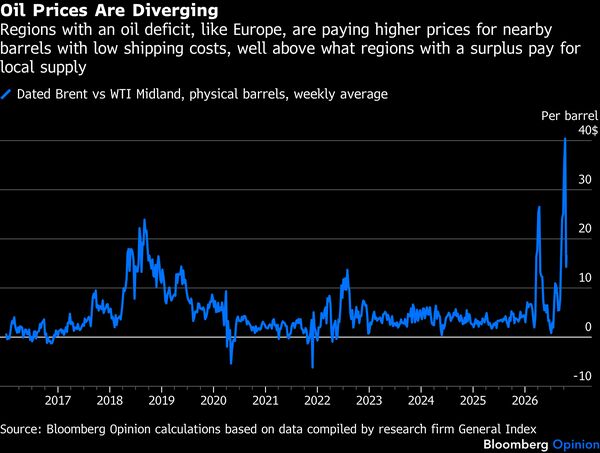
伊朗战争爆发前,区域价差通常不超过几美元,差异主要源于不同原油品质的偏离。但运费正在扭曲市场;尽管近期运费已从历史高位回落,但仍处于极高水平。我的粗略估算显示,如今运输一桶原油的全球平均成本约为 20 至 25 美元,而伊朗战争爆发前不到 3 美元。由此造成的错位意味着,拥有盈余的地区(美洲)价格远低于处于短缺的地区(欧洲和东亚)。
Before the war in Iran, regional price differences typically didn’t exceed a few dollars, with the variances mostly due to quality deviations between alternative types of crude. But freight charges are distorting the market; although shipping rates have declined from record highs in recent days, they remain sky-high. My back-of-the-envelope calculation for a global average suggests it costs about $20 to $25 to ship a barrel of crude today, compared with less than $3 before the war in Iran started. The resulting dislocation means that regions that enjoy a surplus (the Americas) are seeing much lower prices than regions that are in deficit (Europe and East Asia).
最大的潜在赢家——在这种语境下,赢可能仅意味着比其他所有人损失得少——是美国,它能以比其他国家更低的价格进口石油。美国从海外购买的所有原油中,75%来自三个国家——加拿大、墨西哥和委内瑞拉——这些国家目前都在以低迷的价格出售。
The biggest potential winner — and in this context, winning can mean just losing less than everyone else — is the US, which can import oil at lower prices than others are paying. The US sources 75% of all the crude it buys overseas from three countries — Canada, Mexico and Venezuela — which are now selling at depressed levels.
在赤字地区,如欧洲,炼油商愿意为附近的原油支付更高价格,以节省运输成本。荷兰港口城市鹿特丹也是区域炼油中心,传统上是全球石油市场的中心,也是布伦特原油的所在地,布伦特原油是引用最多的石油基准。这种原油主要在距离仅几百英里的北海油田开采,但其他类型的原油产地远达5000英里之外。“目前,布伦特原油受益于一个特定优势,使其获得比其他原油更多的价格支撑——短距离航运,”摩根士丹利分析师马尔泰因·拉茨说。
In deficit regions such as Europe, refiners are willing to pay more for nearby barrels to save on transportation costs. Rotterdam, the Dutch port city that’s also a regional refining hub, is traditionally the center of the global oil market and the home of Brent crude, the most cited oil benchmark. That flavor of crude is mainly pumped just a few hundred miles away in North Sea fields, but other types come from as far 5,000 miles away. “At the moment, Brent benefits from a specific advantage that gives it more price support than other crudes – short shipping distances,” says Martijn Rats, an analyst at Morgan Stanley.
换句话说,布伦特原油以溢价交易,并非因为它稀缺,而是因为它靠近关键炼油厂。因此,其交易价格提供了一个扭曲的全球市场视角。
In other words, Brent trades at a premium not because it’s scarce, but because it’s near the key refineries. As such, its trading price offers a lopsided view of the global market.
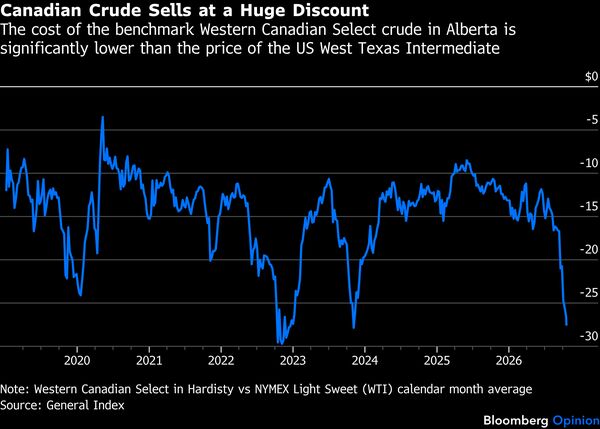
在盈余地区,如北美,情况则相反。加拿大原油通常向南流向美国,边际桶则通过油轮经墨西哥湾或加拿大太平洋海岸流向亚洲。这些海运出口充当了该国石油的安全阀,将其与全球市场挂钩。但航运成本激增意味着前往亚洲的长途航行在财务上几乎没有意义,导致加拿大产量被困在美国。结果如何?在有史以来最严重的石油供应冲击之一之际,西加拿大精选原油比其他基准低约30美元/桶——这是其有史以来最大折价之一。
In regions with surpluses, such as North America, the story flips. Canadian crude typically flows south into the US, with marginal barrels going beyond, via tanker, into Asia, either from the Gulf of Mexico or from Canada’s Pacific coast. Those seaborne exports act as a relief valve for the country’s oil, gluing it to the global market. But the surge in shipping costs means the long voyage to Asia makes little financial sense, trapping Canadian output in the US. The result? In the middle of one of the worst oil-supply shocks ever, Western Canadian Select is selling at about $30 a barrel below other benchmarks — one of its widest discounts ever.
较高的运费也有助于解释,为何西非原油相对于布伦特原油的折价幅度空前,往往超过每桶10美元,甚至达到20美元,这反映了将尼日利亚和安哥拉原油运往亚洲的成本。与此同时,中东原油是亚洲炼厂可获得的最近货源,因此以溢价交易。
Elevated freight costs also help explain why West Africa crude is selling at unprecedented discounts to Brent, often more than $10 and even $20 a barrel, reflecting the expense of shipping Nigerian and Angolan crude to Asia. Middle East crude, meanwhile, offers the nearest barrels available to Asian refiners, so it trades at a premium.
综合效应是,目前美国的原油采购成本低于每桶100美元,肯定低于3月和4月的水平。而世界其他地区面临的成本在每桶120至160美元之间,高于战前水平。由石油市场分裂引发的不同地区能源成本的巨大差异将持续下去,除非运费恢复正常。
The combined effect is that the current US oil bill is sub-$100 a barrel, and certainly lower than it was back in March and April. The rest of the world, on the other hand, faces costs between $120 and $160, higher than before the war. The wide divergence in energy costs for different regions trigged by the splintering of the oil market will persist until and unless shipping costs return to normal.